 0
0
 0
0
There are some names you do not get to choose.
Maybe it is a family name that people where you live already have an opinion about. Maybe it is something you did years ago that still comes up at the wrong moments. Or maybe it is quieter than that — a private line you drew in your own head one day that says: people like me do not get to be close to God. Not after that.
The Bible has a name like that. If you wanted one word for rebellion in the Old Testament, it would be Korah. The ground opened and swallowed him. Parents have used that story to frighten children for three thousand years.
And yet eleven songs in your Bible are headed for the sons of Korah.
That is not a mistake in the printing. It is the same family.
Who the sons of Korah were, and why that name became famous
Korah was not an outsider. That is the first thing most retellings skip, and it is the thing that makes the whole story make sense.
Numbers 16 opens by naming him carefully: Korah, the son of Izhar, the son of Kohath, the son of Levi. He was a Levite. More than that, he was a Kohathite — and the Kohathites had the most extraordinary job in Israel. When the nation packed up camp and moved, the Kohathites were the ones who carried the holy things. Numbers 4 describes their work as being “about the most holy things.” Nobody in the camp got physically closer to the presence of God than Korah’s clan did.
So when Korah gathered a group of leaders and stood up against Moses and Aaron, he was not a man locked outside asking to be let in. He was a man already inside, asking for a bigger title.
Moses’ answer names it exactly. He asks Korah, “Seemeth it but a small thing unto you” that God had set this family apart and brought them near — and then, at the end of the question, the line that lands like a stone: “and seek ye the priesthood also?”
Read that slowly. Korah’s sin was not distance from God. It was contempt for nearness he already had.
What actually happened at the tents
The next morning it ended, and it ended in two separate ways.
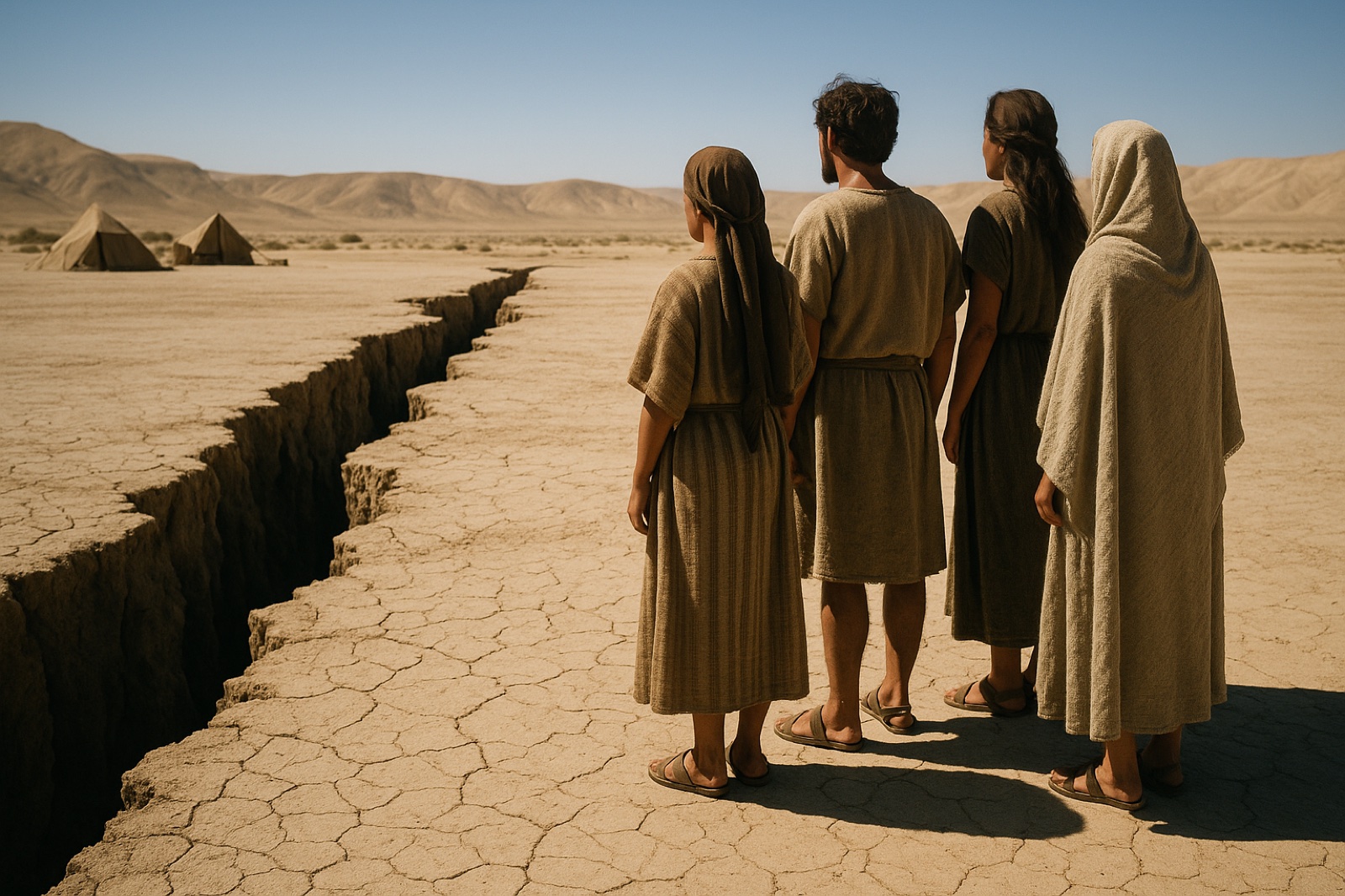
Numbers 16:32 says: “And the earth opened her mouth, and swallowed them up, and their houses, and all the men that appertained unto Korah, and all their goods.” Separately, fire consumed the two hundred and fifty men who had come holding censers.
Later, Numbers 26:10 looks back and sums it up plainly — the earth “swallowed them up together with Korah, when that company died, what time the fire devoured two hundred and fifty men: and they became a sign.”
A sign. A warning marker. That is what the name Korah was supposed to be from then on, permanently. A thing you point at so nobody does it again.
The verse four chapters later
Numbers 26 is a census. It is one of the passages people skim — long lists of families and numbers, the kind of chapter you turn past on your way to something more interesting.
And sitting in the middle of that list, immediately after the summary of the judgment, is verse 11. Seven words in English:
“Notwithstanding the children of Korah died not.”
That is the entire verse. No explanation. No story about how they got out, whether they had refused to join their father, whether they stood apart that morning or simply were not where he was. The text does not say, and honest reading means admitting it does not say. Anyone who tells you exactly why they survived is filling in a blank the Bible left empty.
What the Bible does tell us is what happened to them afterward. And that is the part worth sitting with.
Eleven psalms in your Bible carry the sons of Korah’s name
Open the book of Psalms and look at the small print above the poems — the headings most of us read past to get to the actual words. Eleven of them name this family: Psalms 42, 44, 45, 46, 47, 48, 49, 84, 85, 87 and 88. (Psalm 43 carries no heading of its own and has long been read as a continuation of Psalm 42.)
A note on precision: the Hebrew phrase in those headings uses a small preposition that can mean of, for, or belonging to. Scholars have argued for a long time about whether it means this family wrote the songs, performed them, or simply held them in their collection. Nobody can settle that from the text alone. What is not in question is whose name the headings put there — deliberately, repeatedly, and permanently.
And these are not minor entries. This family’s collection includes some of the most tender lines in the whole Bible.
Psalm 42 opens: “As the hart panteth after the water brooks, so panteth my soul after thee, O God.” If you have ever felt a thirst for God that you could not explain to anyone, you have borrowed words from Korah’s descendants. That psalm asks the same aching question three times and never quite answers it — we looked at that pattern more closely in what the Bible says about mental health.
Psalm 47 opens at the other end of the emotional range entirely: “O clap your hands, all ye people; shout unto God with the voice of triumph.”
And Psalm 88, also headed for the sons of Korah, is the darkest song in the book. It ends without relief: “Lover and friend hast thou put far from me, and mine acquaintance into darkness.” No resolution, no turn upward. We wrote about that psalm on its own in why God sometimes does not answer.
Notice what that range means. Being restored did not mean this family only got to sing happy songs. They were handed the joy and the unanswered grief. They were trusted with the whole human register.
(Psalm 88’s heading also names Heman the Ezrahite. In 1 Chronicles 6, the genealogy of Heman the singer runs back through Ebiasaph to Korah. Whether those two are the same man is genuinely debated and cannot be proved from the text — but the Chronicler clearly places a leading temple musician in Korah’s line.)
The detail that changes the whole story
Here is where it stops being a nice story about second chances and becomes something sharper.
The sons of Korah did not only sing. 1 Chronicles 9:19 lists the Korahites among those who were “keepers of the gates of the tabernacle.” 1 Chronicles 26 puts them among the porters — the gatekeepers. And in 2 Chronicles 20, when King Jehoshaphat faced an army he could not beat, it was the Korahites who stood up to praise God “with a loud voice on high.”
So the family whose ancestor tried to seize the priesthood ended up guarding the door of the house instead.
And then one of them wrote Psalm 84:10:
“For a day in thy courts is better than a thousand. I had rather be a doorkeeper in the house of my God, than to dwell in the tents of wickedness.”
Sit with that for a moment. The Hebrew behind the word “doorkeeper” carries the picture of standing at a threshold — of being the one at the doorway rather than the one seated inside. We cannot know whether the writer intended that line as a deliberate nod to his family’s history; the text does not tell us, and it would be overreaching to insist. But the resonance is unmistakable either way.
Korah grabbed for the priesthood. His sons got the doorway — and called it better.
Korah wanted the title. His descendants got the threshold. And a member of that family looked at the threshold and said, in effect: I would not trade this for anything. One day here beats a thousand anywhere else.
The exact thing Korah despised — nearness without status — is the thing his family ended up celebrating for centuries.
What this means for the name you are carrying
Most of us are not carrying a rebellion. We are carrying something smaller and heavier: a quiet belief that a particular door is closed to us specifically.
You know the sentence. People like me don’t get to lead anything. People with my history don’t get to be trusted around other people’s children. My family has always been this way. I already used up my chances.
Korah’s story says something to that, and it is not a soft thing. It does not say the rebellion did not matter — it plainly did, and there is a crater in the story where a man used to be. It says something more surprising: the judgment was real, and the name still got handed back.
Not scrubbed. Not replaced with a nicer one. Handed back, with the history still attached, and written at the top of eleven songs that people all over the world are still singing this week.
The Bible does this more than once. It is the same shape as the man who called himself a dead dog and was given a permanent seat at the king’s table anyway.
And there is a second, quieter thing here. The sons of Korah did not get their father’s ambition fulfilled a generation late. They did not become priests. They became singers and gatekeepers — good work, unglamorous work, work you do at the door while other people walk through it.
Which is worth asking yourself about honestly. When you ask God to restore something, are you asking for the doorway, or are you still asking for the title Korah wanted?
Actions to Take
- Read the seven words out loud. Numbers 26:11 — “Notwithstanding the children of Korah died not.” Then turn to Psalm 42 and read the heading above it. Two minutes, two pages apart, and you have seen the entire arc with your own eyes.
- Write down the sentence. Take a scrap of paper and finish this: “People like me don’t get to ___.” Then write, underneath it, the actual specific thing you have quietly ruled out. Naming the door is most of the work.
- Do the doorway version of it today. Not the title version — the threshold version. Send the message you have been leaving unsent. Take the small task nobody is fighting over. Turn up somewhere and stand at the back. It costs nothing and takes ten minutes, and it is the exact move the sons of Korah made.
Journaling Prompts
- Which name do you assume God uses for you — and where did you first hear that name?
- Korah wanted a role. His sons wanted a doorway. Which of those two are you actually asking God for right now, and what would change if you asked for the other one?
- What have you disqualified yourself from without anyone ever telling you that you were disqualified?
A Prayer
God, I have been carrying a name I never chose, and somewhere along the way I started agreeing with it. I do not think I want a bigger role. I think I just want to be near, even if near means standing at a door doing something nobody notices. If a whole family that everyone had written off ended up singing in your house, then there is a way back for me too. Teach me to want the doorway.
What Do You Think?
Why do you think the Bible kept Korah’s name on those eleven psalms instead of quietly leaving it off? Share your thoughts in the comments below — we read every one.
Share This
- Rebellion swallowed him. His children lived. And they became the singers. Read that again.
- The most famous rebel in the Old Testament — and four chapters later: “Notwithstanding the children of Korah died not.” Eleven psalms in my Bible still carry that family’s name. Your last name is not your verdict.
- Korah tried to grab the priesthood. His descendants ended up guarding the door, and one of them wrote that he would rather be a doorkeeper in God’s house than live anywhere else. That is not a demotion. That is the whole point.
Questions People Ask
Who were the sons of Korah in the Bible?
The sons of Korah were the descendants of Korah, a Levite of the Kohathite clan who led a rebellion against Moses and Aaron in Numbers 16 and died in the judgment that followed. Their descendants went on to serve at the tabernacle and temple as singers and as gatekeepers, and eleven psalms in the book of Psalms carry headings naming them.
Did the sons of Korah die with Korah?
No. Numbers 26:11 states plainly, “Notwithstanding the children of Korah died not.” The verse gives no explanation for how or why they survived, and the Bible never fills that gap in — it simply records that Korah’s line continued after the judgment that took him.
Which psalms are attributed to the sons of Korah?
Eleven psalms carry headings naming the sons of Korah: Psalms 42, 44, 45, 46, 47, 48, 49, 84, 85, 87 and 88. Psalm 43 has no heading of its own and is often read as a continuation of Psalm 42. The Hebrew preposition used in these headings can mean “of,” “for,” or “belonging to,” so whether the family wrote, performed, or preserved these songs is debated.
What did the sons of Korah do at the tabernacle and temple?
They served as musicians and as gatekeepers. 1 Chronicles 9:19 describes the Korahites as “keepers of the gates of the tabernacle,” 1 Chronicles 26 lists them among the porters who guarded the entrances, and 2 Chronicles 20:19 records the Korahites standing up to praise God “with a loud voice on high” before King Jehoshaphat’s army went out.
What does “doorkeeper” mean in Psalm 84:10?
Psalm 84:10 reads, “For a day in thy courts is better than a thousand. I had rather be a doorkeeper in the house of my God, than to dwell in the tents of wickedness.” The Hebrew term carries the picture of standing at a threshold rather than being seated inside. The verse contrasts the lowest position in God’s house with comfort and status anywhere else, and declares the doorway to be the better place.