 0
0
 0
0
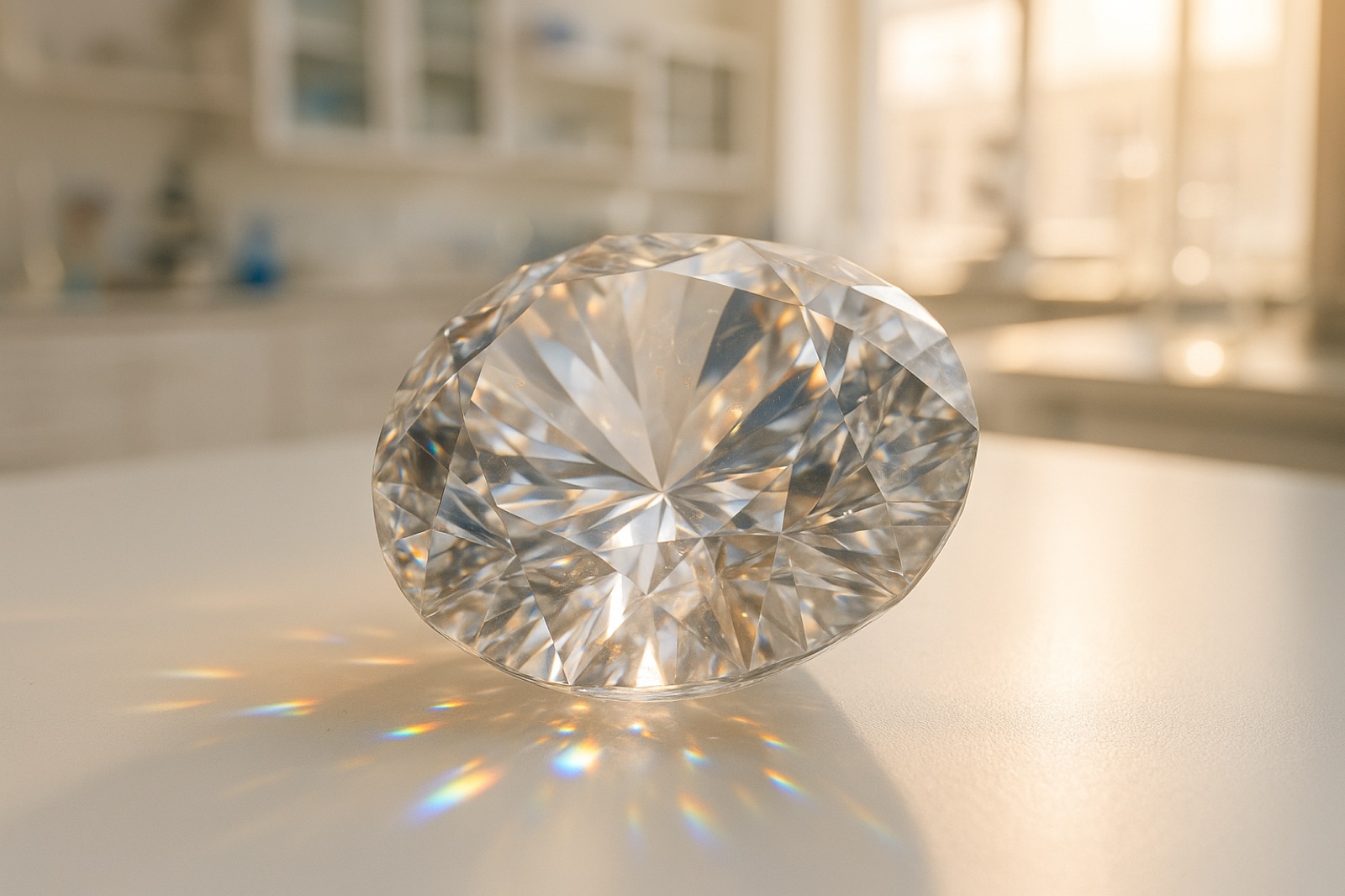
Diamond is the hardest thing most of us can name. It cuts steel. It survives heat that would melt almost anything else. When engineers need a material that will not give, this is the one they reach for.
Can diamond generate electricity? For more than a century, the answer was no. Not “not much” — no. Diamond sat in the textbooks alongside the short list of materials that simply do not do this, and nobody spent much time arguing about it.
That answer has now changed. And the reason it changed is stranger than the finding itself.
How Can Diamond Generate Electricity at All?
Some crystals make a small voltage when you squeeze or bend them. Press on one side and charge shifts: one face ends up slightly positive, the opposite face slightly negative. This is called the piezoelectric effect, and it is not exotic. It is the click in a gas lighter. It is the timekeeping inside a quartz watch. It is how an ultrasound probe turns electricity into sound, and sound back into a picture.
But it only works if the crystal is lopsided. The atoms have to sit in an arrangement where pressing on them tilts the balance of charge in one direction. If the arrangement is perfectly symmetrical, squeezing it achieves nothing. Push from one side, and an identical arrangement pushes straight back. Nothing leans. No voltage.
Diamond is famously, almost stubbornly symmetrical. Every carbon atom sits in the same relationship to its neighbours, in every direction, all the way through. That symmetry is exactly why it is so hard. It is also why, since the early 1900s, diamond has been filed under “not piezoelectric” and left there.
The perfection was the problem.
What the Hong Kong Team Actually Did
A team at the University of Hong Kong, led by Zhiqin Chu in electrical and computer engineering and Yuan Lin in mechanical engineering, came at the question from an odd angle. Rather than hunting for piezoelectricity inside a gemstone, they changed the shape of the diamond entirely.
They grew diamond onto a silicon wafer using a plasma process, scored the edge to expose the seam underneath, then lifted the diamond off with sticky tape. What came away was a membrane a few micrometres thick — thin enough that this famously unbending material could actually bend.
So they bent it, over and over, and watched the wires.
There was a voltage. A stable one. It appeared every time they flexed the membrane and disappeared when they stopped. They ran it through long cycles of mechanical testing and worked through the obvious alternative explanations. Static from handling was the main suspect — rubbing two surfaces together builds up charge, and that would have looked similar on the readout. So they touched the membrane with an earthed metal rod to drain any surface charge away. The signal stayed. Whatever was making it was inside the material, not sitting on its skin.
The peak response came in at roughly 82 millivolt metres per newton, published in Science Advances this year.
The Part That Makes It Strange
Here is the detail that turns a technical result into something worth sitting with.
The diamond that worked was polycrystalline. Not one clean crystal, but a mass of small crystals grown together, packed against each other at every angle, meeting along messy internal seams called grain boundaries. It is the cheaper, rougher, industrially grown kind — the kind nobody would put in a ring.
The team’s calculations traced the voltage straight to those seams. At a grain boundary the perfect repeating pattern breaks down. One grain ends, another begins at a different angle, and along that join the symmetry is gone. Bend the membrane, and charge shifts in those small broken regions — because there, and only there, it has somewhere to go.
Then they ran the control. They took ordinary single-crystal bulk diamond — the flawless kind, one continuous lattice — and bent it and squeezed it and measured.
Nothing. Zero output. The perfect diamond did exactly what a hundred years of physics said it would do, which is nothing at all.
The electricity did not come from the diamond being diamond. It came from the places where the diamond had failed to be perfect.
Two Things Worth Being Honest About
This is a real result, and it is also easy to oversell, so it is worth being precise about what it is not.
First, diamond has not suddenly become a powerhouse. The amount of charge it actually produces is small — a few picocoulombs per newton, which is a modest number in this field. The reason the voltage figure looks impressive is that voltage depends on two things: how much charge a material makes, and how much the material itself dilutes that charge before you can use it. Diamond is a poor dielectric, meaning it barely dilutes anything. It does not generate much; it simply refuses to waste what it generates. That is a genuine advantage for a sensor. It is not the same thing as being strong.
Second, there is a sweet spot, and it is not “thinner is better.” The response peaked at around five micrometres. Thinner membranes gave less. Past roughly seven micrometres it fell away again. And the researchers put a limit on their own explanation: spread the effect across a wide enough area, with enough grain boundaries facing enough different directions, and the contributions begin cancelling one another out. Too little disorder and there is no signal. Too much and it averages back to nothing.
The flaw is not a magic ingredient. It is the right amount of flaw, at the right scale.
It is also not the first time recently that a closer look at something we had written off as plain damage turned out to be more complicated than that — the same thing happened with what childhood stress does to the brain, where the interesting part was not the harm but what stayed changeable afterwards.
The Idea Underneath It
The Hong Kong team were solving an engineering problem. They were not making a point about anything else, and they would probably be uncomfortable to hear that they had.
But the shape of what they found is old. It turns up in ancient wisdom again and again: that the place a person proves strongest is almost never the polished place. That whatever moves through a life tends to move through the part that cracked, not the part that held. There is a long tradition of insisting God works this way on purpose — that the flaw is not being tolerated, it is being used. The most famous version of it is a first-century letter about a “thorn in the flesh” that was asked about three times and never taken away. It is an easy idea to wave off as consolation, the sort of thing people say when there is nothing else to say.
It is also, as it turns out, how you get a voltage out of a diamond.
What Happens Next
The practical version is already being sketched. Diamond is chemically stable, extremely tough, and does not upset living tissue, which makes it interesting for things that go inside a body — a sensor that reports on movement or pressure and powers itself from that same movement, with no battery to replace. That is years away, and the team says so. Real devices always are.
But the smaller thing this changes is available now, and it costs nothing.
For a century, the reason nobody found this is that nobody looked. Diamond was classified early, the classification made good sense, and the file was closed. The material was too perfect to be interesting, so the question stopped being asked. The answer had been sitting there the whole time, in the cheap industrial version nobody thought to bend.
Most of us run the same filing system on ourselves. We assume the flawed part is the part to hide, work around, or apologise for. It rarely occurs to us that it might be the part doing the work. If that idea lands somewhere tender, our free Do I Have Imposter Syndrome? assessment is a short and honest place to look at it.
Worth a second look, anyway. A hundred years is a long time to be sure about the wrong thing.
Questions People Ask About This
Can diamond generate electricity?
Yes, but only in a specific form. In 2026, researchers at the University of Hong Kong showed that ultrathin polycrystalline diamond membranes, a few micrometres thick, produce a stable voltage when bent. Flawless single-crystal diamond, tested as a control in the same work, produced no measurable output at all. The effect depends on the material’s internal imperfections, not on diamond itself.
What is the piezoelectric effect, in simple terms?
The piezoelectric effect is a material producing a small voltage when it is squeezed, bent, or stretched. It happens because mechanical pressure shifts the balance of electrical charge inside the crystal, leaving one face slightly positive and the other slightly negative. Everyday uses include gas lighters, quartz watches, and medical ultrasound probes.
Why was diamond considered non-piezoelectric for over a century?
Because diamond’s atomic structure is perfectly symmetrical. For a material to produce a voltage under pressure, its internal arrangement must be lopsided enough that squeezing it tips the charge one way. In a flawless diamond lattice, every direction is identical, so pressure from one side is answered by an identical push back, and no voltage results. Diamond was classified as non-piezoelectric in the early 1900s and the classification went unchallenged.
Where does the voltage in a diamond membrane actually come from?
From grain boundaries — the seams where small diamond crystals grown at different angles meet inside polycrystalline material. The perfect repeating pattern breaks down along those seams, so the local symmetry is lost, and bending the membrane shifts charge in those regions. The electricity comes from the imperfections in the structure rather than from the ideal crystal.
What could piezoelectric diamond be used for?
The researchers point to self-powered sensors, especially medical ones placed inside the body. Diamond is chemically stable, mechanically tough, and well tolerated by living tissue, so a diamond membrane could in principle sense movement or pressure while generating its own power from that same movement, removing the need for a battery. This remains a proposed application, not an existing device.
What Do You Think?
Physics kept diamond in the “cannot do this” column for a hundred years because the assumption was reasonable and nobody re-tested it. What is another widely accepted idea you suspect is only holding up because nobody has bothered to check it lately? Leave a comment — this is exactly the sort of question that gets more interesting with more people in it.
Share This
“Diamond was written off as electrically useless for a hundred years because it is too perfect. Turns out the cheap, flawed, industrial kind makes a voltage — and the flawless kind still makes nothing. The imperfections are doing the work.” — Diamond Can Generate Electricity — But Only If It’s Flawed
“I did not expect a materials science paper to stay with me all day. Researchers in Hong Kong bent an ultrathin diamond film and got electricity out of it, traced straight to the grain boundaries — the places the crystal failed to be perfect. Then they tested a flawless diamond as a control and got zero.” — Diamond Can Generate Electricity — But Only If It’s Flawed
“The perfect diamond produced nothing. The flawed one produced a voltage. That is the whole story and I cannot stop thinking about it.” — Diamond Can Generate Electricity — But Only If It’s Flawed