 0
0
 0
0
It is late. Everyone else in the house is asleep. And you are lying there with your phone in your hand, typing five words into a search bar that you would never say out loud to anyone: can you lose your salvation.
Then you read the results. One page says no, never, absolutely not. The next page says yes, and here are the warning signs. Both of them sound completely sure. Both of them quote the Bible. And forty minutes later you are more frightened than when you started.
If that is you tonight, there is something worth saying before we open a single verse.
You did not come here for a debate. You came here because you are scared.
Why “Can You Lose Your Salvation?” Is Rarely a Theology Question
There is the question people type, and there is the question underneath it. They are almost never the same.
The question typed is: can you lose your salvation?
The question underneath is usually: am I still God’s?
Those are not the same question, and they do not have the same answer. The first one is a doctrine you can look up. The second one is a person, awake at night, wondering if something they did last month, or last year, or for the last ten years, quietly ended something they thought was permanent.
Almost everything written on this subject answers the first question. It is written for people arguing. It is not written for people afraid. That is why you can read for an hour and feel worse — you keep getting handed a position when what you needed was a hand.
So this article is not going to hand you a position. If you want a related starting point on the doctrine side, we have written about how you actually know if you are saved and about whether baptism is necessary for salvation. Read those when you are calm.
Tonight, let’s go somewhere else. Let’s go to the one time Jesus was standing in front of a crowd of people demanding that He end their uncertainty — and listen to what He actually said.
What Was Happening in the Room When Jesus Said It
Most people meet these verses on a coffee mug, floating free of anything. They did not arrive that way. John tells us exactly where Jesus was standing and exactly what had just been shouted at Him.
“And it was at Jerusalem the feast of the dedication, and it was winter. And Jesus walked in the temple in Solomon’s porch.” John 10:22-23, KJV
It was winter. It was a festival. Solomon’s porch was a covered walkway along the edge of the temple — the sheltered side, where you stood when the weather was bad.
And there, a crowd closed in around Him.
“Then came the Jews round about him, and said unto him, How long dost thou make us to doubt? If thou be the Christ, tell us plainly.” John 10:24, KJV
Read that again slowly, because it is your question in older clothes.
How long are you going to leave us not knowing?
That is the setting. Not a quiet chapel. Not a calm teaching moment. A ring of people, cold and impatient and demanding to be told, once and for all, where they stand.
Everything that comes next is Jesus answering people who could not stand the not-knowing anymore.
The Two Hands
Here is what He said:
“My sheep hear my voice, and I know them, and they follow me: And I give unto them eternal life; and they shall never perish, neither shall any man pluck them out of my hand. My Father, which gave them me, is greater than all; and no man is able to pluck them out of my Father’s hand.” John 10:27-29, KJV
Notice that the promise is made twice. Not once. Twice.
No one takes them out of Jesus’ hand. And then, as if that were not enough: no one takes them out of God’s hand either.
And notice the reason given for why that holds. It is not “because the sheep are strong.” It is not “because the sheep have been very consistent lately.” The reason is one short line: is greater than all.
The security in this passage rests entirely on the size of the one doing the holding.
There is one more thing sitting in verse 27 that almost everyone reads straight past. Jesus lists three things about the sheep — they hear, they follow, and in the middle of those two, “I know them.”
The middle one is not something the sheep do. Sheep are not required to correctly identify themselves. The recognising is done from the other direction.
The Word Jesus Chose — And Where He Had Just Used It
This is the part almost nobody mentions, and it is the reason this passage is stronger than the coffee mug version of it.
The word translated “pluck” in verses 28 and 29 is the Greek word harpazo. It does not mean to drift, wander, or slip away. It means to seize, to snatch away by force — a sudden grab you could not resist.
Now here is the part worth sitting up for. Jesus had used that exact word sixteen verses earlier, in the same conversation, describing the hired man who runs off when danger comes:
“…seeth the wolf coming, and leaveth the sheep, and fleeth: and the wolf catcheth them, and scattereth the sheep.” John 10:12, KJV
“The wolf catcheth them.” Same word. Harpazo.
So Jesus names a specific horror — a wolf snatching sheep while the man who was supposed to be watching runs away — and then, a few breaths later, closes that exact door: no man shall pluck them out of my hand.
He is not making a vague, general comment about eternity. He is answering the precise danger He had just described. The thing you are afraid of getting snatched by is the thing He specifically said cannot snatch you.
One more detail in the Greek. “They shall never perish” uses a doubled negative — ou me — which is the strongest way that language has of saying not ever, under any circumstances. English has to use two words, “never” and “not,” to carry it.
Now, an honest word, because you have been handed enough overconfidence tonight. This passage speaks to being snatched by someone else. Sincere Christians who love the Bible have read the wider question differently for centuries, and this article is not going to settle that argument for you. It is not the argument you came with.
What can be said plainly is this: the passage exists, Jesus said it, and it speaks directly to the fear that woke you up.
The Turn: You Have Been Measuring the Wrong Grip
Read those verses one more time and look for the sheep’s grip.
It is not there.
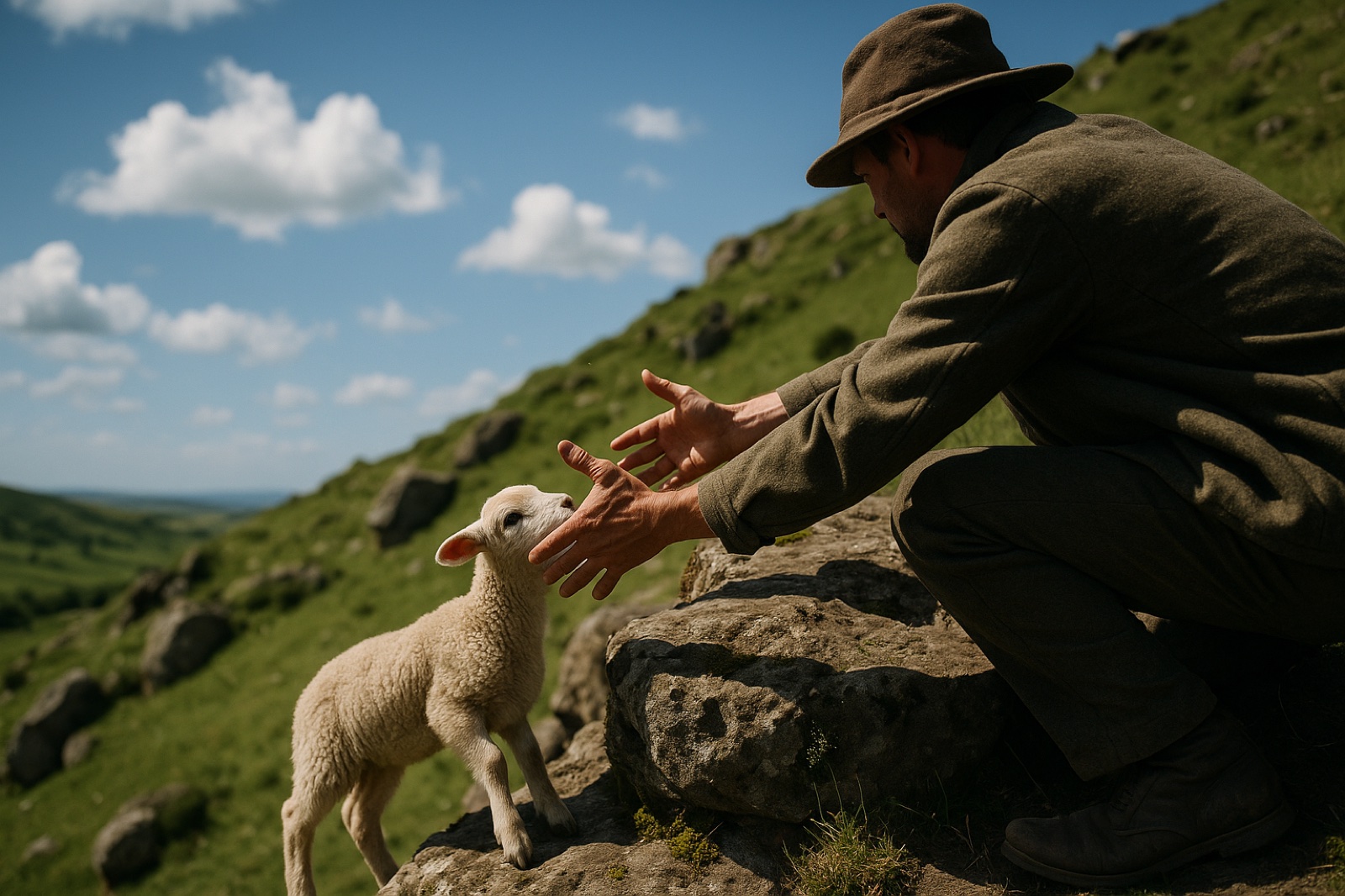
Jesus never once mentions how tightly the sheep are holding on. He mentions His hand. He mentions God’s hand. He mentions God being greater than all. He never says a word about the strength of the sheep’s grip, because a sheep in a shepherd’s hands is not hanging on. It is being carried.
And that is the quiet cruelty of what you have been doing at 2am. You have been checking your own grip. Am I holding on hard enough? Did I mean it enough? Was my faith real enough last Tuesday when I did that thing?
You have been running a strength test on the wrong hand.
You are not held by how tightly you hold. You are held.
There is one more thing, and it needs to be said carefully, because the genre this article lives in loves turning observations into tests.
You are frightened of being away from God.
That will not be turned into proof here, and you should be suspicious of anyone who offers you a checklist of signs that you are truly saved — that genre is exactly what makes a person in your position worse, because a checklist just gives your fear somewhere new to hunt. But it is worth noticing, quietly, without making a doctrine of it: fear of losing God is not the emotion of someone who has stopped caring whether God is there.
A sheep straining to hear whether the shepherd is still nearby is a sheep that still knows the voice.
What to Do in the Next Ten Minutes
Not “pray more.” Not “read your Bible.” Here is what would actually help tonight.
Actions to Take
- Close every tab but this one. Reading five sites that contradict each other is not research at 2am — it is the machine making it worse. Then open your notes app and type the real sentence, the one underneath the search. It will probably be four or five words long.
- Read John 10:22-31 out loud, once, slowly. Not to study it. To hear it. As you read, count how many times you are the one doing something, and how many times God is. It takes about two minutes.
- Send that real sentence to one person. A friend, a pastor, a group chat, one honest message. “I’m scared I’m not God’s anymore” is a complete message. You do not have to explain it. Fear that stays inside your own head at night gets to make up its own answers.
Journaling Prompts
- When you picture losing your salvation, what does the losing actually look like in your mind — something you did, or something that was taken from you? Which of those does John 10:28 speak to?
- Whose strength have you been measuring this week: God’s, or your own?
- What would be different about tomorrow if the hand holding you never got tired?
And if the honest answer tonight is that you cannot find words at all, that is allowed too. Sometimes you just need someone to hand you the verse that matches the feeling — our free Bible Verse for How I Feel tool does exactly that, in about thirty seconds.
A Prayer for Tonight
God, I am scared I have lost something I cannot get back. I have been checking my own grip for weeks and it does not feel strong enough to hold anything. If it is true that I was never the one holding on, help me believe it tonight and not just understand it. I am not asking to feel certain. I am asking to be held. Amen.
A Question Worth Discussing
Why do you think so much writing about salvation is built to win the argument instead of answering the fear underneath it? Share your thoughts in the comments — we read every one.
Share This
- “I spent an hour searching whether you can lose your salvation and got more scared. Then I noticed Jesus never once mentions how tightly the sheep are holding on. He only talks about the hands.”
- “You are not held by how tightly you hold. You are held. — John 10:28”
- “The word for ‘pluck’ in John 10:28 is the same word used for the wolf snatching the sheep sixteen verses earlier. Jesus wasn’t being vague. He was closing the exact door He had just described.”
Questions People Ask About Losing Salvation
Can you lose your salvation?
Christians who take the Bible seriously have answered this differently for centuries, and the debate is unlikely to be settled by any single article. What John 10:28-29 says plainly is that no one can pluck a believer out of Jesus’ hand or out of God’s hand, and that the reason given is God’s greatness rather than the believer’s performance. Anyone who tells you the question is simple is either not familiar with the whole discussion or is not being straight with you.
What does John 10:28 mean when it says no man can pluck them out of my hand?
In John 10:28 Jesus says, “And I give unto them eternal life; and they shall never perish, neither shall any man pluck them out of my hand” (KJV). The word translated “pluck” is the Greek harpazo, meaning to seize or snatch away by force. Jesus used the same word sixteen verses earlier in John 10:12 to describe a wolf snatching sheep after the hired man runs away, so the promise in verse 28 directly answers the danger described in verse 12.
Why do I feel afraid that I have lost my salvation?
Fear about standing with God often has less to do with theology than with exhaustion, guilt over a specific event, or a long stretch of not feeling anything spiritually. The fear is real, but the feeling of distance is not the same thing as a measurement of a relationship. Searching for reassurance late at night usually makes the fear worse, because contradictory answers give anxiety more to work with. Naming the actual fear out loud to one trusted person tends to help far more than reading another article.
Does the Bible have passages that seem to point both ways on this?
Yes. Passages such as John 10:28-29 and Romans 8:38-39 are read as promises of security, while passages such as Hebrews 6:4-6 and Hebrews 10:26-27 are read as serious warnings, and sincere Christian traditions weigh them differently. Honest teachers on both sides acknowledge the passages on the other side rather than pretending they are not there. A reader who is currently frightened is generally better served by the assurance passages first and the debate later.
What did Jesus mean by “My sheep hear my voice”?
In John 10:27 Jesus says, “My sheep hear my voice, and I know them, and they follow me” (KJV). Earlier in the same chapter, in John 10:3-4, Jesus describes a shepherd who calls his own sheep by name and leads them out, and says the sheep follow “for they know his voice” (KJV) — so recognition, not a rope or a mark, is what identifies them. The middle clause, “I know them,” describes the shepherd’s recognition rather than anything the sheep achieve, which is why the verse reads as a description of belonging rather than as a test to pass.