 0
0
 0
0
You typed it in and got a chart. Green for money. Red for love. Purple for power. Somebody’s list, copied onto forty sites, with no footnote anywhere.
That is not where the Christian answer lives. There is a real, documented tradition of color in Christian worship, and it does answer your question — it is just a very different kind of answer than a chart. The colors are not a code. They are a calendar.
What the Church Colors Actually Track
In the Roman Catholic church, and in most Anglican, Lutheran and Methodist churches that keep the same year, color marks where you are in the story of Jesus. The U.S. bishops publish the list (USCCB, Understanding the Liturgical Colors), and it runs like this:
- White — Christmas Time and Easter Time; celebrations of the Lord other than the Passion, of Mary, of the angels, and of saints who were not martyrs.
- Red — Palm Sunday, Good Friday and Pentecost Sunday; the Lord’s Passion, and the apostles, evangelists and martyrs.
- Green — Ordinary Time, the long ordinary stretches that make up most of the year.
- Violet — Advent and Lent, and Masses for the Dead.
- Rose — twice a year only: the Third Sunday of Advent and the Fourth Sunday of Lent.
- Black — Masses for the Dead. In the United States white is also permitted there, and gold or silver for more solemn occasions.
Now read the list again and notice what is missing. Not one entry is a request. Nothing says “use this color to get money” or “burn this one for love.” Every single entry is a date. Rose exists because the Third Sunday of Advent is called Gaudete Sunday, from the Latin for “rejoice” — the violet gets lightened for one week because the waiting is nearly over. The color is not doing anything. It is telling you what time it is.
For the First Few Centuries There Was Only One Color
Here is the part that never makes the charts, and it reframes the whole question.
The Catholic Encyclopedia, citing Pope Benedict XIV, reports that “up to the fourth century white was the only liturgical colour in use”. One color. Not a system — a default.
The four-color scheme most people picture is medieval. Innocent III, writing in the 1190s and before he was ever elected pope, is among the first to set the colors out in order, and his list is shorter than today’s: white, red, green and black, with violet named only as occasionally employed. Purple was not yet the fixed color of penitence. The Roman Rite’s settled set of five arrived later still, under Pius V in the sixteenth century.
So the honest timeline runs: a few centuries with no color scheme at all, then local variation, then a medieval list, then a fixed one. That is a tradition worth knowing. It is not a key handed down from the apostles, and it was never, at any point in it, a mechanism.
And the Color Rules Are About Cloth, Not Wax
This next detail resolves most of the confusion, and it is easy to miss because the charts never mention it. The color list in the Missal governs vestments and altar cloths — what the priest wears, how the altar is dressed. It is not a list of candle colors. Church candles are overwhelmingly plain, and they do not change with the season.
The clearest place where candle color itself is specified is the Advent wreath: three violet candles and one rose. The rose one is lit on the third Sunday, Gaudete, and many families add a white candle in the middle for Christmas Eve. Even there, look at what decides the color — the Sunday. The date again. (If what you picture at the words “prayer candle” is a rack of little cups at the side of a church, those have two old Latin names of their own, and what votive and vigil really mean is worth knowing.)
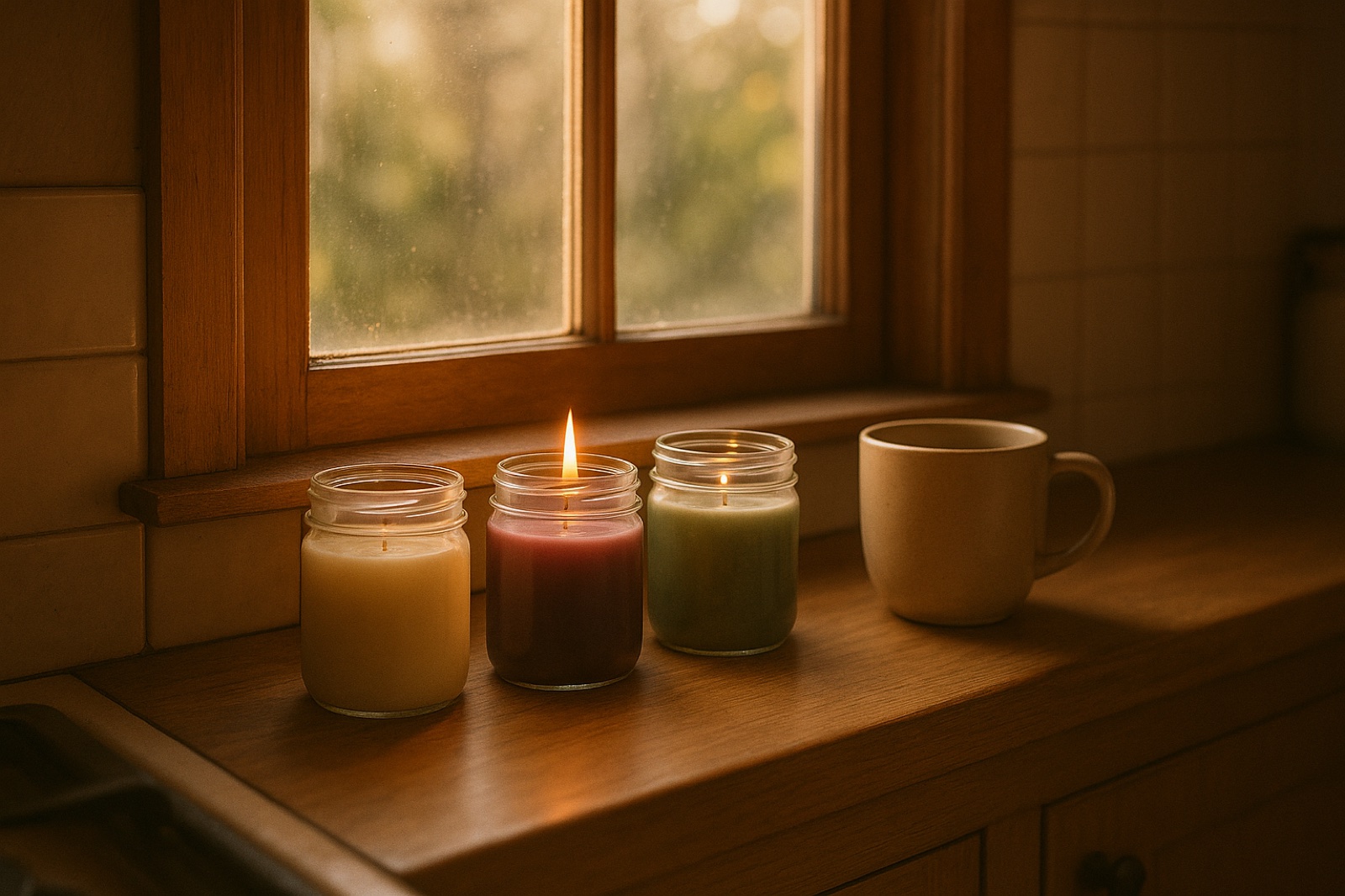
Which means that for the candle on your own windowsill, there is no color rule to break. Nobody is grading the wax.
The One Place the Bible Gives a Color a Meaning
Scripture does put meaning on color, in one line almost everybody half-remembers. And the direction it runs is the exact reverse of a chart:
“Come now, and let us reason together, saith the LORD: though your sins be as scarlet, they shall be as white as snow; though they be red like crimson, they shall be as wool.” (Isaiah 1:18, KJV)
Scarlet, white, crimson, wool — four colors in one sentence. But not one of them is on an object. They are all on the person. The color is not something you choose in order to get an outcome. It is something God changes about you.
That is the whole difference. In a color-code system, you pick a shade to move God. In Isaiah, God is the one doing the recoloring, and the only invitation is: come, and let us reason together. Nothing in your hands has to be the right color first.
So What Color Should Your Prayer Candle Be?
Any color you like. Pick whatever looks right in the room where you will actually light it — and then put your care into the part that genuinely carries meaning: the words on it.
That is the quiet case for a scripture candle. What you see when you walk past it is not a shade you have to decode; it is a sentence you already understand. The MyCandlePrayers candles each carry a Bible verse on the front in faith-centered artwork. God, Be My Strength for a long stretch at work. God, Grant Me Serenity for the 3 a.m. worry. Fill Me With Hope, Lord for a hospital season. Give Me Courage, Lord for the conversation you keep putting off. There is no single right verse — only the one that fits the season you are in, or the season the person you are buying for is in.
On the back of each one is a QR code that opens 100+ written prayers sorted by need: strength, healing, peace, gratitude, guidance, protection. No app, no account, no subscription. That is the part that earns its place on the mornings when you sit down, light it, and find you have nothing of your own to say — the words are already written and waiting. The candle is 9 oz of eco-friendly soy wax with a 50–60 hour burn time in a reusable glass vessel, so when the wax is gone the glass stays. (Wherever you set it, the spot matters more than the stand.)
A Prayer for the Night You Light It
God, I went looking for the meaning in a color, and found out You were never waiting on me to get the shade right.
Nothing here is a mechanism. The wax is wax. The light is light.
But You said: come now, and let us reason together.
So here I am, at this table, with this small flame and the people I am carrying tonight.
Make the scarlet in me white as snow, the way only You can.
And when I run out of words, bring me back to Yours.
In Jesus’ name, amen.
One last honest note. The candle does nothing. It is a reminder and an act of prayer, the same as the flame in a church rack and the same as the lamp in Psalm 119:105 — “Thy word is a lamp unto my feet, and a light unto my path.” Notice in that line, too, what is actually doing the lighting. Not the lamp. The word. (If you have wondered whether a candle needs blessing first, where the blessing really comes from is a short, surprising story.)
Questions People Are Asking
Q: What is the prayer candle color meaning in Christianity?
A: In Christian worship, color marks the season of the church year rather than a request. The U.S. bishops’ list runs: white for Christmas and Easter, red for Palm Sunday, Good Friday, Pentecost and the martyrs, green for Ordinary Time, violet for Advent and Lent, rose for the Third Sunday of Advent and the Fourth Sunday of Lent, and black for Masses for the Dead. Every entry is a date, not a desire — the color tells you where you are in the story of Jesus.
Q: Do different candle colors do different things when you pray?
A: No. In Christian practice a candle is a reminder and an act of prayer, not a mechanism, and nothing is triggered or activated by the color of the wax. The charts that assign green to money or red to love come from folk-magic correspondence traditions, not from the Bible or from Christian liturgy. God hears prayers with or without a candle in the room, in any color.
Q: Why is one Advent candle pink?
A: The Advent wreath is usually three violet candles and one rose, and the rose one is lit on the Third Sunday of Advent. That Sunday is called Gaudete Sunday, from the Latin word for “rejoice.” The violet of the penitential weeks is lightened for seven days because the waiting is nearly over. Many families add a white candle in the center of the wreath and light it on Christmas Eve.
Q: Did the early church have liturgical colors?
A: Not as a scheme. The Catholic Encyclopedia, citing Pope Benedict XIV, reports that up to the fourth century white was the only liturgical color in use. Innocent III, writing in the 1190s before he became pope, is among the first to set colors out in order, and he names four principal ones — white, red, green and black — with violet only occasionally employed. The Roman Rite’s fixed set of five dates from Pius V in the sixteenth century.
Q: What color prayer candle should I buy for my home?
A: Any color you like, because there is no rule to break — the church’s color list governs vestments and altar cloths, not the wax on your windowsill. Choose by the words on it instead, and match the verse to the season you or the person you are gifting is in: strength, hope, peace, courage, trust, protection or marriage. Each MyCandlePrayers candle carries a Bible verse in a reusable glass vessel plus a QR code to 100+ written prayers organised by need, so you can choose the verse that fits them. Current pricing and shipping details are shown on that page.