
 0
 0
You went looking for a custom prayer candle for a child because you wanted it to be theirs. Not a grown-up’s candle that happens to sit in their room. Theirs — their name on it, maybe, or the verse you whisper over them once they’ve finally stopped asking for water.
Here’s what the search results don’t mention. A child will not read the name. A child will point at it from the doorway and say three words.
What a Child Actually Asks
Scripture records the question, and it is shorter than you’d expect.
“And it shall be when thy son asketh thee in time to come, saying, What is this? that thou shalt say unto him, By strength of hand the LORD brought us out from Egypt, from the house of bondage” (Exodus 13:14, KJV).
What is this. That’s the whole question. Not what does that verse mean, not why do we pray. A small person sees something in the room that wasn’t there yesterday and wants to know what it’s for.
And here’s the part that’s easy to read straight past: that instruction was written down before any child had asked it. A page earlier, on the night of the Passover itself — still in Egypt, still not knowing how the night would end — the families were handed the same thing: “And it shall come to pass, when your children shall say unto you, What mean ye by this service?” (Exodus 12:26, KJV). The verse just before it reaches further out still, to “when ye be come to the land which the LORD will give you” (Exodus 12:25, KJV). A land they had never seen. Children who had not asked yet.
The question was given to the parents in advance so they would not be caught without an answer.
Which is close to what you’re actually shopping for. You’re not really after a personalized object. You want something that will sit steady in your child’s room on a night when you are tired and they are frightened — and you’d like to know what to say when they ask about it.
The Answer You’re Told to Give Isn’t a Lesson
Read the instruction again and watch where it lands. It doesn’t say explain the ordinance. It doesn’t say teach them the history. A few verses earlier it gets more personal still:
“And thou shalt shew thy son in that day, saying, This is done because of that which the LORD did unto me when I came forth out of Egypt” (Exodus 13:8, KJV).
Unto me. First person, singular. And that line was handed down to generations of parents who had never been anywhere near Egypt and had never watched a sea open. They were still told to answer as someone it had happened to.
So the answer to “what is this?” was never meant to be a definition. It was meant to be a testimony — small enough to say while standing in a doorway. This is here because of what God did for me.
That reframes the whole search. What makes a candle a child’s own isn’t an engraving. It’s that you have an answer ready for it.
Choose the Verse You Can Answer For
Here’s a test that takes about ten seconds and will save you from buying a beautiful verse that goes quiet in the room.
Read the verse. Then say out loud, “That’s there because…” and finish the sentence out of your own life. Not out of theology. Out of your Tuesday. If you can’t finish it, it’s the wrong verse for this child, however lovely it is.
Run the test on the ones built for a child’s hardest hours:
- Give Me Courage, Lord — “Be strong and of a good courage; be not afraid, neither be thou dismayed: for the LORD thy God is with thee whithersoever thou goest” (Joshua 1:9, KJV). For the child who’s scared of the dark, or the new school, or the thing they won’t name. Your answer: that’s there because I get scared too, and that’s the sentence I say. It’s worth knowing that God said that line to Joshua three times in a row, which tells you something about how often one telling is enough.
- God, Grant Me Serenity — “And the peace of God, which passeth all understanding, shall keep your hearts and minds through Christ Jesus” (Philippians 4:7, KJV). For the child whose brain won’t stop at bedtime. Notice the promise is a keeping, not a quieting — something posted at the gate rather than something that empties the room. Your answer: that’s there because my head does the same thing, and that’s what I ask for.
- Fill Me With Hope, Lord — “Now the God of hope fill you with all joy and peace in believing, that ye may abound in hope, through the power of the Holy Ghost” (Romans 15:13, KJV). For the child who is waiting — on a grandparent’s scan, on a move, on a parent who is away.
If none of those is the one, the range runs wider than three, and the honest move is to pick the verse that fits this child rather than the one that sounds most like a children’s verse. Children aren’t shallow. They’re just short.
About the Name
There’s no engraving to order here. You choose the verse, and the verse is what’s on the front, in artwork made for it. Which is where this whole article has been heading: the name was never the part your child was going to ask about. If you want the longer version of why the Bible puts names where it does, that has a story of its own.
Where It Goes, and Who Lights It
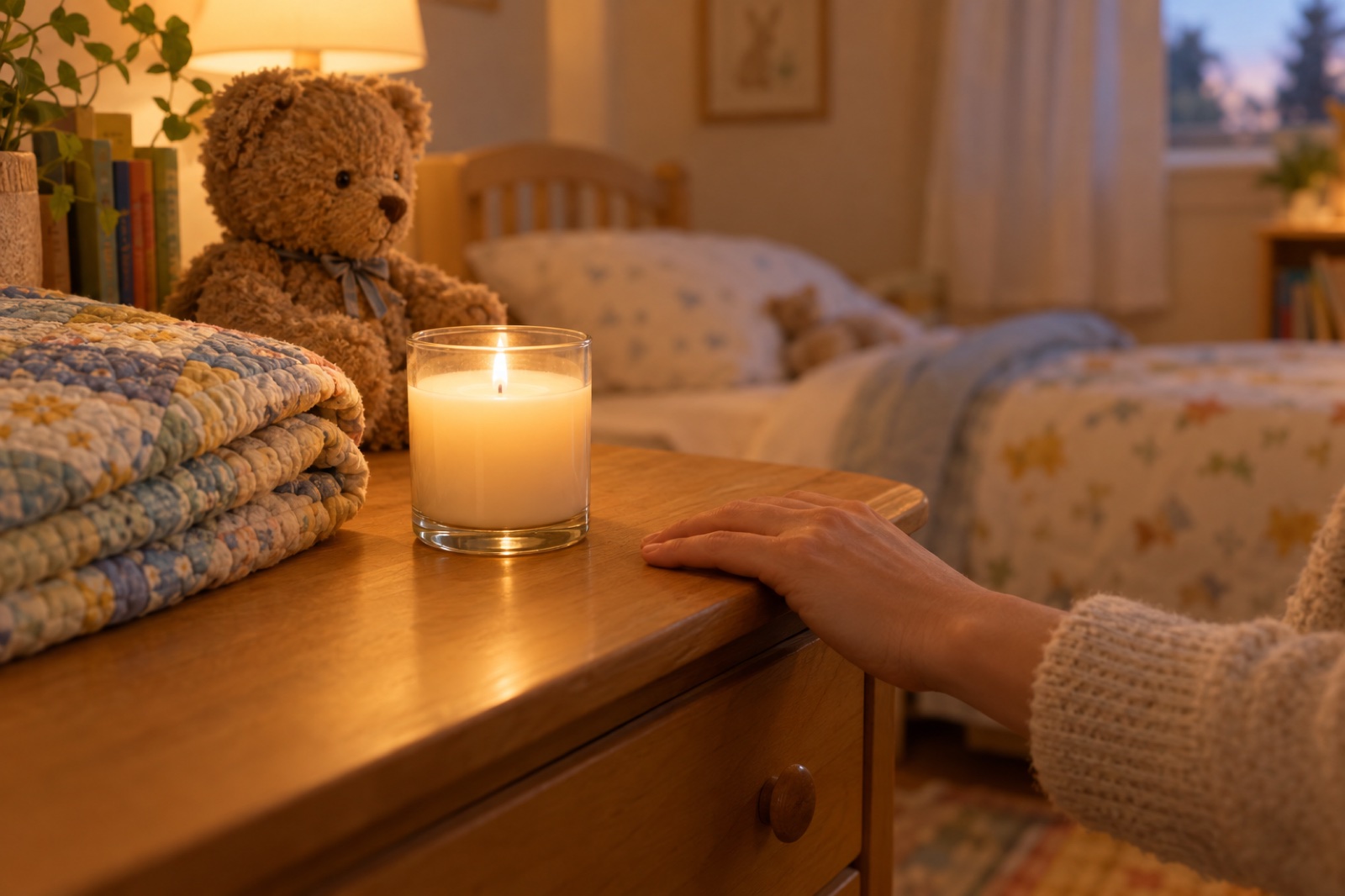
Put it where they’ll be when the question comes, which is usually low — near the bed, at the eye level of somebody three feet tall. If you want the longer thinking on that, where you put it is most of the point.
And be plain with yourself about the rest: an adult lights it, and an adult puts it out. Never leave a flame burning unattended, keep it well clear of bedding, curtains and small hands, and treat the lit part as yours rather than theirs. The candles are 9 oz soy wax, vegan and non-toxic, made to ASTM safety standards with no lead, parabens, phthalates, synthetic dyes or plastics — which matters more in a child’s room than almost anywhere else in the house.
They burn 50 to 60 hours, which is a great many bedtimes. And when the wax is finally gone, the glass stays: washed out, holding hair ties and bottle caps and three small stones from a holiday, still in the room, still carrying the verse.
Two Short Prayers for Tonight
One for them — short enough to be said in the dark without being read:
God, thank You for being here.
I am a little scared.
Please be strong in me.
Help me sleep.
Amen.
And one for you, for after the door is shut:
God, I can’t follow this child into every room. Not into the school, not into the dream, not into whatever is coming in ten years that I don’t know about yet. You can. Keep watch where I cannot. And when they ask me what this light is for, give me a true sentence — not a speech, not a lesson, just something true about what You have done for me. Let them learn the sound of being answered. Amen.
The Prayer Is Already in the Room
Here’s the thing worth knowing as a parent. Every one of these candles carries a QR code, and the code opens more than a hundred written prayers sorted by what’s actually happening — strength, healing, peace, gratitude, guidance, protection. No app, no account, no subscription.
Which means on the night you have nothing — the night the fever is up, or a friend was cruel, or they ask you something about dying and you are nowhere near ready — the words are already in the room. On the object. Two feet from the bed.
That’s what you were reaching for when you typed “custom.” Not a name in nice lettering. Something in your child’s room that is theirs, that holds a sentence worth hearing, and that leaves you with something true to say when a small voice asks what it is.
Questions People Are Asking
Q: Can I get a custom prayer candle for a child with their name on it?
A: Not an engraved name — these aren’t made to order, and there’s no personalization option. What you choose instead is the verse, and the verse is printed on the front in faith-centered artwork. For a young child that tends to work better anyway: they won’t read a name on a jar, but they will ask what the words are for, and that question is the opening you actually want. If you know the child’s hardest hour, you can see which verse candle fits.
Q: What Bible verse is best for a child who is scared at night?
A: Joshua 1:9 is hard to beat: “Be strong and of a good courage; be not afraid, neither be thou dismayed: for the LORD thy God is with thee whithersoever thou goest” (KJV). It’s short, it’s concrete, and what it promises is company rather than the absence of fear — which is the honest thing to tell a frightened child. Philippians 4:7 suits a child whose mind races instead. The test that matters is whether you can read the verse and then finish the sentence “that’s there because…” out of your own life. If you can, your child will hear the difference.
Q: Is it safe to keep a candle in a child’s room?
A: A lit flame is an adult’s job, every time. Light it yourself, stay with it, and put it out before you leave the room — never at bedtime-and-forget, never left burning while anyone sleeps, and never near bedding, curtains or anything hanging. Many families light it for the few minutes of prayers or a story and then blow it out together, which also gives the ritual a clear end. The glass itself stays in the room long after the wax is gone.
Q: How do I explain a prayer candle to a young child without making it sound magical?
A: Say exactly what it is: a reminder, not a mechanism. The flame doesn’t carry prayers anywhere, doesn’t make God listen, and doesn’t make anything more likely to happen. Lighting it simply marks the time — it’s a way of saying “we’re praying now” that a child can see. Scripture’s own pattern is a parent answering a question about an object with a plain account of what God has done (Exodus 13:8). That’s the whole explanation, and children take it well.
Q: What do I say when my child asks a question about God that I can’t answer?
A: “I don’t know” is a real answer, and it costs you far less credit than a bluff does. Then add the part you do know, which is usually something that happened to you rather than something you were taught. It’s worth remembering that in scripture even the people who heard God directly didn’t recognize the voice at first — Samuel needed three tries and an adult’s help. Not knowing yet is the ordinary starting place, not a failure.



