 0
0
 0
0
It happens fast. You open your phone to check one thing. Two minutes later, something is on its way to your door. You did not plan to buy it. You are not even sure you wanted it until you saw it.
If you are searching for how to stop impulse buying, you are not weak, and you are not alone. Researchers have studied this exact moment for decades. The best thing they found is this: an impulse buy is not one choice. It is three quick steps. And once you can see the steps, you can break them.
What Is Impulse Buying, Really?
In 1987 a consumer researcher named Dennis Rook published a study called “The Buying Impulse”. He described impulse buying as “a sudden, often powerful and persistent urge to buy something immediately.”
Look at the words he picked. Sudden. It comes out of nowhere. Powerful. It is hard to argue with. Persistent. It does not go away just because you said no once. And immediately. The urge wants it now, not next week.
That last word is the key to everything that follows. The urge is strong, but it is short-lived. It needs the purchase to happen before it fades. Anything that slows the purchase down works against it.
The Three Steps Inside Every Impulse Buy
Almost every impulse purchase follows the same short path:
- You see it. A photo, a shop window, an ad between videos, a “you might also like” box.
- You want it. The wanting shows up a second after the seeing. It feels like it came from you, but it was started by what you saw.
- You take it. You tap, you pay, you carry it to the till.
Saw. Wanted. Took. The whole thing can happen in less time than it took you to read this list.
Two other researchers, Stephen Hoch and George Loewenstein, looked closely at this in a 1991 paper on consumer self-control. They described it as a tug of war between desire and willpower. And they found that the single strongest thing that makes desire jump is physical closeness. When a thing is right in front of you, in your hand, or one tap away, you want it more.
They also noticed that sellers lean on time closeness. “Sale ends tonight.” “Only a few left.” The point is to make the chance feel like it is about to disappear, so you will skip the pause where you might change your mind.
Checkout Screens Are Built to Remove the Gap
Here is the part most people never think about. The space between “wanted” and “took” is where good decisions happen. That space is also where shops lose sales. So a lot of clever work has gone into making it smaller.
The clearest example is the one-click button. Amazon applied for a patent on buying with a single click in 1997. The patent was granted in 1999 and did not expire until September 2017. Apple paid to license it. Think about that: removing a few seconds between wanting and taking was worth patenting and fighting over for twenty years.
Saved cards, stored addresses, “buy now, pay later,” tap-to-pay, and shopping apps that remember you all do the same job. Every one of them makes the gap shorter. None of them are evil. But none of them are on your side, either.
How to Stop Impulse Buying: Put Distance Between Saw and Took
If the problem is a gap that has been made too small, the fix is simple. Make it bigger again. You do not need more willpower. You need more distance. Every idea below is free.
1. Use a waiting rule
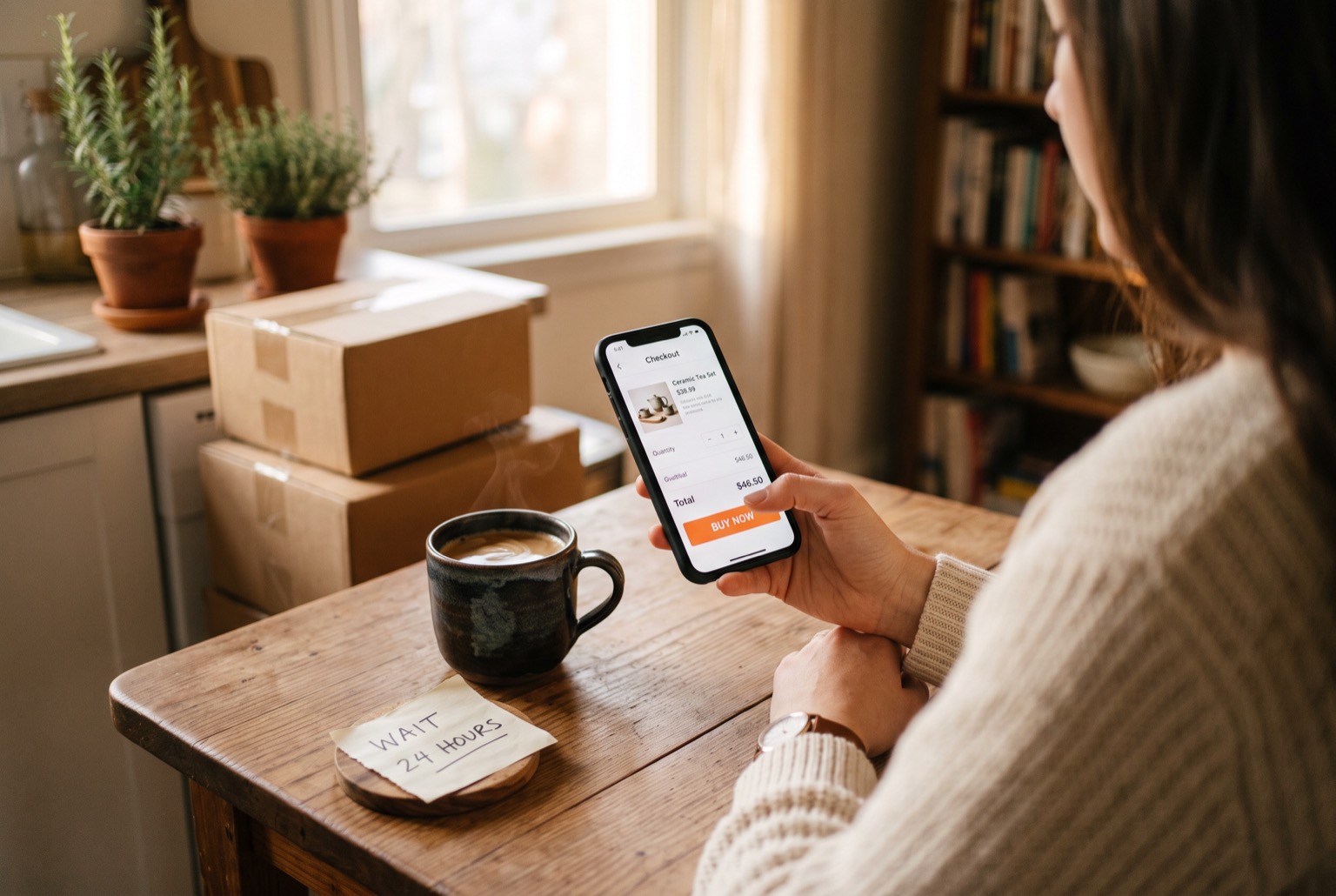
When you want something you did not plan to buy, wait before you buy it. Many people use 24 hours. For bigger things, some wait a week. The exact number is not magic. The point is that the urge is “immediate” and a wait is not. Put the item in your cart or write it down, then walk away. Often, when you come back, you will find you no longer care.
2. Remove your saved card
Delete your card from shopping sites and apps. Having to get up, find your card, and type the number is a small hassle. That small hassle is the whole point. It turns one tap into a real decision.
3. Move the shopping apps
Take shopping apps off your home screen, or delete them and use the website only when you actually need something. Out of sight really does mean less wanting. That is Hoch and Loewenstein’s closeness finding working for you instead of against you.
4. Unsubscribe from sale emails and messages
Every “flash sale” message is a new “saw” delivered straight to your pocket. Unsubscribe from the ones that tempt you. You will not miss the one you actually need, because you will go looking for it.
5. Ask “where will it live?”
Before you buy, picture exactly where the thing will go in your home and when you will use it this week. If you cannot answer, that is your answer.
6. Notice when you shop
Many impulse buys happen when we are tired, lonely, bored, or stressed, often late at night. If you notice a pattern, that tells you the buying is not really about the thing. Our piece on the hedonic treadmill explains why the lift from something new fades so fast, which is why that feeling keeps sending you back for more.
If you want to see where your money is actually going, our free budget calculator takes a couple of minutes and shows it plainly. Small, unplanned buys are also one of the quiet engines behind lifestyle creep, where more money comes in and somehow none of it stays.
The Oldest Impulse Buy on Record
The three steps above are not new. They are very, very old.
There is a story in the Bible, thousands of years old, about a man who took some treasure he had been told not to touch: a fine robe, some silver, a bar of gold. When he was finally found out, he explained himself in three steps. He saw. He wanted. He took. It is the same path a checkout screen is built around today.
But the part people usually read past is what he did next. He did not wear the robe. He did not spend the silver. He dug a hole in the floor of his tent and buried it all. The things he could not stop himself from taking, he could not even enjoy. They just sat in the dark, hidden, weighing on him.
Most of us know a small version of that. The parcel we never opened. The bag pushed to the back of the wardrobe. The thing we hid so no one would ask how much it cost.
That old story points at something quiet and true. The wanting was never really about the robe. There is a hunger in people that things were never built to fill. The ancient writers believed that hunger has a shape, and that it was made for God, not for more stuff. You can take that or leave it. But it might explain why the lift from a new thing never lasts, and why the next “saw” always seems to come so soon.
Starting Small
You do not have to fix this all at once. Pick one gap to widen this week. Delete one saved card. Move one app. Wait one day on one thing you want.
Each time you let the urge pass and nothing bad happens, it gets a little weaker next time. You are not fighting yourself. You are just giving the wiser part of you enough time to show up.
Discussion Question
Which do you think makes impulse buying worse today: how easy it is to pay, or how often we see things to buy? Tell us which one you would get rid of first, and why, in the comments below.
Share This
Every impulse buy is three steps: I saw it, I wanted it, I took it. The fix isn’t more willpower. It’s more distance between “saw” and “took.” https://bgodinspired.com/index.php/personal-growth-and-life-skills/how-to-stop-impulse-buying/
Deleted my saved card from every shopping app today. Turns out that one small hassle is the whole trick. This explains why: https://bgodinspired.com/index.php/personal-growth-and-life-skills/how-to-stop-impulse-buying/
Amazon patented the one-click button and held that patent for about 20 years. That’s how valuable it is to shrink the gap between wanting and buying. Worth knowing next time you shop.
Questions People Ask About Impulse Buying
How do I stop impulse buying online?
The most effective way to stop impulse buying online is to add distance between seeing an item and paying for it. Remove saved cards from shopping sites, take shopping apps off your home screen, unsubscribe from sale emails, and wait at least 24 hours before buying anything you did not plan to buy. These steps are free and work because the urge to buy on impulse is strong but short-lived.
Why do I impulse buy?
People impulse buy because desire rises quickly when something is seen up close or feels available right now. Consumer researchers Stephen Hoch and George Loewenstein found in 1991 that physical closeness is the strongest trigger for this rise in desire. Tiredness, stress, boredom and loneliness can make the urge harder to resist, which is why many impulse purchases happen late at night.
What is the 24-hour rule for impulse buying?
The 24-hour rule is a simple habit: when you feel the urge to buy something you had not planned to buy, you wait a full day before buying it. The wait works because an impulse is an urge to buy immediately. After a day, the urge has usually faded, and you can decide calmly whether you still want the item.
Is impulse buying the same as a shopping addiction?
No. Impulse buying is a common, everyday behavior where someone makes an unplanned purchase on a sudden urge. A shopping addiction, often called compulsive buying, is more serious and involves repeated buying that causes real distress, debt, or harm to relationships. If buying feels out of control or is causing serious harm, speaking with a doctor or counselor is a wise next step.
What is the oldest example of impulse buying?
One of the oldest written accounts of the impulse pattern is a story in the Bible, thousands of years old, in which a man takes forbidden treasure and explains that he saw it, wanted it, and took it. He then buried what he took in the floor of his tent and never used it. The same three steps of seeing, wanting and taking still describe how impulse buying works today.