 0
0
 0
0
In 2024, a man in Quebec sat down to plan a camping trip.
He did what a lot of us do. He opened a satellite map and started scrolling over the forest, looking for a good spot near water. Somewhere to pitch a tent. Nothing more than that.
Then he noticed a circle.
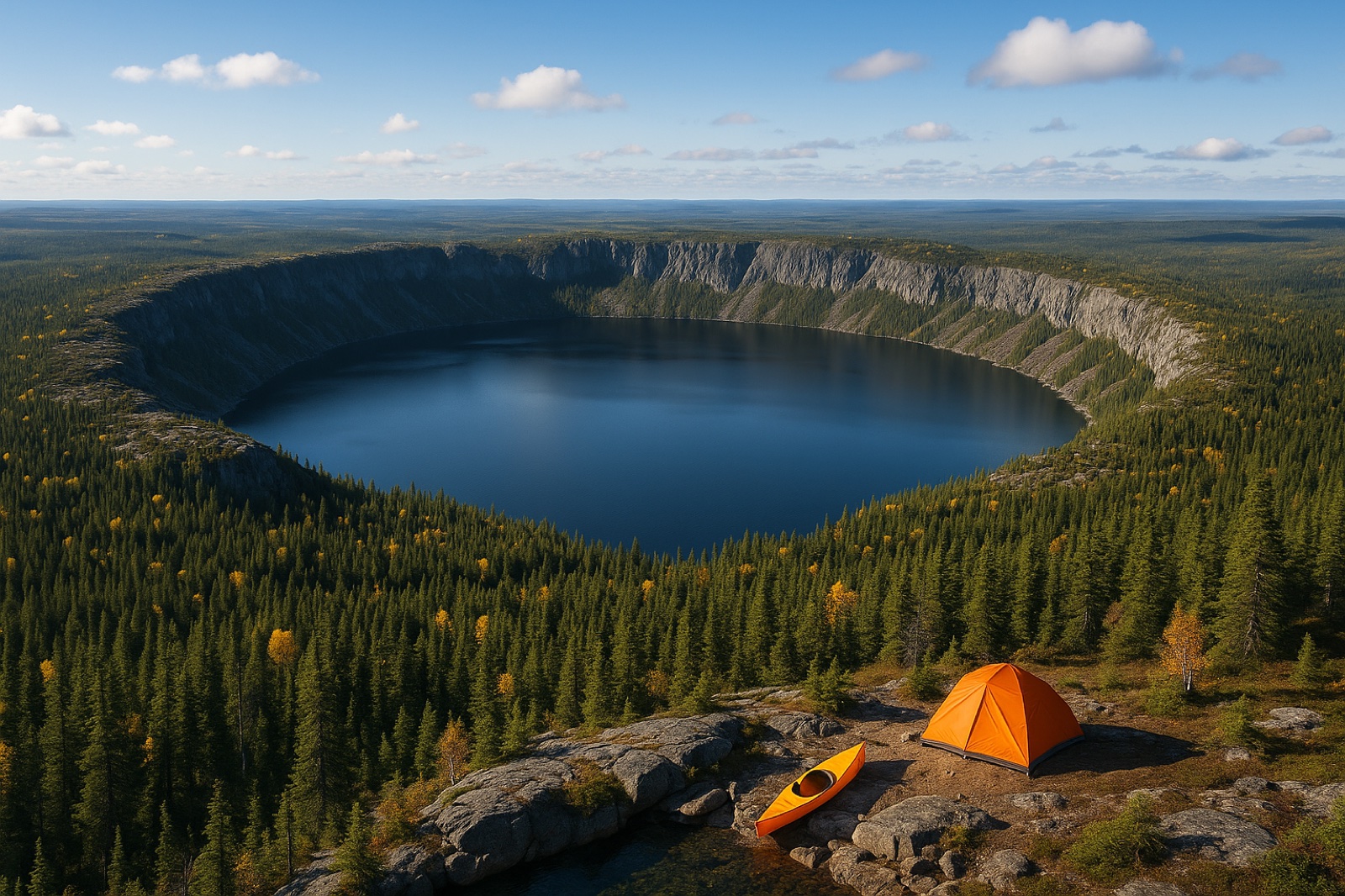
Not a small one. A ring about 25 kilometres wide (around 16 miles), sitting in the remote Côte-Nord region of Quebec, with a lake called Lake Marsal near its middle. It had been on every satellite map for years. Anyone could have opened it. Almost nobody had seen it for what it was.
Scientists now say it is an impact crater in Quebec, made when a space rock hit the Earth roughly 390 million years ago. And the man who spotted it was not a geologist. He was an amateur astronomer named Joël Lapointe, and he was looking for a campsite.
The Impact Crater in Quebec, in Plain Numbers
Here is what the researchers have said so far, according to NASA’s Earth Observatory and Smithsonian Magazine:
- About 25 kilometres across (roughly 16 miles), with a raised centre and high rock cliffs.
- About 390 million years old, based on rock samples. That is long before the dinosaurs.
- Named Uhackatik, a name chosen in consultation with the Innu Council of Ekuanitshit, the Indigenous community whose land this is.
- The biggest impact structure found anywhere on Earth since 2018, when the 31-kilometre Hiawatha structure was reported under the ice in Greenland.
- One of only about 200 confirmed impact structures on the whole planet.
One honest caveat: the Meteoritical Society, the group that officially confirms impact sites, still has to formally sign off. The team calls it “essentially confirmed.” So it is very likely, not yet stamped.
The story has been told since mid-2026, and it resurfaced in September. But the discovery itself goes back to 2024. What makes it worth your time is not how new it is. It is how it happened.
How Do You Miss Something 25 Kilometres Wide?
It sounds impossible. How does a hole the size of a city hide on a map?
The answer is time. Almost 400 million years of it. Wind, water, ice and rock have worn the crater down. Forest has grown over it. From above, the ring is subtle. NASA’s own description of the satellite picture uses exactly that word: subtle. You can see it once you know. You can scroll right past it if you don’t.
And the land is hard to reach. The crater sits deep in the boreal forest of northeastern Canada, far from roads. Nobody was going to trip over it on a walk.
So it waited. Not hidden, exactly. Just unnoticed.
The Part the Headlines Skip: It Took Two People
Most versions of this story stop at “man finds crater on Google Maps.” But that is only half of it.
When Lapointe saw the circle, he did something a lot of people wouldn’t. He spoke up. He wrote to planetary scientists in Europe and North America and told them what he suspected. He had no degree in geology. He could easily have told himself, “Who am I to email experts about this?”
His message reached a team of French researchers, who listed the Lake Marsal area as a possible new impact site at a Meteoritical Society meeting in 2024. That eventually reached Gordon Osinski, a planetary geologist at Western University in Canada who runs a large database of Earth’s impact craters.
And here is the twist. Osinski was skeptical at first.
That was not arrogance. It was experience. People report “craters” to scientists all the time, and nearly all of them turn out to be nothing. Osinski put it this way to Smithsonian: “It just goes to show, while 9 out of 10 or 99 out of 100 might not be [impact craters], there could always still be that one that will surprise you.”
He went anyway. In October 2025 he led an expedition into that remote forest to look for proof.
They found it. The rocks held shatter cones, cone-shaped fracture patterns that only form under the enormous shock of an impact. Osinski described them as “the only unequivocal evidence of an impact event that you can see in the field with the naked eye.” They also found impact melt rock, stone that had been melted by the blast.
So the discovery needed two things. An amateur brave enough to say, “I think I see something.” And an expert humble enough to say, “Probably not, but let’s go look.”
If you want to feel how deep 390 million years really goes, our free How Old Is the Universe? Explorer walks you back through time one step at a time. Spoiler: this crater is young compared to the rock it sits in.
Not the Only Thing Waiting to Be Noticed
This keeps happening in science. A few days ago, NASA confirmed a new crater on the Moon that its own orbiter had photographed more than a year before anyone spotted it in the data. And researchers recently named a new penguin species that had been standing on remote islands, unrecognised, for years.
But the Quebec crater is different in one way. The survey didn’t find it. The software didn’t find it. A person who wasn’t paid to look found it, because he was paying attention while doing something ordinary.
What Joël Lapointe Said Afterward
After the crater was confirmed, Lapointe offered one piece of advice. It is worth reading slowly:
“I encourage everyone to not ignore intuition or an observation, even if it isn’t part of your field of expertise.”
A lot of us quietly believe the opposite. We think our noticing only counts inside our job title. The nurse can speak about patients, but not about the building. The cleaner can talk about floors, but not about the thing everyone walked past. The kid should stay quiet while the adults figure it out.
Over time, that turns people into their function. You are allowed to see what you are paid to see, and nothing more.
There is a very old idea that runs straight against that. It says that some of the most important things are hidden from the clever and the credentialed, and shown instead to ordinary people who are simply paying attention. The ones with open eyes, not the ones with the right title. For thousands of years people have believed that God works exactly this way, handing real sight to whoever is still looking, whatever their rank.
That idea doesn’t make experts useless. The crater still needed a geologist to walk into the forest and read the rocks. But it does mean your eyes count. What you notice counts, even outside your field.
Why This Impact Crater Is Worth a Moment of Your Day
Somewhere in northern Quebec, a ring of cliffs and forest sits around a quiet lake, just as it has for hundreds of millions of years. It has a name now. It will be studied for decades. It will appear in textbooks.
And it is there because someone planning a weekend away looked at a map a little longer than they needed to, and then had the nerve to send an email.
Next time you notice something that doesn’t quite fit, at work, at home, on a walk, on a screen, don’t wave it away because it isn’t your area. Look a little longer. Tell someone. Nine times out of ten it may be nothing.
But there could always be that one.
Discussion Question
Gordon Osinski said most reported “craters” turn out to be nothing, yet he went to check this one anyway. Do you think experts should spend more time following up tips from ordinary people, or would that waste too much of their time? Tell us what you think in the comments.
Share This
Post 1: A guy in Quebec was looking for a campsite on a satellite map and spotted a 25 km meteorite crater, 390 million years old, that nobody had noticed. Pay attention to the “small” stuff. bgodinspired.com
Post 2: My favourite part of the Quebec crater story: the expert admitted 9 out of 10 reported craters are nothing, and went to check anyway. The amateur spoke up, the expert listened. That’s how it’s supposed to work. bgodinspired.com
Post 3: “Don’t ignore intuition or an observation, even if it isn’t part of your field of expertise.” Said by the amateur astronomer who found the biggest new impact crater since 2018. Read the whole story: bgodinspired.com
Questions People Ask About the Impact Crater in Quebec
What is the new impact crater found in Quebec?
The Uhackatik impact structure is an ancient meteorite crater about 25 kilometres (roughly 16 miles) wide in the Côte-Nord region of Quebec, Canada, with Lake Marsal near its centre. Scientists estimate it formed about 390 million years ago. Researchers consider it essentially confirmed, with formal recognition by the Meteoritical Society still pending.
Who discovered the Uhackatik crater in Quebec?
The Uhackatik crater was first spotted in 2024 by Joël Lapointe, an amateur astronomer who noticed a circular feature on online satellite maps while planning a camping trip. He contacted planetary scientists, and in October 2025 an expedition led by Western University planetary geologist Gordon Osinski found shatter cones and impact melt rock that confirmed an ancient impact.
How did scientists confirm the Quebec crater was made by a meteorite?
Scientists confirmed the Quebec impact crater by finding shatter cones, cone-shaped fracture patterns in rock that form only under the extreme shock of a space-rock impact, along with impact melt rock. Geologist Gordon Osinski has described shatter cones as the only unequivocal evidence of an impact that can be seen in the field with the naked eye.
Is the Quebec crater the biggest crater found in years?
Yes. According to NASA’s Earth Observatory, the 25-kilometre Uhackatik structure in Quebec is the largest impact structure identified on Earth since the 31-kilometre Hiawatha structure was reported beneath Greenland’s ice sheet in 2018. Only about 200 impact structures have been confirmed worldwide.
Why did nobody notice a 25-kilometre crater for so long?
The Uhackatik crater in Quebec is roughly 390 million years old, so erosion and dense boreal forest have worn down and covered much of its shape. On satellite images the circular outline is subtle, and the site is in a remote part of northeastern Canada far from roads, so few people had reason to study the area closely.