 0
0
 0
0
It is late. The house is quiet. And you are still arguing with someone who is not in the room.
You go over what they said. You plan what you should have said. You work out how to stop the thing they are doing before it spreads. Somewhere under all of it is one tired thought: if I don’t stop this, nobody will.
There is a man in the Bible who stood up in a room full of angry, powerful people and said, in effect, “You don’t have to stop this. Wait.” His name was Gamaliel. And the most surprising part of his story is not what he said. It is what his own best student did next.
Who Was Gamaliel in the Bible?
Gamaliel was a Pharisee and a teacher of the Jewish law in Jerusalem in the first century. He appears by name only twice in the Bible, both times in the book of Acts.
The first time, Luke describes him as “a Pharisee, named Gamaliel, a doctor of the law, had in reputation among all the people” (Acts 5:34). “Doctor” here means teacher. He was not a priest. He was the kind of man people listened to because they trusted him.
The second time, it is the apostle Paul who mentions him. Paul says he was “brought up in this city at the feet of Gamaliel, and taught according to the perfect manner of the law of the fathers” (Acts 22:3). Sitting “at the feet” of a teacher meant being his student.
So who was Gamaliel? The most respected teacher in Jerusalem, the man who talked the council out of killing the apostles, and the teacher of the man who would go on to hunt them.
Outside the Bible, Jewish tradition remembers him as Rabban Gamaliel the Elder, “Rabban” being an honoured title for a teacher. Later tradition calls him a grandson of the great teacher Hillel. The Mishnah (Sotah 9:15) records a saying that when Rabban Gamaliel the Elder died, the glory of the Torah ceased. That tells you how deeply he was honoured. It is tradition, not scripture, but it matches the picture Luke paints.
The Day the Council Wanted Blood
To understand what Gamaliel did, you need to see the room he did it in.
The apostles had been arrested for preaching about Jesus. They had been told to stop. They had not stopped. Now they stood before the council, the ruling body of Jewish leaders in Jerusalem, and Peter told them plainly that they would obey God rather than men.
The council’s reaction is recorded in one line: “When they heard that, they were cut to the heart, and took counsel to slay them” (Acts 5:33).
They were not planning a warning. They were planning a killing.
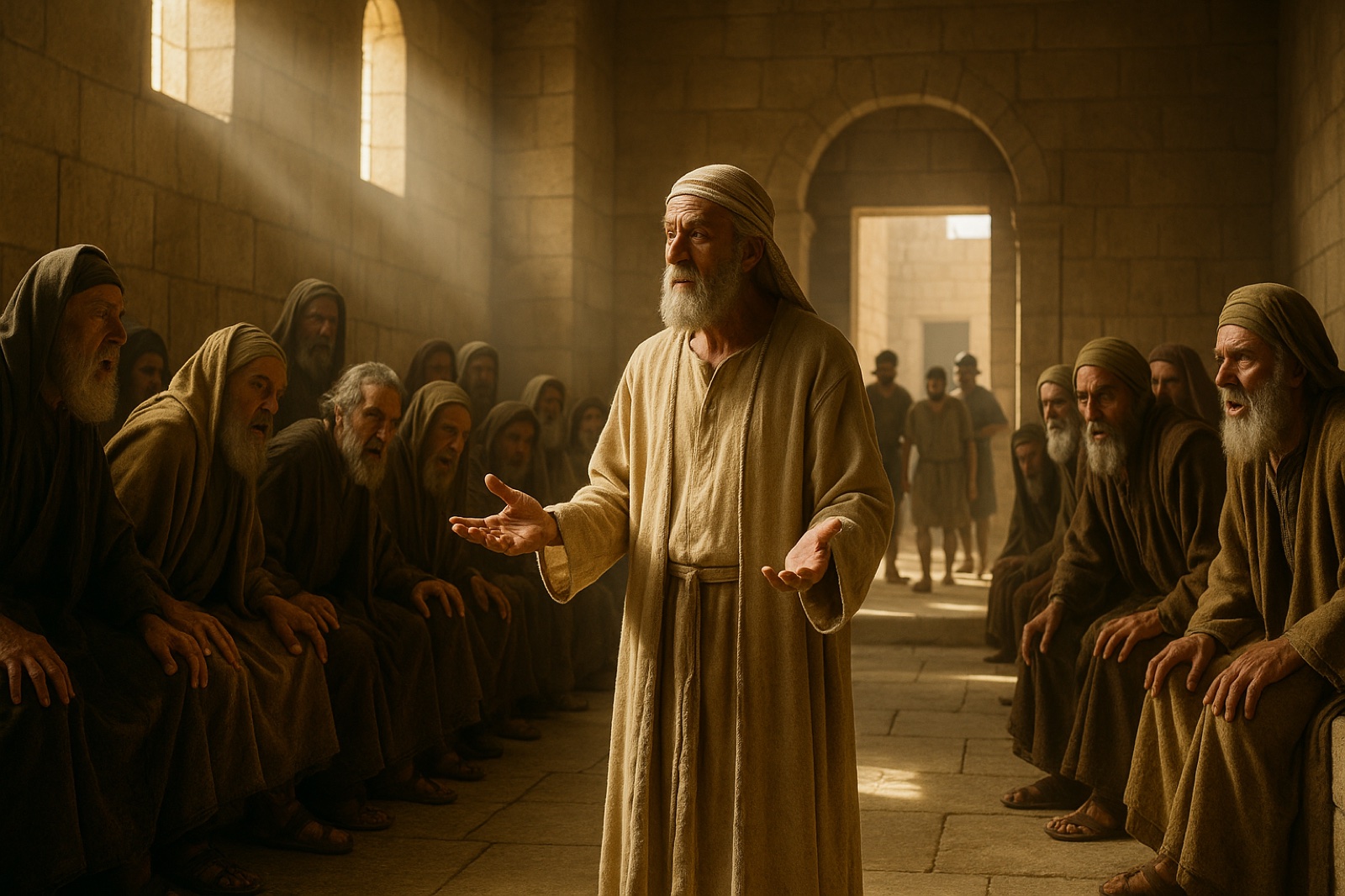
Then one man stood up. Gamaliel asked for the apostles to be taken outside for a moment. And with the room to himself, he gave a short history lesson.
He reminded them of Theudas, a man who had claimed to be somebody and gathered “about four hundred” followers. Theudas was killed, and his followers “were scattered, and brought to nought” (Acts 5:36). Then he reminded them of Judas of Galilee, who led a movement “in the days of the taxing” and also perished, his followers dispersed (Acts 5:37).
His point was simple. Movements built by men fall apart on their own. You don’t have to crush them.
Then came the words this whole story turns on:
“And now I say unto you, Refrain from these men, and let them alone: for if this counsel or this work be of men, it will come to nought: But if it be of God, ye cannot overthrow it; lest haply ye be found even to fight against God.” (Acts 5:38-39, KJV)
Two outcomes. Only two. If it is of men, it will fall without your help. If it is of God, you cannot stop it, and trying will put you on the wrong side of God.
Either way, you can put the sword down.
The Line Almost Everyone Skips
Most retellings stop at Gamaliel’s speech, as if the council nodded and everyone went home. Read one verse further.
“And to him they agreed: and when they had called the apostles, and beaten them, they commanded that they should not speak in the name of Jesus, and let them go” (Acts 5:40).
They agreed. And then they beat them anyway.
Gamaliel’s wisdom saved the apostles’ lives. It did not stop the council from needing to do something. They could not quite let go. They had to leave a mark, even while admitting the matter was out of their hands.
That is a very human thing. Most of us know the feeling of saying “I’ll leave it with God” while still sending one more sharp message on the way out.
And the apostles? “They departed from the presence of the council, rejoicing that they were counted worthy to suffer shame for his name” (Acts 5:41). The very next verse says they did not stop teaching for a single day (Acts 5:42). The beating changed nothing. Gamaliel was right.
The Student Who Went the Other Way
Now think about who was learning from Gamaliel during these years.
Saul of Tarsus, the man we now know as Paul, had been trained by him in the law. Paul later described himself this way: “a Pharisee” (Philippians 3:5), and “more exceedingly zealous of the traditions of my fathers” than others his age (Galatians 1:14). If you want to go deeper into that word, our study of the Greek word for zeal shows how the same word can mean burning devotion or burning envy.
Acts does not tell us whether Saul was in the room when Gamaliel spoke, so we should not claim he was. But we do know what Saul did soon after. When Stephen was stoned, “Saul was consenting unto his death” (Acts 8:1). Then: “As for Saul, he made havock of the church, entering into every house, and haling men and women committed them to prison” (Acts 8:3).
His teacher had said: let them alone. The student said: not while I’m alive.
Gamaliel trusted that what was of God would stand and what was of men would fall. Saul decided the outcome was his job. He would be the one to make sure this thing came to nought.
The Voice on the Road Used Gamaliel’s Warning
You probably know how Saul’s story turns. On the road to Damascus, a light, a fall, and a voice.
When Paul told this story years later before King Agrippa, he added a line that is easy to read past. The voice said: “Saul, Saul, why persecutest thou me? it is hard for thee to kick against the pricks” (Acts 26:14).
A “prick” was a goad, a sharp stick used to steer an ox. An ox that kicks against it only hurts itself.
Put that next to Gamaliel’s warning. The teacher had said: be careful, “lest haply ye be found even to fight against God.” Now the risen Jesus tells the student: you are kicking against something you cannot move, and you are the one getting hurt.
Gamaliel’s warning came true in his own student’s life. The thing Gamaliel said could not be overthrown overthrew Saul, face down in the dust.
But notice what it did not do. It did not destroy him. It recruited him.
Years Later, Gamaliel’s Argument Saved His Student
Here is the detail that almost nobody talks about.
Many years after the Damascus road, Paul himself stood before the same council in Jerusalem. The room broke into uproar. And some of the Pharisees, Gamaliel’s own party, stood up to defend him. Their words: “We find no evil in this man: but if a spirit or an angel hath spoken to him, let us not fight against God” (Acts 23:9).
Let us not fight against God.
It is Gamaliel’s argument, coming back around. The same reasoning that once protected the apostles from the council now protected Paul from it. The student who refused to listen to his teacher’s advice was, in the end, shielded by it.
Wisdom you refuse can still be waiting for you later.
What Gamaliel Was Not
It would be easy to turn Gamaliel into a hero who secretly believed. The Bible does not say that.
His advice was careful, not converted. He did not say “these men are right.” He said “wait and see.” That was wise, and it saved lives, but it was neutral. There is an old Christian story, found in a writing called the Clementine Recognitions, that Gamaliel was secretly a believer. It is a legend, and there is no way to confirm it.
There is also an honest puzzle in his speech. The Jewish historian Josephus writes about a rebel named Theudas who rose up under the Roman governor Fadus, which would be some years after Gamaliel spoke. Some scholars think Gamaliel meant an earlier man with the same fairly common name. Others think the details got tangled. Nobody knows for sure, and it is fine to say so. The point of Gamaliel’s lesson does not depend on the date.
You Don’t Have to Win Every Fight Yourself
Go back to that late-night argument in your head.
Saul lived there. He was sure that if he did not personally stop this movement, it would win. So he worked harder, travelled further, and hurt more people. His zeal was real. His conclusion was wrong.
Gamaliel’s two outcomes are not just about a first-century council. They are about you.
If the thing you are worried about is of men, a rumour, a bad plan, a person’s unfair opinion of you, it will come to nought. Time is hard on things that are not true. You do not have to be the one who takes it down.
If the thing is of God, you cannot stop it. And the good news runs both ways. You cannot stop what God is doing in someone else. But you also cannot ruin what God is doing in you. Your failures, your bad week, your worst reply, none of it can overthrow what God has started.
That is what the council never quite believed, and why they beat the apostles on the way out. It is what Saul refused to believe until the road. And it is what Gamaliel knew: God is not waiting for you to win the fight before God can act.
Some fights really are yours to fight. Injustice needs to be named. People need protecting. But a lot of what keeps us awake is not that. It is the need to control an outcome that was never ours to control. If you are not sure how heavy that has become, our free How Anxious Am I? assessment is a gentle place to check.
Actions to Take Today
- Name the fight. Write down the one situation you keep replaying in your head this week. Under it, write Gamaliel’s two options: “of men, it will fall” and “of God, I can’t stop it.” Look at which one it is.
- Leave one thing alone today. Pick one reply, correction, or follow-up you were about to send, and don’t send it. Put a reminder in your phone for seven days from now to see whether it still matters.
- Swap a point for a question. If there is someone you have been pushing against, send them one honest question instead of one more argument. Saul never asked. The voice on the road did.
Journaling Prompts
- Where in your life are you acting like it is your job to make something “come to nought”?
- When have you said “I’ll leave it with God” but still left your mark on the way out, like the council did?
- What would it feel like in your body tonight to truly believe that nothing can overthrow what God is doing in you?
A Prayer for Letting Go of the Fight
God, I am tired of arguing with people who aren’t even in the room. I keep acting like everything depends on me stopping the wrong thing and fixing the right one. Help me tell the difference between the fights you’ve given me and the ones I picked up myself. Where something is not from you, let it fade without my help. And where something is from you, in them or in me, let me stop kicking against it and rest. Amen.
Join the Conversation
Gamaliel’s test says time will sort out what is of God and what is not. Do you think that is always true, or are there things we should never just “wait and see” about? Tell us in the comments.
Share This
- “If it be of God, ye cannot overthrow it.” Needed that tonight. I don’t have to win every fight myself. (Acts 5:39)
- Gamaliel told the council to let the apostles alone. His own student, Saul, went out and did the opposite. Years later, Gamaliel’s argument is what saved him. Wisdom you refuse can still be waiting for you.
- Just realised the council agreed with Gamaliel and then beat the apostles anyway. That’s me: “I’ll leave it with God”… plus one more sharp message.
Questions About Gamaliel
Who was Gamaliel in the Bible?
Gamaliel was a Pharisee and a highly respected teacher of the Jewish law in Jerusalem in the first century. Acts 5:34 calls him “a doctor of the law, had in reputation among all the people.” He persuaded the Jewish council not to kill the apostles, and he was also the teacher of Saul of Tarsus, who became the apostle Paul (Acts 22:3).
What did Gamaliel say about the apostles?
In Acts 5:38-39, Gamaliel told the Jewish council to leave the apostles alone. He argued that if their movement was of men it would come to nothing on its own, but if it was of God, nobody could overthrow it, and anyone who tried might be found fighting against God.
Was Gamaliel the teacher of the apostle Paul?
Yes. In Acts 22:3, Paul says he was “brought up in this city at the feet of Gamaliel,” which means he was trained by Gamaliel in the Jewish law in Jerusalem. Despite Gamaliel’s advice to leave the followers of Jesus alone, Paul, then called Saul, went on to persecute the early church before his conversion on the road to Damascus.
Did Gamaliel become a Christian?
The Bible never says that Gamaliel became a Christian. His advice in Acts 5 was cautious and neutral rather than a statement of faith in Jesus. A later Christian writing called the Clementine Recognitions claims he was secretly a believer, but this is a legend that cannot be confirmed.
What does “fight against God” mean in Acts 5:39?
In Acts 5:39, Gamaliel warned the Jewish council that if the apostles’ work came from God, trying to stop it would put the council in opposition to God. The same idea appears again in Acts 23:9, when Pharisees defending Paul said, “let us not fight against God.”