 0
0
 0
0
There is a moment — maybe you have had it this week — when you reach for a word and find your language does not have one.
Someone is not in the room who should be. Maybe they are three countries away and you have not heard their voice in a year. Maybe they are gone, and there is no number left to call. And what you feel is not quite sadness, and not quite love, and not quite “missing them,” because missing sounds small and polite, like a bus you didn’t catch.
Portuguese has a word for it. Thousands of people look up the saudade meaning every month, and almost none of them are studying Portuguese. They are looking for a name for something they already carry.
So here is the word. What it actually says, where it really came from — the famous origin story turns out to be off by about two hundred years — and one short line in the Bible that reads completely differently once you know what saudade means.
Saudade Meaning: What the Portuguese Word Actually Says
Saudade (roughly sow-DAH-duh in Portugal, closer to sow-DAH-jee in Brazil) is the longing you feel for someone or something you love and do not have — carrying the quiet weight of knowing it may never come back.
That last part is what makes it different from ordinary missing. Saudade is not waiting at the arrivals gate. It holds affection and grief in the same hand, and it refuses to promise a happy ending. It is the ache of loving something across a distance you cannot walk.
Two small details that most explanations in English leave out:
- It usually comes in the plural. You do not have saudade of someone. You have saudades. The feeling arrives in handfuls, not singles.
- There is a phrase for the cure. Matar as saudades — literally, “to kill the saudades.” And you do it by showing up. By seeing the face. The language treats this ache as something a reunion can genuinely end, not something you are supposed to talk yourself out of.
It is also not Portugal’s alone. Galician, spoken just across Portugal’s northern border, carries the same word, and its older spellings sit in the same medieval manuscripts.
The Story Everyone Tells About Saudade
You will find this version almost everywhere, and it is beautiful.
Portugal is a small country with its back to Spain and its face to the Atlantic. During the age of sea voyages, its men left. Ships went out for years at a time. Plenty never came back. So — the story goes — the people left standing on the docks needed a word for what they were doing: loving someone who was out there somewhere, across water they could not cross, who might already be dead.
The feeling even has its own music. Fado — Portugal’s mournful national song form — is where saudade lives out loud. The name fado itself is usually traced to the Latin fatum: fate. Songs about what was handed to you and cannot be handed back.
Brazil went further and gave the feeling a date on the calendar. The 30th of January is Dia da Saudade there — a day for the people you miss. Nobody seems to have a reliable record of why that date was chosen; the most honest answer in the Portuguese-language sources is that it simply got agreed on.
It is a good story. It is just not where the word came from.
The Date That Breaks the Story
Portugal’s voyages of discovery are usually dated from 1415.
But the word is already in the manuscripts before that. Its older forms — soidade, soedade, suidade, soydade — show up in thirteenth-century Galician-Portuguese song. They appear in the great medieval songbooks and among the poets around the court of King Denis, who reigned from 1279 to 1325. One of the oldest recorded appearances sits in the Cantigas de Santa Maria, a thirteenth-century collection of devotional songs.
Which exact line in which exact manuscript came first is not settled, and anyone who tells you otherwise is tidying up a genuinely messy record. But the broad dating is not really in dispute, and it matters: the word is roughly two centuries older than the ships that supposedly made it.
The sailors did not invent saudade. They inherited it.
Where Saudade Actually Comes From
The most widely accepted route is much lonelier than the harbour.
It starts with the Latin solitas, solitatem — solitude. That became soidade in old Galician-Portuguese, and soidade became saudade. A common suggestion is that the shift happened under the pull of saúde (“health”) and saudar (“to greet”) — but that step is a supposition that scholars flag as unproven, not a settled fact. An Arabic origin has also been argued, and has not won acceptance.
So strip it back and the word does not mean “longing for a sailor.” It means something closer to the state of being left alone. The loneliness came first. The sea just gave it somewhere enormous to stand.
The sea did not invent the ache. It gave it somewhere to be enormous.
This is worth sitting with if you have ever felt faintly ridiculous about how much you miss someone. You are not borrowing a feeling from a nation of sailors. You are using a word that was already old when the first ship left.
If you want the companion words, Welsh built its own from scratch and it started out meaning grief for a person, not a place — we traced that one in Hiraeth Meaning: The Welsh Word That Started Out as Grief.
Why the Sea Kept the Word Anyway
Here is the fair part of the popular story.
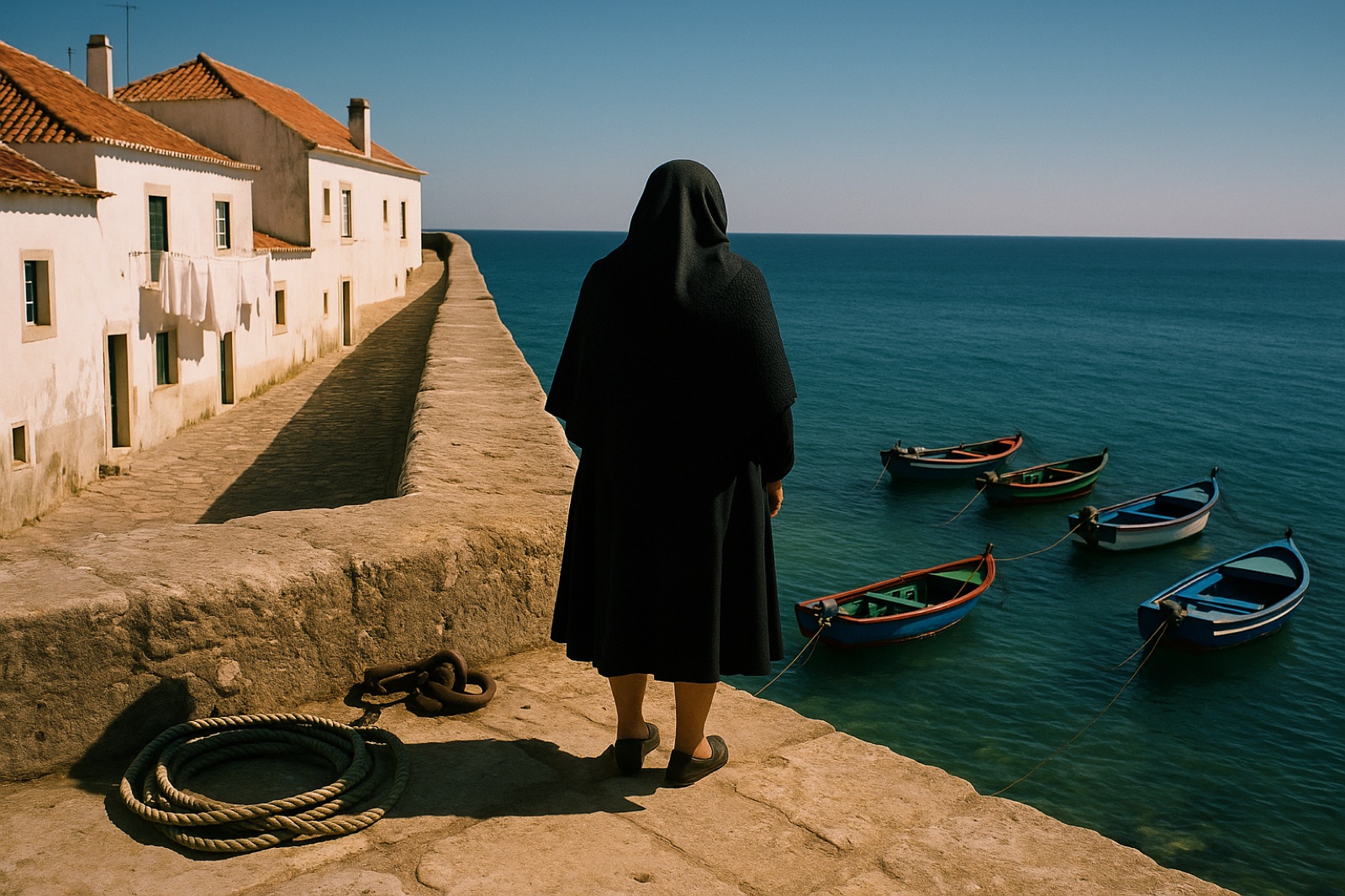
The sea did not create saudade, but it is the best picture of it anyone has found. Water is distance you cannot walk across. You can stand at the edge of it and see for miles and be no closer to the person than you were in your kitchen. You can watch the horizon all day and the horizon gives you nothing.
That is not a Portuguese experience. That is a global one. It is the mother in Manila whose daughter works in Dubai. It is the man who has not been home to his village in eleven years because the fare costs more than a month’s wages. It is anyone who has buried someone and then walked out of the building into ordinary traffic.
The sea in that picture is not the problem. The distance is the problem. The sea is just what the distance looks like.
Hold on to that, because it is about to matter.
The Strange Detail in Revelation 21
Near the very end of the Bible there is a sentence most people read straight past.
Revelation 21:1 — “And I saw a new heaven and a new earth: for the first heaven and the first earth were passed away; and there was no more sea.”
A new heaven and a new earth. Lovely. Everyone nods.
And then: and there was no more sea.
Which is, on the face of it, strange. Why would the sea be a problem? Why would anyone open the description of a perfect world by pointing out what is missing from the map?
Two things unlock it.
First, in the Bible the sea is almost never scenery. It is where chaos comes from. When Daniel describes his vision of the empires that will tear the world apart, he writes in Daniel 7:3: “And four great beasts came up from the sea, diverse one from another.” The sea is the place things rise out of that you cannot control and did not ask for.
Second — and this is the part that stopped me — look at who wrote the line, and from where.
The author tells us himself in Revelation 1:9: “I John, who also am your brother, and companion in tribulation, and in the kingdom and patience of Jesus Christ, was in the isle that is called Patmos, for the word of God, and for the testimony of Jesus Christ.”
An island. He is writing letters to seven churches full of people he knows and loves, and every single one of those letters has to cross water to reach them. He cannot walk to any of them. For the man holding the pen, the sea was not a metaphor for separation. It was the separation. It was the thing standing between him and everyone he cared about, every day, visible from wherever he stood.
And what he is given to write down is: in the end, there was no more sea.
Not “You Will Stop Missing Them”
Read that promise next to what saudade actually means and something shifts.
Most comfort offered to people in grief is aimed at the feeling. Give it time. Stay busy. Try not to dwell. It all quietly suggests that the ache itself is the malfunction, and that a healthier person would be over it by now.
Revelation 21:1 does not touch the ache. It goes after the distance.
It does not say the sea gets calmer, or that you learn to live beside it, or that you grow strong enough not to mind the water. It says the water is gone. The thing that made the missing possible is simply not there anymore. And then the next few lines spell out what that costs the people standing on the shore — Revelation 21:4: “And God shall wipe away all tears from their eyes; and there shall be no more death, neither sorrow, nor crying, neither shall there be any more pain: for the former things are passed away.”
Notice the order. The tears get wiped away after they have been cried. Nobody in that sentence is told they should not have wept. God is described as bending down to a face that has been crying, not as explaining why the crying was unnecessary.
Which means your saudade is not a failure of faith or a failure of healing. It is an accurate reading of the situation. Something really is missing. You are not wrong about the distance. You are simply being told, by a man who had to shout his letters across water, that the distance is the temporary part.
The Portuguese knew the cure was never an argument. It was matar as saudades — killing the longing by seeing the face. That is exactly the shape of the promise. Not a better explanation. A reunion.
A good place to start:
The Beginner’s Guide to Feeling God’s Presence Every Day
A short video guide and companion PDF for noticing God in ordinary days — the commute, the kitchen, the long quiet evening.
Get the free guide
Free.
What to Do With Saudade This Week
None of this costs money, a counsellor, or a plane ticket.
- Say the name out loud, once. Not the feeling — the name. “I miss Grandma.” Saudade gets vague and heavy when it has no face attached to it. Attach the face. It takes four seconds and it usually gets gentler.
- Kill one saudade that is still killable. Somewhere in your phone there is a person you miss who is still reachable, and you have been not-calling them for months for no good reason. Call them today. Not a message. The voice is the point. The Portuguese were right that showing up is what ends it.
- Write the one sentence you cannot send. For the person who is not reachable. One line on paper, the thing you would say if you had sixty seconds with them. You do not have to keep it. The ache usually wants to be spoken, not solved, and this is the smallest honest way to do that.
If the feeling is on you right now and you do not even have words for which kind it is, our free Bible Verse for How I Feel finder will hand you one in about thirty seconds.
Three Things to Sit With
- Who is the face that shows up when you feel this? Not the general sadness — the specific person. What do you actually miss about being near them?
- Have you been treating your own missing as a problem to fix? Where did you learn that?
- If the distance really is the temporary part, what changes about how you carry today?
A Prayer for When You Miss Someone
God, I miss them. I am not going to pretend I don’t, and I am tired of acting like I should be further along than this. You know exactly how far away they are and I don’t have to explain the distance to You. Hold the part of me that is still standing at the edge of the water looking out. And if it is true that one day there is no more sea, help me carry this ache like something that ends, instead of something that defines me.
One Question
Do you think a word like saudade helps people carry a feeling, or just makes it heavier by naming it? Tell us what you think in the comments.
Share This With Someone Who Feels It
Just found out the Portuguese word “saudade” is about 200 years older than the sailing ships everyone says invented it. The ache came first. The sea just gave it somewhere enormous to stand. https://bgodinspired.com/index.php/spiritual-devotional/saudade-meaning/
Portuguese has a phrase for the cure for missing someone: “matar as saudades” — to kill the longing. You do it by seeing the face. Not by arguing yourself out of it. I needed that today.
Revelation 21 says “there was no more sea.” It was written by a man stuck on an island, separated by water from everyone he loved. That line is not about geography. It is about the distance ending. https://bgodinspired.com/index.php/spiritual-devotional/saudade-meaning/
Questions People Ask About Saudade
What does saudade mean in English?
Saudade is a Portuguese and Galician word for a deep longing for someone or something absent that you love, carrying the quiet awareness that it may never return. English has no single equivalent; “longing,” “missing,” “yearning” and “nostalgia” each catch part of it. What makes saudade distinct is that it holds affection and grief together and does not assume a reunion is coming.
Where does the word saudade come from?
The most widely accepted etymology traces saudade to the Latin solitas, solitatem, meaning “solitude.” That became soidade in old Galician-Portuguese, which became saudade — possibly reshaped by the influence of saúde (“health”) and saudar (“to greet”), though that last step is a scholarly suggestion rather than an established fact. A proposed Arabic origin has been argued but has not been accepted.
Did saudade come from the Portuguese Age of Discovery?
Almost certainly not, despite being the most repeated explanation. Portugal’s voyages of discovery are usually dated from 1415, but older forms of the word — soidade, soedade, suidade — already appear in thirteenth-century Galician-Portuguese song, including the Cantigas de Santa Maria and among poets of the court of King Denis, who reigned from 1279 to 1325. The word predates the voyages by roughly two centuries. The sea strengthened the word’s association with longing; it did not create it.
How do you pronounce saudade?
In European Portuguese it is roughly “sow-DAH-duh,” with the stress on the second syllable. In Brazilian Portuguese the final sound softens toward “sow-DAH-jee.” Portuguese speakers most often use the plural form, saudades, as in “tenho saudades” — “I have saudades.”
What does “there was no more sea” mean in Revelation 21:1?
Revelation 21:1 reads, “And I saw a new heaven and a new earth: for the first heaven and the first earth were passed away; and there was no more sea.” In biblical imagery the sea commonly stands for chaos and threat, as in Daniel 7:3 where four beasts rise out of it. It also meant literal separation to the author: Revelation 1:9 says John was on the island of Patmos, cut off by water from the seven churches he was writing to. Readers have taken the line as the end of chaos, the end of danger, and the end of separation, and the text itself does not force a choice between them.
Is saudade the same as nostalgia?
No. Nostalgia is usually a warm, bittersweet remembering of your own past. Saudade is aimed at a specific absent person or thing in the present, and it carries grief as well as affection. You can feel saudade for someone who is still alive but unreachable, which is not what nostalgia describes.