 0
0
 0
0
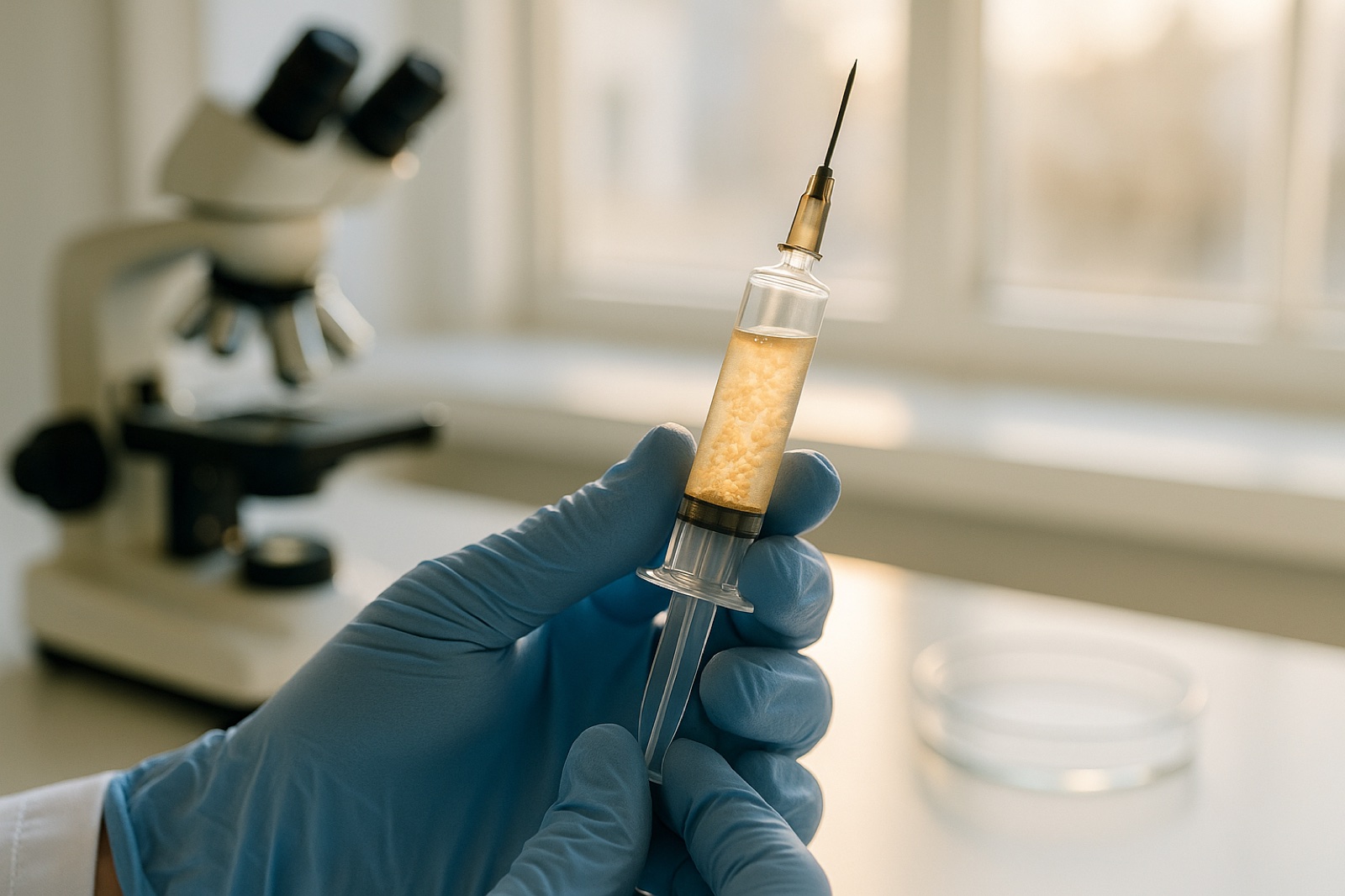
A syringe. That is the whole idea.
No operating theatre. No donor waiting somewhere on the other end of a phone call. A team at MIT has been working on injectable satellite livers — living liver cells pushed through a needle, which then settle somewhere inside the body and get on with doing liver work.
It has only been done in mice, and that matters enormously. We will come back to it. But the part worth your attention is not the needle. It is the thinking underneath it.
They are not trying to build you a new liver. They are trying to build your old one some help.
What Injectable Satellite Livers Actually Are
Start with the material, because it is genuinely strange.
The researchers make microscopic beads of hydrogel — a soft, water-heavy gel — in a device that turns them out at a uniform size and shape. Those beads get mixed with real liver cells, called hepatocytes. Packed tightly together, the mixture behaves like a liquid. That is what lets it go through a needle at all. Once it is inside the body, it recovers its solid structure and holds together as a compact little graft.
Then the body does the rest. Blood vessels grow in over the following weeks, and the graft gets its own supply line.
The team named it INSITE, for Injected Self-assembled Image-guided Tissue Ensembles. The everyday name came from the lab’s senior author, Sangeeta Bhatia. "We think of these as satellite livers," she said. "If we could deliver these cells into the body, while leaving the sick organ in place, that would provide booster function."
Leaving the sick organ in place. Hold on to that phrase.
The Word in the Paper’s Title Is Not "Liver"
This is the part that changed how I read the whole story.
The study was published in the journal Cell Biomaterials in March 2026. Its title is not about building a liver. It is about building a niche — an image-guided injectable niche for hepatocyte transplantation. A niche is a place. A home. Somewhere to live.
Vardhman Kumar, the study’s lead author, put it plainly: "What we did is use this technology to create an engineered niche for cell transplantation."
Transplanting liver cells is not a new idea. It has simply never worked very well, and the paper is direct about why. The cells fail to take hold. They do not stay where you put them. And there has been no reliable way to deliver them to a chosen spot in the first place.
Read that list again and notice what is missing from it. Nobody is saying the cells were not good enough. The cells were fine. They had nowhere to live and no way to get there.
So the fix was not a better cell. The fix was somewhere to put it. The gel beads give the cells something to hold on to, the imaging lets the doctor place the whole thing exactly where it is wanted, and supporting cells go in alongside the liver cells to help them survive and to coax blood vessels into growing toward them.
Biology keeps rewarding that kind of second look. The same instinct is what turned up an antivenom hiding in the rattlesnake’s own blood — the answer was never in a cleverer chemical, it was in looking at the problem from a different side.
They Did Not Put It in the Liver
Here is the detail I cannot stop turning over.
The cells were not injected into the liver. They went into fatty tissue in the abdomen — nowhere near the failing organ at all. The researchers note that other sites in the body could work too.
And they lived. The cells stayed viable for at least two months, which is as long as the study ran, and over that time they produced many of the enzymes and proteins a working liver produces. Blood vessels grew into the graft. It stayed put and stayed compact.
So the help did not need to be at the site of the damage. It just needed to be somewhere in the same body, connected to the same bloodstream, doing the work.
What This Study Does Not Say
Four things, and every one of them matters.
- This was done in mice. There are no human trials. Nobody has been treated with this. Nobody is about to be.
- Two months is the length of the experiment, not a measured lifespan for the graft and not a promise about how long it would last in a person.
- The immune system is still a real obstacle. The researchers say themselves that with the current version, a patient would most likely need immune-suppressing drugs. They are working on ways around it, including making the liver cells harder for the immune system to notice, or delivering the drugs locally rather than through the whole body.
- It may never be a replacement for transplant. The team’s own honest framing is that it could serve as a bridge — support that holds someone steady until a donor organ actually becomes available.
More than 10,000 people in the United States with chronic liver disease are on the waiting list right now, and waiting lists like it exist in every country that keeps one. If you or someone you love is on one, this research changes nothing about today. It would be unkind to pretend otherwise.
What it changes is the direction people are looking.
Help That Comes Alongside
Almost every instinct we have about rescue is replacement. The broken part comes out. The new part goes in. That is how we fix a car, a boiler, a phone, a knee. It is how we have thought about failing organs for most of a century, and it is why the word most people know is transplant.
This is a different shape of help entirely.
The sick organ stays. It keeps doing whatever it can still do. Something small comes and settles nearby — not in its place, not even in the same part of the body — and quietly carries the part it cannot carry anymore. The failing thing is not discarded. It is accompanied.
There is an old word for that kind of help, from a language far older than any of this. It means something close to one called to your side. Not a repair. Not a replacement. Someone who comes and stands next to you inside the thing you cannot manage, and takes the weight you were never going to lift on your own. People have used that word for God for a very long time.
It is a strange thing to find the same shape of it in a syringe.
Where That Leaves You
Probably not with a treatment. Probably with something smaller and more useful than that.
Most of the hard things in a life are not the kind you get to swap out. The diagnosis stays. The job stays. The person who is not going to change does not change. And a lot of the exhaustion in a season you cannot fix or leave comes from believing that the only real help is the kind that removes the problem — so anything less than removal feels like failure, including all the help you are actually being offered.
The mice did not get new livers. They got company for the one they had, and it was enough to keep the work going.
That is worth remembering on the days you are the one doing the carrying. If you have been holding someone else up for a long time and cannot tell anymore how much is left in you, our free caregiver burnout check takes about two minutes and is honest with you about the answer.
Unfixable and unhelpable were never the same word. Scientists have just spent several years and a great deal of money proving it in a mouse.
The full research announcement is available from MIT.
A Question Worth Sitting With
Here is what we are curious about. When you think about being helped, which version comes to mind first — someone taking the problem away from you, or someone staying beside you while you carry it? And has your answer changed over the years?
There is no wrong answer here, and you do not need a medical or religious background to have a good one. Leave a comment and tell us what you think.
If You Want to Share This
- MIT researchers injected liver cells into the belly fat of mice, not into the liver, and the cells lived for two months and did liver work. The sick organ stays. The help just comes and sits alongside it. https://bgodinspired.com/index.php/health-and-wellness/injectable-satellite-livers-helper-not-replacement/
- The paper’s title does not say liver. It says niche. The problem was never that transplanted liver cells were not good enough. It was that they had nowhere to live and no way to get there. https://bgodinspired.com/index.php/health-and-wellness/injectable-satellite-livers-helper-not-replacement/
- Unfixable and unhelpable are not the same word. Scientists just spent years proving it in a mouse. https://bgodinspired.com/index.php/health-and-wellness/injectable-satellite-livers-helper-not-replacement/
Questions People Ask
What are injectable satellite livers?
Injectable satellite livers are small grafts of living liver cells combined with microscopic hydrogel beads, developed by a team at MIT and published in the journal Cell Biomaterials in March 2026. Packed together, the mixture flows like a liquid so it can pass through a needle, then recovers its solid structure once inside the body. The aim is to add liver function while leaving the patient’s own diseased liver in place, rather than removing and replacing it.
Have injectable satellite livers been tested in humans?
No. The work published in March 2026 was carried out in mice. There have been no human trials of injectable satellite livers, and no patient has been treated with them. Anyone living with liver disease should follow the treatment plan their own medical team has given them.
Where in the body were the liver cells injected?
They were injected into fatty tissue in the abdomen, not into the liver itself. The researchers report that other sites in the body could also be used. The injected cells remained viable for at least two months, produced many of the enzymes and proteins a liver produces, and blood vessels grew into the graft to supply it.
Would a patient need immunosuppressant drugs for this?
With the current version, most likely yes. The MIT researchers state that patients would probably need immune-suppressing drugs so the body did not reject the transplanted cells. They are exploring alternatives, including engineering the liver cells to be less visible to the immune system and delivering immune-suppressing drugs locally to the graft rather than throughout the whole body.
Could this replace a liver transplant?
Not on current evidence. The researchers describe it as a possible alternative to surgery in some cases, or as a bridge that provides support until a donor organ becomes available. More than 10,000 people in the United States with chronic liver disease are waiting for a transplant, and this research does not change what is available to them today.