 0
0
 0
0
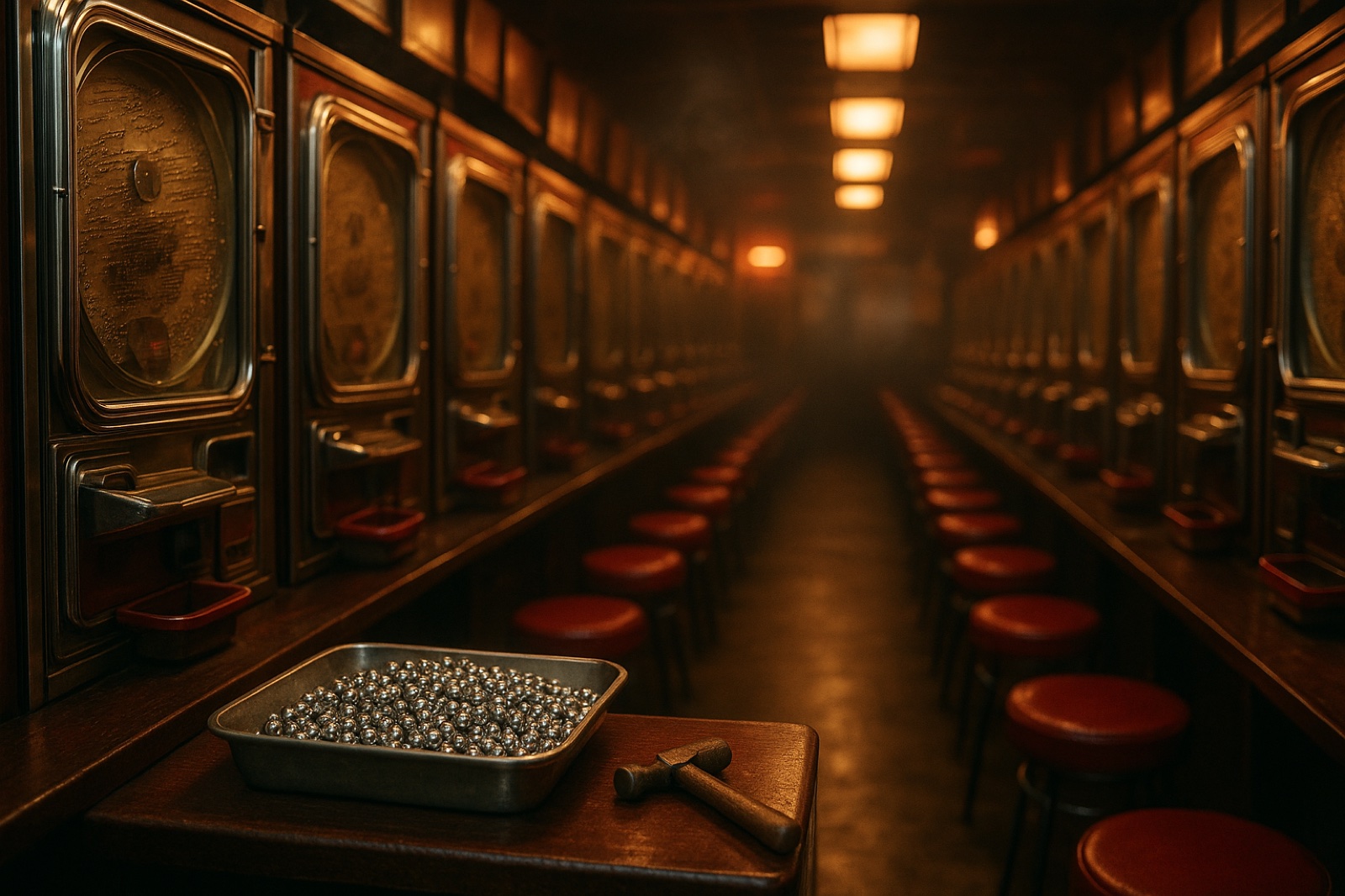
Before a pachinko parlor opens for the day, someone walks the rows with a small hammer.
The machines are packed with tiny brass pins. A steel ball drops through them and bounces down toward the pockets. Move one pin a fraction of a degree and the ball’s whole path changes. Do that across a few hundred machines and you have decided, before a single customer arrives, roughly how many people will win today. Not who. How many.
If you are looking for the Pachinko book meaning, start with that hammer. Min Jin Lee named her novel after it.
In the book, Mozasu does this every morning to his own machines, and he is not ashamed of it. It is the job. Then the doors open, and the customers come in, and most of them lose, and tomorrow they come back.
Which raises a question worth sitting with. Why is a four-generation family saga about Koreans in Japan named after a pinball machine — and why does Lee wait two-thirds of the book to use the word at all?
The Pachinko Book Meaning Is Hiding in the Table of Contents
Pachinko, published in 2017, is built in three parts, and the names of those three parts are the argument.
Book I is called Gohyang/Hometown, and it runs from 1910 to 1933. Book II is called Motherland, 1939 to 1962. Book III is called Pachinko, 1962 to 1989.
Read those titles in order and something happens.
The first two are words for a country. Hometown is Yeongdo, the small island beside the port city of Busan, where Sunja is born to Hoonie — a man with a cleft palate and a twisted foot — and Yangjin, who keep a boarding house. But 1910 is the year Korea is annexed by Japan, so the hometown is already not quite theirs when the book opens. And Hometown ends with Sunja far away from it, pregnant, married to a man she barely knows, giving birth in Osaka. The word does not survive its own section.
Motherland does worse. Book II covers the war and everything after it, and by the time that section closes there is no motherland to return to. There are two countries where one used to be, and this family belongs to neither, living in a third that will not have them. They are Zainichi — Koreans in Japan, many of them born there, raised there, and registered there as foreigners for life. Both of the words that mean home get spent.
Then Book III arrives, and the word Lee gives it is not a place at all. It is a game. It is the only one of the three names that survives to the last page, and it is the one she put on the cover.
That is the thesis, and it is sitting in the table of contents where almost nobody looks. This family does not lose a country and then find another one. They lose a country and get handed a machine.
“History has failed us, but no matter”
The novel’s first sentence is one of the most quoted opening lines of the century, and it works in two halves. The first half is an accusation. The second half is the entire personality of the book.
Lee has been unusually direct about what she meant. Speaking at the Radcliffe Institute in 2019, she said she was arguing that history has failed almost everybody — because for a historian to record a life, there have to be documents and artifacts, and where those do not exist, the life simply does not get written down. Asked who the “us” in that sentence is, she has answered: “I think it’s you and me.”
That is a startling thing to open a novel with. It tells you on page one that the story ahead is the kind that leaves no paper trail — and then spends five hundred pages generating exactly that kind of life, in detail, on purpose. The book is a document for people who were never issued one.
Chimamanda Ngozi Adichie builds a whole novel around the same anxiety from a different continent, and if you want to see the machinery up close, it is worth reading who actually gets to write the war down in Half of a Yellow Sun. Chinua Achebe was doing it decades earlier, which is part of what makes the ending of Things Fall Apart land the way it does. Lee is working the same seam, in Osaka.
Nobody in Pachinko Wins by Being Good
Here is the thing this novel does that most family sagas will not do.
Isak — Baek Isak, the sickly young minister from the north who marries Sunja and gives Noa a name — is the best person in the book. In 1939 his congregation is required to bow at a Shinto ceremony, and Hu, the church sexton, is seen mouthing the Lord’s Prayer instead of the pledge to the emperor. Isak is arrested alongside Pastor Yoo. He is released in 1942, starved and sick, and dies at home shortly after. He is destroyed over a prayer somebody else said, and Lee gives him no redemptive death scene to pay for it.
Noa is the most disciplined person in the book. Quiet, careful, works harder than anyone, wins a place at Waseda to study English literature, loves George Eliot. Then his girlfriend Akiko remarks on how much he resembles Koh Hansu, and Noa learns that his father is not Isak but a married, yakuza-connected broker who has been quietly paying his fees all along. He walks away from every part of his life. He goes to Nagano, takes a Japanese name, keeps the books at a pachinko parlor, marries Risa, has four children, and lives sixteen years as an ordinary middle-class Japanese man. When Sunja finally finds him in 1978, he speaks to her gently — and then he shoots himself.
Yoseb goes to Nagasaki for work and is burned in the bombing. Yumi, who dreamed of America, is killed by a drunk driver. Solomon, who has never lived anywhere but Japan, is fingerprinted as a resident alien on his fourteenth birthday. Later he is educated in the West, hired by a British bank, and dropped the moment his father’s world brushes against his employer’s.
The pattern is not subtle once you see it. Every character who tries to leave the parlor gets put back inside it. Virtue is not the exit. Discipline is not the exit. Education is not the exit. There is no exit, and Lee flatly refuses to write one.
This is also why the book does not read as a misery catalogue, which on paper it should. The pins are set. Everyone in the story knows the pins are set. Lee has no interest in the fantasy that a sufficiently good person can beat the machine — the same clear-eyed thing another Korean story does when the players in Squid Game are released and most of them come back anyway.
So What Is Sunja Actually Doing for Five Hundred Pages?
If winning is off the table, the question becomes what endurance is for. And Lee answers it, consistently — just very quietly, and never with a payoff.
Watch what the novel rewards.
At sixteen, pregnant and out of options, Sunja is offered everything by Hansu. A house. Money. Her child provided for. Security for her mother. The single condition is that she be his Korean wife while he keeps his Japanese one. She says no. It is the worst financial decision anyone makes in the entire book, and the novel treats it as the moment she becomes a person.
After that: she and her sister-in-law Kyunghee sell kimchi at the market in Ikaino through the war years, and later candy, and Lee describes that work with more attention and dignity than she gives any man’s career in the book. Sunja takes in Yoseb after Nagasaki and nurses him for years. She raises Mozasu’s son after Yumi is killed.
None of it accumulates into a victory. That is the design. The novel’s currency is not outcome — it is refusing to let go of the person next to you, inside a system built so that letting go would be the reasonable move.
That is a much harder thing to build five hundred pages on than triumph. And it is what makes the last scene work.
The Last Thing Sunja Finds Out
At the end of the book Sunja is an old woman, and she goes to Isak’s grave in Osaka.
The groundskeeper mentions, in passing, the way you mention something ordinary, that her son used to come here. Regularly. For years. Even while he was living in Nagano under another name, the son who cut every thread back to her had been driving to this grave and standing at it.
She never knew. She was never going to know. She only knows now because a man who tends the grass happened to say so.
Then she kneels and buries a photograph of Noa in the dirt.
That gesture is the whole novel compressed into about four seconds. A life of unrecorded, undocumented, unrewarded faithfulness — precisely the kind of life the first sentence warned us history would fail to write down — turns out to have had a witness the whole time. Not a rescuer. A witness.
The oldest version of that idea we have is about a woman standing in almost exactly Sunja’s position. Hagar is a foreign servant, pregnant by a man who already has a wife, pushed out into a country that is not hers, with no standing, no protection and no document to her name. Nobody is writing her down either. And what she says, out there in the emptiness, is that she has been seen. She gives God a name for it — the God who sees me (Genesis 16:13).
She is not lifted out of the situation. She is seen inside it. That is a far stranger comfort than rescue, and it is the exact comfort the final page of Pachinko is offering Sunja.
And the Parlors Are Still Open
The book ends, and nothing about the machine has changed.
Somewhere in Osaka a man is walking the rows with a small hammer, tapping the pins a fraction of a degree, deciding how many people will win today. In an hour the doors open. Customers come in knowing perfectly well that the machines have been adjusted, because everyone knows, and they sit down and play anyway.
Lee does not frame that as stupidity. She does not frame it as courage either. It is simply what this family was given instead of a country. You do not get to choose the machine. You get to choose whether you keep showing up to it, and who you sit beside while you do.
That, and the outside chance that the whole time you were sure nobody was watching, somebody was.
Over to You
Here is the one I keep going back and forth on. Were Noa’s sixteen years in Nagano a real life, or a hiding place?
He had a wife, four children, work he was good at, and a name he chose for himself. Lee gives us almost no interiority for those years — we mostly watch them from outside, at a distance. So did he genuinely build something and lose it the second his mother walked through the door? Or was it always going to end that way, and the sixteen years were borrowed from the start?
Tell me what you think in the comments — I would genuinely like to hear it.
Questions People Ask About Pachinko
What is the book Pachinko actually about?
Pachinko by Min Jin Lee follows four generations of one Korean family living in Japan, from 1910 to 1989. It begins with Sunja, a teenage girl in the fishing village of Yeongdo near Busan, who becomes pregnant by a married broker named Koh Hansu, refuses to become his second wife, and instead marries a young minister named Isak who takes her to Osaka. On the surface it is a family saga. Underneath, it is a book about the Zainichi — Koreans who were born and raised in Japan but registered there as foreigners — and about what endurance is worth in a system that is not built to let you win.
What does the title Pachinko actually mean?
Pachinko is a Japanese arcade gambling game, something like an upright pinball machine, where steel balls fall through a field of small brass pins. Parlor operators adjust those pins to control how many players win, which is why the game works as the novel’s central image. It is also literal history: Koreans in Japan were shut out of most professions, and the pachinko industry became one of the few places they could build real wealth. In Min Jin Lee’s novel, the word is also the title of the third and final section — the first two sections are named Hometown and Motherland, and neither of those survives the story.
What happens at the end of Pachinko?
At the end of Pachinko, Solomon walks away from his career at a British bank and decides to join his father Mozasu in the pachinko business — the industry his family spent three generations trying to escape. In the closing scene, an elderly Sunja visits Isak’s grave in Osaka and learns from the groundskeeper that her estranged son Noa had visited the grave regularly for years, even while living under a Japanese name in Nagano, and she never knew. She buries a photograph of Noa in the dirt at the grave.
Why does Noa die in Pachinko?
Noa dies by suicide in 1978, shortly after his mother Sunja finds him in Nagano. Years earlier he had discovered that his biological father was not Isak, the minister who raised him, but Koh Hansu, a married broker with yakuza ties. Noa had spent his whole life trying to be beyond reproach as a Korean in Japan, and he could not survive the idea that his blood came from a criminal. He left Waseda University, took a Japanese name, and built sixteen years of an ordinary life in which nobody knew who he was. Sunja finding him ended the one thing that had made that life possible, which was that no one from before could see him.
Is Pachinko based on a true story?
The family in Pachinko is fictional, but the history around them is not. The Japanese annexation of Korea in 1910, the wartime labor conditions, the bombing of Nagasaki, the division of Korea, the alien registration and fingerprinting of Korean residents born in Japan, and the Korean dominance of the pachinko industry are all real. Min Jin Lee first encountered the subject as a student in 1989, began a draft in the mid-1990s and abandoned it, and then lived in Japan from 2007 to 2011, where she interviewed Zainichi Koreans and rewrote the novel from the ground up.
Share This
Just realized Pachinko names its three sections Hometown, Motherland, and Pachinko — in that order. Two words for a country, then a word for a game. The family doesn’t lose a homeland and find another one. They lose it and get handed a machine.
The quietest, most devastating thing in Pachinko: Sunja only finds out at the very end that Noa had been visiting his father’s grave for years. She spent her whole life not knowing she was seen. Not rescued. Just seen.
Nobody in Pachinko wins by being good. Isak is the kindest man in the book and dies first. Noa is the most disciplined and dies worst. Min Jin Lee absolutely refuses to write an exit, and that’s exactly why the ending hits.