
 0
0
 0
0
The first explicit Messianic declaration in the Gospel of John wasn’t given to the disciples. It was given to the last person anyone would have expected.
There is a question that sounds like it should have an obvious answer.
Who did Jesus first tell he was the Messiah?
Take a moment with it before you answer. Most people’s minds go to Peter — the rock, the first among the disciples. Or maybe John, the beloved one. Perhaps Nicodemus, the Pharisee who came seeking Jesus at night in Jerusalem. Or one of the synagogue leaders — someone religious, respected, who would have understood the weight of the declaration.
The actual answer is buried in the middle of a scene most people skip over on their way to the Sermon on the Mount. But if you slow down and look at it — really look at it — you’ll find one of the most deliberate choices in all four Gospels. And it says something about the Kingdom of God that nothing else quite says the same way.
To find it, you need to follow Jesus to a place no respectable rabbi would have gone. And meet the person he was looking for when he got there.
The Road Nobody Took
John 4 opens with a detail that would have stopped any first-century reader cold: “He had to go through Samaria” (John 4:4).
The Greek word translated “had to” is dei — a word John uses throughout his Gospel for divine necessity. Not convenience. Not geography. Not the most direct route on a map. Necessity. The same word used for things that must happen because God has ordained them.
Every Jewish person of the time knew you didn’t have to go through Samaria. Most didn’t. The mutual contempt between Jews and Samaritans ran so deep — a 700-year-old wound that included the Assyrian conquest, rival temples, and the destruction of the Samaritan temple on Mount Gerizim by Jewish forces in 128 BCE — that Jewish travelers routinely added hours to their journey just to avoid Samaritan territory. They would cross the Jordan River, travel the longer eastern route, and cross back again. Going around was normal. Going through was a statement.
Jesus took the direct route through the middle of enemy territory. And John wants us to know from the first sentence: this wasn’t an accident.
The Woman No One Saw Coming
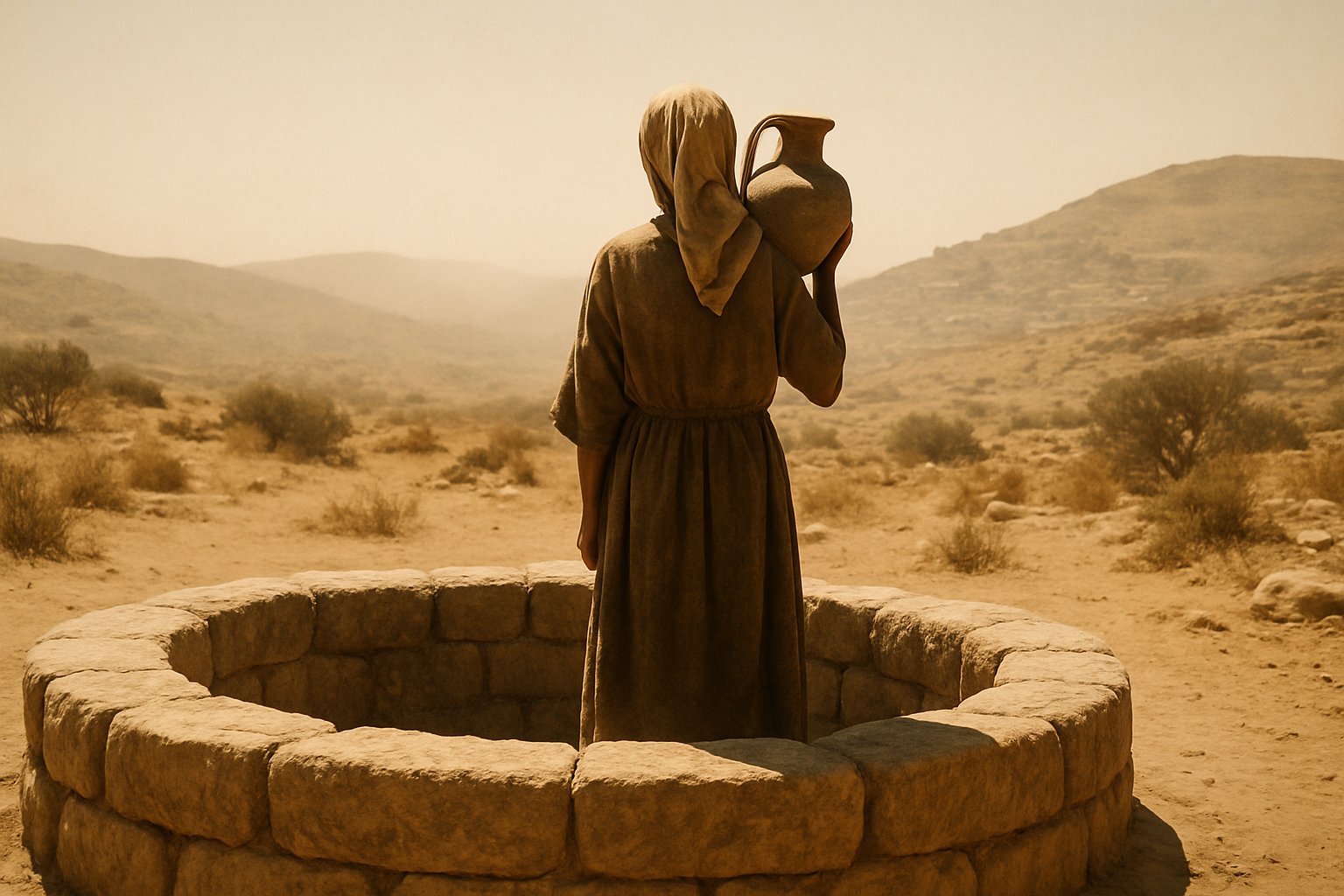
He arrives at Jacob’s Well near the town of Sychar, tired from the journey. It’s midday. His disciples go into town to buy food. And there, at a stone well in the middle of Samaria, a woman comes to draw water.
It is noon.
That single detail carries more weight than it first appears. Water was drawn at wells in the morning and the evening — the cool hours, when it was a communal act, when the women of the village gathered together, when relationships happened and news traveled. Drawing water alone at noon, in the heat of the day, was not a practical choice. It meant one of two things: you had been excluded from the community’s rhythm, or you were deliberately avoiding it.
She is already, by the metrics of first-century Jewish religious culture, the wrong ethnicity. Samaritan. But the layers keep coming.
When Jesus speaks to her — simply asks her for a drink — she is startled. “How is it that you, a Jew, ask for a drink from me, a woman of Samaria?” (John 4:9). John adds a parenthetical: “For Jews have no dealings with Samaritans.”
She’s right to be surprised. A rabbi speaking privately and directly to an unrelated woman was scandalous by the standards of the day. Which is why John 4:27 — the moment the disciples return and find Jesus deep in conversation with her — records their reaction this way: “They were amazed that he was talking with a woman.”
Not a Samaritan. A woman. The gender barrier was more jarring to them than the ethnic one.
What the Conversation Reveals About Who This Is
The conversation unfolds slowly. Jesus offers her living water — water that would become “a spring of water welling up to eternal life” (John 4:14). She wants this. She asks for it. And then Jesus says something that stops the exchange entirely.
“Go, call your husband, and come here.”
“I have no husband,” she says.
“You are right in saying, ‘I have no husband’; for you have had five husbands, and the one you now have is not your husband. What you have said is true.” (John 4:16–18)
This is the moment that has been used, over centuries, to reduce this woman to her history. To make her a cautionary tale. But look carefully at what Jesus actually does here: he states her situation factually. He does not lecture her. He does not moralize. He does not use what he knows to disqualify her from the conversation or withhold what he’s offering. He states it — and keeps going.
It’s worth sitting with what five husbands actually meant in that world. Women in first-century Jewish and Samaritan culture could not initiate divorce. Five husbands could mean widowhood, abandonment, Levirate marriage obligations under Jewish law, or other circumstances entirely beyond her control. The text gives us no details. Jesus doesn’t ask — because the details are not the point.
She recognizes something in him: “Sir, I perceive that you are a prophet” (John 4:19). And she does what people often do when they’ve just been completely seen by a stranger: she moves the conversation toward safer, more theoretical ground.
She raises the oldest dispute between Jews and Samaritans — whether the proper place to worship God is the Samaritan holy site at Mount Gerizim or the Jewish temple in Jerusalem. A theological question. Impersonal. A debate that had been running for centuries and carried no personal stakes for her in this moment.
Jesus doesn’t deflect. He tells her the hour is coming when true worship won’t be about either mountain — that “true worshipers will worship the Father in spirit and truth, for the Father is seeking such people to worship him” (John 4:23). The Father is seeking such people. Not waiting. Seeking.
And then she says the thing that opens the door completely:
“I know that Messiah is coming (he who is called Christ). When he comes, he will tell us all things.” (John 4:25)
She is not making a theological argument. She is expressing something closer to longing. Whatever her life has been — the five husbands, the noon-hour isolation, the centuries of mutual contempt between her people and his — she is still holding onto the expectation of someone who would come and explain everything. Who would make sense of all of it.
Jesus responds with ten Greek words that carry the weight of Exodus 3.
The Ten Words
“Ἐγώ εἰμι, ὁ λαλῶν σοι.”
“I, the one speaking to you — I am he.”
The phrase is ego eimi — the same divine name God spoke from the burning bush when Moses asked who was sending him. “I AM WHO I AM” (Exodus 3:14). It is the name that carries the full weight of divine identity in the Hebrew and Greek scriptures.
John uses this phrase across his entire Gospel for the great declarations of Jesus: “I am the bread of life.” “I am the light of the world.” “I am the door.” “I am the good shepherd.” “I am the resurrection.” “I am the vine.” “Before Abraham was, I am.”
This is where that pattern begins. John 4:26 is the first time in the entire Gospel of John that Jesus speaks ego eimi directly to another person as a plain, unambiguous declaration of who he is.
And he says it to her.
Who Jesus First Told He Was the Messiah — and What That Choice Reveals
In the Gospel of John, nothing happens by accident. John was a careful and deliberate writer. The structure of his Gospel is intentional from the first word — “In the beginning”, a deliberate echo of Genesis — to the last. Details are not decorative. They are arguments.
So notice what John is telling us by placing the first explicit Messianic declaration here, in this scene, with this person.
Not with the disciples — the twelve men who had already committed their lives to following Jesus.
Not with Nicodemus — the Pharisee, the member of the Jewish ruling council, the man of Israel who had come to Jesus at night seeking truth.
Not in Jerusalem, the center of Jewish religious life, the holy city, the place every Jewish heart turned toward in prayer.
Not even with a respected woman, a woman of standing, the kind whose word would carry weight in her community.
Jesus chose a Samaritan woman who was drawing water alone at noon because her community — even her own people — had become a place she avoided. A woman with five former husbands and a current situation the whole village knew about. The most disqualified person in the scene by every standard of first-century Jewish religious culture.
To her, first, he said: I am he.
This is not incidental. This is not Jesus stumbling into a conversation and making the best of it. John 4:4 told us at the start: he had to go through Samaria. Divine necessity. He crossed enemy territory deliberately. He sat down at a well in the heat of noon. He sent the disciples into town. And when this particular woman arrived, he told her what he had not yet told Peter, James, or John.
The choice is the declaration. It is a statement about who the Kingdom of God is for.
What She Did Next
John 4:28–29: “So the woman left her water jar and went away into town and said to the people, ‘Come, see a man who told me all that I ever did. Can this be the Christ?'”
She forgot her water jar. The object she had come to fill — the thing that would have anchored her story as the woman who drew water alone — she left it at the well.
She went back to the community she had been hiding from. The people she had been drawing water at noon specifically to avoid seeing.
And she brought them to Jesus.
John 4:39: “Many Samaritans from that town believed in him because of the woman’s testimony.”
The person who had been invisible — the noon-hour woman, the one with too much history, the wrong ethnicity, the wrong everything — became the first person in the Gospel of John to successfully bring a community to faith in Jesus. Not a disciple. Not a synagogue leader. Not a man of Israel.
The woman who had been avoiding the community at noon brought the whole community to Jesus by sundown.
What This Means for the Person Who Feels Disqualified
There’s a reason this story finds the people it finds.
If you have ever felt too disqualified to be seen by God — too far gone, too complicated, too much history, too aware of the gap between where you are and where you think you should be — this scene was constructed specifically for you.
Jesus didn’t choose the Samaritan woman in spite of her situation. He didn’t overlook it to find something worthwhile underneath. He chose her as she was, in the place she had retreated to, in the middle of the noon hour she had carved out to be invisible.
He traveled through enemy territory — dei, divine necessity — to get there. He waited. And he chose her for the most significant disclosure in the Gospel of John: who he was.
Not because she had the right credentials. Not because she had cleaned up her situation first. Not because she had the right background, the right community standing, the right religious lineage. The Kingdom doesn’t work that way. The woman at the well is John’s first and clearest argument that it never did.
If you’ve been wondering whether God notices you — whether, given your history and your situation and the gaps in your life, there’s room for you in any of this — the answer is sitting in John 4, at a well in Samaria, at noon.
He went through Samaria on purpose. He sat down and waited. And when she arrived, carrying every reason the world had given her to believe she didn’t belong in a conversation like this, he told her first.
That is not an accident. That is a declaration about how the Kingdom works — and who it works for.
If you’re just beginning to wonder whether God is real, or whether He actually sees you, or what it even means to feel His presence in your life — we put together a free resource called the Beginner’s Guide to Feeling God’s Presence for exactly that moment. No pressure. No prerequisites. Just a door, if you want to walk through it. You can find it here.
Actions to Take
- Read John 4:1–42 in one sitting — the full chapter, without stopping to study. Let the story unfold the way a first-time reader would experience it. Notice what surprises you.
- Write one honest sentence about something in your own history that you’ve been treating as a disqualifier — from God, from community, from something you’ve wanted but assumed wasn’t for you. Just name it. You don’t have to do anything with it today.
- Find the person in your life who draws water at noon — the one on the edges, the one who seems to be avoiding the room when everyone else is in it. This week, go toward them instead of waiting for them to come toward the group.
Journaling Prompts
- When you picture what it would feel like to be truly seen by God — not just acknowledged, but genuinely known — what does that look like? What would have to be true for you to believe that’s actually available to you?
- What is the thing in your history that you most expect would disqualify you from God’s attention or care? Where did that belief come from — and who taught it to you?
- The Samaritan woman went back to the exact community she had been avoiding. If you received the same encounter she did — if Jesus told you, at your particular noon hour, who he was — what would you go back toward that you’ve been avoiding?
Prayer
God, I’ve been keeping a list in my head of all the reasons You might not have time for me. The history. The situation. The noon hour I retreat to when I don’t want to be seen. If You went through Samaria on purpose — if the detour was for her — I’m asking You to let that be true for me too. I’m not cleaned up. I’m not ready. I’m at the well. And I’m right here.
Discussion Question
Do you think most people believe God is paying personal attention to their specific life — or do they believe in God in a general sense but quietly assume He’s focused on more important things? I’d love to hear your take in the comments.
Frequently Asked Questions
Who did Jesus first tell he was the Messiah?
The first person Jesus explicitly told he was the Messiah was a Samaritan woman at Jacob’s Well — recorded in John 4:25–26. When she mentioned that she knew the Messiah was coming, Jesus responded: ‘I, the one speaking to you — I am he.’ This was the first explicit, unambiguous Messianic declaration in the Gospel of John. What makes it remarkable is who he said it to: a Samaritan woman — the wrong ethnicity, the wrong gender by first-century religious standards, alone at the well at noon with a complicated personal history — and not to any of his twelve disciples, the Pharisees, or Jewish religious leaders.
What does ego eimi mean in John 4:26?
Ego eimi (ἐγώ εἰμι) is Greek for ‘I am’ — and in John’s Gospel, the phrase carries deliberate weight. It echoes God’s self-identification to Moses in Exodus 3:14: ‘I AM WHO I AM.’ John uses ego eimi throughout his Gospel for the seven great ‘I am’ declarations of Jesus — ‘I am the bread of life,’ ‘I am the light of the world,’ ‘I am the resurrection,’ and others. John 4:26 is where this pattern begins — the first time Jesus speaks ego eimi directly to another person as a plain declaration of who he is, without metaphor or parable.
Why did Jesus go through Samaria in John 4?
John 4:4 says Jesus ‘had to go through Samaria,’ using the Greek word dei — which John reserves for divine necessity, not geographical convenience. Most Jewish travelers of the time deliberately avoided Samaria, taking a longer route around it because of the centuries-long hostility between Jews and Samaritans. Jesus chose the direct route through enemy territory. John signals to his readers that this was intentional: he went through Samaria because someone was waiting there — a Samaritan woman at a well at noon — and the encounter was by design, not accident.
What happened to the woman at the well after she met Jesus?
After Jesus told the Samaritan woman he was the Messiah, she left her water jar at the well and went back into town — the same community she had apparently been avoiding by drawing water alone at noon. She told the townspeople: ‘Come, see a man who told me all that I ever did. Can this be the Christ?’ (John 4:28–29). John 4:39 records that ‘many Samaritans from that town believed in him because of the woman’s testimony.’ The person who had been hiding from her community at noon became the first individual in the Gospel of John to successfully bring a whole community to faith in Jesus.
Why did Jesus tell the woman at the well he was the Messiah before telling his disciples?
The Gospel of John doesn’t give a direct explanation, but the pattern John creates is unmistakably intentional. In a Gospel where nothing is accidental, the first explicit Messianic declaration (ego eimi) goes to the most socially disqualified person in the scene: a Samaritan woman with a complicated history, drawing water alone at noon because her own community had become a place she avoided. Biblical scholars suggest John is making a deliberate theological argument about who the Kingdom of God is for. The person Jesus chose to tell first was the person every religious and social system of the day would have placed last in line — and she became the first evangelist in John’s Gospel.




One thought on “Jesus Told One Person He Was the Messiah — You’ll Never Guess Who He Chose First”
Leave a Reply
You must be logged in to post a comment.
[…] behind her and every social mark of someone the world had already written off. He chose her. That story is worth reading on its own. The pattern was already […]