 0
0
 0
0
There’s a version of you that only a few people know about.
Maybe it’s one night. One year. One habit you kept quiet. And every so often someone says something — not even on purpose — that walks right up to the edge of it, and your stomach drops.
The woman in John 8 doesn’t get a quiet stomach drop. Her worst moment gets dragged into a temple courtyard, in daylight, in front of a crowd.
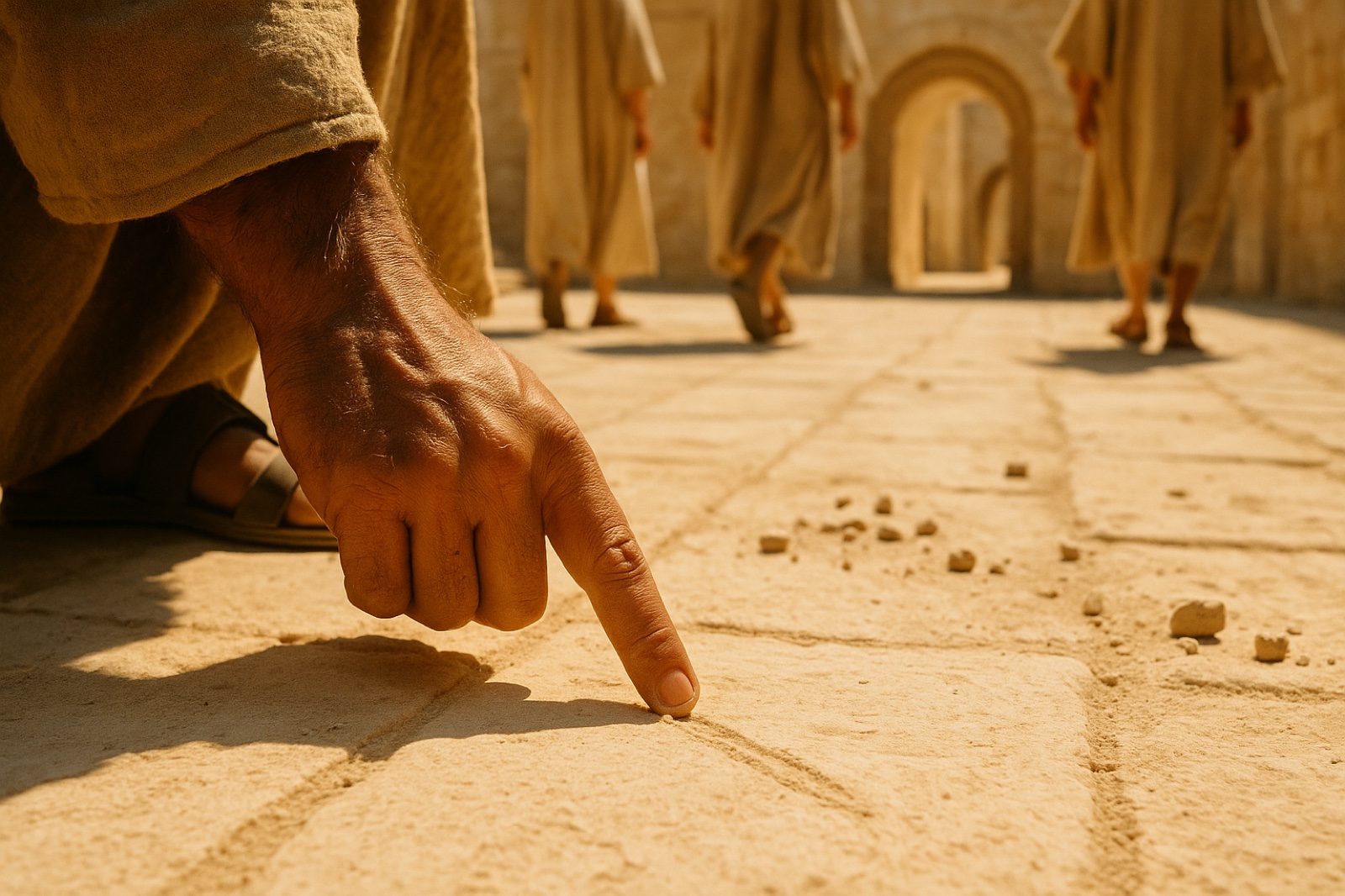
And Jesus kneels down and starts writing in the dirt. What did Jesus write in the sand? Two thousand years later, nobody knows.
I think that’s on purpose. And I think it’s the most merciful thing in the whole story.
What Did Jesus Write in the Sand?
Let’s be honest right up front: nobody knows.
Not a scholar. Not a pastor. Not one of the thousands of articles written about it. John says it plainly and then just keeps walking:
“But Jesus stooped down, and with his finger wrote on the ground, as though he heard them not.” (John 8:6, KJV)
That’s all we get. No content. No transcript. This is the only time in all of scripture that Jesus is recorded writing anything — and the words themselves are gone.
People have guessed for twenty centuries. Some say He wrote the sins of the men holding the rocks. Some say He wrote a line from the prophets. Some say He wrote nothing readable at all and was simply making them wait. Every one of those is a guess wearing the costume of an answer.
I’d rather hand you something better than a guess. Because the missing words are not a hole in the story. They are the story.
The Trap Was Never Really About Her
Before the writing, there’s the setup. And the setup tells you what kind of room this was.
The scribes and Pharisees bring her in and announce she was caught “in the very act.” Which raises a question nobody in that courtyard asks out loud: where is the man? The law they’re quoting required both people. Only one got hauled to the temple.
She wasn’t the target. She was the tool.
John tells us exactly why they did it: “This they said, tempting him, that they might have to accuse him” (John 8:6). It was a trap with two jaws. Tell them to stone her, and Jesus is picking a fight with Rome, which alone held the power to execute. Tell them to let her go, and He’s a teacher who just waved off the law of Moses in public.
Either answer ends Him. That was the point. They needed a body standing in the middle of the circle to make the trap work, and hers was available.
So there she stands. Guilty, probably. Terrified, certainly. And completely beside the point to every man in the room holding a stone.
He Wrote It Where It Could Not Last
Now watch what Jesus actually does, because the details are doing real work.
He doesn’t argue. He doesn’t defend her. He doesn’t lecture them about their own hypocrisy — not yet. He stoops down. He gets low, below the eye level of every accuser in the courtyard, down where she is.
And He writes on the ground.
Pay attention to the surface. Not a scroll. Not parchment. Not stone — and stone is what God used at Sinai, words carved to outlast the people who received them. This time, dust. A surface a breeze undoes. A surface a sandal scuffs out. By evening there would be nothing left to read.
Then He stands up and says the sentence everyone remembers:
“He that is without sin among you, let him first cast a stone at her.” (John 8:7, KJV)
And then — this is the part people skip — He kneels back down. “And again he stooped down, and wrote on the ground” (John 8:8). He doesn’t stand there watching them squirm. He goes back to the dirt and gives them the dignity of leaving without being stared at.
They leave. All of them. And John records how: “beginning at the eldest, even unto the last.”
The oldest ones went first. Read that again. The men who had lived the longest had the longest list — and they were the first to know it.
The One Thing Jesus Wrote, Nobody Kept
Here’s what stopped me cold.
The single time in recorded history that Jesus writes something down, nobody preserved it. John was standing close enough to watch the finger move through the dust. He still doesn’t tell us the words.
Now put that inside this specific story.
This is a story about a woman whose private record got read out loud in public. Her accusers showed up holding her file, ready to recite it. And in the middle of that, Jesus writes something — and the writing does not survive. It goes into a surface that physically cannot hold it.
The only words Jesus ever wrote, He wrote where they could not last.
That’s not a missing detail. That’s a demonstration.
Because when the courtyard finally empties and it’s just the two of them, look at what He says — and more importantly, what He never says:
“Woman, where are those thine accusers? hath no man condemned thee? She said, No man, Lord. And Jesus said unto her, Neither do I condemn thee: go, and sin no more.” (John 8:10-11, KJV)
He never reads her list back to her. He never makes her say it out loud. He never summarizes the charge “for the record.” He doesn’t require a confession, an explanation, or a performance of shame before the mercy shows up.
Her accusation is gone. Whatever He wrote is gone. Both of them went into the dust on the same afternoon.
And honestly? If we had those words, we would have ruined them. We’d have framed them, embroidered them, printed them on mugs, and argued about them for centuries. Instead we were handed the thing that actually matters: a record that didn’t survive the day.
The withholding is the answer. Scripture refuses to tell us what He wrote, and that refusal is the sermon.
What This Means for the File You’re Carrying
You have a file. Most of us do.
It’s the thing you’d have to explain if someone really got close. The reason you flinch a little when a conversation turns honest. It doesn’t come up often. It just sits there, and every so often it opens itself and reads a page to you at two in the morning.
Here’s the test John 8 gives you, and it’s a simple one.
The voice that keeps reading your record out loud is not the voice of Jesus.
Jesus had every legal right to recite her charge. He had the standing. He was the only person in that courtyard qualified to throw something. And what He did instead was kneel down and write where the words wouldn’t keep.
So when a voice in your head says remember what you did, remember what you did — you can ask a very clarifying question: whose voice is this? Because it isn’t coming from the One who knelt in the dirt. If you’ve ever wondered why you can’t seem to forgive yourself even after you’ve prayed about it a hundred times, that question is usually where the answer starts.
And if some part of you is quietly certain you’re the exception — that everyone else gets the dust but your file is written in stone — that’s worth sitting with too. It’s the same doubt behind the question am I too far gone for God to forgive me. The woman in John 8 was caught in the act, with witnesses, in front of the religious authorities of her city. If there were a line, she was past it. She still walked out of that courtyard uncondemned.
Notice, too, that mercy didn’t cancel the future. “Go, and sin no more” is not a threat tacked onto the end — it’s what freedom sounds like when it’s handed to someone who expected a funeral. He doesn’t send her back to the life that put her in that circle. He sends her somewhere better, without a chaperone and without a probation officer.
That’s what grace does. It clears the record and trusts you with tomorrow.
If watching Jesus handle a person like that makes you want more of Him — not more rules, more Him — the whole story is worth reading straight through. We put together the complete Book of Matthew as a free immersive PDF and a 28-chapter audiobook you can listen to on a commute or a walk. It’s the same Jesus you just watched kneel in the dust, twenty-eight chapters of Him, at no cost. That’s the natural next step from here.
Actions to Take Today
- Write it in the dust yourself (2 minutes). Take a scrap of paper and write the one line your file keeps reading to you. Not a paragraph — one line. Then tear it up and throw it away, saying out loud, “Neither do I condemn thee.” Physical actions land in a way thoughts don’t.
- Name the voice (3 minutes). Next time the accusation shows up, stop and finish this sentence honestly: “This voice sounds like ______.” A parent. A church. An ex. Yourself at nineteen. Whoever it is, it isn’t Jesus — and naming it takes most of its authority away.
- Read John 8:1-11 out loud, slowly. Ten minutes, in the actual Bible, not a summary. Read it as if you’re the one standing in the middle. If you’re not sure where your heart is right now, our free Bible Verse for How I Feel tool will point you to a passage that meets you where you actually are today.
Journaling Prompts
- If Jesus had written something in the dust in front of you today, what are you most afraid it would have said — and what does that fear tell you about the God you think you’re dealing with?
- Whose forgiveness are you still waiting for before you’ll let yourself feel forgiven?
- The accusers walked away oldest first. What have you gotten old enough to finally admit about yourself?
A Prayer for the Record You Still Carry
God, I know what’s in my file, and most days I’d rather nobody read it — including me. I’ve asked to be forgiven so many times that I’ve started to wonder if the asking is the problem. Help me believe that You already knelt down and wrote it somewhere it can’t last. Quiet the voice that keeps reading it back to me, because I’m tired and I don’t think that voice is Yours. Teach me what “go, and sin no more” is supposed to feel like when it’s said kindly. Amen.
Discussion Question
Why do you think God chose to preserve the fact that Jesus wrote, but not a single word of what He wrote? Share your take in the comments — I read them, and this one is worth talking about.
Share This
- The only time Jesus is recorded writing anything, He wrote it in dust — inside a story about a woman’s record being erased. Nobody kept the words. I don’t think that’s an accident.
- He had every right to read her list out loud. He knelt down and wrote in the dirt instead. That’s the God I’m trying to believe in on my worst days.
- “Neither do I condemn thee.” No recap of the charge. No confession demanded. No conditions. Just gone. (John 8:11)
Questions People Ask About What Jesus Wrote in the Sand
What did Jesus write in the sand in John 8?
Scripture doesn’t say, and no reliable source has ever known. John 8:6 records that Jesus “stooped down, and with his finger wrote on the ground,” and John 8:8 says He did it a second time — but the text never gives the content. Anyone who tells you with certainty what the words were is offering a theory, not a fact.
What are the most common theories about what He wrote?
The popular ones are that He listed the accusers’ own sins, that He wrote out a passage from the prophets about those who turn away being “written in the earth,” or that He wrote nothing meaningful and was simply refusing to react to the pressure in the room. All three are guesses. None can be proven, and the passage itself shows no interest in settling it.
Why did Jesus write on the ground instead of just answering?
The text doesn’t explain, but the choice of surface is striking. Stooping put Jesus below the eye level of the accusers and down at the level of the accused. And dust is the one writing surface that guarantees the words won’t survive the day — a fitting choice inside a story where a woman’s record is erased in front of the people holding it against her.
Is the story of the woman caught in adultery actually in the Bible?
Yes — it appears in John 7:53-8:11 in virtually every Bible you’ll pick up. It’s worth knowing honestly that some of the earliest surviving manuscripts don’t include it, which is why many Bibles add a footnote about it. Christians have read, preached, and treasured this passage for many centuries, and everything it shows about Jesus lines up completely with how He treats people everywhere else in the Gospels. It’s a footnote worth knowing, not a reason to lose sleep.
What does John 8 teach about shame and forgiveness?
That Jesus doesn’t require you to recite your worst moment before mercy arrives. He never read the woman’s charge back to her, never demanded a confession in front of the crowd, and never referenced it again. His words were “Neither do I condemn thee: go, and sin no more” (John 8:11) — a clean record and a trusted future, handed over in the same breath.