 0
0
 0
0
There is usually one moment in a person’s life that others still bring up.
Maybe you fell apart in front of everyone. Maybe you asked the wrong question at the wrong time, in front of the wrong people. You have grown since then. You are not that person anymore. But the story got told enough times that it set like concrete, and now it is simply who you are to people.
A man named Thomas knows the feeling. The whole world calls him doubting Thomas, and his label has held for two thousand years. Almost nobody has checked it against the record.
So let’s check it.
The Phrase “Doubting Thomas” Is Not in the Bible
Read the Gospel of John from beginning to end and you will not find the words “doubting Thomas” anywhere in it. Not from Jesus. Not from John. Not from any of the other disciples.
The nickname came into common English long after the Gospel was written, and it stuck so well that it now travels further than the story it came from. People who have never opened a Bible use it in ordinary conversation.
What the Gospel actually says about this man is different. In one place it is close to the opposite.
He Volunteered to Die While the Others Argued About the Risk
The scene is John chapter 11.
Jesus has just been in Judaea, and it went badly. The crowd there “took up stones again to stone him” (John 10:31), and he got out. Then word comes that his friend Lazarus is sick, in Bethany — which John notes is only about fifteen furlongs from Jerusalem, roughly three kilometres. Under two miles. Which is to say: right back in the middle of the danger.
Jesus says, “Let us go into Judaea again.”
The disciples push back straight away:
“His disciples say unto him, Master, the Jews of late sought to stone thee; and goest thou thither again?” — John 11:8
That is a fair question. It is also a stalling question. They are counting the risk out loud and hoping he hears it.
Jesus tells them plainly that Lazarus is dead, and that they are going anyway.
And then one man speaks.
“Then said Thomas, which is called Didymus, unto his fellowdisciples, Let us also go, that we may die with him.” — John 11:16
Read that again slowly.
He is not asking for a guarantee. He is not asking for the risk to be lowered first. He has done exactly the same sum the others did, reached the same conclusion they did — this could get us killed — and come out the other side with a different answer. Fine. Then we die too. But we go.
That is the bravest line in the chapter, and it belongs to the man we nicknamed the doubter.
By the way, “Thomas” is not really a first name in the way we use them. John twice points out that he was “called Didymus,” a Greek word meaning twin. The man everyone remembers by a nickname was already known by one.
The Verse Everyone Quotes Exists Because Thomas Admitted He Was Lost
Here is the part that almost never gets mentioned, and it is the thing that changed how I read him.
Later, at the last meal, Jesus is comforting the disciples. He tells them he is going somewhere to prepare a place for them, and then says: “And whither I go ye know, and the way ye know” (John 14:4).
Everyone in that room nods along. Everyone except one.
“Thomas saith unto him, Lord, we know not whither thou goest; and how can we know the way?” — John 14:5
The very next sentence is one of the most quoted lines in the entire Bible:
“Jesus saith unto him, I am the way, the truth, and the life: no man cometh unto the Father, but by me.” — John 14:6
Sit with the order of that for a second. The answer millions of people have built their faith on exists because somebody in the room was willing to say he did not understand.
The others were just as lost. They stayed quiet. Thomas asked — and the asking pulled out an answer the world has been repeating ever since.
That is the pattern with him. Every time Thomas opens his mouth in John’s Gospel, he says out loud the thing everyone else is only thinking.
What Thomas Actually Asked For in John 20
Now the famous scene. And there is a detail sitting four verses before the part everybody quotes that changes the whole thing.
On the evening of the resurrection, Jesus comes and stands among the disciples in a locked room. Then this:
“And when he had so said, he shewed unto them his hands and his side. Then were the disciples glad, when they saw the Lord.” — John 20:20
Nobody asked. Jesus showed them the wounds without being requested to, and their gladness came after they saw. Seeing is how they believed too.
Thomas was not in the room that night (John 20:24). We are never told why. So the others tell him afterwards: we have seen the Lord. And he answers:
“Except I shall see in his hands the print of the nails, and put my finger into the print of the nails, and thrust my hand into his side, I will not believe.” — John 20:25
Let’s be precise here, because precision cuts both ways. Thomas asked to see exactly what the others had already been shown for free — and he asked for more than that as well. He wanted to touch, not only to look. That is a bigger ask, and it is worth saying honestly.
Now watch what happens with the bigger ask.
Eight days later, Jesus comes back. Locked doors again. And the first thing he does is turn to one man:
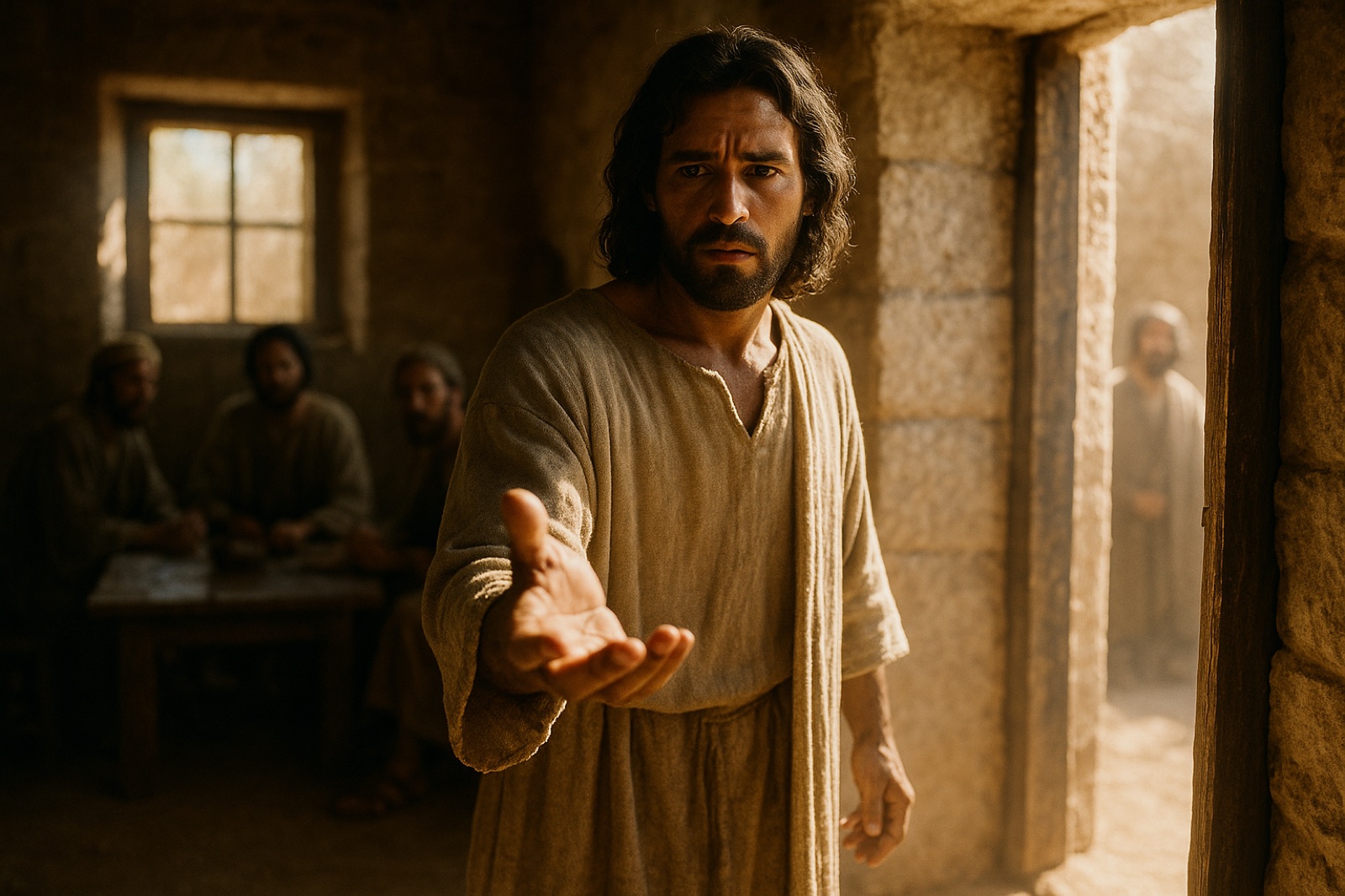
“Then saith he to Thomas, reach hither thy finger, and behold my hands; and reach hither thy hand, and thrust it into my side: and be not faithless, but believing.” — John 20:27
Jesus repeats Thomas’s own words back to him, item for item, and grants every single one. Not a trimmed-down version. All of it. He does not scold the request — he fills it.
And then there is something the text is quiet about. John never actually says Thomas touched anything. The next line is simply:
“And Thomas answered and said unto him, My Lord and my God.” — John 20:28
Whether he reached out or not, the Gospel does not tell us. What it does tell us is what came out of his mouth: the highest thing anyone says about Jesus in the whole book of John. Not from Peter. Not from John himself. From Thomas.
The Turn: His Problem Was Never Doubt
Jesus’s closing line usually gets read as a telling-off. “Thomas, because thou hast seen me, thou hast believed: blessed are they that have not seen, and yet have believed” (John 20:29).
But look at who that sentence is actually for. It is not really about Thomas at all. It is a blessing spoken over everyone who would come afterwards — including you, reading this two thousand years later with no wounds to touch. Thomas’s honesty is the reason that blessing is in the book.
And notice what Jesus does not say. He never calls him a doubter. The word in verse 27 is “faithless,” set against “believing” — and it arrives inside an invitation, with a hand held out. Come closer. Put your hand here. Not: you should not have asked.
So here is the Turn, and it is not the one the nickname trained us to expect.
Thomas’s problem was never that he had questions. His problem was that he missed a meeting. He was not in the room the first time. Almost everything he asked for was just the thing the others had already been handed while he was somewhere else.
He was not the disciple who doubted. He was the disciple who was not there.
And when Jesus came back, He came back specifically for him. A second appearance. Eight days later. Locked doors again. For one man who had missed it.
That is worth sitting with if you have ever felt like everybody else got the moment and you did not — the answered prayer, the clear sign, the season when God seemed obvious to everyone in the room but you. Thomas missed it too. It did not disqualify him. It just meant Jesus came back.
What This Means for Your Monday
Most people carrying a hard question about God are also carrying a second thing on top of it: the belief that having the question at all is the real problem.
That belief is what keeps the question unsaid. Unsaid for years, sometimes. And an unsaid question does not go away — it just goes underground and quietly runs things from down there.
The record says the opposite. In John’s Gospel, the questions get the best answers in the book. If you have ever wondered why God leaves some things unresolved, it is worth seeing that the same thing happens to Paul, whose thorn in the flesh nobody has ever identified — and that when a man in the Bible demanded a straight answer about suffering, what he got back was a storm full of questions, and he said it was enough.
You are allowed to ask. Asking is how the man with the worst nickname in the Bible ended up saying the best sentence in it.
Three Things You Can Do Today
- Read John 11:1-16 right now. It takes about two minutes. Notice who speaks first about actually going, and notice how long the others spend on the risk before he does.
- Write down the one question about God you have never said out loud to anyone. Just the question. Do not try to answer it, and do not soften the wording to make it sound more respectful. Get the real one on paper.
- Say that exact question to God tonight, in your own words. Out loud if you can. Not a polished prayer around it — the question itself, the way you wrote it down.
Journaling Prompts
- What label did someone hang on you during your worst season — and where do you still quietly live as if it is the accurate version of you?
- Thomas said out loud what the others were only thinking. What have you gone without, or gone on not understanding, because asking felt like it would prove something about your faith?
- Thomas missed the first appearance and Jesus came back. Where in your life are you assuming you already missed your one chance?
If you are not sure where you actually stand with God right now, our free How Close Am I to God? assessment is a quiet, honest few minutes with no one watching — a fair place to start.
A Prayer You Can Pray Right Now
God, I have questions I have been too embarrassed to say out loud. I have been carrying them like they are proof that something is wrong with me. If Thomas could ask for more than everyone else got and still be standing in that room when Jesus came back, then there is room for me too. So here is what I actually want to know — I am saying it to You instead of hiding it. Thank You that the question does not send me away.
One Question for You
Why do you think the “doubting” nickname stuck so hard, when the story sitting right there in the same Gospel says almost the opposite? Tell us what you think in the comments — we read every one.
Share This
- Nobody in the Bible ever calls Thomas “doubting.” In the same Gospel, he is the first one to say: let’s go with Jesus, even if it kills us. The label is ours. The courage was his.
- “I am the way, the truth, and the life” exists because Thomas admitted he had no idea where Jesus was going. The question came first. The answer we all quote came second.
- Thomas was not the disciple who doubted. He was the disciple who was not in the room — and Jesus came back eight days later for him alone. If you missed the moment everyone else got, that story is for you.
Questions People Ask About Doubting Thomas
Is the phrase “doubting Thomas” in the Bible?
No. The phrase “doubting Thomas” does not appear anywhere in the King James Bible. It is a later English nickname. In the Gospel of John, Jesus tells Thomas to “be not faithless, but believing” (John 20:27), but never calls him a doubter, and no other character in the Bible uses the nickname either.
What did Thomas say when Jesus decided to return to Judaea?
When Jesus announced he was going back to Judaea, where a crowd had recently tried to stone him, the other disciples questioned the decision. Thomas said, “Let us also go, that we may die with him” (John 11:16). He was the first disciple in that scene to commit to going, and he did it expecting it might cost his life.
Did Thomas actually touch the wounds of Jesus?
The Gospel of John does not say. Jesus invites Thomas to reach out his finger and his hand in John 20:27, and the very next verse has Thomas answering, “My Lord and my God” (John 20:28). The text never states whether he physically touched anything before saying it.
Had the other disciples already seen the wounds of Jesus?
Yes. On the evening of the resurrection, before Thomas arrived, “he shewed unto them his hands and his side. Then were the disciples glad, when they saw the Lord” (John 20:20). They did not have to ask — Jesus showed them. Thomas was not present at that appearance (John 20:24), so he asked for what the others had already been given, and additionally asked to touch.
What does “Didymus” mean?
Didymus is a Greek word meaning “twin.” The Gospel of John notes twice that Thomas was “called Didymus” (John 11:16, John 20:24). The name Thomas itself comes from an Aramaic word with the same meaning, so both names describe him as a twin. The Bible never names his twin.
Which verse came out of a question Thomas asked?
John 14:6 — “I am the way, the truth, and the life: no man cometh unto the Father, but by me.” Jesus said it in direct response to Thomas asking, in John 14:5, “Lord, we know not whither thou goest; and how can we know the way?” One of the most quoted verses in the Bible is an answer to a disciple admitting he was lost.