 0
0
 0
0
You’re sitting in the meeting, and you already know what you want to say. You’ve said it in your head three or four times. It’s a good point. It’s true. And then the moment opens up — someone pauses, someone glances around, someone says “anyone have thoughts?” — and your chest tightens, your face goes hot, and you say nothing. The moment closes. Someone else says almost the exact thing you were about to say, and gets nodded at like it was obvious.
If that’s happened to you more than once, you already know the aftermath isn’t really about the meeting. It’s the replay afterward — the quiet, exhausting conversation with yourself about why you couldn’t just open your mouth like a normal person.
There’s a man in the book of Exodus who had that exact conversation with God directly. Out loud. To His face. And what happened next is one of the most overlooked details in the whole story — because God’s answer wasn’t to fix him.
The Excuse God Didn’t Argue With
By the time we get to Exodus chapter 4, Moses has already had his burning bush moment. God has already told him he’s the one being sent to confront Pharaoh and lead Israel out of slavery. Moses has already asked “who am I?” — the impostor-syndrome question people are still asking 3,500 years later — and God has already answered that one with a promise of presence, not a resume.
But Moses isn’t done objecting. He raises a second concern, and it’s a different kind of fear entirely. Not “am I qualified for this.” Something closer to home:
“And Moses said unto the LORD, O my Lord, I am not eloquent, neither heretofore, nor since thou hast spoken unto thy servant: but I am slow of speech, and of a slow tongue.” (Exodus 4:10, KJV)
The Hebrew phrase behind “slow of speech, and of a slow tongue” is kevad peh, ukvad lashon — literally, “heavy of mouth and heavy of tongue.” Scholars have debated exactly what Moses meant for centuries. Some read it as a literal speech impediment, maybe a stutter. Jewish tradition has long told a story about a childhood injury to Moses’s mouth that may have left him with a real physical difficulty getting words out. Others read it more broadly — a man who simply doesn’t trust his own voice under pressure, who freezes when the stakes are high and the room is watching.
Either reading lands in the same place a lot of us live: a very real, very specific dread of being the one who has to speak, in the moment when speaking matters most.
God’s First Answer Isn’t What You’d Expect
Here’s where the story gets interesting. God doesn’t dismiss the concern. He doesn’t tell Moses he’s overreacting. He responds with a question that reframes the whole thing:
“And the LORD said unto him, Who hath made man’s mouth? or who maketh the dumb, or deaf, or the seeing, or the blind? have not I the LORD? Now therefore go, and I will be with thy mouth, and teach thee what thou shalt say.” (Exodus 4:11-12, KJV)
Notice what that promise actually is. It isn’t “I will remove your fear.” It isn’t “you’ll wake up tomorrow eloquent.” It’s “I will be with your mouth” — presence in the moment of speaking, not a personality transplant beforehand. If you’ve ever prayed for your anxiety to just disappear before a hard conversation and felt like the prayer didn’t work, this is worth sitting with. Maybe it wasn’t supposed to disappear. Maybe it was supposed to be accompanied.
Moses Pushes Back Again — And This Time God Changes the Plan
Most retellings stop at verse 12, like Moses accepted the answer and moved on. He didn’t. Verse 13 is Moses, still standing there, still not convinced:
“And he said, O my Lord, send, I pray thee, by the hand of him whom thou wilt send.” (Exodus 4:13, KJV)
In plain language: please send someone else. Scripture says this made God angry — the text doesn’t hide that. But look at what God does with that anger. He doesn’t walk away from Moses. He doesn’t pick a different, more confident man for the job. He restructures the plan around the real person standing in front of Him:
“Is not Aaron the Levite thy brother? I know that he can speak well… thou shalt speak unto him, and put words in his mouth… and he shall be, even he, thy mouth.” (Exodus 4:14-16, KJV, condensed)
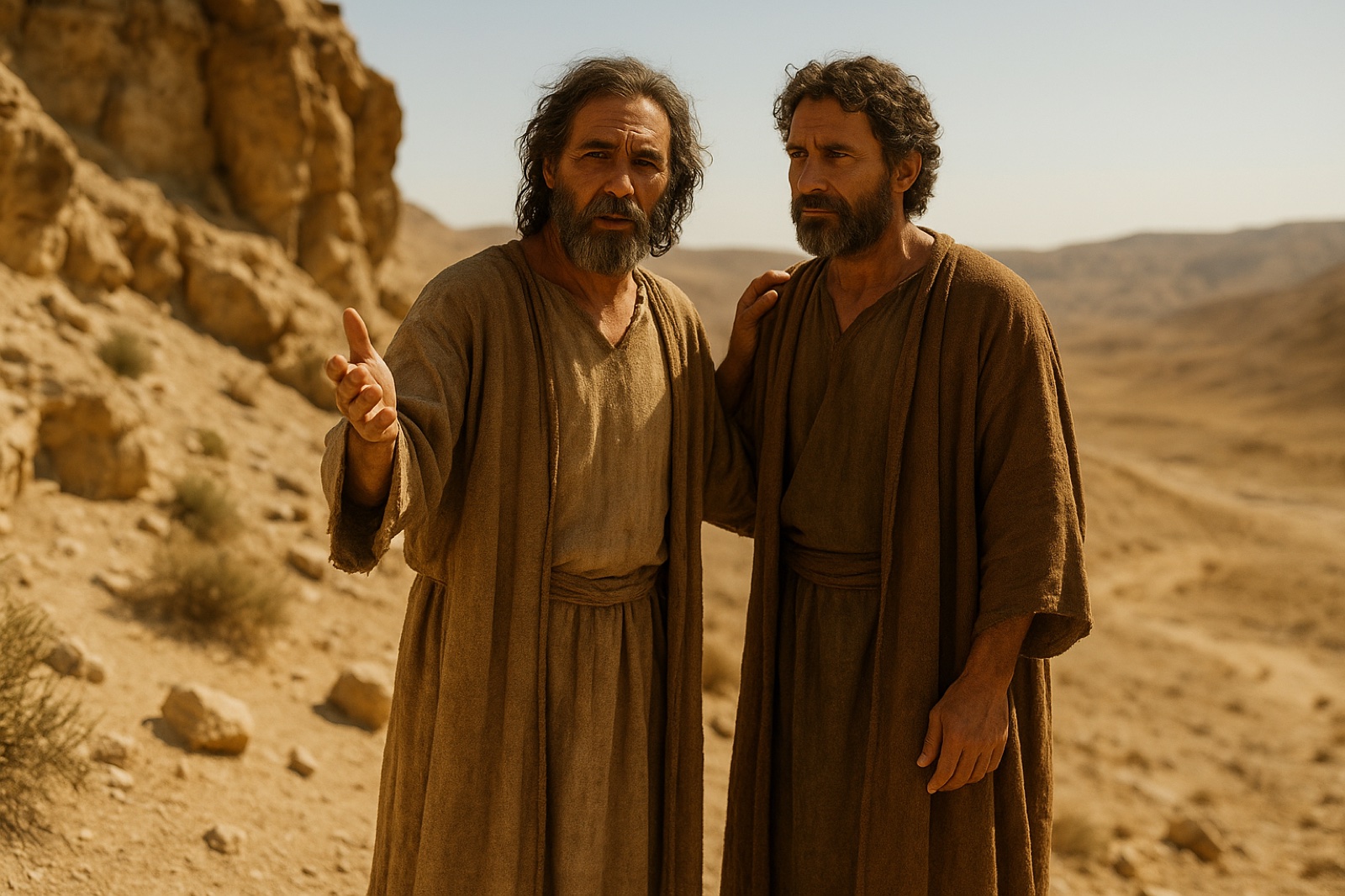
Aaron becomes the mouth. Moses stays the one carrying the message, receiving the words, standing in the room, leading the confrontation — but he’s not asked to do the one part of the job that terrified him alone. God builds a two-person system instead of demanding a one-person miracle.
The Part That Changes How You Read the Rest of the Story
Here’s what’s easy to miss reading this quickly: nowhere in the rest of Exodus does Moses’s speech difficulty get healed. God never circles back and gives him a moment of sudden eloquence. The accommodation — Aaron, standing next to him — is the permanent answer, not a temporary crutch until Moses “gets better.” Moses goes on to lead an entire nation out of slavery, confront the most powerful ruler on earth, and receive the Ten Commandments directly from God — still, as far as the text ever tells us, a man who dreaded speaking.
That’s the detail search results on this topic tend to skip past. The anxious voice was never the disqualifying thing. It was the reason the plan included another person — not proof Moses didn’t belong in the room. If you’ve ever quietly assumed that the “real” leaders, the “real” contributors, are the ones who never feel their throat close up before they talk, this story is direct evidence against that assumption. God’s chosen spokesperson for the Exodus dreaded speaking, and led anyway, with help he didn’t have to apologize for needing. It’s the same pattern behind why an involuntary reaction you can’t control isn’t something to be ashamed of — the body doing what it does under real weight was never the disqualifying part.
What That Means for the Conversation You’re Dreading Tomorrow
You don’t have to wait to feel brave before you show up. Moses didn’t get calm first — he got accompanied. Dreading the room isn’t a character flaw, and it isn’t proof you’re in the wrong place. It’s just the real shape of how you’re wired, and it’s allowed to have a real accommodation instead of a silent, white-knuckled workaround.
Here’s how to actually put that to work this week:
Three Things You Can Do Today
- Write your hardest sentence out, word for word, before you say it. Aaron got scripted words from Moses before he ever opened his mouth to Pharaoh. Before your next hard conversation — the ask, the pushback, the difficult text — write the actual first sentence you’ll say. Not an outline. The real words. Read it out loud once, alone, before you need it.
- Ask someone to be your Aaron. Not a metaphor — an actual text message. “Can you sit next to me in that meeting” or “Can you be on the call with me when I say this” is a completely reasonable thing to ask a friend or coworker. Moses didn’t lead alone. You don’t have to walk into the hard room alone either.
- Stop treating the racing heart as your cue to wait. Notice the anxious feeling, name it, and go anyway — not because it stopped, but because presence was always the promise, not composure. Moses’s hands were still shaking when he raised his staff.
Journal It Out
- What’s one room or conversation you’ve been avoiding specifically because you dread being the one who has to speak?
- Where did you first learn that a shaky voice or a frozen moment meant you weren’t cut out for something — and is that actually true, or just old and familiar?
- Who in your life could be your “Aaron” this week, if you actually asked them?
A Prayer for the Moment Before You Speak
God, You know exactly how heavy my chest gets before I have to say the hard thing. You didn’t ask Moses to stop feeling that, and You’re not asking me to either. I don’t need to feel brave before I walk in — I just need to know You’re with me when I open my mouth. Give me the courage to ask for help instead of hiding, the way Moses asked for Aaron. Thank You for never once calling him disqualified. Amen.
Discussion Question
Do you think God asks anxious people to become confident before He uses them, or does He send help and use them exactly as they are? What’s changed for you either way?
Share This
- “Moses told God to His face ‘I am slow of speech.’ God’s answer wasn’t to fix him — it was to send Aaron. That reframed my whole week.”
- “Turns out the guy who led Israel out of Egypt dreaded public speaking his entire life. Nobody tells you that part.”
- “If you’ve ever frozen in a meeting and replayed it all night: so did the man God chose to confront Pharaoh. He just got a co-pilot instead of a personality change.”
Questions People Ask About Moses and Social Anxiety
Did Moses actually have a speech impediment?
Exodus 4:10 records Moses describing himself as “slow of speech, and of a slow tongue” — a Hebrew phrase (kevad peh, ukvad lashon) that could point to a literal stutter or speech difficulty. Jewish tradition has long connected it to a childhood injury. Scripture itself doesn’t specify the exact cause, only that Moses considered it a real and serious obstacle.
Did God heal Moses’s speech problem?
No. There’s no point in Exodus where Moses’s difficulty speaking is described as healed or removed. Instead, God provided Aaron as a permanent spokesperson. The accommodation, not a cure, was the lasting answer.
Why did God get angry at Moses in Exodus 4:14?
The text says God’s anger was kindled after Moses asked a third time to send someone else in his place. Even so, God didn’t withdraw the calling — He responded by providing Aaron, showing the anger didn’t cancel the plan, it adjusted it.
What can Exodus 4 teach someone with social anxiety?
It shows that feeling unable to speak isn’t automatically disqualifying from something important. God’s response to Moses’s fear was practical help — a person standing beside him — rather than a demand that Moses stop being afraid before he could be used.
Who actually spoke to Pharaoh, Moses or Aaron?
Exodus 4:16 establishes that Aaron would serve as Moses’s mouth, speaking the words Moses gave him. Moses remained the one receiving instruction from God and leading the confrontation; Aaron’s role was to voice it alongside him.