 0
0
 0
0
You get the text, or the call, or the nudge in your spirit — and it’s about the last person on earth you want to help. Maybe it’s the coworker who got you passed over. Maybe it’s the family member who said the thing you still haven’t forgiven. Maybe it’s just someone whose name makes your stomach drop. And somewhere underneath the dread, you hear it: go to them.
That’s the oldest obedience problem in the book. And nobody lived it more literally than Ananias of Damascus, who gets exactly nine verses in the entire Bible — and in those nine verses, changed the course of Christianity.
The Man Nobody Wanted to Visit
By the time Ananias enters the story in Acts 9, everyone in Damascus already knew the name Saul of Tarsus. He wasn’t a rumor. He was a documented threat — a man with signed authority from the chief priests in Jerusalem to hunt down followers of Jesus, drag them out of their homes, and haul them back in chains. Believers weren’t nervous about Saul. They were terrified of him, in the specific, physical way you’re terrified of someone who has already proven what they’re capable of doing to people like you.
Then Saul is struck blind on the road to Damascus by a light and a voice that says, “Saul, Saul, why persecutest thou me?” (Acts 9:4). His companions lead him into the city by the hand. For three days, he doesn’t eat. He doesn’t drink. He just sits in the dark — this powerful, feared man, suddenly as helpless as anyone he’d ever arrested.
And that’s when God speaks to Ananias, “a certain disciple” the text never mentions again — not an apostle, not a leader, just an ordinary believer in Damascus with a name and an address (Acts 9:10-11).
“Lord, I Have Heard by Many of This Man”
What happens next is the part most retellings skip past too fast. Ananias doesn’t just obey. He argues first.
“Then Ananias answered, Lord, I have heard by many of this man, how much evil he hath done to thy saints at Jerusalem: And here he hath authority from the chief priests to bind all that call on thy name” (Acts 9:13-14).
Read that again slowly. Ananias is not questioning whether God is really speaking to him. He believes it’s God. He just thinks God might not have the full picture — as if Heaven needed a briefing on who Saul was and what he’d done. That’s how real the fear is. It’s not doubt about God’s voice. It’s doubt about God’s judgment, which is a much harder thing to admit out loud.
Every honest believer has had a version of this conversation with God. Not “is this really You?” but “You can’t actually mean them, right?” Ananias said the quiet part out loud, and Scripture kept it in the record instead of editing it out. That alone should tell you something about how God handles our objections — He doesn’t strike Ananias down for pushing back. He answers him.
The Three Sentences That Changed Everything
God’s response doesn’t erase the danger. It reframes the assignment: “Go thy way: for he is a chosen vessel unto me, to bear my name before the Gentiles, and kings, and the children of Israel: For I will shew him how great things he must suffer for my name’s sake” (Acts 9:15-16). No safety guarantee. No promise that Saul has changed his mind about killing Christians. Just a name and a purpose bigger than either of them yet understood.
And Ananias goes anyway.
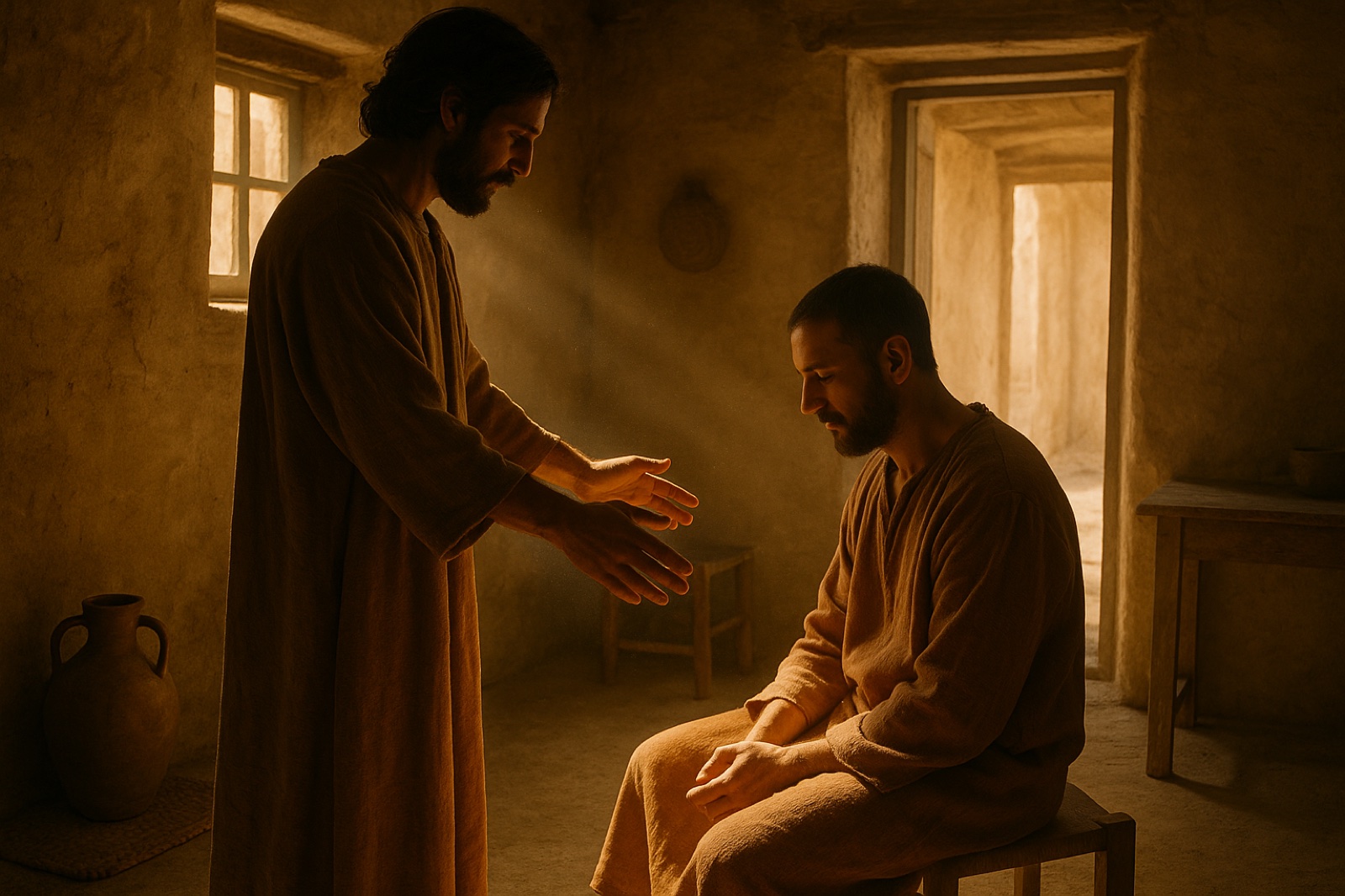
“And Ananias went his way, and entered into the house; and putting his hands on him said, Brother Saul, the Lord, even Jesus, that appeared unto thee in the way as thou camest, hath sent me, that thou mightest receive thy sight, and be filled with the Holy Ghost. And immediately there fell from his eyes as it had been scales: and he received sight forthwith, and arose, and was baptized” (Acts 9:17-18).
Look at the first word Ananias says to the most feared man in the region: Brother. Not “prisoner.” Not “you.” Not even his formal name. Brother Saul — before Saul had done a single thing to earn that word, before there was any proof this conversion was real and not a trick, before Paul had written a single letter of the New Testament that would carry his name. Ananias extended family status to his own would-be executioner, on nothing but God’s instruction and his own trembling obedience.
Obedience Came Before the Courage Did
Here’s the part that tends to surprise people once they actually sit with this story instead of skimming past it: nothing in the text says Ananias stopped being afraid before he went. There’s no verse where his fear lifts, no moment where God calms his nerves first and sends him second. He objects. God answers. Ananias goes — still, presumably, with his stomach in knots the entire walk to Straight Street.
We tend to assume courage has to arrive before obedience — that God has to make us feel brave first, and then we’ll act. Ananias flips that order completely. He acts while still afraid, and the courage seems to show up somewhere in the walking, not before it. That’s not a minor detail. It means you don’t have to wait until the fear is gone to do the thing God has actually asked of you. You just have to go while it’s still there.
And notice who God didn’t send. Not Peter, the visible leader of the whole movement. Not one of the original twelve. An anonymous disciple whose name appears in exactly one chapter of Scripture and nowhere else — not in any epistle, not in any other Gospel, not once more in Acts. The man who personally restored the sight of the apostle Paul, who welcomed him into the family of God with a single word, then simply exits the story. He’s not mentioned again in Paul’s own letters as someone Paul thanks by name. Whatever recognition Ananias got for this, he mostly didn’t get it here on earth.
This is the quiet pattern behind half the pivotal moments in the Bible: God rarely routes His biggest turning points through the most famous person in the room. He routes them through whoever says yes while still shaking. If you’ve ever felt like the “ordinary” one in your church, your family, your circle of faith — like the real spiritual work happens through someone more qualified than you — Ananias is proof that’s not how the Kingdom actually runs.
What This Looks Like on an Actual Monday
You probably don’t have a literal Saul of Tarsus in your contacts. But you likely have someone who plays that role in your life right now — the person whose name still makes your chest tighten, who you’ve quietly decided is someone else’s problem to reach, someone else’s forgiveness to extend. Ananias’s story says the nudge to go toward that person, even now, even with the fear fully intact, might not be a mistake in your discernment. It might be exactly what it was for him.
That doesn’t mean every uncomfortable prompting is God, and it doesn’t mean you ignore real safety concerns — Ananias’s obedience still involved wisdom, not recklessness. But it does mean fear alone was never the disqualifier Ananias assumed it was, and it isn’t yours either.
Three Things You Can Do Today
- Name the person. Take sixty seconds right now and actually name — out loud or on paper — the one person you’ve been avoiding reconciling with or reaching out to because their reputation, or your history with them, makes you afraid. Ananias had to name Saul before he could go to him.
- Send one message. Not a full reconciliation, not a grand gesture — just a text or a short email to that person today. “Thinking of you” or “checking in” is enough of a first Straight Street. You don’t have to resolve everything in one step; Ananias only had to walk through one door.
- Pray the way Ananias prayed. Before he went, he clearly told God his fear out loud instead of pretending it wasn’t there. Tonight, name your fear to God directly and specifically — not a vague “help me be brave,” but the actual person and the actual dread — before you take the next step toward them.
If you want a rhythm for staying in step with God on ordinary days like this one — not just the dramatic Damascus-road moments but the daily walk in between — Gideon’s story shows the same pattern: God calling a frightened, hidden person a “mighty warrior” long before he acted like one. And if the fear you’re carrying feels more like avoidance than danger, Jonah’s flight from Nineveh is worth reading next — it’s the same call, the opposite response.
Saul, of course, became Paul — the “chosen vessel” God told Ananias about before there was a single visible reason to believe it. If you want to go deeper on what that phrase actually meant and what it means for your own sense of purpose, this look at being God’s chosen instrument picks up right where Ananias’s story leaves off.
A Prayer for the Person You’re Avoiding
God, You know exactly who I’ve been picturing while I read this. I don’t feel brave about them. Honestly, I feel the way Ananias must have felt — like You might not have the full file on what they did, or what it would cost me to go toward them. But I don’t want to be the one voice missing from the story You’re writing. Help me go while I’m still afraid, the way Ananias did, and give me one honest, doable next step today instead of a grand gesture I’ll never take. Amen.
A Question Worth Sitting With
Do you think it’s possible to genuinely obey God while your fear is still fully present — not gone, not managed, just still there — or does real obedience require the fear to lift first? Drop your honest answer in the comments below.
Share This
- I just found out the guy who healed Paul’s blindness is mentioned in exactly one chapter of the Bible — and he argued with God before he did it. Ananias is my new favorite “minor” character.
- Ananias didn’t wait for his fear to leave before he obeyed God. He obeyed while still afraid, and the courage showed up in the walking. That might be the whole secret. #Acts9 #FaithOverFear
- The first word Ananias said to the most feared man in Damascus was “Brother.” Before Saul had done anything to earn it. That’s the Gospel in one sentence.
Questions People Ask About Ananias of Damascus
Who was Ananias of Damascus in the Bible?
Ananias was a disciple of Jesus living in Damascus, mentioned only in Acts 9:10-19 (and referenced again by Paul in Acts 22:12-16). God sent him in a vision to restore Saul of Tarsus’s sight and welcome him into the church after Saul’s conversion on the road to Damascus. He is not the same Ananias who appears later in Acts 5.
Why was Ananias afraid to go to Saul?
Saul had official authority from the chief priests in Jerusalem to arrest and imprison Christians, and he had already been actively doing so. Ananias knew Saul’s reputation firsthand and told God so directly in Acts 9:13-14 before agreeing to go.
What did Ananias say to Saul?
He called him “Brother Saul,” explained that Jesus Himself had sent him so Saul could regain his sight and be filled with the Holy Spirit, then laid hands on him (Acts 9:17). Saul’s sight was restored immediately, and he was baptized.
What happened to Ananias after Acts 9?
Scripture doesn’t say. He isn’t mentioned again by name in Acts or in any of Paul’s letters. His only recorded appearance in the biblical narrative is this one act of obedience.
What is the lesson of Ananias and Saul?
That obedience to God doesn’t require fear to disappear first, and that God often uses ordinary, unnamed people — not just the most visible leaders — for the most pivotal moments in His story.