 0
0
 0
0
You typed who were the Nephilim into a search bar, and the internet had a great deal to say. Giants. Fallen angels. Ancient astronauts. Documentaries with heavy music and a narrator who never quite finishes a sentence.
Then you opened the Bible to check for yourself, and it was over almost before it began.
That gap — between how much gets said about the Nephilim and how little scripture actually says — is the strangest thing about this whole subject. And it is where the real find is hiding.
Who were the Nephilim, according to the Bible itself?
Start with something that catches most people off guard. If you are reading a King James Bible, the word “Nephilim” is not in it. Not once. The Hebrew word behind it is translated “giants.”
And that Hebrew word shows up three times, spread across only two verses, in the entire Hebrew Bible. Genesis 6:4. Numbers 13:33. That is all of it.
Two verses. For a subject that fills whole bookshelves and entire video channels.
So the honest answer to “who were the Nephilim” begins with an admission: the Bible tells us far less than we would like. What it does tell us, though, turns out to be pointed in a completely different direction than most of the arguing.
The first mention: Genesis 6:4
Here is the verse, in full:
“There were giants in the earth in those days; and also after that, when the sons of God came in unto the daughters of men, and they bare children to them, the same became mighty men which were of old, men of renown.”
One sentence. No description of what they looked like. No height. No account of what they did. No explanation of where they went.
People have argued for centuries about who the “sons of God” were — fallen angels, the line of Seth, ancient rulers of some kind. The genuinely honest answer is that the text does not say, and it never circles back to clear it up. Anyone who tells you scripture settles that question is adding something scripture withheld. It is worth making peace with that. The Bible leaves a handful of things deliberately unfinished, and this is one of them.
But look at what comes immediately next, because this is the part almost everyone reads straight past on the way to the giants:
“And God saw that the wickedness of man was great in the earth, and that every imagination of the thoughts of his heart was only evil continually. And it repented the LORD that he had made man on the earth, and it grieved him at his heart.”
The giants get half a sentence. What follows immediately is grief — and it is God’s grief.
That phrase, “it grieved him at his heart,” is doing something remarkable. This is not a passage about monsters. It is a passage about a heartbroken God, and the giants are one strange detail sitting at the front of it. We come to Genesis 6 for the mystery. The chapter itself is about something else entirely, and it is not hiding that fact — we just read past it.
The second mention: a report scripture calls evil
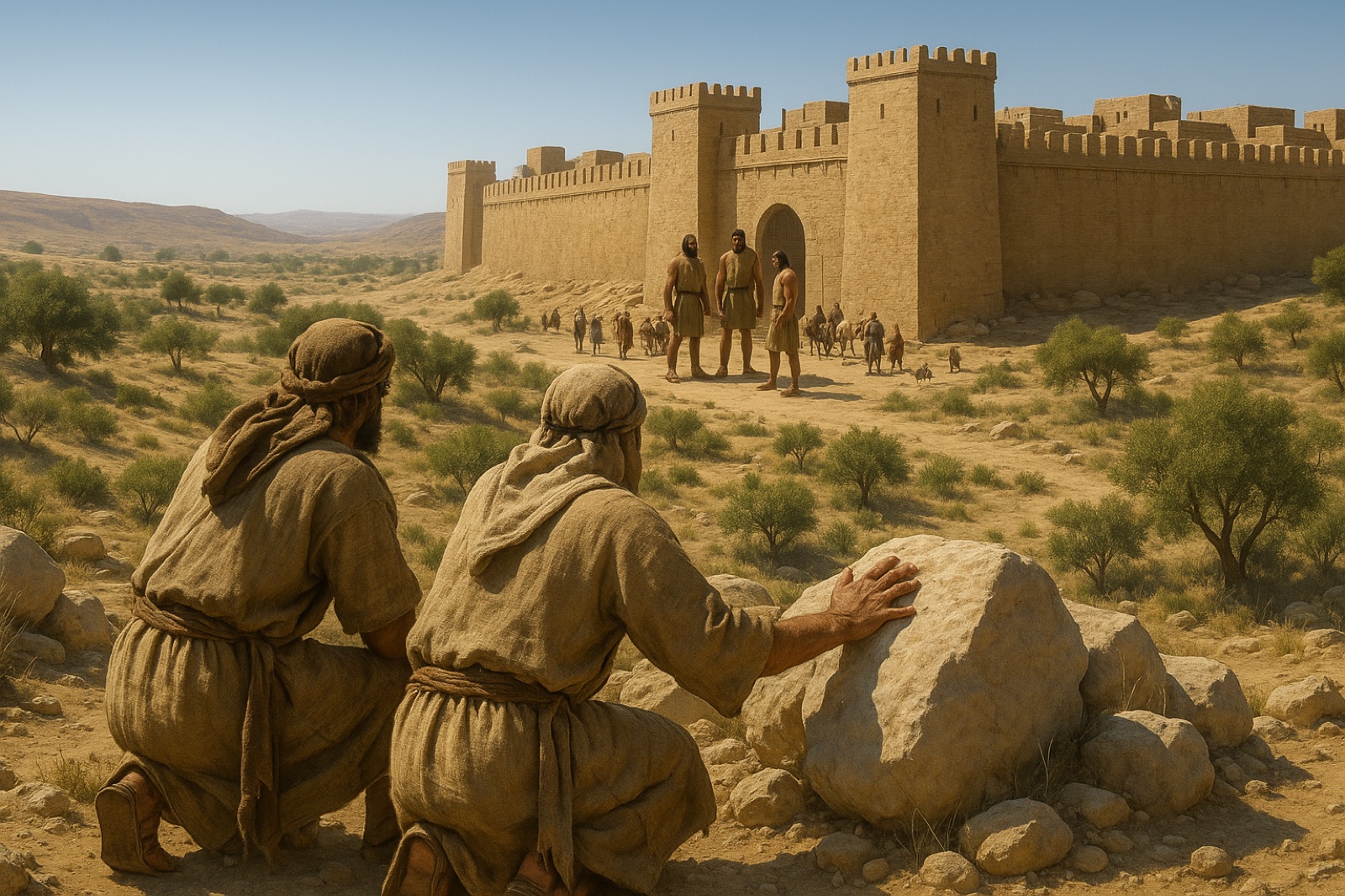
The only other time the word appears, the situation could hardly be more different. Numbers 13. Twelve scouts sent into Canaan for forty days to see what was there.
They come back with fruit and a mixed account. The land is good — “surely it floweth with milk and honey.” But the towns are walled, the people are strong, and they saw the children of Anak there.
Then Caleb speaks up: “Let us go up at once, and possess it; for we are well able to overcome it.”
The others push back — “We be not able to go up against the people; for they are stronger than we.” And then verse 32 does something the Bible almost never does. It labels what is being said:
“And they brought up an evil report of the land which they had searched unto the children of Israel…”
An evil report. And the very next verse, still inside that same speech, is where the giants appear for the second and final time in scripture:
“And there we saw the giants, the sons of Anak, which come of the giants: and we were in our own sight as grasshoppers, and so we were in their sight.”
The clause nobody stops on
Read that ending once more. “And so we were in their sight.”
They are now telling an entire nation what they looked like from the giants’ point of view.
But nobody asked the giants. These men were scouting in secret. They looked, and they left. There was no conversation at the city gate, no one came over to tell them how small they seemed. That information does not exist. They did not learn it.
They supplied it.
The sentence has two halves, and they are not the same kind of statement at all. The first half is honest reporting: we felt small. The second half is invented: and they saw us that way too. One is a feeling. The other is presented as a fact, and it is the part that cannot possibly be checked.
Fear never stops at how you feel. It goes on to tell you how you look.
That is the entire mechanism, sitting in one verse, roughly three thousand years before anyone had a word for it. Fear rarely stops at describing your own state. It goes on to tell you how you appear in everyone else’s eyes — and it does it in such a confident voice that you never think to ask how it could possibly know.
What this does not mean
Precision matters here, because it would be easy to overshoot and claim more than the text allows.
Scripture does not say the tall people of Canaan were imaginary. Caleb and Joshua walked the same forty days and saw the same men. What verse 32 calls evil is the report — the framing, the conclusion, the spin put on what they saw. Not the existence of the people.
And we know that because Joshua and Caleb looked at the identical situation and said this instead:
“…neither fear ye the people of the land; for they are bread for us: their defence is departed from them, and the LORD is with us: fear them not.”
Same land. Same men. Same height. Two completely different reports.
The difference was never in the giants. Fear inflates — that is simply what it does, and it is worth knowing how ordinary that is. Even a giant everyone agrees on can grow in the retelling: the oldest surviving manuscripts do not agree on how tall Goliath actually was, and the number moves in one direction.
What this changes on an ordinary Tuesday
Here is where this stops being about ancient giants.
Think of the thing you have been putting off. The conversation. The application. The apology. The phone call to the person you have not spoken to in two years.
You have almost certainly already filed a report on it. And if you listen closely to how you worded it in your own head, there is a good chance it has the same two halves as Numbers 13:33.
The honest half: this feels far too big for me. That part is real, and God has never once asked anyone to pretend otherwise.
Then the invented half: and they will think I am ridiculous for even trying. They can see it on me. They already decided.
That second half arrives wearing the same clothes as the first, which is exactly why it gets believed. But it is not a report. It is a guess about the inside of somebody else’s mind, delivered as though it came back from the field with evidence.
Ten of the twelve scouts could not tell those two halves apart. Two of them could — and forty-five years later, one of those two was still standing, asking for the hardest ground on the map. If you want to see how that turned out, Caleb was eighty-five and still asking for the mountain with giants on it.
Three things you can do in the next ten minutes
- Write the thing you are dreading in one sentence. Just as you would say it out loud to a friend. No editing.
- Underline every part that claims to know what someone else thinks. Anything in the shape of “they will think,” “everyone can tell,” “they already decided.” Those are the words “and so we were in their sight.” You cannot know them, and neither could the scouts.
- Ask the one question that would actually settle it. Send the message. Make the call. Real information is the only thing that has ever shrunk an invented giant, and it usually takes under a minute to go get.
If a question about a passage is what brought you here in the first place, our free Bible Answers assistant will talk any of this through with you — it opens in ChatGPT and costs nothing.
A prayer for when it all looks bigger than you
God, I have been carrying a report I never checked. I told myself how small I am, and then I went ahead and decided what everybody else sees when they look at me, as though I had any way of knowing that. I do not. Help me put down the part I invented and keep only the part that is true, and please stay close while I go and find out what is actually there. I would rather walk toward it with God than keep guessing at it alone.
What do you think?
The Bible gives the Nephilim two verses, and gives God’s grief the whole rest of the chapter — yet nearly all the attention goes to the giants. Why do you think mysteries hold us so much more tightly than the plain things sitting right beside them? Leave a comment and tell us what you make of it.
Share this
- The word “Nephilim” appears in only two verses in the entire Hebrew Bible. Two. For a subject that fills whole bookshelves. https://bgodinspired.com/index.php/bible-resources/bible-answers/who-were-the-nephilim/
- Numbers 13:33: “we were in our own sight as grasshoppers, and so we were in their sight.” Nobody asked the giants. The scouts made that half up — and it is the half everyone believed. https://bgodinspired.com/index.php/bible-resources/bible-answers/who-were-the-nephilim/
- Fear never stops at telling you how you feel. It goes on to tell you how you look to everyone else, in a very confident voice, with no way of knowing. There is a verse about that. https://bgodinspired.com/index.php/bible-resources/bible-answers/who-were-the-nephilim/
Frequently asked questions about the Nephilim
Who were the Nephilim in the Bible?
The Nephilim are named in Genesis 6:4 as figures present on the earth “in those days,” associated with the union of “the sons of God” and “the daughters of men,” and described as “mighty men which were of old, men of renown.” The Bible gives no physical description, no account of their deeds, and no explanation of what became of them. The identity of “the sons of God” has been debated for centuries — fallen angels, the line of Seth, and ancient rulers are the main proposals — but the biblical text does not resolve the question and never returns to it.
How many times are the Nephilim mentioned in the Bible?
The Hebrew word occurs three times across only two verses in the entire Hebrew Bible: once in Genesis 6:4 and twice in Numbers 13:33. Every other discussion of the Nephilim, in any book or documentary, is built on those two verses plus material from outside the Bible, such as the Book of Enoch.
Does the word “Nephilim” appear in the King James Bible?
No. The King James Version translates the Hebrew word as “giants” in both places it occurs, following the Greek Septuagint’s use of gigantes. A reader using the KJV will find “giants” in Genesis 6:4 and Numbers 13:33 and will never encounter the word “Nephilim” anywhere in the text. Many modern translations leave the Hebrew word untranslated instead, which is why the term is far more familiar today than it was to earlier English readers.
What does Numbers 13:33 mean?
Numbers 13:33 is part of the report twelve scouts brought back after exploring Canaan for forty days: “And there we saw the giants, the sons of Anak, which come of the giants: and we were in our own sight as grasshoppers, and so we were in their sight.” The preceding verse explicitly labels this account “an evil report of the land.” The verse’s final clause claims to describe how the scouts appeared from the giants’ perspective, which the scouts had no way of knowing, since they were observing in secret. Caleb and Joshua saw the same land and reached the opposite conclusion.
Does the Bible say the giants were not real?
No. Scripture does not say the tall people of Canaan were imaginary. Numbers 13:32 labels the scouts’ report evil, but what is condemned is the framing and conclusion of the report rather than the existence of the people described. Caleb and Joshua went on the same expedition, saw the same inhabitants, and urged the nation forward anyway, saying in Numbers 14:9, “neither fear ye the people of the land; for they are bread for us.” The disagreement in the account is about interpretation and courage, not about whether the people were there.