 0
0
 0
0
Maybe you saw one of the videos. A slow zoom on the sky, dramatic music, and a voice saying the Bible teaches that we live under a solid dome. Then the comments: hundreds of people arguing, quoting verses at each other, some mocking, some honestly shaken.
And maybe you quietly wondered: wait, what does my Bible actually say about the firmament in the Bible? Is it a dome? Is it just the sky? Why does the King James use such a strange word?
Those are good questions. You don’t need to be afraid of them. The honest answer is more interesting than either side of the argument, and it ends somewhere neither side is looking.
What Is the Firmament in the Bible?
The short answer: “firmament” is how the King James Version translates the Hebrew word raqia (say it rah-KEE-ah). It is the thing God makes on the second day of creation to separate “the waters from the waters,” and it is what we would call the sky.
“And God said, Let there be a firmament in the midst of the waters, and let it divide the waters from the waters.”
– Genesis 1:6 (KJV)
Two verses later, the Bible gives the firmament its everyday name: “And God called the firmament Heaven” (Genesis 1:8). The Hebrew word there, shamayim, is the ordinary word for the sky, the same place where the sun, moon and stars are set (Genesis 1:17) and where the birds fly (Genesis 1:20).
Raqia appears 17 times in the Old Testament, mostly in Genesis 1, Psalms, Ezekiel and Daniel. So it isn’t a common word. That is part of why it is so easy to argue about.
Where the English Word “Firmament” Came From
Here is something most people never hear. The word “firmament” doesn’t come from Hebrew at all. It came to English through two older translations.
When Jewish scholars translated the Hebrew Scriptures into Greek in the centuries before Jesus (the version called the Septuagint), they rendered raqia as stereoma, a word built on the idea of something firm or solid. Later, the Latin Vulgate turned that into firmamentum. By the time English Bibles arrived, “firmament” was the word everyone had inherited.
So when an English reader hears “firmament” and pictures something hard, part of that picture came from translators, not from the Hebrew word itself. That doesn’t settle the question. Those Greek translators may have been reading Genesis exactly right. But it is worth knowing that the “firm” in firmament is a translator’s choice. (The King James has other famous inherited words like this. Its “unicorn,” for example, turns out to be a real two-horned wild ox.)
Raqia: A Word From the Metalworker’s Shop
Raqia comes from a Hebrew verb, raqa, and you can watch that verb at work in the Bible’s own workshops.
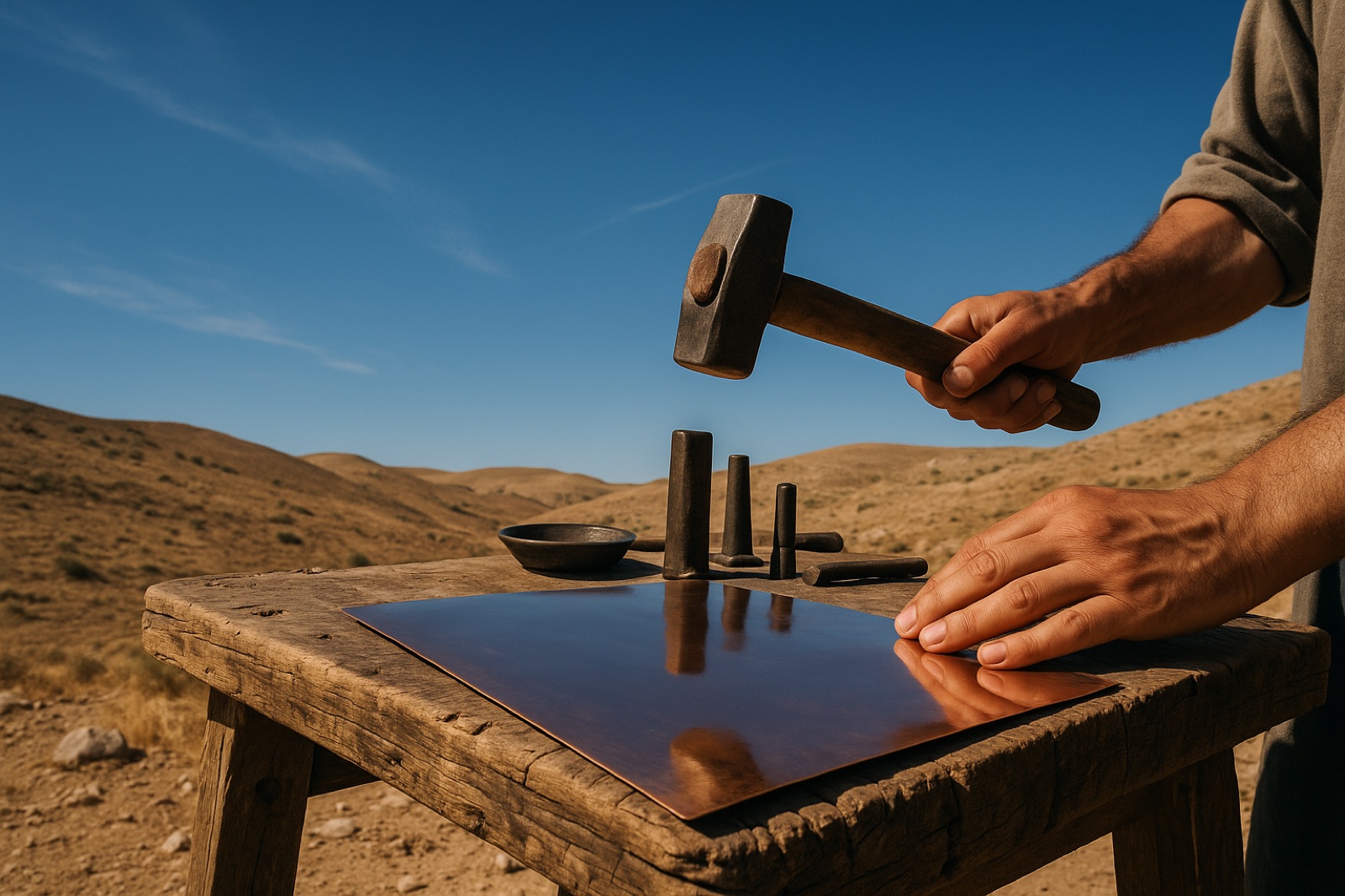
When the priest’s clothing was made in the wilderness, “they did beat the gold into thin plates, and cut it into wires” (Exodus 39:3). The word for beating the gold flat is raqa.
After the rebellion of Korah, the bronze censers were collected and “made broad plates for a covering of the altar” (Numbers 16:39). Hammered flat again: raqa.
Jeremiah mentions “silver spread into plates” brought from Tarshish (Jeremiah 10:9), and Isaiah describes a goldsmith who “spreadeth it over with gold” (Isaiah 40:19). Same verb.
So picture a craftsman with a hammer, working a lump of metal until it becomes a wide, thin, shining sheet. That is the picture behind the word for the sky.
The detail the dome argument usually skips
This is where it gets surprising. The same verb, raqa, is also used for spreading out the earth.
“To him that stretched out the earth above the waters: for his mercy endureth for ever.”
– Psalm 136:6 (KJV)
Isaiah 42:5 speaks of God “that spread forth the earth,” and in Isaiah 44:24 God says, “I am the LORD that maketh all things… that spreadeth abroad the earth by myself.” In all three, the Hebrew verb is raqa. Ezekiel even uses it for stamping your foot on the ground (Ezekiel 6:11).
So raqa is a verb about the action: pressing, beating, stamping, spreading something out wide. It is used of metal, of feet, of the ground under us, and of the sky above us. That means the word alone can’t prove the sky is a hard shell, any more than Psalm 136 proves the ground is a sheet of beaten gold. The word tells you something was spread out by force and skill. It doesn’t hand you a material.
What Does the Bible Say About the Firmament? An Honest Look
It is fair to ask what the first readers pictured. And here, honesty matters more than winning.
Some passages do sound solid. Genesis says waters are above the firmament (Genesis 1:7), and at the flood “the windows of heaven were opened” (Genesis 7:11). Job is asked, “Hast thou with him spread out the sky, which is strong, and as a molten looking glass?” (Job 37:18). Mirrors in that world were polished metal, not glass. Ezekiel sees above the living creatures “the likeness of the firmament… as the colour of the terrible crystal” (Ezekiel 1:22).
Many Bible scholars believe ancient Israelites, like their neighbours across the ancient Near East, pictured the sky as a solid vault. Other scholars read raqia more simply as “expanse,” the open space above us, pointing out that Genesis has birds flying across it (the Hebrew of Genesis 1:20 says they fly across “the face of” the raqia). Serious, faithful people land in both places. Nobody can climb back into an ancient Israelite’s head and check.
But notice what Genesis 1 is actually doing. It is not a physics lesson written to settle an argument that would start thousands of years later. It speaks in the sky its first hearers could see: water falls from above, the blue stretches overhead, lights move across it. And then it says one thing about all of it, over and over. God made this.
That is the claim the text cares about. And the clearest place to see it is a song.
Psalm 19: The Sky as a Craftsman’s Work
“The heavens declare the glory of God; and the firmament sheweth his handywork.”
– Psalm 19:1 (KJV)
Read that again with the workshop in mind. The word for firmament is raqia, the hammered-out thing. The word for “handywork” in Hebrew is literally the work of the hands.
David doesn’t stop to say what the sky is made of. He doesn’t describe its thickness or where its edges are. He looks up at the great beaten-out sheet of the sky and says: somebody made that with their hands. You can tell a craftsman by the work.
Then the psalm says something strange and beautiful:
“Day unto day uttereth speech, and night unto night sheweth knowledge. There is no speech nor language, where their voice is not heard. Their line is gone out through all the earth, and their words to the end of the world.”
– Psalm 19:2-4 (KJV)
Here is a small detail that is easy to read past. In most printed King James Bibles, the word “where” in verse 3 is in italics. That means the translators added it to smooth the English. The Hebrew reads more like: no speech, no words, their voice not heard. Many modern translations keep it that way.
Put back together, the psalm is saying something almost impossible: the sky speaks without using any words at all. No sound. No language. And yet its message has gone out “to the end of the world.”
The Turn: Arguing About the Material, Missing the Maker
Here is what struck me putting all this together.
The loud modern fight over the firmament, dome or no dome, solid or space, is an argument about material. What is it made of? How thick? How high?
Psalm 19 was never interested in that question. It is interested in hands. Whose work is this? And the answer arrives without a single word, in every sky, on every continent, every single day.
Think about who that reaches. A farmer in Kenya who has never opened a Bible sees the same sky as a pastor in Manila. A child in a city flat and a grandmother in a village both look up at the same beaten-out blue. Nobody needs a translation. Nobody needs to win a debate first. The sky has been preaching the same one-line sermon to all of them since the second day: somebody made this, and made it well.
You can spend a lifetime arguing about the metal and never once look up to admire the Smith.
And there is one more verse that finishes the picture. Daniel, looking toward the end of all things, writes: “And they that be wise shall shine as the brightness of the firmament” (Daniel 12:3). The hammered-out sky, the thing made by God’s hands, becomes a picture of what a wise life looks like. Spread out. Shining. Pointing past itself to the One who made it.
If you like to wonder about how big and how old all of this really is, our free How Old Is the Universe? Explorer walks through it one step at a time. And if the idea of God stretching out the heavens grabs you, Isaiah 40 goes there too, which we explored in Is the Universe Slowing Down? Dark Energy and Isaiah 40.
You can argue about the metal your whole life and never look up at the Smith.
What This Means for Your Monday
You don’t have to solve ancient cosmology to hear what Psalm 19 is saying. You only have to look up and ask the psalm’s question instead of the internet’s.
Actions to Take
- Step outside for two minutes today and look straight up. Don’t take a photo. Just notice one thing about the sky right now, a colour, a cloud, the light, and say out loud, “Somebody made that.”
- Read Psalm 19:1-4 slowly, once, before you sleep tonight. When you reach “no speech nor language,” pause and think of someone far away who is under the same sky tonight.
- The next time a sky or dome argument shows up on your feed, don’t scroll into the fight. Before you comment or share, ask the gentler question: “Does this help anyone see whose hands made the sky?” If not, let it go and look up instead.
Journaling Prompts
- When was the last time you looked at the sky and felt small in a good way? What was happening in your life that day?
- Where in your faith have you been arguing about the “material” of something, the details, and missing the Maker behind it?
- Psalm 19 says the sky speaks without words. What has God been saying to you lately without words?
A Prayer
God, I have spent a lot of time looking down at screens and arguing about things I can’t see. Today I want to look up. Thank you for the sky over my head right now, the same sky over people I will never meet. Teach me to notice your handiwork before I try to explain it. And make my life shine a little, like the firmament does, so someone else looks up too. Amen.
Let’s Talk About It
Here is a question for you: do you think the argument over whether the firmament was a solid dome helps people come to faith, or gets in the way? Tell us what you think in the comments. We read every one.
Share This
- “The heavens declare the glory of God; and the firmament sheweth his handywork.” I never knew “firmament” comes from a Hebrew word for hammering out metal. The sky is literally described as handiwork. Psalm 19:1
- Everyone’s arguing about what the sky is made of. Psalm 19 only asks whose hands made it. Looked up today for the first time in a while.
- The sky speaks with no words and no language, and it has reached every corner of the earth. That hit me today. Psalm 19:3-4
Questions About the Firmament in the Bible
What is the firmament in the Bible?
The firmament in the Bible is the King James Version’s word for the Hebrew “raqia,” the sky that God creates on the second day of creation in Genesis 1:6-8 to separate the waters above from the waters below. Genesis 1:8 says God called the firmament “Heaven,” meaning the visible sky, where the sun, moon and stars are set and where birds fly.
What does the Hebrew word raqia mean?
The Hebrew word raqia comes from the verb “raqa,” which means to beat, stamp or spread out. The verb is used for hammering gold into thin plates in Exodus 39:3 and for beating bronze censers into plates in Numbers 16:39. It is also used for God spreading out the earth in Psalm 136:6, Isaiah 42:5 and Isaiah 44:24, so the word describes something spread out wide rather than naming a specific material.
Does the Bible say the sky is a solid dome?
Bible scholars disagree about whether the firmament in Genesis describes a solid dome. Many believe ancient Israelites, like their neighbours in the ancient Near East, pictured the sky as a solid vault, pointing to phrases like “the windows of heaven” in Genesis 7:11 and Job 37:18’s description of the sky as “strong, and as a molten looking glass.” Others read raqia as an open expanse, noting that Genesis 1:20 has birds flying across it. The Bible’s own emphasis, especially in Psalm 19:1, is on the sky as God’s handiwork rather than on what it is made of.
Why is it called the firmament?
The English word “firmament” comes from the Latin “firmamentum” in the Vulgate Bible, which followed the Greek Septuagint’s translation of the Hebrew raqia as “stereoma,” a word suggesting something firm or solid. Early English Bibles, including the King James Version of 1611, inherited “firmament” from that Latin tradition. The idea of firmness in the English word comes from these translations rather than directly from the Hebrew.
What does Psalm 19:1 mean by “the firmament sheweth his handywork”?
Psalm 19:1 means that the sky itself is evidence of God as its maker, in the way a craftsman’s work shows the craftsman’s skill. “Firmament” translates the Hebrew raqia, a word linked to beating out metal, and “handywork” means the work of God’s hands. Psalm 19:2-4 adds that the sky delivers this message without speech or words, yet its message reaches “to the end of the world.”