 0
0
 0
0
Maybe you saw it three times in a row and felt a small chill. Maybe someone told you six is “the number of man,” and it sounded like a verdict. Or maybe you just typed the question because a six keeps catching your eye and you want to know if it means anything.
Here is the honest answer to what does the number 6 mean in the Bible: it is not a curse, and it is not a secret code. Six is where Scripture keeps putting work, people, and effort. And almost every time it shows up, it is standing one step away from something better.
Let us walk through where it actually appears.
What Does the Number 6 Mean in the Bible? Start on Day Six
The first six in the Bible is not frightening at all. It is the day people were made.
On the sixth day, God makes the land animals and then humankind. And the day closes with this line, Genesis 1:31: “And God saw every thing that he had made, and, behold, it was very good. And the evening and the morning were the sixth day.”
Six times in that chapter, God looks at something and sees that it is good. Only at the close of day six, looking at everything together, does the text say very good. So whatever six means in the Bible, it does not start as a bad number. It starts as the day you were made, and the day God looked at it all and was pleased.
But notice something. Day six is not the last day. The story keeps going.
Six Is the Number of Work
Once you see the pattern, it shows up everywhere in the Law. Six is the length of the working stretch. Seven is the release.
- The work week. Exodus 20:9 says, “Six days shalt thou labour, and do all thy work.” The next verse gives the seventh day to rest, for everyone in the house, even the servants and the animals.
- The servant’s term. Exodus 21:2 says, “If thou buy an Hebrew servant, six years he shall serve: and in the seventh he shall go out free for nothing.”
- Creation itself. Genesis 2:2 says that “on the seventh day God ended his work which he had made; and he rested on the seventh day from all his work which he had made.”
Six days of labour. Six years of service. Six days of making. In each case, six is honest, good, necessary work. And in each case, six is not allowed to be the end. Something comes after it that the work itself could not produce: rest, freedom, completion.
That is the heart of it. In Scripture, six is the number of what people can do. It is real and it is good, but it is always one short.
When Six Stands Too Tall
Now watch what happens when six stops pointing forward and starts showing off.
Goliath, the giant who mocked Israel’s army, is measured in sixes. First Samuel 17:4 says his “height was six cubits and a span.” That is roughly three metres tall by the usual reckoning of a cubit.
Later, King Nebuchadnezzar of Babylon builds a golden statue and orders everyone to bow to it. Daniel 3:1 gives its size: “whose height was threescore cubits, and the breadth thereof six cubits.” Threescore is sixty. Sixty high, six wide.
Both are human greatness at full stretch. Both demand to be feared or worshipped. And both fall: Goliath to a shepherd boy with a sling, and the statue’s claim to three young men who simply would not bow.
Then comes the most famous six of all. Revelation 13:18: “Here is wisdom. Let him that hath understanding count the number of the beast: for it is the number of a man; and his number is Six hundred threescore and six.”
Readers have argued about 666 for nearly two thousand years. One long-standing view reads it as a name spelled out in letter-values. Another hears six repeated three times: human power trying to be complete on its own and never reaching seven. We have gone into what the chapter actually says in what the mark of the beast is. But notice the phrase the verse itself uses: the number of a man. Not a monster. A man. Six, again, is about people.
An Honest Limit: The Bible Never Defines Six
This part matters, so let us be plain.
No verse in the Bible stops and says, “six stands for humanity” or “six means imperfection.” Those are patterns readers have noticed, not definitions the text hands us. The same is true of every other number. We said the same thing about the number 4 in the Bible, and about why 40 keeps showing up.
And not every six fits the pattern neatly. In Isaiah 6:2, the seraphim around God’s throne each have six wings. At the crucifixion, Mark 15:33 says darkness fell “when the sixth hour was come.” Sometimes six is simply a count, or a time of day.
So hold the pattern loosely. It is real, and it teaches something true. But it is not a system for decoding the clock, your receipts, or your life. A six in the text can show you something about God. A six on your phone screen cannot.
Six Stone Jars at a Wedding
Here is the six most people read straight past, and it may be the most beautiful one in the Bible.
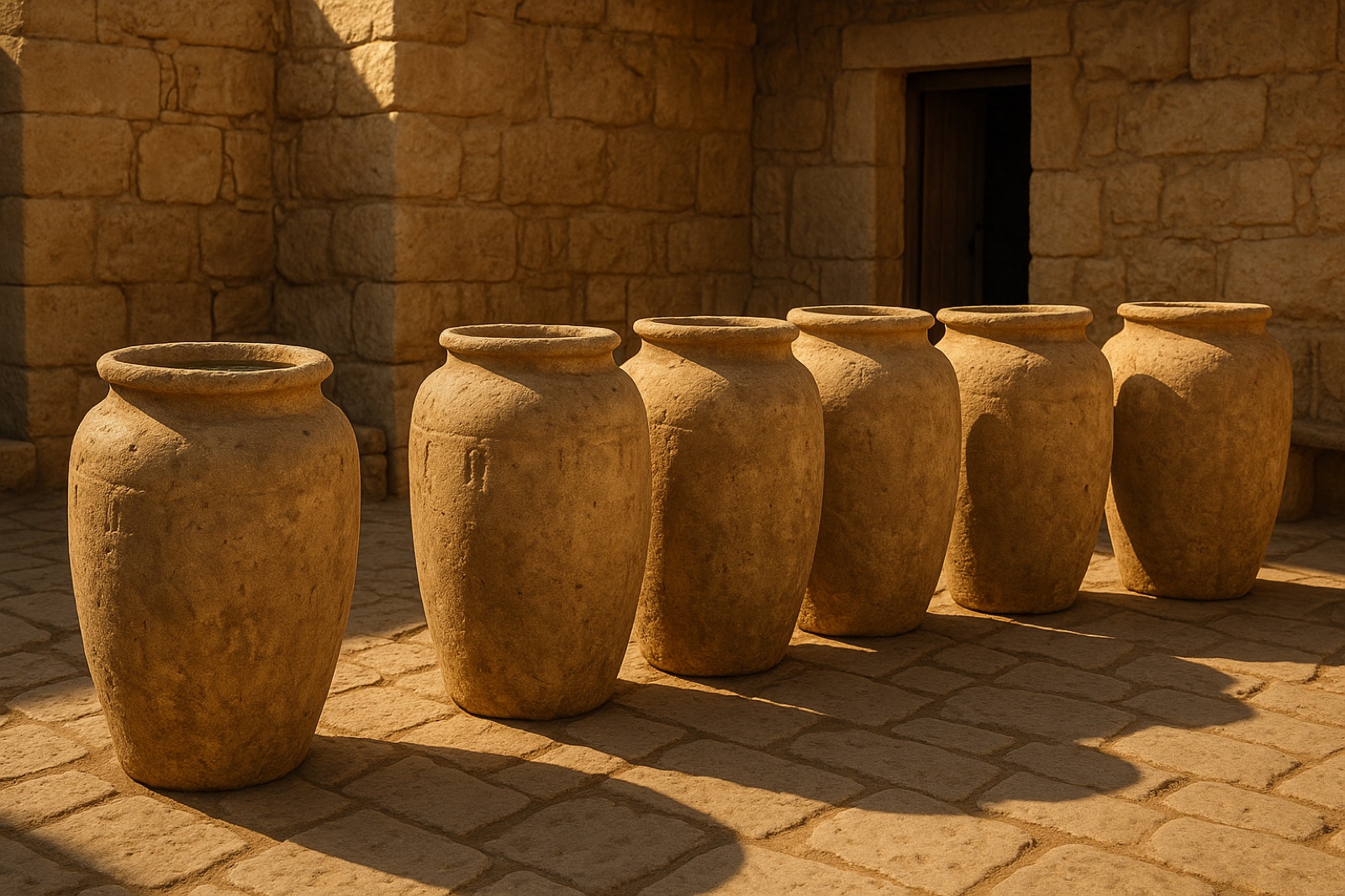
Jesus is at a wedding in Cana. The wine has run out, which in that culture was a real public embarrassment for the family. And John 2:6 stops to describe the room: “And there were set there six waterpots of stone, after the manner of the purifying of the Jews, containing two or three firkins apiece.”
Look at what those jars were for. Not for drinking. They held water for ritual washing, the careful religious effort of trying to be clean. Six of them, standing there.
Then Jesus says, in John 2:7, “Fill the waterpots with water. And they filled them up to the brim.” And the water becomes wine. The best wine at the whole feast.
John never explains why he counted the jars. We should not pretend he did. But many readers across the centuries have noticed what it looks like: six vessels of human effort, filled to the brim, and then changed by Jesus into something they could never have become on their own. John 2:11 calls it “This beginning of miracles.” The very first sign.
Six Was Never Meant to Be the End
Put it all together and the picture is surprisingly gentle.
Six is the day you were made, and it was very good. Six is your working week, your years of effort, the honest labour of being human. Six can grow proud and tall and try to stand on its own, and when it does, it falls. And six is six stone jars of trying hard to be clean, waiting for Jesus to fill them with something new.
Which means the number 6 is not a warning pointed at you. It is a description of you. Made well. Working hard. Always one short of finished.
And the good news of the whole Bible is that the story never stops at six. There is a seventh day. There is a year of release. There is wine where there used to be washing water. The thing your effort cannot finish, God finishes.
If you have been living as though everything depends on how hard you push this week, the number six has a quiet message for you: you were never built to be the last day.
What to Do With This Today
- Name your six. Write down the one thing you have been carrying this week as though it all depends on you. Just one line. Seeing it on paper makes it smaller.
- Stop before it is finished. Pick one task today and deliberately stop five minutes before you feel “done.” Use those five minutes to sit still and say, out loud or silently, “God, you finish this.” It feels strange. That is the point.
- Read the six jars slowly. Open John 2:1-11 and read it once, slowly. When you reach the six waterpots, stop and ask what in your life has been full of effort but empty of joy.
Two Things to Sit With
- Where are you living as if your week has no seventh day? What would change if you believed the rest was already on its way?
- What “stone jar” in your life have you filled with effort, hoping it would make you clean enough? What would it mean to let Jesus change what is inside it?
A Prayer for the One Who Is Tired of Being Six
God, I am tired of trying to finish everything myself. I have worked hard, and some of it was good, but I keep coming up one short. Thank you that my story does not end with my effort. Fill the jars I have been carrying, and change what is inside them. Teach me to stop, to rest, and to let you finish what I cannot. Amen.
A Question for You
Which six in the Bible surprised you most: the “very good” sixth day, the giant measured in sixes, or the six stone jars at Cana? Tell us in the comments below.
Share This
- I always thought 6 was the Bible’s “bad” number. Turns out “very good” is first said at the end of day six. Six isn’t a curse. It’s just one day short of rest.
- Six days of work. Six years of service. Six stone jars at Cana. Every time, six is human effort, and every time the story keeps going. My effort was never meant to be the last word.
- Jesus’ first miracle used six stone jars meant for religious washing. Filled to the brim, then turned into the best wine at the party. That’s what grace does with our trying.
Questions People Ask About the Number 6 in the Bible
What does the number 6 mean in the Bible?
In the Bible, the number 6 is closely tied to human beings and human work. People were created on the sixth day (Genesis 1:31), the Law set six days for labour before a day of rest (Exodus 20:9), and a Hebrew servant served six years before going free in the seventh (Exodus 21:2). Because six keeps appearing just before the completion of seven, many readers see it as the number of human effort that is good but not complete. The Bible itself never formally defines the number.
Is 6 a bad number in the Bible?
No, 6 is not a bad or cursed number in the Bible. The first appearance of six is the sixth day of creation, the day humankind was made, and Genesis 1:31 says God saw everything and it was “very good.” Six becomes troubling in Scripture only when human power tries to stand as if it were complete, as with Goliath or Nebuchadnezzar’s golden statue.
Why is 666 connected to the number 6?
Revelation 13:18 calls 666 “the number of a man” and names it as the number of the beast. Interpretations differ: one long-standing view reads 666 as a name spelled out using the number-values of letters, while another sees six repeated three times as a picture of human power trying to be complete on its own. Revelation does not explain the number, so certainty about its exact meaning is not possible.
Why were there six water jars at the wedding in Cana?
John 2:6 says there were six stone waterpots at the wedding in Cana, used “after the manner of the purifying of the Jews,” meaning they held water for ritual washing. John does not explain why he recorded the number six. Many readers have noticed that Jesus filled these vessels of religious effort to the brim and changed the water into wine, which John 2:11 calls the beginning of his miracles.
What is the difference between 6 and 7 in the Bible?
In the Bible, 6 usually marks the working stretch and 7 marks rest, release and completion. God worked six days and rested on the seventh (Genesis 2:2), people were told to labour six days and rest on the seventh (Exodus 20:9-10), and servants worked six years and went free in the seventh (Exodus 21:2). Six describes what people can do; seven describes what only God completes.