 0
 0
Someone sends it to you at exactly the wrong moment.
You are in the middle of a disagreement that has dragged on too long — with a relative, a neighbour, someone you sit near every week — and a message arrives with four words in it: do everything in love. It lands like a door closing. Like you have just been told, politely, to stop pushing back.
Those words are 1 Corinthians 16:14, and the 1 Corinthians 16:14 meaning most of us carry around is exactly that: be softer, be nicer, let it go. It goes on mugs and bracelets and the end of emails.
But Paul did not open with that line. He arrived at it — at the end of a list that sounds nothing like a mug.
What 1 Corinthians 16:14 actually says
Here is the whole verse. It takes about three seconds.
“Let all your things be done with charity.” — 1 Corinthians 16:14, KJV
The King James says charity. Newer translations say love. Both are translating one Greek word, agape — the same word running all the way through 1 Corinthians 13, the chapter people read at weddings. If you want the full picture of that word, we took it apart in the Greek word for love.
Two smaller things hide in the Greek, and both of them change the sentence.
First, there is no word for “do.” The verb is ginestho, which sits closer to let it become than to do it. It is not a push. It is a setting.
Second, the subject of the sentence is not you. The Greek reads panta hymon — “all things of yours.” Your affairs. Your business. Everything with your name on it. The King James caught that better than most modern versions did: all your things.
The four orders that come first
Verse 14 is the second half of a two-verse unit, and almost nobody quotes the first half.
“Watch ye, stand fast in the faith, quit you like men, be strong.” — 1 Corinthians 16:13, KJV
Four commands, back to back, with nothing joining them. Watch ye translates a word used for staying awake at a post. Stand fast is about holding a position rather than giving ground. Then two more: be courageous, be strong.
It does not read like encouragement. It reads like a briefing before something difficult. And that is the sentence verse 14 is bolted onto.
Paul uses this word exactly once
“Quit you like men” is old English that has aged badly. The Greek behind it is andrizesthe, from andrizomai, and it appears exactly one time in the entire New Testament. This verse. Paul never writes it again, and neither does anyone else.
But it is all over the Greek Old Testament — the version most of Paul’s readers actually heard read aloud. It turns up 21 times there, and the company it keeps is the interesting part:
- It is the word in the charge given to Joshua before he crosses into the land, four times in Joshua chapter 1 alone: “Be strong and of a good courage; be not afraid, neither be thou dismayed” (Joshua 1:9).
- It is what Joab says to his brother with an army in front of him and another one behind: “Be of good courage, and let us play the men for our people” (2 Samuel 10:12).
- It is what Hezekiah says to his officers with Assyria outside the wall (2 Chronicles 32:7).
- It is what David says to Solomon about building the temple (1 Chronicles 22:13).
Commissionings and battles. That is the neighbourhood this word lives in. We looked at the Hebrew side of Joshua’s version in what “be strong and courageous” actually means.
The exact pair he chose shows up in two psalms about waiting
Paul does not use that word on its own. He pairs it with another: andrizesthe krataiousthe — be courageous, be strong.
That specific pairing appears twice in the Greek Old Testament. Neither time is it on a battlefield.
“Wait on the LORD: be of good courage, and he shall strengthen thine heart: wait, I say, on the LORD.” — Psalm 27:14, KJV
“Be of good courage, and he shall strengthen your heart, all ye that hope in the LORD.” — Psalm 31:24, KJV
Same two verbs, in the same order. Both verses about waiting — the slowest, least heroic thing a person ever has to do. So the formula stretches across both: the courage to move, and the courage to stay put when nothing is happening.
One honest note, because it matters. Paul does not say “as it is written” here. He flags no quotation. What can be said is that the words are the same words, and that his readers knew that Greek Bible well. Whether he reached for the echo on purpose is not something the text tells us.
Worth knowing too: Psalm 31:24 addresses that courage to “all ye that hope in the LORD” — everyone, without a filter. Whatever the old English of “quit you like men” suggests, Paul sent his letter to a whole church, women included. He names the household of a woman called Chloe in the first chapter.
Who he was actually writing to
Now the part that makes verse 14 land.
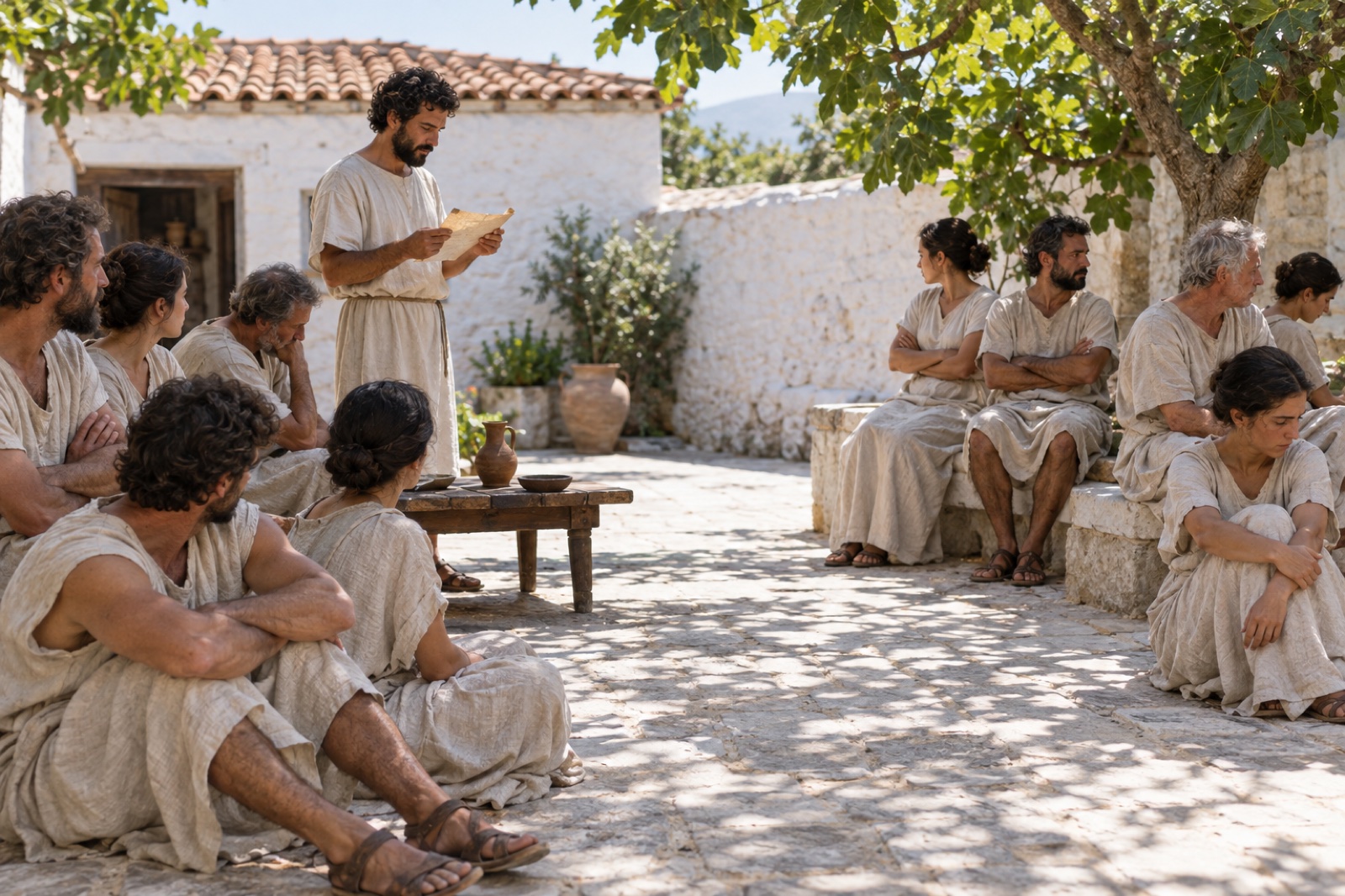
1 Corinthians is not a calm letter. It is written to a church coming apart at the seams, and Paul lists the damage as he goes:
- They had split into fan clubs. “Every one of you saith, I am of Paul; and I of Apollos; and I of Cephas; and I of Christ” (1:12).
- They were taking each other to public court. “Brother goeth to law with brother, and that before the unbelievers” (6:6).
- Their shared meal had turned into a class divide. “In eating every one taketh before other his own supper: and one is hungry, and another is drunken” (11:21).
- They were competing over whose spiritual gift was more impressive (chapters 12 to 14).
- And somewhere in there, Paul drops the line that explains the whole problem: “Knowledge puffeth up, but charity edifieth” (8:1).
Chapter 13 — “Charity suffereth long, and is kind” — was not written for weddings. It was written into that mess, as the cure for it.
Verse 14 is not a fifth command
Here is the detail that gets read straight past, because it is stated once and never repeated: the grammar changes between the two verses.
All four orders in verse 13 are second person plural. You watch. You stand fast. You be courageous. You be strong. Four things the Corinthians do.
Verse 14 is third person singular. The subject is no longer them. It is “all your things.” Not “you, do everything in love” — closer to “let everything of yours happen in love.”
So it is not item five on a list of five. It is the air the other four have to happen in.
And look at what “all your things” actually referred to, right there in that chapter. The verses around it are pure admin: a collection to be set aside a little at a time each week (16:1-2), travel plans and a possible winter stay (16:5-6), Timothy arriving and needing not to be looked down on (16:10-11), Apollos declining an invitation (16:12), a request to defer to the household of Stephanas (16:15-16).
Money, scheduling, visitors, somebody saying no, who gives way to whom. That is “all your things.” Not your big spiritual moments. Your logistics.
Paul writes “let all things be done” three times in this one letter. “Let all things be done unto edifying” (14:26). “Let all things be done decently and in order” (14:40). And then, last of the three, with charity.
The order Joshua never got
Put it together and the verse stops being a request to be nicer.
Paul hands a church at war with itself the exact vocabulary of a commissioning. Stay awake. Hold the line. Be courageous. Be strong. It is Joshua’s briefing, delivered to people arguing over dinner.
And then he adds a line Joshua never got.
Joshua’s courage had somewhere to point. Outward, at what stood between a people and a land. Corinth’s courage had nowhere to go but sideways — the only thing left to be strong against was each other. So Paul gives them the entire warrior formula, and then names the one direction it is not permitted to travel.
Which turns the popular reading inside out. “Do everything in love” sounds like an instruction to stand down. In context it is nearly the opposite: keep watching, keep standing, stay courageous, stay strong — and let love set the rules of engagement for all of it.
Love is not the alternative to strength. It is what decides where your strength is allowed to point.
If you have been reading this verse as a reason to go quiet whenever things get tense, you were handed the wrong half of the sentence. It never asks you to stop standing. It asks what your standing is made of.
Other “be strong” verses get flattened in the same way. 2 Chronicles 15:7 is usually quoted as a promise that effort pays off eventually — and the Hebrew turns out to be saying something far more concrete than that.
Actions to take
- Name what you are strong against. Think of one disagreement you are in right now. Write one line: what am I actually defending? Then write a second line: what do I want this person to feel when it is over? If those two cannot both happen, you have just found the question this verse is asking.
- Rewrite the message you keep composing in your head. Write it out properly. Then change only the parts that exist to win rather than to be understood. Keep the point — Paul never says drop the point. Then send it.
- Do one boring obligation in love today. Pick the dullest thing on your list: a payment, a reply, a form, a shift someone asked you to cover. Do it as though the person on the other end is the whole reason for it. That is what “all your things” meant in the first place.
Journal Prompts
- Where is your strength currently pointed at a person rather than at a problem? Write down the name of the problem.
- Think of the last time somebody held their ground with you and you did not come away feeling crushed. What did they do differently?
A prayer for the middle of a disagreement
God, I am tired of this argument, and I am not even certain I am right any more. I do not want to go silent just to end it, and I do not want to win it either. Show me what I am really defending, and whether it is worth what it is costing the person on the other side. Let the way I hold my ground look like love from where they are standing. Amen.
Over to you
Which is harder — holding your ground without going cold, or letting something go without feeling like you lost? Tell us which one you find tougher, and why — leave a comment below.
Share this
- “Do everything in love” is the second half of a sentence. The first half is: “Watch ye, stand fast in the faith, quit you like men, be strong.” It was never an instruction to stand down.
- The Greek word behind “quit you like men” in 1 Corinthians 16:13 appears exactly once in the New Testament. In the Greek Old Testament it appears 21 times — mostly commissionings and battles. It is the word used sending Joshua into the land. Paul hands it to a church arguing about dinner.
- 1 Corinthians 16:14 is not a fifth command. The grammar shifts: the four orders before it are things you do, and this one is about everything you do. Love is not the opposite of standing firm. It is the rule of engagement.
Questions About 1 Corinthians 16:14
What does 1 Corinthians 16:14 mean?
1 Corinthians 16:14 reads, “Let all your things be done with charity” in the King James Version, and “Do everything in love” in many modern translations. The Greek word translated charity or love is agape, the same word used throughout 1 Corinthians 13. The verse is the second half of a two-verse unit: 1 Corinthians 16:13 gives four commands — watch, stand fast in the faith, be courageous, be strong — and verse 14 then states the manner in which all of those are to happen. Its Greek subject is “all things of yours,” meaning a person’s ordinary affairs rather than their religious activity.
Is 1 Corinthians 16:14 telling people to avoid conflict?
No. The verse immediately before it, 1 Corinthians 16:13, tells its readers to stay alert, stand fast, be courageous and be strong, using vocabulary the Greek Old Testament reserves for commissionings and battles. 1 Corinthians 16:14 does not cancel those instructions; grammatically it describes the manner in which they are to be carried out. The letter was written to a church that was splitting into factions, suing one another in public court and dividing over a shared meal, so the instruction addresses how to conduct a disagreement rather than how to avoid one.
What does “quit you like men” mean in 1 Corinthians 16:13?
“Quit you like men” is King James English for the Greek verb andrizomai, which means to act courageously. It occurs only once in the entire New Testament, at 1 Corinthians 16:13. In the Septuagint, the Greek translation of the Old Testament, it occurs 21 times, including the charge to Joshua in Joshua 1:6, 1:7, 1:9 and 1:18, Joab’s words before battle in 2 Samuel 10:12, and Hezekiah’s address to his officers in 2 Chronicles 32:7. The same verb appears in Psalm 27:14 and Psalm 31:24, where the context is waiting rather than fighting, and Psalm 31:24 addresses it to “all ye that hope in the LORD.”
Why does the King James Version say “charity” instead of “love”?
The King James Version of 1611 renders the Greek noun agape as “charity” in 1 Corinthians 16:14 and throughout 1 Corinthians 13, following the Latin caritas used in earlier Western translation. In seventeenth-century English, “charity” carried the sense of committed goodwill toward another person rather than the narrower modern sense of giving money to the poor. Modern translations generally render the same word as “love.” The underlying Greek is identical in both cases.
What was happening in the church at Corinth?
The letter known as 1 Corinthians addresses a congregation in serious internal conflict. 1 Corinthians 1:12 records members aligning themselves behind rival figures, saying “I am of Paul; and I of Apollos; and I of Cephas; and I of Christ.” 1 Corinthians 6:6 describes believers taking one another to court before unbelievers. 1 Corinthians 11:21 describes their shared meal dividing along lines of wealth, with one person hungry and another drunk. Chapters 12 to 14 address competition over spiritual gifts. The closing instruction in 1 Corinthians 16:14 comes at the end of that letter.