 0
0
 0
0
You step out of a warm shower into a cold room and your arms go pebbled. A song you have heard a hundred times reaches the key change and the back of your neck prickles. Someone tells a story in the dark and the hair on your forearm lifts before you have decided anything at all about it.
It is one of the few things your body does that you can watch happen and cannot start or stop on purpose. So why do we get goosebumps — and why does the same reaction turn up for cold air and for a piece of music, which have almost nothing in common?
The usual answer is that it is a leftover from when we had fur. That is true. It is also where nearly every explanation stops, and it turns out to be the least interesting part of the story.
What a goosebump actually is
Every hair on your body sits in a small pocket in the skin called a follicle. Attached to the side of that pocket is a muscle so tiny you will never feel it work on its own. Its name is the arrector pili — the raiser of the hair.
When the sympathetic nervous system fires, that muscle contracts. The sympathetic system is the automatic branch that handles cold, fright and anything sudden. It works through a chemical messenger called noradrenaline, and you get no say in it.
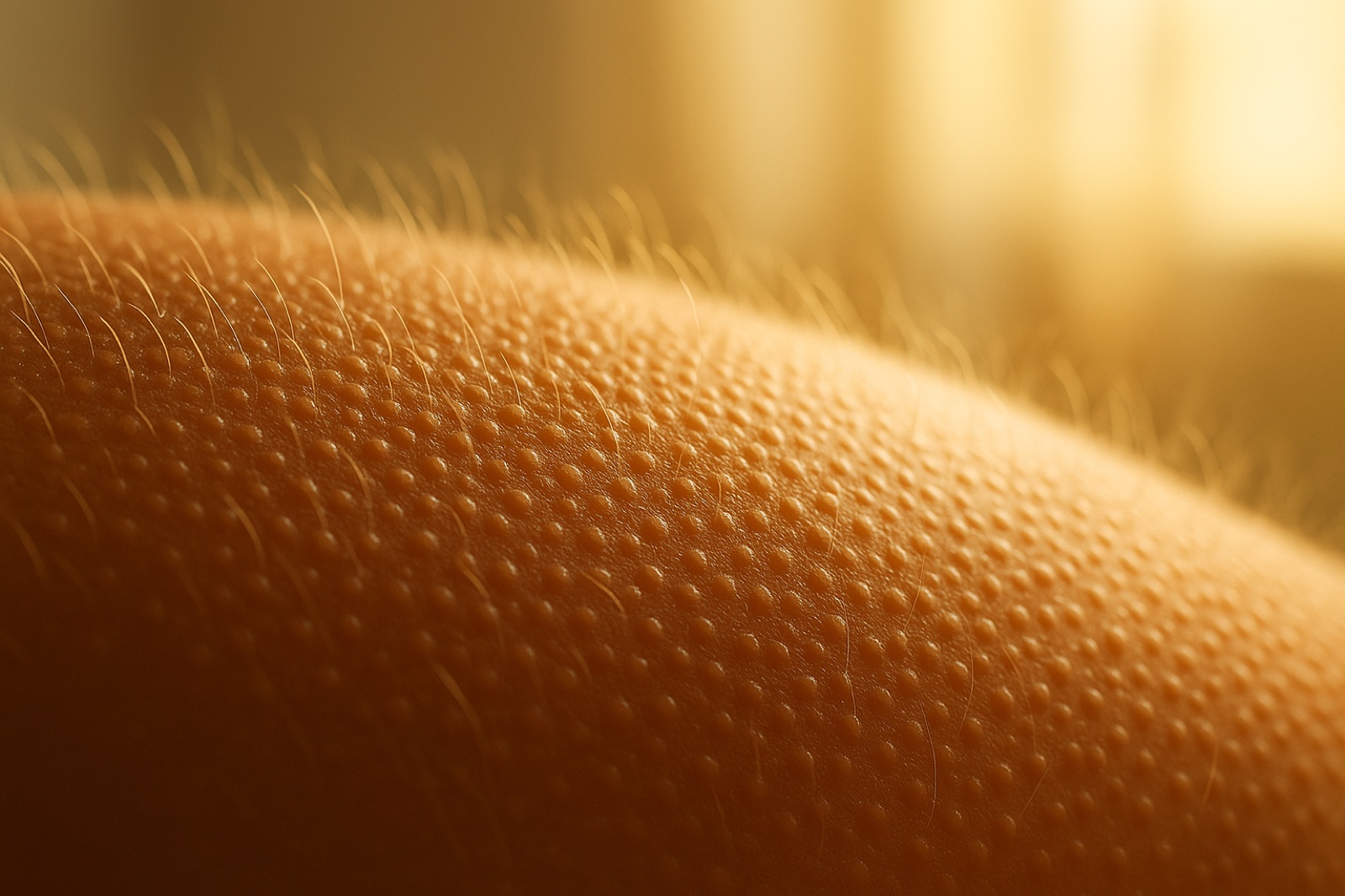
The muscle pulls the follicle upright and drags the skin around it into a tiny dimple. The hair stands. The skin puckers. That is the bump.
The medical name is piloerection. You notice it most on arms, legs and the back of the neck, because that is where the hairs are long enough to see and the skin is thin enough to dimple.
Why do we get goosebumps if we do not have fur?
On an animal with a real coat, this reflex does two jobs, and both are easy to see.
Raised fur traps a thicker layer of still air against the skin, and still air is a good insulator. That is warmth. Raised fur also makes an animal look suddenly bigger, which matters when the thing in front of you is deciding whether to attack. Charles Darwin wrote about this at length in 1872, in a book about how emotion shows up in the body — the mane of an angry lion, the bristling hair of a frightened cat, all of it driven by the same involuntary reflex.
Now do the same thing on a human arm. The hairs are fine and short. Raising them traps almost no air. Nobody has ever looked bigger because of it.
By any practical measure the reflex does nothing for you, which is why it usually gets filed alongside the appendix and the muscles some people can use to wiggle their ears — a mechanism that outlived its job.
That filing was tidy. In 2020 it got complicated.
The study that found what the muscle is really for
A team led by Ya-Chieh Hsu at Harvard University, working with Sung-Jan Lin at National Taiwan University, published work in the journal Cell that was not really about goosebumps at all. They were studying hair follicle stem cells — the cells that grow new hair — and trying to work out how those cells know when to wake up.
What they found in mice was a piece of wiring nobody expected. The sympathetic nerve does not only run to the little muscle. It also reaches the stem cells at the base of the follicle and forms connections with them that look like the junctions nerves normally make with other nerves or with muscle. Hsu called that surprising, because stem cells of that kind are not a typical target for a nerve.
And the muscle turned out to be the reason the connection holds at all. When the researchers took the muscle away, the nerve pulled back and the contact with the stem cells was lost. The muscle is the anchor.
That gives cold a two-speed response. A short blast of cold makes the nerve fire, the muscle contract and the hairs stand — fast, visible, not worth much. Cold that keeps going drives the same nerve harder, and the signal reaching the stem cells pushes them out of rest and into growing new hair. One of the researchers, Yulia Shwartz, put it plainly: goosebumps are a quick bit of relief in the short term, but when the cold lasts, this becomes a way for the stem cells to know it is time to regenerate a new coat.
It is worth being careful about how far that goes. This was mouse skin, and it explains what the wiring is for — it does not show that your goosebumps are keeping you warm today. But useless leftover is no longer the whole story. The muscle that appears to do nothing is holding a nerve against the cells that grow your hair.
Why do we get goosebumps from music?
Then there is the other kind, the kind that has nothing to do with temperature.
Researchers call it frisson, or aesthetic chills: the prickle that arrives at a swell in a song, an unexpected chord, a line in a film, a voice on an old recording, sometimes a memory that turned up uninvited. The machinery is identical. Same nerve, same muscle, same bump. Only the trigger has changed.
In 2011, Valorie Salimpoor and colleagues published work in Nature Neuroscience showing that dopamine, the brain’s reward chemical, is released during the most emotionally intense moments in music — and, more strikingly, in the build-up just before those moments arrive. The body is responding to something it expects but has not received yet.
Not everyone gets them. Published estimates of how common frisson is vary a great deal between studies, depending on how the question is asked and what gets played, so treat any single confident figure with suspicion. What is not in doubt is that the reflex which stopped being useful for cold did not go quiet. It got borrowed. Your body kept a physical signal for the moment something becomes larger than you.
That is worth noticing as a pattern, because the body’s involuntary moves often come with a confident popular explanation that does not survive a closer look. The idea that crying helps because tears flush stress chemicals out of you is one of the most repeated, and it has never been replicated. Others turn out to matter more than they look: a sudden sense of impending doom has a real medical name and a short list of symptoms worth taking seriously. Goosebumps sit somewhere between the two.
The oldest description we have of it
The sensation is not new, and neither is the difficulty of knowing what to do with it.
One of the oldest books in the Bible contains a man describing a night he could not sleep. Something moved past him in the dark. He says the hair of his flesh stood up. That is not a poetic flourish. It is more or less the phrase a physiologist would reach for, written roughly three thousand years before anyone knew an arrector pili muscle existed.
Here is the part that usually gets left out. The man saying it is not the book’s main character. He is one of the friends who came to sit with a suffering man, and he uses that night — the prickle of hair, the certainty that something passed through the room — as the foundation for a long speech about why his friend’s suffering is his friend’s own fault. By the end of the book, that speech is not treated as wisdom. The friends are told plainly that they had not spoken rightly about God.
Which leaves something quietly worth holding. What he felt was real; his body did what bodies do. What he concluded from it was wrong. Awe is evidence that something happened to you. It has never been evidence of what happened. People have been feeling the bigger thing long before they could name it, and the feeling and the answer have never been the same thing.
What to do with a bump on your arm
Nothing, really. That is almost the point.
The next time a chord change runs a prickle up the back of your neck, you do not have to decide what it means. You can know exactly what it is — a nerve, a muscle older than the coat we stopped growing, and a set of stem cells being told the weather has changed — and still notice that your body kept an alarm for beauty long after it stopped needing one for cold.
Most of us walk straight past that. It costs nothing to stop for a second and let it stay strange. If you like that particular flavour of strange, where a small fact opens onto something much larger, our free How Old Is the Universe? explorer does the same trick with time.
Your skin remembers a coat you never wore. And it still lifts for a song.
Questions People Ask About Goosebumps
Why do we get goosebumps?
Goosebumps happen when the sympathetic nervous system releases noradrenaline and a tiny muscle called the arrector pili, attached to the side of every hair follicle, contracts. That contraction pulls the hair upright and tugs the surrounding skin into a small raised bump. The medical name for it is piloerection. It is involuntary, which is why it cannot be started or stopped on purpose, and it is set off both by cold and by strong emotion.
Are goosebumps a useless leftover from when humans had fur?
Only partly. Raised fur insulates an animal and makes it look bigger, and human body hair is far too fine for either, so the visible bump does little. But a 2020 study in the journal Cell, led by Ya-Chieh Hsu of Harvard University with Sung-Jan Lin of National Taiwan University, found in mice that the same small muscle anchors a sympathetic nerve to the hair follicle’s stem cells. Remove the muscle and the nerve retracts. Under prolonged cold, that nerve signals the stem cells to start growing new hair. The bump is nearly useless; the wiring behind it is not.
Why does music give you goosebumps?
Goosebumps from music are called frisson, or aesthetic chills. The physical mechanism is the same as cold-triggered goosebumps, but the trigger is emotional rather than thermal. Research published in Nature Neuroscience in 2011 by Valorie Salimpoor and colleagues found that dopamine is released during the most emotionally intense moments in music, and also in the anticipation just before those moments arrive. Not everyone experiences frisson, and published estimates of how common it is vary widely between studies.
Does the Bible describe goosebumps?
The Bible does not use the word, but it does describe the sensation. In the book of Job, among the oldest books in the collection, a man recounts a sleepless night when something passed before his face and the hair of his flesh stood up. The speaker is not Job himself but one of the friends who came to counsel him, and the book later states that those friends had not spoken rightly about God. The physical experience is described accurately; the conclusion the speaker drew from it is not endorsed by the text.
Something to Think About
Here is a question with no right answer. If a piece of music can raise the hair on your arms and a cold room can do exactly the same thing, does that make the music less remarkable — or the body more so? Tell us which way you lean, and which song does it to you every single time. We read every reply.
If You Want to Pass This On
Take any of these:
- Turns out the tiny muscle that makes goosebumps is not a useless leftover. It is the anchor holding a nerve against the stem cells that grow your hair. Filed under: things I did not expect to learn today. https://bgodinspired.com/index.php/bible-resources/bible-and-science/why-do-we-get-goosebumps/
- Your body kept an alarm for a cold it no longer needs, then quietly repurposed it for beautiful music. I am not over this. https://bgodinspired.com/index.php/bible-resources/bible-and-science/why-do-we-get-goosebumps/
- Someone described getting goosebumps in the middle of the night about three thousand years ago, in almost the words a doctor would use now. Same body. Same dark. https://bgodinspired.com/index.php/bible-resources/bible-and-science/why-do-we-get-goosebumps/