 0
0
 0
0
For as long as humans have looked up, we’ve only ever seen one face of the Moon. Not because we chose to look away — the Moon simply never lets us see the other side. It’s tidally locked to Earth, its rotation and orbit perfectly in sync, so the exact same familiar face has stared back at every generation of stargazers who ever lived. The far side of the moon wasn’t even photographed until a Soviet spacecraft caught a glimpse of it in 1959.
Now scientists have found something strange about that hidden hemisphere. It’s not just unfamiliar. It’s older.
What Chang’e-6 Found
In 2024, China’s Chang’e-6 mission did something no spacecraft had ever done: it landed on the far side of the moon, drilled into the surface, and brought physical samples back to Earth. Every previous sample-return mission in history — including all six of NASA’s Apollo landings — collected rock only from the near side, the half we’ve always been able to see.
Researchers have now finished analyzing those far-side samples, and the results, published this month, are reshaping what we thought we knew about the Moon. The far side shows measurably heavier space weathering than the near side — more of the wear and damage that comes from billions of years of exposure to the raw environment of space. Same rock. Same age. Same distance from the sun. But one side has clearly taken a beating the other side hasn’t.
Earth’s Invisible Shield
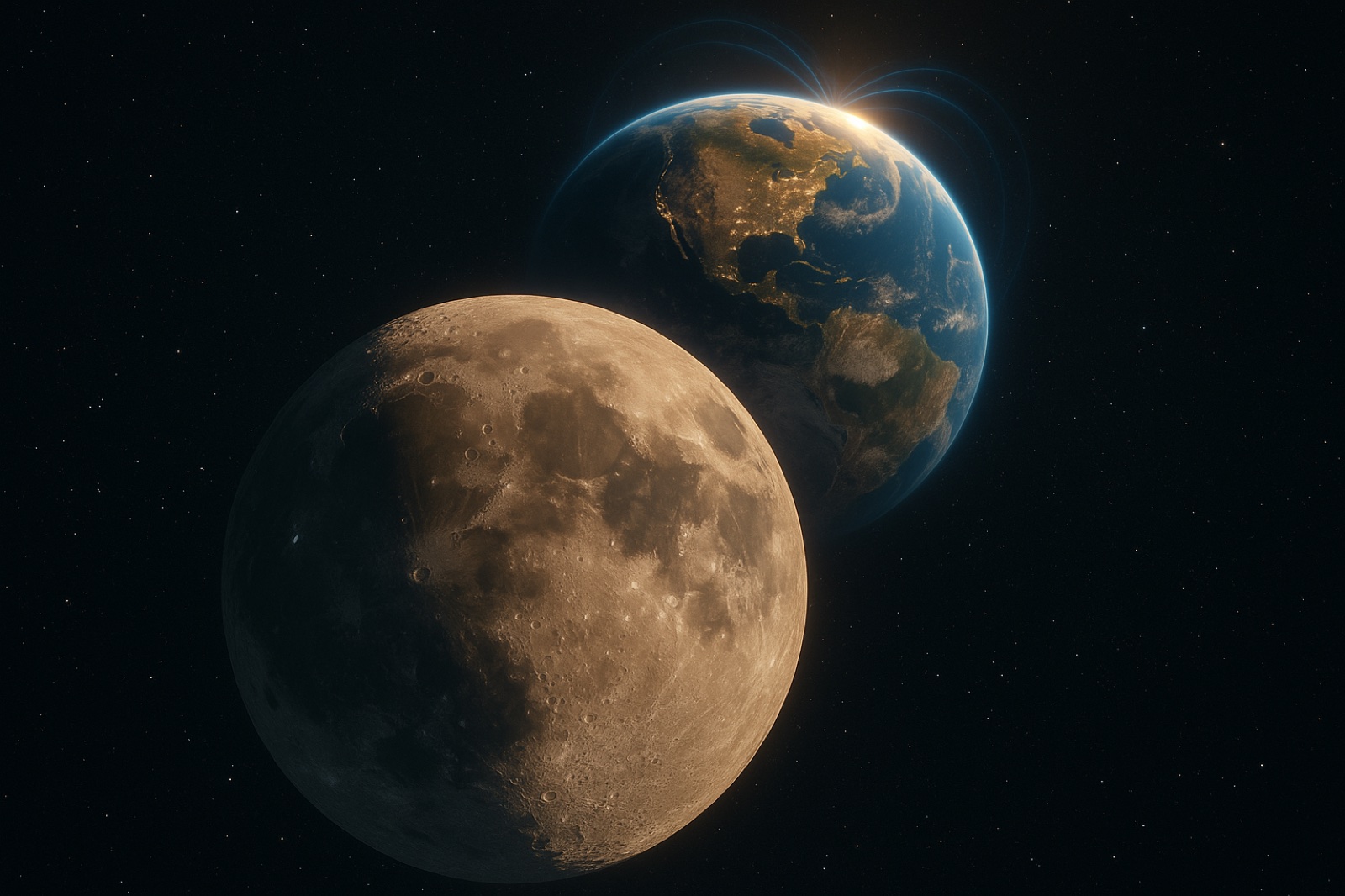
The explanation comes down to something you can’t see, touch, or photograph: Earth’s magnetic field. Generated deep inside the planet by a churning core of molten iron, this magnetosphere extends far past Earth’s surface — and according to the new research, its influence reaches all the way to the Moon.
Solar wind — the constant stream of charged particles blasting out from the sun — is one of the biggest sources of that space weathering. Earth’s magnetic field partially deflects that solar wind away from the Moon’s near side, the half that orbits within Earth’s magnetic influence. The far side gets no such shield. It has spent over four billion years taking the full, unfiltered brunt of the sun’s particle wind while the near side has been quietly, invisibly protected the entire time.
It isn’t the first time scientists have caught Earth’s magnetic field doing something unexpected. Astronomers recently watched a magnetar be born — the most magnetically powerful object known to exist — and even Earth’s own field has been shown to be far from static; the magnetic north pole itself is currently racing across the Arctic faster than researchers expected. Magnetic fields, it turns out, quietly shape far more of the universe than we tend to notice.
This is also why the Chang’e-6 samples matter so much. Before this mission, every model of the Moon’s history was built on an incomplete picture — near-side rock only. Scientists had theories about the far side, but no direct evidence. Now they finally have physical proof, and it’s already changing the timeline of how the Moon’s two hemispheres diverged. It’s a reminder that even a body we’ve stared at for all of human history — one among countless moons scattered across the cosmos — can still surprise us.
A Kind of Protection You Can’t See
Here’s the part that stayed with me after reading through the research. Earth never touched the Moon to change it. It never reached out or intervened directly. It just sat there, generating its own magnetic field, and for over four billion years, that alone was enough to make one whole side of another world measurably different from the other.
The protection didn’t look dramatic. It looked like an absence — an absence of scars, of extra weathering, of the slow accumulated damage the unprotected side quietly wore instead. You’d never know the shielding was happening at all unless you went looking for what it prevented.
People sometimes describe something similar when they look back on hard seasons of their own life. Not a lightning-bolt moment they can point to. Not a dramatic rescue. Just a quiet realization, much later, of everything that somehow never touched them — a diagnosis that didn’t happen, a door that didn’t open, a version of events that could have gone so much worse and simply didn’t. Something bigger seemed to be holding a kind of field around them the whole time, and the only proof was what never got through. That’s often what God’s presence in a life actually looks like — not loud, not staged, just a covering you only notice in hindsight, in everything it quietly kept from ever reaching you.
Half the Moon, Twice the Story
Next time you look up at a full moon, remember: half of it has been absorbing solar wind, unprotected, for four billion years. The other half — the one facing you right now — has been shielded that entire time by something it never had to ask for and could never see coming from ninety-two million miles away. Same rock. Same sun. Same amount of time. Just a difference in what was standing between it and the damage.
Makes you wonder what’s been standing between you and yours.
Discussion Question
The Moon’s two sides tell such different stories because of something neither side could see, choose, or control. Do you think most protection in life works the same way — quiet, invisible, and only obvious looking back? Or do you think we usually know when we’re being shielded from something? Tell us what you think in the comments below.
Share This
Turns out the Moon has two different ages depending on which side you’re looking at, and Earth is the reason why. Wild what an invisible magnetic field can do over 4 billion years. 🌙
China’s Chang’e-6 just brought back the first ever samples from the far side of the moon, and they prove Earth has been quietly shielding the side we see this whole time.
Half the Moon has been getting hit by the sun’s radiation for 4 billion years, completely unprotected. The other half, the one facing us, hasn’t. Same rock, same sun, wildly different amount of shielding. Kind of makes you think.
Quick Questions, Answered
What is Chang’e-6 and why does it matter?
Chang’e-6 is a Chinese lunar mission that in 2024 became the first in history to collect and return physical samples from the far side of the Moon, the hemisphere that never faces Earth. Every previous sample-return mission, including NASA’s Apollo missions, brought back rock only from the near side.
Why does the Moon only show one side to Earth?
The Moon is tidally locked to Earth, meaning its rotation and orbit are perfectly synced, so it always keeps the same face pointed toward us. The far side was never seen at all until a Soviet spacecraft, Luna 3, photographed it for the first time in 1959.
Why is the far side of the moon older or more weathered than the near side?
According to the new analysis of the Chang’e-6 samples, Earth’s magnetic field partially shields the Moon’s near side from solar wind, the stream of charged particles constantly flowing from the sun. The far side gets no such shield, so it has absorbed more of that space weathering over billions of years.
What is Earth’s magnetosphere?
It’s the magnetic field generated by Earth’s molten iron core, extending far out into space. It’s best known for protecting life on Earth from harmful solar radiation and for creating the aurora borealis, but this new research shows its influence reaches all the way to the Moon.
Does this discovery change what we know about the Moon’s history?
Yes. Because scientists previously only had near-side samples, models of the Moon’s age and surface history were built on an incomplete picture. Having a direct sample from the far side gives researchers a way to check those models against physical evidence for the first time.