 0
0
 0
0
In Puerto Rico, the rain has a schedule. The wet season starts in May, builds through the summer, and by August the hills are green enough that most people never think about water at all.
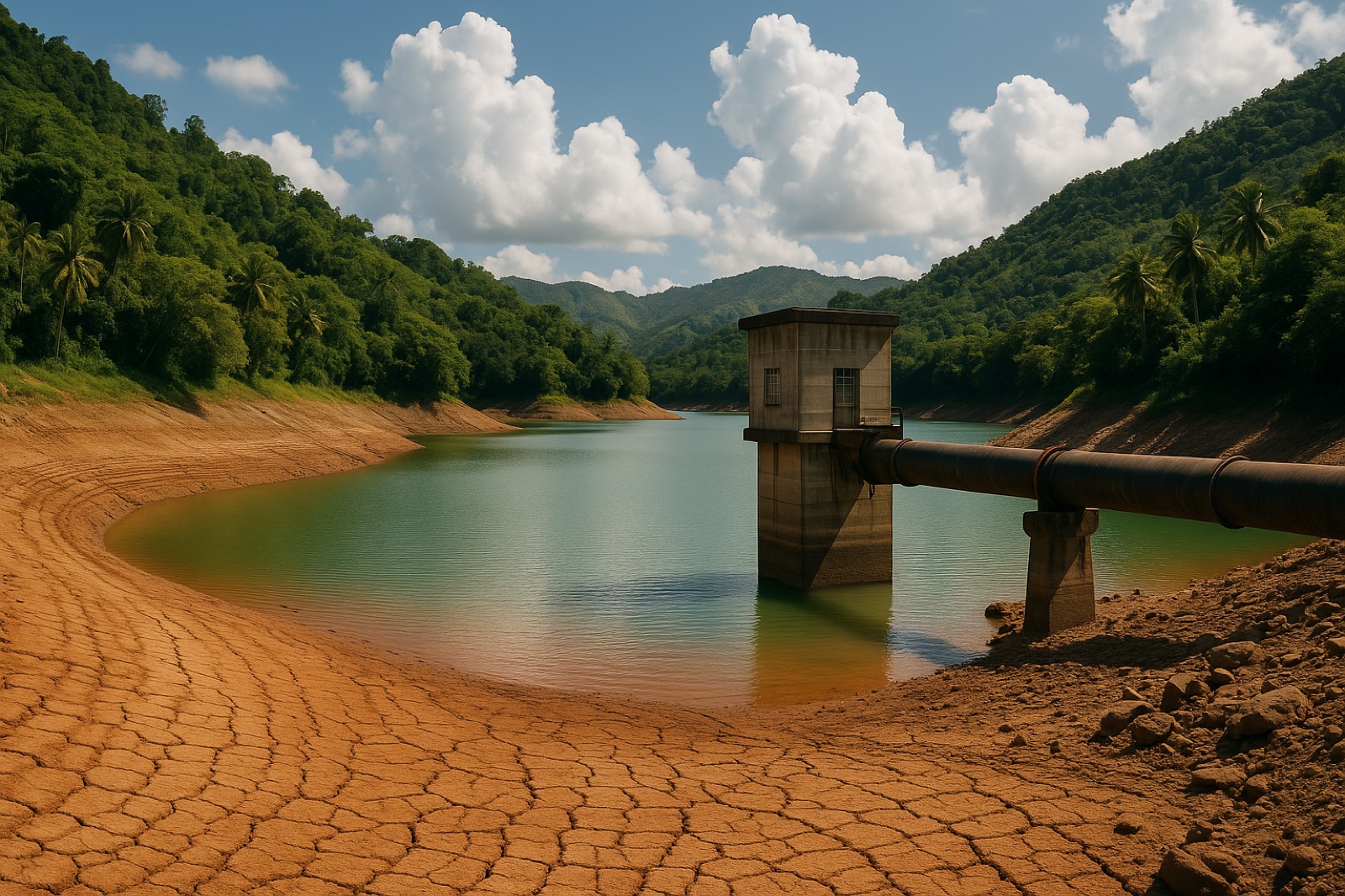
This year it simply did not arrive. The Puerto Rico drought that followed is now the kind measured in shut-off taps rather than dry lawns. Since early August, more than 180,000 households and businesses in San Juan and six nearby municipalities have been living on 48-hour rotating water outages.
Two days on. Two days off. Then again.
But here is the thing that turned up while reading through the actual data, and it is in almost none of the headlines: the rain failing is only half the story. Arguably less than half.
What the Puerto Rico drought actually looks like right now
The official picture is redrawn every week by the U.S. Drought Monitor. As of the map valid 1 September 2026:
- Extreme drought covered about 41% of the island.
- A week before that, the same figure was closer to 44%. It is edging down, slowly.
- Some level of drought covered roughly 75% of the territory.
- In late May, none of Puerto Rico was in drought at all.
That last line is the one worth sitting with. Three months, from nothing to three quarters.
The rainfall gap did the work. From mid-May to mid-July, most of the island received less than 60% of its normal rain. In the south and southwest it was under 20% of normal, a shortfall of roughly 76 to 152 millimetres (3 to 6 inches) in exactly the season when the year’s water is supposed to be banked. Rivers dropped with it, and streamflow hit record lows in the Río Fajardo in the northeast. San Juan then had one of its warmest Julys on record, which quietly pulled more moisture back out of the ground.
If you have ever watched a reservoir number fall, you know how final those figures feel while they are dropping. They are not always final. We followed one earlier this year when Elephant Butte Reservoir hit 1.4% full and then stopped falling — for a reason that had nothing to do with rain.
The number that actually explains the empty taps
Now the part the drought map cannot show you.
In fiscal year 2024 — before any of this started — Puerto Rico’s water utility produced around 513 million gallons of treated water a day, roughly 1.94 billion litres. About 267 million gallons of that, close to 1.01 billion litres, never reached a single customer. It leaked out of the pipes along the way.
Close to half. Every single day. In a normal year, too.
That figure comes from Ivis García, an associate professor of landscape architecture and urban planning at Texas A&M University, writing about why the island’s taps were fragile long before the sky went quiet. Two systems are aging at once: the big transmission mains, where a single break can cut off a whole city, and thousands of miles of smaller distribution lines that simply leak, all the time, everywhere.
Once you know that, the crisis reads differently.
A system that loses half of what it makes can still work — as long as the rain is generous enough to cover the gap. Puerto Rico’s rain has usually been that generous. So the loss sat there for years, fully paid for, entirely invisible, absorbed by the weather.
The drought did not break the water system. The drought stopped covering for it.
That distinction is worth borrowing, because it is very rarely only about water. Most things that fail suddenly were failing slowly first, in a season generous enough that nobody had to notice.
People stopped trusting the tap long before it stopped running
There is a second layer under the first one, and it is the reason this landed the way it did.
In a 2022 survey of 154 residents across three regions of the island, 64% said they did not trust their tap water. A separate 2022 survey of 208 older adults in one area found 86% relying on bottled water. This is not new. Puerto Rico rationed water during the 2015 drought, when around 400,000 customers were affected, and again in 2020. After Hurricane María in 2017, much of the island went nearly five months without dependable service.
So when this August’s outage schedule was announced, it did not land on people who assumed the water would be there. It landed on people who had stopped assuming years ago, and who had already built quiet workarounds: the stored buckets, the filled bottles, the washing done at odd hours because that is when the pressure comes back.
There is something genuinely impressive in that, underneath how sad it is. Three million people have gotten very good at a thing nobody should have to be good at.
What waiting for a rain that never comes does to a person
Ordinary scarcity is hard in a straightforward way. You have less, so you use less.
This is a different shape of hard. This is the failure of a thing you were entitled to expect. The rain was supposed to come in May. It comes every May. And so you keep checking the sky, not out of anxiety exactly, but because some part of you cannot stop believing the schedule will resume — and every clear morning is a small, specific disappointment that you cannot even really name out loud, because a sunny day is not a tragedy.
That is the exhausting part. Not the loss. The waiting for a thing that has never before had to be waited for.
The oldest farming communities we have any written record of organised their entire year around exactly this problem. They had two named rain seasons — an early one to soften the ground for planting, a later one to fill the grain before harvest — and losing either meant losing the year. What is striking, reading them now, is what they did when the rain ran late. They did not simply endure it in silence, and they did not pretend everything was fine. They asked. Out loud, plainly, by name, they asked God for rain — and they kept working the ground while they waited for an answer. Waiting, in their hands, was an active verb.
One of them went further and bought a field in the middle of a siege, paid for it, and sealed the deed in a clay jar while the army that would take the city was already at the gate. Not optimism, exactly. Something more stubborn than optimism.
What happens after the rain comes back
The rain will return to Puerto Rico. It always has, and the extreme-drought figure has already started ticking down.
What will still be there when it does is a pipe network losing close to half of everything it carries. That does not get fixed by weather. It gets fixed by budgets, crews, and years of unglamorous work that nobody photographs.
Which is, strangely, the hopeful part. Rain is not something anyone controls. Pipes are.
And in the meantime, on an island where three million people are watching the sky, the old instinct still looks like the right one: do the practical thing that is actually in your hands today, and ask for the thing that is not.
If your own water supply is unreliable
None of this is specific to the Caribbean. Rationing, outages, and unsafe supply are ordinary facts of life for a large share of the world. A few things that cost nothing:
- Store during the on-window, not the off-window. The moment pressure returns is the moment to fill, not the moment to relax.
- Plan roughly 4 litres (1 gallon) per person per day for drinking and basic cooking. That is the standard figure in most emergency-preparedness guidance, and it is a planning minimum, not a comfortable amount.
- Keep drinking water covered. Closed bottles and sealed containers, kept out of sun. Open buckets are for washing and flushing, not for drinking.
- Fill the large things too. A bath, a bin, a barrel. Washing and sanitation quietly use far more than drinking does.
- Check who cannot carry water. Anyone elderly, ill, disabled, or alone on an upper floor is dealing with a different crisis than you are, and a full container carried upstairs is a real kindness.
Questions people are asking about the Puerto Rico drought
How much of Puerto Rico is in drought right now?
As of the U.S. Drought Monitor map valid 1 September 2026, about 75% of Puerto Rico was in some level of drought, and roughly 41% of the island was in extreme drought. That extreme-drought share was near 44% a week earlier, so conditions have begun to ease slightly. In late May 2026, no part of Puerto Rico was classified as being in drought.
Why is Puerto Rico rationing water?
Puerto Rico’s wet season normally begins in May, but rainfall largely failed to arrive in 2026. From mid-May to mid-July, most of the island received under 60% of its normal rain, and the south and southwest received under 20%. With reservoirs and streamflow dropping, water rationing began in early August 2026, placing more than 180,000 customers in San Juan and six nearby municipalities on 48-hour rotating outages.
How much water does Puerto Rico lose to leaks?
In fiscal year 2024, Puerto Rico’s water utility produced roughly 513 million gallons (about 1.94 billion litres) of treated water per day and lost about 267 million gallons (about 1.01 billion litres) of it to leaks before it reached any customer. That is close to half of all treated water, lost every day, in a normal year — which is why the drought produced shortages so quickly.
Is this the first time Puerto Rico has rationed water?
No. Puerto Rico rationed water during a drought in 2015, when roughly 400,000 customers were affected, and again in 2020. Following Hurricane María in 2017, large parts of the island went nearly five months without dependable water service.
When does Puerto Rico’s rainy season normally start?
Puerto Rico’s wet season typically begins in May and builds through the summer months. In 2026 that pattern did not hold: rainfall stayed well below normal through May, June, July and August, which is why drought conditions spread across the island during what should have been its wettest stretch of the year.
What do you think?
Here is the question worth arguing about: when something has been quietly failing for years and a crisis finally drags it into the open, is the crisis the disaster — or is it the honest moment?
Plenty of people would say a system losing half its water was always the emergency, and the drought just turned the lights on. Others would say that is easy to declare from a distance, and that the crisis is simply the crisis. Which one do you land on? Tell us in the comments — we read them.
Share this
- Puerto Rico is rationing water for 180,000+ customers. But the number that actually explains it isn’t rainfall — nearly half the island’s treated water leaks out of the pipes before it reaches anyone. The drought didn’t break the system. It stopped covering for it. https://bgodinspired.com/index.php/bgodinspired-news/puerto-rico-drought-half-the-water-never-arrives/
- Most things that fail suddenly were failing slowly first, in a season generous enough that nobody had to notice. Puerto Rico’s water crisis, in one line. https://bgodinspired.com/index.php/bgodinspired-news/puerto-rico-drought-half-the-water-never-arrives/
- Three months ago no part of Puerto Rico was in drought. Today it’s three quarters of the island. The part I can’t stop thinking about is what happens to a person who keeps checking a sky that’s supposed to deliver, and doesn’t. https://bgodinspired.com/index.php/bgodinspired-news/puerto-rico-drought-half-the-water-never-arrives/