 0
 0
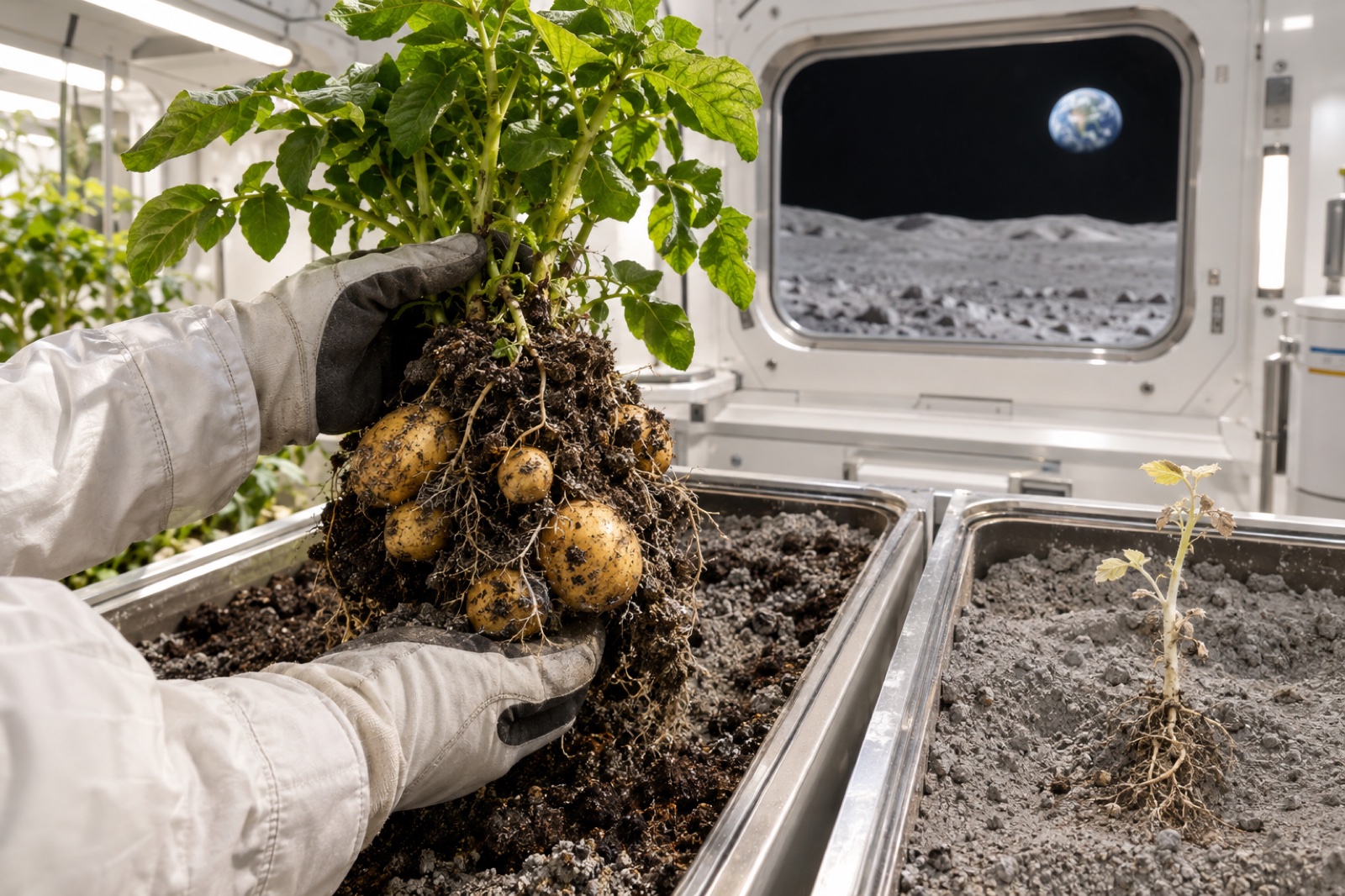
Here is a sentence that sounds like science fiction and is not: researchers have grown a full life cycle of potatoes in fake moon dirt. Seed to harvest. The catch is that it only worked when they mixed in worm compost.
Plants in plain moon-soil simulant came up stunted, with roots that never really formed. Plants in simulant with 30% worm compost grew as well as the control plants in ordinary Earth soil. That one number is the heart of the story.
What the potato study actually did
A team at Oregon State University, led by plant scientist Aymeric Goyer with postdoctoral researcher David Handy, tested potatoes in five different moon-soil simulants. These are powders made on Earth to imitate the real thing. Some copy the dark, fine-grained volcanic plains of the Moon. Others copy the pale, feldspar-rich highlands. NASA’s Johnson Space Center lab supported the work, and the team used farm soil from Hermiston, Oregon, a big potato-growing area, as the control.
Then they changed one thing: how much vermicompost went into the mix. Vermicompost is what you get when earthworms break down old plant matter. It is dark, crumbly, and made entirely of things that used to be alive.
The results were clean:
- No compost: plants were severely stunted, with underdeveloped roots.
- 5% to 15% compost: growth was only partial.
- 30% compost: plants did as well as the Earth-soil controls.
The potatoes also kept their nutritional quality, and the team saw no statistically significant rise in glycoalkaloids. Those are the natural toxins that turn green potato skins bitter and unsafe.
Moon soil has the minerals. So why did the plants fail?
This is the part most headlines skip. You might guess the compost was simply food, a bag of nutrients that moon dust lacks. That is not the main idea the researchers put forward.
Their proposed explanation is about protection. Real lunar soil is known to carry extremely fine, sharp dust and elevated levels of heavy metals. The team believes the organic matter binds those metals, keeping them away from the roots, away from slowing growth, and out of the potatoes themselves. In other words, the dead material may not be mainly feeding the plants. It may be making the ground safe enough for roots to exist at all.
Notice what that means. The mineral dust was all there. Everything a plant could want, on paper. What was missing was something that had once lived, finished, and been broken down. Without it, the ground stayed a place where roots could not settle in.
What this study cannot tell us yet
Honesty matters here, so let’s be exact. This was done with simulants, not real Moon soil. Nothing was grown on the Moon. The article we drew these facts from does not discuss low gravity or radiation either, and real lunar dust is nastier than the copies. A follow-up paper testing ten potato varieties is expected.
There is also a practical puzzle. The plan assumes astronauts would bring compost, and live earthworms, with them to make more fertilizer on the spot. It is a bit like needing a starter to make bread: you have to carry a little of the living world with you.
If you like this corner of space research, our pieces on emergency blankets as moon-base insulation and on NASA’s 378-day Mars simulation cover the same theme: people rehearsing, on Earth, for the day they have to live somewhere else.
The old idea hiding in a pot of dirt
People have noticed this pattern for a very long time. Farmers know a field rests, rots, and rebuilds. Gardeners know the best soil is made from last year’s leaves. There is an old piece of ancient wisdom that says a single seed stays a seed, alone, until it goes into the ground and gives itself up, and then it becomes something that feeds many. The Moon experiment is a strangely literal picture of that: bright minerals, no life, until something that has ended is mixed in.
It is also a quiet reminder that endings are not always waste. A thing that has finished can be the very thing another life needs to begin. We wrote about a similar idea in the seed that waits in dark soil.
Where this leaves us
For now, the headline is simple and good. A team on Earth found that moon-style dirt can grow potatoes that look and test like normal ones, if you give it enough of what once lived. Whether it works on the real Moon is still a question for another day. But next time you tip scraps into a compost heap, you are doing the same thing: turning what is finished into the ground where something new can start.
Discussion Question
Would you eat a potato grown in moon soil, or does the idea make you nervous? Tell us what you think in the comments.
Share This
- Scientists grew potatoes in fake moon dirt. Plain dust gave stunted plants. Add 30% worm compost and they matched Earth soil. https://bgodinspired.com/index.php/bgodinspired-news/potatoes-in-moon-soil-worm-compost/
- The moon soil had the minerals. What it lacked was something that used to be alive.
- Future Moon farmers may have to pack worms. I did not have that on my bingo card.
Questions About Potatoes in Moon Soil
Can potatoes grow in moon soil?
In a 2026 Oregon State University study, potatoes completed their life cycle in moon-soil simulants when about 30% worm compost was mixed in. This used simulants made on Earth, not real lunar soil, so it has not been shown on the Moon itself.
How much worm compost did the potatoes need?
Plants with 30% vermicompost grew as well as plants in Earth-soil controls. Plants with 5% to 15% grew only partially, and plants with none were severely stunted with underdeveloped roots.
Why does moon soil need compost to grow plants?
The researchers propose that organic matter binds heavy metals in the soil, which protects roots and keeps the metals out of the potatoes. This explanation is a proposal, not a settled finding.
Were the moon-grown potatoes safe to eat?
The team found no statistically significant increase in glycoalkaloids, the natural toxins in potatoes, and nutritional quality was kept. These were simulant-grown potatoes, and the work is still early.
Has anyone grown food in real moon dirt?
This study did not use real lunar soil. It used five simulants from NASA Johnson Space Center’s simulant lab. Real lunar dust is finer and has more heavy metals, so results may differ.