 0
0
 0
0
Right now, somewhere above your head, a satellite is telling your phone where you are.
You never think about it. You open a map, the blue dot appears, and the dot is right. But that dot is not something your phone worked out by itself. It is a gift arriving from about 20,000 kilometres up, every second of every day, free, whether you are paying attention or not.
So here is a strange question. What happens when that gift stops? Not for you — for the satellite. Can a spacecraft navigate without GPS, with nothing at all being sent to it?
NASA just found out. The answer turned out to be stranger, and better, than anyone was expecting.
What “Lost in Space” Actually Means
Engineers have a real technical term for this, and it is wonderfully blunt: lost in space.
It does not mean the spacecraft is drifting off into the dark. It means something more specific. It means the spacecraft has to work out where it is from scratch, with no starting guess, no ground station whispering coordinates, and no prior estimate to correct. A blank page. Total position amnesia.
Most navigation is not like that. Most navigation is correction — you already roughly know where you are, and you nudge that guess. Being lost in space means having nothing to nudge.
How NASA Satellites Navigate Without GPS
The experiment is called FALCON, which stands for Fast Autonomous Lost-in-space Catalog-based Optical Navigation. NASA announced the results in August 2026. It flew on Starling, a swarm of four small satellites launched in 2023 and run out of NASA’s Ames Research Center, alongside EraDrive, a startup that spun out of Stanford University.
Here is the part worth slowing down for.
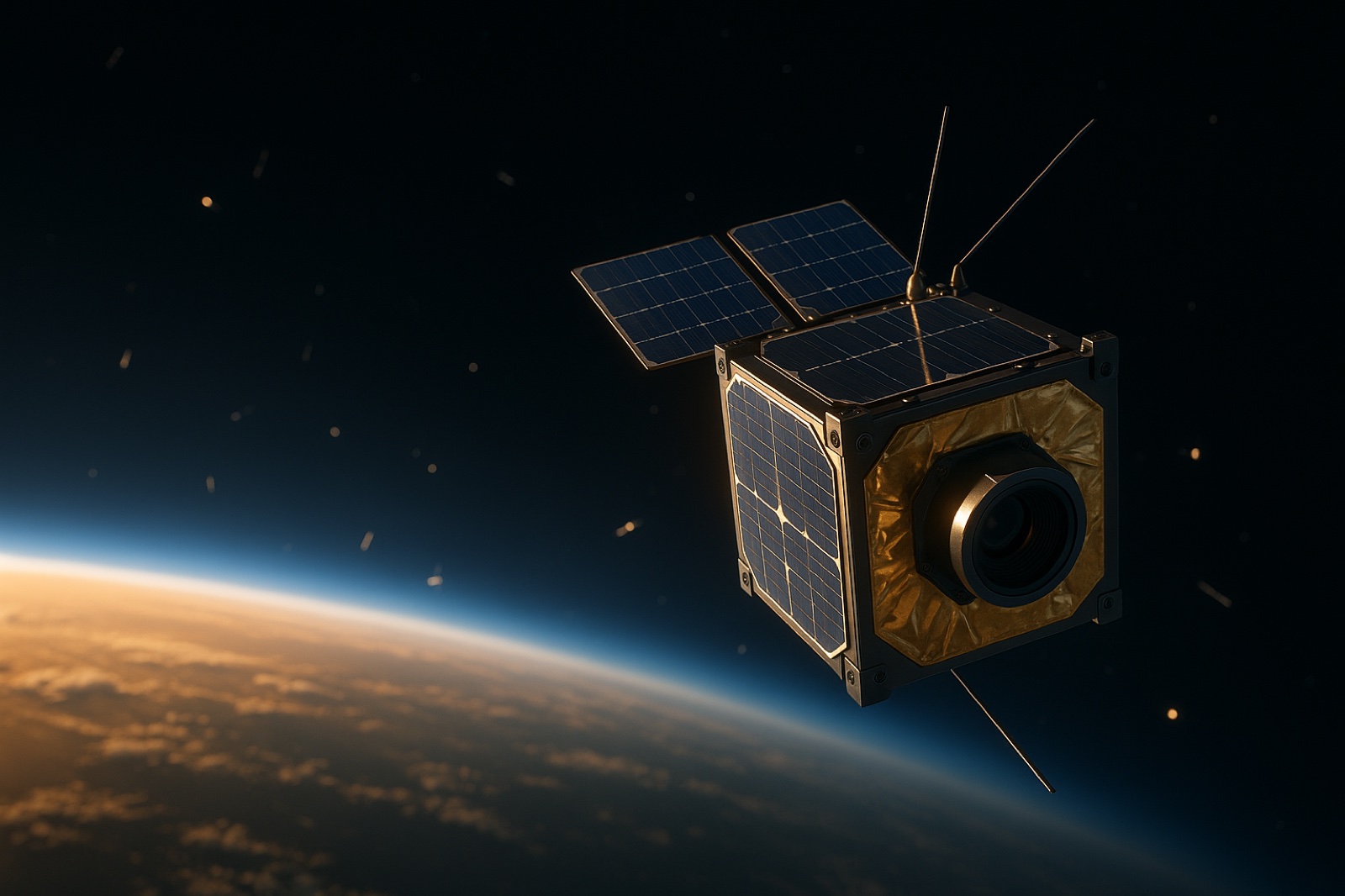
Every satellite carries a small camera called a star tracker. Its normal job is not to tell the spacecraft where it is. Its job is to tell the spacecraft which way it is facing. It stares at the distant stars, matches the pattern, and reports back: you are pointed this way.
Those are two very different questions. Which way am I facing is not the same as where am I.
So the team pointed that same camera at something else entirely. Not the far-off stars. The near stuff. The clutter. Other satellites, and orbital debris — the dead, the broken, the leftover pieces of everything humanity has already put up there.
Then they loaded a catalogue onto the spacecraft: roughly 20,000 known space objects and where each one was predicted to be. And they let it look.
The spacecraft spotted objects with its camera, matched them against the catalogue, and worked backwards. If that one is there, and that one is there, and that one is there — then I must be here.
No signal. No ground station. Nothing sent to it. It found itself using things that were already in view.
NASA describes this carefully, and the careful wording is the interesting bit: this is a first for spacecraft using optical cameras to navigate by their position relative to other objects in space. Not a first for navigation. A first for doing it this particular way — by the junk.
The Part Nobody Was Promised
Now the result that makes this more than a clever trick.
Over a three-day stretch, with no one on the ground stepping in, FALCON improved the known orbits of more than 200 of those objects. NASA reported that the spacecraft’s own onboard estimates ended up more accurate than the catalogue data it had been given in the first place.
Read that again slowly.
It was handed a map. It used the map to find itself. And in the process of finding itself, it made the map better.
It did not just get back what it had lost. It ended up knowing more than it was given.
Why This Matters More the Farther You Go
There is a plain engineering reason all of this is urgent, and it has nothing to do with philosophy.
GPS was never built for deep space. It was built to point down at Earth. Go far enough — out to the Moon, and well beyond — and the signal gets weak, unreliable, or simply is not there. Anything travelling that far has to know where it is without being told.
Which means the skill NASA was testing here is not a backup plan. For everything past a certain distance, it is the only plan. It is the same problem in a different form as the one that shows up whenever a mission has to look after itself — as NASA found out when it sent a spacecraft to rescue a falling telescope and the rescuer broke too. Out there, help is slow and the spacecraft is on its own.
It also says something about scale that is easy to skim past. Twenty thousand objects sounds like a lot until you remember what surrounds them. If you have ever wondered how old the universe actually is, you already know the feeling — the numbers get big fast, and the mind slides right off them. A satellite has no such luxury. It has to pick individual specks out of all that and be right about them.
Finding Yourself When Nothing New Is Coming In
There is an old habit, much older than satellites, that works almost exactly the same way.
When things go quiet — when no new answer is arriving, no one is telling you which way to go, and the sky seems to have stopped sending anything — the modern instinct is to wait. Wait for a sign. Wait for the signal to come back on.
The older instinct is different. It is to stop waiting for new information and go carefully back over what is already known to be true. Not fresh news. Old news, looked at properly. People have been steadying themselves before God this way for thousands of years, long before anyone had language for it: not asking for a new sign, but going back over the ones already given, and finding their position somewhere in the middle of them.
And the strange thing — the thing that matches the engineering almost too neatly — is what people who do that tend to report afterwards. Not that they simply got back to where they had been. That they came out the other side seeing more clearly than before the quiet started.
The catalogue gets corrected in the dark stretch. It usually does.
What Starling Does Next
The experiment is not finished. Later in 2026, NASA plans to let all four Starling spacecraft share what they are seeing with each other, so the swarm can work out its position together rather than each satellite doing it alone.
Four sets of eyes, comparing notes, none of them being told anything from home.
That may end up being the more useful result. But the one from these three days is the one that sticks. A satellite went quiet, looked at the ordinary broken things that happened to be nearby, and not only worked out where it was — it improved the record of everything it looked at.
Nothing new was sent. Nothing new was needed. The useful thing was already in frame.
Most of us spend a fair amount of energy hunting for a signal that will finally tell us where we stand. It is worth noticing how often that hunt is itself the thing in the way — something worth sitting with if you have ever felt the pull of chasing a sense of purpose instead of letting it find you.
A Question Worth Sitting With
If you had to find your way with nothing new coming in — no map, no directions, no one to ask — would you rather have a long list of everything already around you, or one single thing you knew for certain was fixed?
There is no right answer, and people split on this more evenly than you would think. Tell us which one you would pick, and why. We read every reply.
Share This
Worth passing along if it stuck with you:
NASA asked a satellite to work out where it was with no signal at all. It navigated by space junk — then made the map better than the one it was given. https://bgodinspired.com/index.php/bgodinspired-news/bgodinspired-technology-news/nasa-satellites-navigate-without-gps/
A satellite’s star tracker normally looks at distant stars to know which way it is facing. NASA pointed it at nearby debris instead — and it worked out where it was. Being lost, it turns out, is where the map got better. https://bgodinspired.com/index.php/bgodinspired-news/bgodinspired-technology-news/nasa-satellites-navigate-without-gps/
Favourite detail from this: the spacecraft did not just find itself using the catalogue it was given. It corrected the catalogue. Three days, 200-plus objects, nobody on the ground helping. https://bgodinspired.com/index.php/bgodinspired-news/bgodinspired-technology-news/nasa-satellites-navigate-without-gps/
Questions People Ask About GPS-Free Navigation
How do satellites navigate without GPS?
In NASA’s FALCON experiment, a satellite used its onboard camera to spot other satellites and pieces of orbital debris, matched what it saw against a stored catalogue of roughly 20,000 known space objects and their predicted orbits, and then worked backwards from those sightings to calculate its own position. No GPS signal and no ground station were involved. The technique is a form of optical navigation, meaning the spacecraft navigates by what it can see rather than by a signal sent to it.
What is FALCON on NASA’s Starling mission?
FALCON stands for Fast Autonomous Lost-in-space Catalog-based Optical Navigation. It is a flight experiment run jointly by NASA and EraDrive, a startup spun out of Stanford University, aboard NASA’s Starling mission — a swarm of four small satellites launched in 2023 and managed by NASA’s Ames Research Center. NASA announced the successful demonstration in August 2026, describing it as a first for spacecraft using optical cameras to navigate by their position relative to other objects in space.
What does “lost in space” mean for a spacecraft?
“Lost in space” is a technical term in navigation engineering. It describes a system that has to determine its own position completely from scratch, with no prior estimate to refine and no external source telling it where it is. This is harder than ordinary navigation, which usually starts from a rough known position and corrects it. A spacecraft in the lost-in-space condition begins with nothing.
Why doesn’t GPS work at the Moon or in deep space?
GPS satellites were designed to broadcast toward Earth, so their signals are aimed at users relatively close to the planet. At lunar distances and beyond, those signals become weak, unreliable, or unavailable entirely. Missions travelling that far therefore need a way to determine their own position without receiving GPS, which is one of the main reasons NASA is testing optical navigation methods such as FALCON.
Did the FALCON experiment improve the space object catalogue?
Yes. NASA reported that over a three-day period, FALCON improved the known orbits of more than 200 space objects without any intervention from operators on the ground, and that the spacecraft’s onboard position estimates for those objects became more accurate than the existing catalogue data it had been loaded with. In other words, the spacecraft did not only locate itself using the catalogue — it refined the catalogue in the process.