 0
0
 0
0
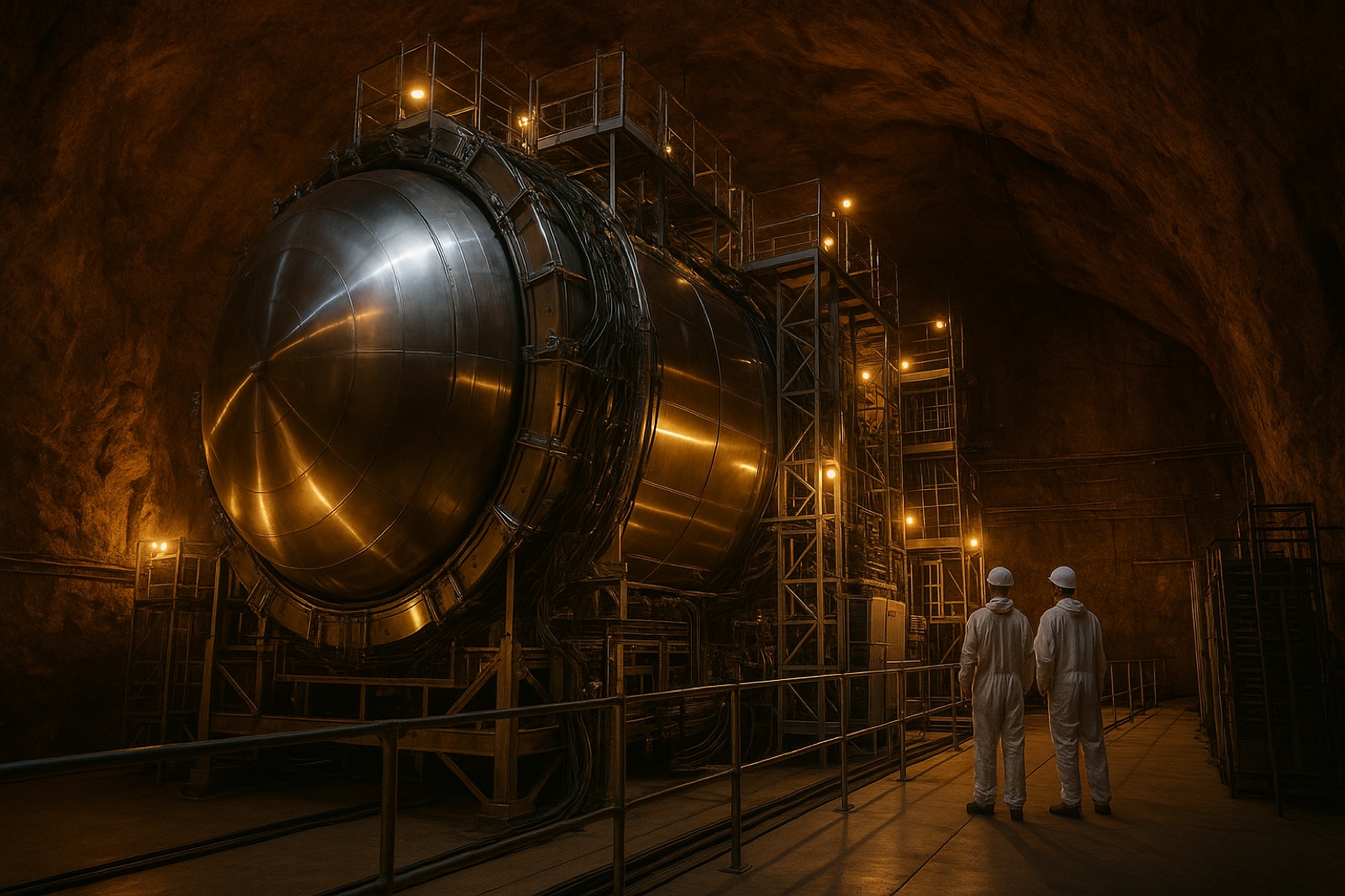
Nearly a mile below the surface of South Dakota, in a cavern hollowed out of old gold-mining rock, sits a tank holding ten tonnes of liquid xenon. It is chilled, shielded, and almost perfectly still. It has spent years waiting to be touched by something no one has ever seen.
On 1 September 2026, the scientists who built it announced that something touched it. Once.
The dark matter signal they found is a single flash — one particle interaction they cannot account for. And the very first thing the team did in public was explain, carefully, why it might still turn out to be nothing at all.
What the LZ experiment actually recorded
The instrument is called LUX-ZEPLIN, or LZ. It is run by roughly 250 scientists and engineers from 39 institutions, spread across the United States, the United Kingdom, Portugal, Switzerland, Australia and South Korea.
It lives about 1,600 metres underground for a simple reason: rock is a filter. The surface of this planet is showered constantly with particles from space, and a mile of stone blocks nearly all of them. What is left is quiet enough that one unexplained flash actually counts as news.
Working through 220 days of data recorded between March 2023 and April 2024, the team found exactly that. One event. A nuclear recoil of roughly 248 keV, sitting in a corner of the data where almost no background was expected. Statistically it lands at 2.6 sigma — meaning there is around a 0.5% chance that ordinary, known sources produced it.
If it really was dark matter, the particle would have to be a heavy one. At least 200 GeV/c², which is more than 200 times the mass of a proton.
“We’re very intrigued to see this event in the data, in the region where we expect dark matter to show up and the competing backgrounds are very low,” said Rick Gaitskell, a professor at Brown University and spokesperson for the LZ collaboration.
Why this dark matter signal is not a discovery
A 0.5% chance of being a fluke sounds convincing. In most of life, it would be. You would act on odds like that without thinking twice.
In particle physics it is nowhere near enough. The threshold for announcing a discovery is 5 sigma, a vastly stricter bar than 2.6 — and that gap is not bureaucratic caution. It exists because the field has been burned. Promising hints have appeared before, looked strong, and then quietly dissolved once more data arrived. So physics built the disappointment into the rules.
“We understand our detector and the backgrounds so well that even a single outstanding event, like the one we found, is important,” said Sam Eriksen, a senior research associate at the University of Bristol. “We expect dark matter events to be extremely rare, so only a handful could mark the first detection of WIMP dark matter.”
And then, immediately, the brake:
“With only one event, we don’t want to get ahead of ourselves. We are not claiming to have seen dark matter. But we have seen something interesting that we want to share with the scientific community for their input,” Gaitskell said.
That is the most exciting result of a career, announced with a warning label attached by the people who found it.
The detail almost every write-up skipped
Look at the dates again. The data was recorded between March 2023 and April 2024. The announcement came in September 2026.
The flash had been sitting in the files the whole time. Nothing new arrived. What changed was where they looked, and how hard they tried to make it go away.
“This was a detailed study in a region we hadn’t explored within this dataset, and we spent months of additional effort to understand all the possible causes of background events,” Eriksen said.
Read that sentence slowly. Months of additional effort to understand all the possible causes. Those were not months spent building a case for dark matter. They were months spent trying to find something ordinary — a stray bit of radioactivity in the steel, a detector quirk, a mistake in the maths — that would explain the flash away and take the discovery back.
“A huge amount of work has been done by the entire team with countless hours being spent to further our understanding of possible background processes, but to date none provide a convincing explanation,” said Henning Flaecher, a professor of physics at the University of Bristol.
The event is interesting only because it survived the people who most wanted to kill it — who happened to be the same people who found it. That is a rarer thing than the flash. It is the same instinct behind the NASA satellites that learned to navigate by watching space junk, then went back and improved the very map they had been given.
Nobody has ever seen the thing they are hunting
Here is the part that is easy to forget while reading about sigmas and keV. Dark matter accounts for something like 85% of the mass in the universe. It has never once been directly detected.
Everything known about it is known from what it moves. Galaxies spin faster at their edges than their visible matter can possibly explain. Light bends around clusters that look far too light to bend it. The most abundant ingredient in everything is inferred entirely from its effects on the small, bright, visible remainder.
Which means the picture we have of the universe is mostly a picture of an absence with a shape. If that sort of thing pulls at you, the How Old Is the Universe? explorer is a free walk through what we do and do not know about the age of everything, and the planets that are the size of Jupiter and nearly empty inside are a reminder that size and substance are not the same measurement.
It is a strange position to hold, and it is not a new one. People have described God in almost exactly these terms for thousands of years — not as something you could put in a jar and weigh, but as something you notice by what it moves. What is striking is not that the two claims rhyme. It is that both are held honestly only by people willing to say plainly how much they still cannot prove.
What happens next
More data. That is the whole plan, and it is enough. LZ keeps running, the exposure keeps growing, and the single event either gathers company and grows in significance, or it thins out and disappears into the noise it may have always been.
“It’s an incredibly exciting time, the kind of event every astro-particle physicist dreams of, and we can’t wait to analyse more data to see if additional candidate events appear,” Flaecher said.
One of two things is true a mile under South Dakota. Either 250 people just caught the first direct glimpse of most of the universe, or they caught a very good imitation of one. Nobody knows yet, and none of them pretended otherwise.
That already seems worth something, whichever way the data falls. A group of people found the most thrilling result of their working lives and then spent months trying to prove themselves wrong before they told anyone about it. The full announcement is available from Berkeley Lab.
Questions people are asking about the LZ dark matter signal
What did the LZ experiment find in September 2026?
The LUX-ZEPLIN (LZ) dark matter experiment reported a single particle interaction that its scientists cannot explain using known background sources. The event was a nuclear recoil of about 248 keV, found in data collected over 220 live days between March 2023 and April 2024. Its statistical significance is 2.6 sigma, meaning roughly a 0.5% chance that ordinary known sources caused it. The collaboration announced the result on 1 September 2026 and explicitly stated it is not claiming to have detected dark matter.
Has dark matter been detected?
No. As of September 2026, dark matter has never been directly detected. The LZ result is a single unexplained event, not a detection. Particle physics requires a statistical significance of 5 sigma before a discovery can be claimed, and the LZ event sits at 2.6 sigma. LZ spokesperson Rick Gaitskell said plainly: “We are not claiming to have seen dark matter.”
What is dark matter and how do scientists know it exists?
Dark matter is a form of matter that accounts for approximately 85% of the mass in the universe but does not emit, absorb or reflect light, which makes it invisible to telescopes. Scientists infer its existence from its gravitational effects: galaxies rotate faster at their outer edges than their visible matter can account for, and light bends around galaxy clusters more strongly than their visible mass would cause.
Why is the LZ detector built a mile underground?
The LZ detector sits about 1,600 metres below ground at a former gold mine in South Dakota because rock blocks cosmic radiation. The Earth’s surface is constantly struck by particles from space that would swamp the extremely rare signal a dark matter particle would produce. A mile of stone filters out nearly all of that interference, leaving the detector quiet enough that a single unexplained event is scientifically meaningful.
What does 2.6 sigma mean?
Sigma is a measure of statistical significance. A result of 2.6 sigma corresponds to roughly a 0.5% probability that the observation was produced by known background processes rather than something new. Particle physics does not treat that as a discovery. The field’s accepted threshold for announcing a discovery is 5 sigma, a far stricter standard adopted because promising lower-significance hints have repeatedly faded as more data was collected.
What do you think?
Physics decided long ago that being 99.5% sure is not sure enough to say something out loud. Almost no other field — and almost nobody in daily life — holds that line. Is that level of caution admirable, or does it slow down the things we most want to know? Tell us where you land in the comments.
Share this
- Scientists a mile under South Dakota found one flash they cannot explain. Then they spent months trying to prove themselves wrong before telling anyone. https://bgodinspired.com/index.php/bgodinspired-news/bgodinspired-science-news/dark-matter-signal-lz-experiment/
- 85% of the mass in the universe has never been seen. Everything we know about it, we know from what it moves. https://bgodinspired.com/index.php/bgodinspired-news/bgodinspired-science-news/dark-matter-signal-lz-experiment/
- “We are not claiming to have seen dark matter.” That is how a team announced the most exciting result of their careers — and honestly, I respect it more for that. https://bgodinspired.com/index.php/bgodinspired-news/bgodinspired-science-news/dark-matter-signal-lz-experiment/