 0
0
 0
0
Astronomers Discover First Stellar Stream Beyond Milky Way, Shedding Light on Dark Matter
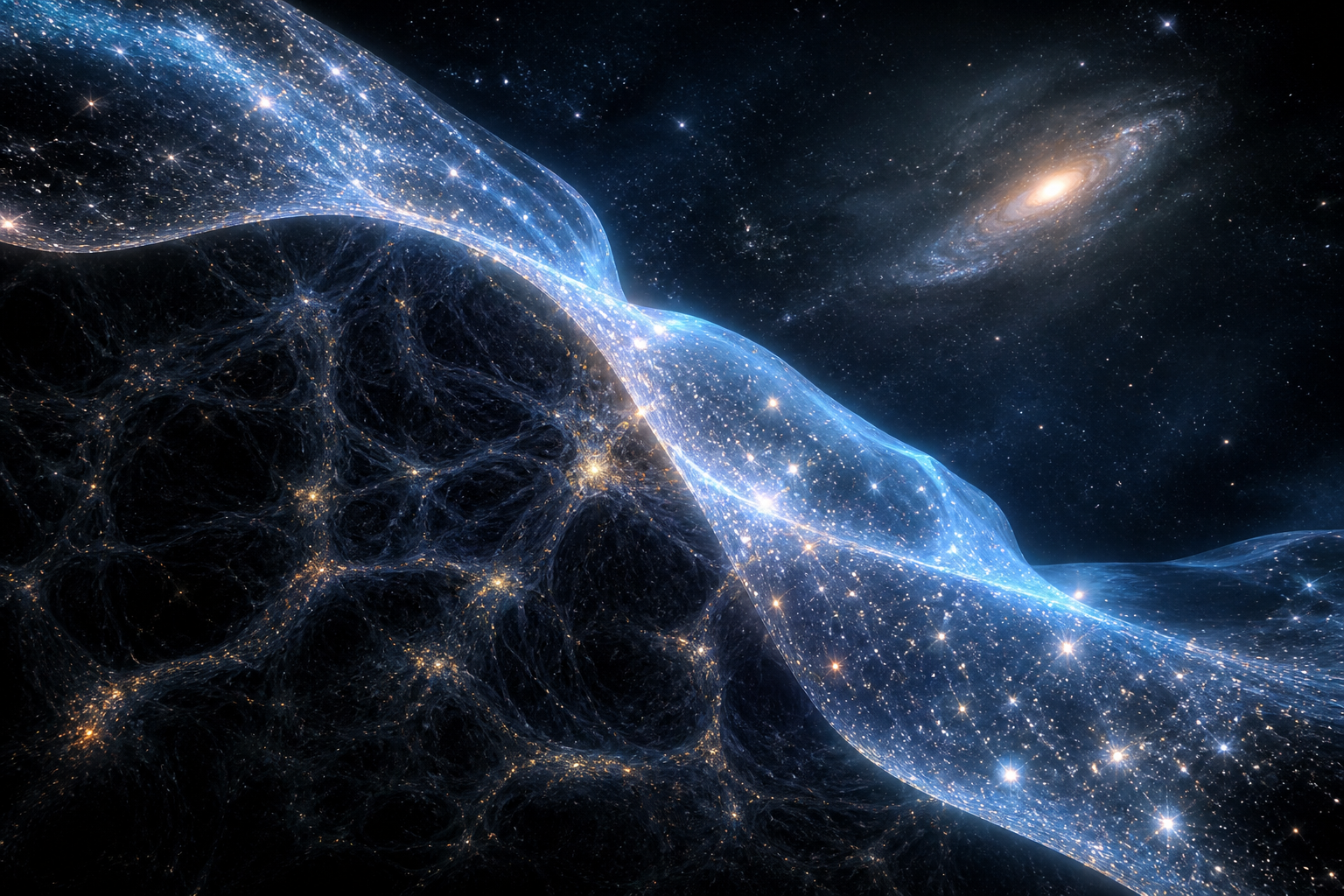
For billions of years, an ancient cluster of stars has been gradually dispersing, creating a faint, narrow ribbon across space. This delicate structure offers astronomers a groundbreaking opportunity to delve into one of the universe’s greatest mysteries: dark matter.
In a pioneering study published on August 12 in Nature, an international team, featuring Northwestern University astrophysicist Tjitske Starkenburg, has identified the first stellar stream of its kind observed outside the Milky Way. While astronomers have long theorized that such streams exists around other galaxies, their extreme faintness has made detection a significant challenge.
What makes this discovery particularly remarkable is not just the identification of a stellar stream, but its potential to provide insights into dark matter—an elusive component that constitutes roughly 85% of the universe’s total mass, yet remains invisible. By analyzing the stream’s unique shape, researchers reconstructed the gravitational field of its host galaxy and gleaned valuable information about dark matter’s impact on stellar paths.
This breakthrough can be likened to the biblical pursuit of wisdom—a theme deeply rooted in Proverbs, where it’s written, “In the same way, wisdom also calls out to you; it stands at the entrance to a city or at the gates of your town.” (Proverbs 1:20). Just as wisdom is to be sought after, understanding the universe gives us a glimpse into the grandeur of creation.
A New Era in Dark Matter Research
Globular clusters, which are densely populated groups of stars bound by gravity, regularly release stars as they orbit their host galaxies. Instead of scattering chaotically, these stars follow almost identical paths, forming thin stellar streams that retain evidence of the gravitational forces they’ve encountered.
Prior to this study, astronomers had identified numerous streams within the Milky Way but had yet to detect a comparable structure in another galaxy. The breakthrough occurred through archival observations from NASA’s Hubble Space Telescope. Researchers noticed a discernible, faint arc resembling a stellar stream around the ultra-diffuse galaxy UGC 9050-Dw1, located approximately 115 million light-years from Earth—a dark canvas that made the dim stream more distinguishable.
Novel Insights into Dark Matter Distribution
This discovery heralds a new method for assessing dark matter beyond our galaxy. Dark matter’s elusive nature—being invisible and detectable only through its gravitational effects—has made it a subject of intrigue and speculation. Utilizing the identified stellar stream, researchers conducted extensive simulations to explore how varying globular cluster characteristics and dark matter distributions matched the observed stream’s features.
Kiel Holm of the University of Copenhagen noted, “Our results reaffirm previous studies regarding dark matter in this ultra-diffuse galaxy, demonstrating that we’re employing a novel method to measure it effectively.”
Future Implications for Astronomy
While this study currently centers on a single galaxy, it opens avenues for exploring similar streams in diverse galactic environments. The potential to identify thin stellar streams—prized for their vulnerability to alterations by small dark matter concentrations—could yield critical insights. Starkenburg mentioned, “If we confirm that identifiable features in these streams are caused by dark matter, it could revolutionize our understanding of its distribution.”
Future observatories like the European Space Agency’s Euclid mission and NASA’s forthcoming Roman Space Telescope may facilitate further discoveries, broadening our cosmic perspective. The excitement is palpable: "It’s promising that we’ve utilized existing Hubble data to confirm this stellar stream, paving the way for future explorations.”
As we probe deeper into the cosmos, we are reminded of the interconnectedness of all creation, as taught by Jesus who emphasized the importance of understanding and caring for the world around us. Just as scientists unravel the fabric of the universe, we too can reflect on the divine design that underpins it all.
In the spirit of exploration and discovery, consider this invitation: what if, like the stars, we each have a unique path shaped by unseen forces? May this inspire us to seek wisdom and understanding, as well as an appreciation for the beauty found in both the heavens and our daily lives.
If you want to want to know more about this topic, check out BGodInspired.com or check out specific products/content we’ve created to answer the question at BGodInspired Solutions
If positive Biblical wisdom matters to you, I’d love your support of the mission
Q&A about
Could the discovery of dark matter align with my faith in God’s creation?
Understanding dark matter can enrich our appreciation of God’s intricate design in the universe. Hebrews 11:3 reminds us that by faith we understand that the universe was formed at God’s command, emphasizing that science can reveal His handiwork rather than contradict it.
How does the idea of a ghostly ribbon of stars relate to the hope we have in Christ?
The ribbon of stars can be seen as a metaphor for God’s guidance and the light of Christ in our lives. Just as He calls us to be the light of the world (Matthew 5:14), the stars remind us that there is hope and beauty even in mystery, encouraging us to trust in His plan.
Does the concept of dark matter suggest that there’s more to life than we can see?
Absolutely, the existence of dark matter reflects the biblical truth that our understanding is limited. Colossians 3:2 encourages us to set our minds on things above, reminding us that spiritual realities often transcend our physical perceptions, inviting us to seek deeper truths.
How can science and faith coexist when exploring phenomena like dark matter?
Science offers insights into God’s creation, complementing our faith rather than opposing it. Romans 1:20 teaches us that God’s invisible qualities are clearly seen in what has been made, suggesting that exploring dark matter can lead us to a greater understanding of His majesty and power.