 0
0
 0
0
Quick Answer
The main Hebrew noun for goodness is tuv (טוּב), pronounced toov, Strong’s H2898. It comes from the same root as tov, the “good” of Genesis 1. Tuv names goodness you can actually receive: good things, the best of the land, prosperity, and gladness. In the Old Testament, God’s goodness is not only a quality God has. It is something God gives away.
Word Study: Where It Comes From
Tuv grows from the three-letter Hebrew root ט-ו-ב (t-w-b). The same root gives us the verb tov (“to be good, to be pleasing”), the adjective tov (“good”), and the noun tuv (“goodness”). It is one of the most common word families in the Hebrew Bible. Its first appearance sets the tone for all the rest: “And God saw the light, that it was good.”
When most English speakers hear “goodness,” they think of moral goodness, meaning a good person who does the right thing. Hebrew tuv includes that, but it starts somewhere more physical. In Genesis 24:10, Abraham’s servant sets out with “all the goods of his master” in his hand, and the word behind “goods” is tuv. In Genesis 45, Pharaoh promises Joseph’s family “the good of the land of Egypt,” meaning its best and most fertile ground. Isaiah 1:19 promises the willing and obedient that they “shall eat the good of the land.” So the word can describe something you can carry, farm, and eat.
Tuv also reaches inward. Deuteronomy 28:47 warns Israel about serving God without “gladness of heart” (tuv levav, literally “goodness of heart”). In Hebrew, goodness is not a cold moral rating. It covers the good thing itself and the joy of having it.
That is why the word matters. When the Psalms praise “the goodness of the LORD,” they are not only saying that God is ethically upright. They are saying God is the source of every good thing a person can taste, harvest, and rejoice in.
Want to taste that goodness day by day? Start a life-changing journey with Jesus through easy-to-read devotionals that bring His words, actions, and love to life. 30 Days Walking with Jesus is built for new Christians learning how to start and for existing Christians who want to rekindle the connection. Grab the free 3-day sample above.
Where This Word Appears in the Bible
| Reference | KJV Text | What Tuv Adds |
|---|---|---|
| Exodus 33:19 | “I will make all my goodness pass before thee, and I will proclaim the name of the LORD before thee” | God’s answer when Moses asks to see God’s glory |
| Psalm 27:13 | “I had fainted, unless I had believed to see the goodness of the LORD in the land of the living.” | Goodness expected here and now, not only after death |
| Psalm 31:19 | “Oh how great is thy goodness, which thou hast laid up for them that fear thee” | Goodness stored up like a harvest in a barn |
| Genesis 45:20 | “Also regard not your stuff; for the good of all the land of Egypt is yours.” | The everyday meaning: the best of the land |
| Jeremiah 31:12 | “and shall flow together to the goodness of the LORD, for wheat, and for wine, and for oil” | God’s goodness spelled out as grain, wine, and oil |
Verse Deep Dive: Exodus 33:18-19
Moses has just come through the worst crisis of the wilderness: the golden calf, the broken tablets, and a nation nearly lost. Then he makes the boldest request in the Torah:
“And he said, I beseech thee, shew me thy glory.” (Exodus 33:18)
The word for glory is kavod, which carries the idea of weight and overwhelming presence. Moses is asking to see God at full strength.
God’s answer does not repeat his word. God doesn’t say “I will make my glory pass before thee.” God says:
“I will make all my goodness pass before thee, and I will proclaim the name of the LORD before thee; and will be gracious to whom I will be gracious, and will shew mercy on whom I will shew mercy.” (Exodus 33:19)
“All my goodness” is kol-tuvi. Moses asked for glory, and God offered goodness. In this exchange, the fullest self-revelation God is willing to give a human being is described as tuv. In the next chapter, when God actually passes by, what Moses hears is not a description of power. He hears “merciful and gracious, longsuffering, and abundant in goodness and truth” (Exodus 34:6).
This changes how the passage reads. We often picture God’s glory as blinding light and thunder, something to hide from. Exodus 33 doesn’t deny that. Moses still has to be sheltered in the cleft of the rock. But it tells us what is at the center of that glory: goodness. The weight of God’s presence is the weight of good.
Not All “Goodness” Is the Same
English Bibles use the word “goodness” for several different Hebrew words. Knowing which one sits underneath a verse changes what it means:
- Tuv (טוּב, H2898): the noun this page is about. It means goodness as substance: good things, prosperity, the best of something, gladness. Examples: “the goodness of the LORD” (Psalm 27:13) and “all my goodness” (Exodus 33:19).
- Tov (טוֹב, H2896): the adjective “good.” This is the word in Genesis 1, where God sees that it was “good” and then “very good” (Genesis 1:31). It is also the word in Psalm 23:6, “Surely goodness and mercy shall follow me,” where the adjective is used as a noun.
- Chesed (חֶסֶד, H2617): covenant loyalty, steadfast love. This one surprises people. In Exodus 34:6, the KJV’s “abundant in goodness and truth” is literally “abundant in chesed and emet.” So the most famous “goodness” verse in the Torah does not actually use tuv. Isaiah 63:7 puts the two words side by side: “the great goodness toward the house of Israel,” given “according to the multitude of his lovingkindnesses.”
Put simply: tov describes something as good, tuv is the good itself, and chesed is the loyal love that keeps giving it.
Why the Original Word Changes the Meaning
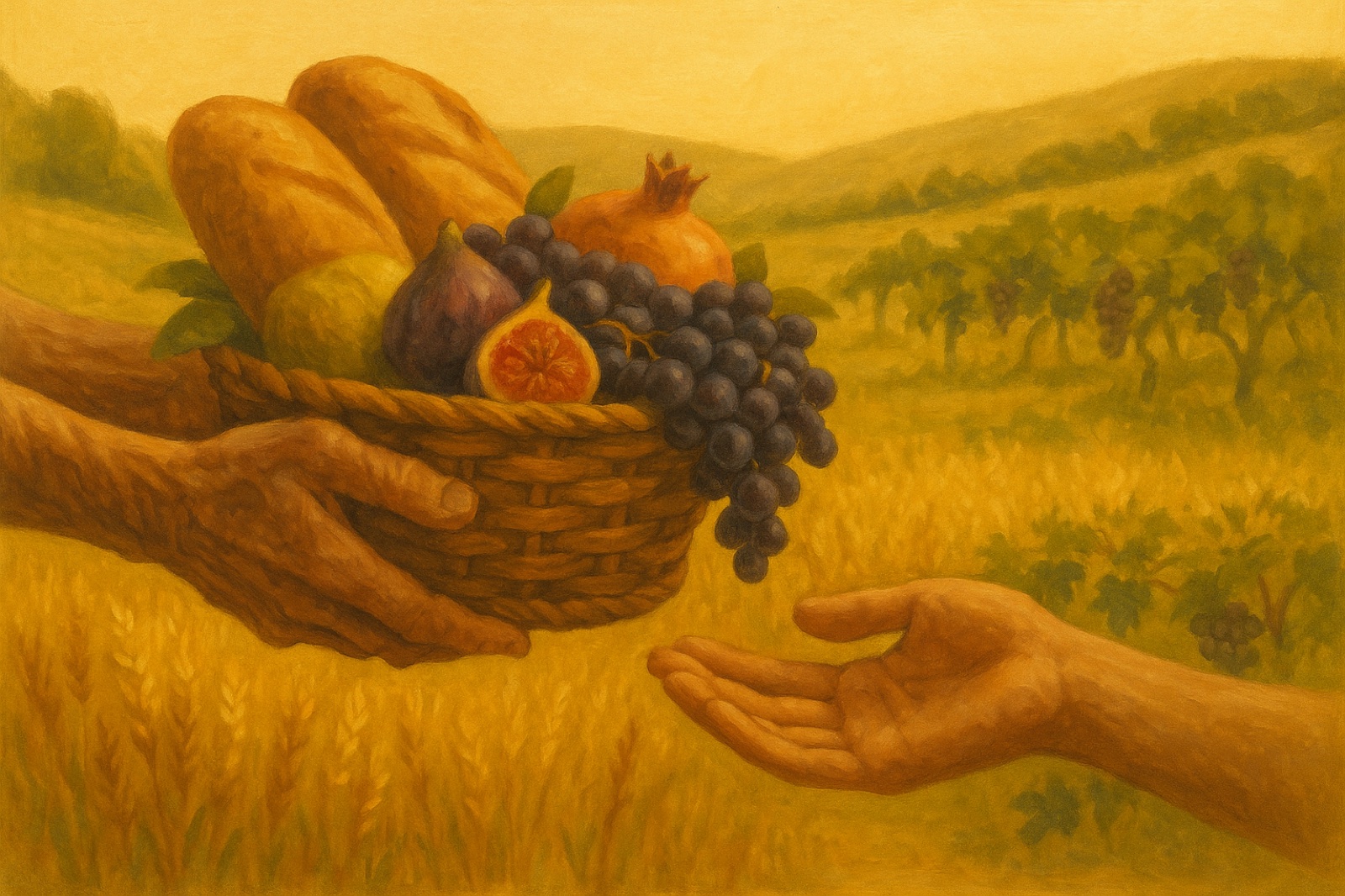
When you read “the goodness of the LORD” in English, it is easy to hear an abstract virtue, as if God simply has a good character. That is true, but the Hebrew is more concrete. Tuv is goodness you could put in a basket.
So when David writes, “I had fainted, unless I had believed to see the goodness of the LORD in the land of the living,” he is not only hoping for heaven someday. He expects to see God’s tuv show up in real life, on this side of the grave. And when Jeremiah describes God’s goodness as wheat, wine, and oil, he isn’t lowering the idea to groceries. He is saying that God’s goodness is always on its way into someone’s hands.
It also reframes Exodus 33. If the deepest thing God shows Moses is tuv, then God’s goodness is not a side feature of God’s character. It is the center that the glory surrounds.
Living It Out
Psalm 31:19 says God’s goodness is “laid up” for those who fear God, stored like grain in a storehouse. This week, look for tuv in its plain, Hebrew sense: a meal, a paycheck, a friend who showed up, a morning you didn’t expect to get. Name one each day as “the goodness of the LORD in the land of the living.” Then pass some tuv along. Goodness in Hebrew is something you hand to someone else.
Journal Prompts
- Moses asked to see God’s glory and was offered God’s goodness (Exodus 33:18-19). What do you usually picture when you think of God’s glory, and how would it change things if goodness were at the center of that picture?
- David said he would have fainted unless he believed he would see God’s goodness “in the land of the living” (Psalm 27:13). Where are you waiting to see God’s tuv right now, in this life rather than someday?
- Tuv can mean “the good of the land,” something you can eat, carry, and share. What concrete good thing has God put in your hands that you could pass on to someone this week?
Prayer
Lord, I have often treated Your goodness as an idea, when You meant it as a gift I could hold. Thank You for every tuv You have laid up for me: bread on the table, breath in my lungs, people who love me. Like Moses, I want to see Your glory. Show me Your goodness, the way You promised, and help me to believe I will see it in the land of the living. Make me glad of heart, and make my hands open enough to pass Your goodness on. Amen.
Share This
- “The Hebrew word for goodness, tuv, can mean ‘the good of the land,’ goodness you can eat and hold. When Moses asked to see God’s glory, God offered ‘all my goodness.’ [Post URL]”
- “Psalm 27:13: ‘I had fainted, unless I had believed to see the goodness of the LORD in the land of the living.’ Not someday. Here. A short word study on tuv: [Post URL]”
FAQ
What is the Hebrew word for goodness?
The main Hebrew noun for goodness is tuv (טוּב), Strong’s H2898, pronounced toov. It comes from the same root as tov, the adjective “good” in Genesis 1. It can mean goodness, good things, prosperity, the best of something, or gladness of heart.
What is the difference between tov and tuv?
Tov is the adjective “good,” as in “God saw that it was good.” Tuv is the noun, goodness itself, often in a concrete sense like “the good of the land.” Both come from the same root, but tov describes something while tuv names the good thing.
Is “goodness” in Psalm 23:6 the word tuv?
Not exactly. “Surely goodness and mercy shall follow me” uses tov, the adjective “good,” used as a noun and paired with chesed (“mercy”). Psalm 27:13 (“the goodness of the LORD”) and Psalm 31:19 (“how great is thy goodness”) use tuv.
Does tuv only mean moral goodness?
No. Tuv includes moral goodness, but it often refers to tangible good things, such as goods, the best produce of the land, and prosperity, as well as inner gladness. That range is why God’s goodness in the Old Testament is so often pictured as something God gives.
Walk with Jesus every day. 30 Days Walking with Jesus offers easy-to-read devotionals that bring His words, actions, and love to life, for new Christians learning how to start and for anyone wanting to rekindle the connection. Start with the free 3-day sample above.