 0
0
 0
0
Every year, farms around the world produce more sheep’s wool than anyone actually wants. Wool that’s too coarse for clothing, too costly to process, or just surplus from shearing season gets stockpiled, burned, or buried. It’s one of agriculture’s quiet waste problems — a material nobody’s fighting over.
Which is what makes this next part so strange. Researchers just found out that this exact “problem” material — ordinary sheep’s wool bone healing scientists had never seriously tried — might be one of the best things we’ve discovered for helping broken bones grow back.
The Byproduct Nobody Wanted
Wool’s biggest advantage, it turns out, has nothing to do with keeping anyone warm. It’s built almost entirely out of keratin — the same tough, fibrous protein that makes up your hair, your fingernails, and a rhino’s horn. Keratin is strong, it’s stable, and there’s an enormous, cheap supply of it sitting in warehouses because nobody wanted the wool it came from in the first place.
A team at King’s College London, led by Dr. Sherif Elsharkawy of the university’s Faculty of Dentistry, Oral & Craniofacial Sciences, had a hunch that this overlooked protein might solve a real problem in medicine: how do you rebuild bone when the damage is too large to heal on its own?
How Scientists Turned Wool Into a Scaffold for New Bone
Right now, the material doctors reach for most often is collagen — a different structural protein, usually pulled from animal tissue. Collagen works, but it has real weaknesses. It’s relatively weak on its own, it breaks down faster than bone can rebuild around it, and it’s expensive to extract in the quantities medicine actually needs.
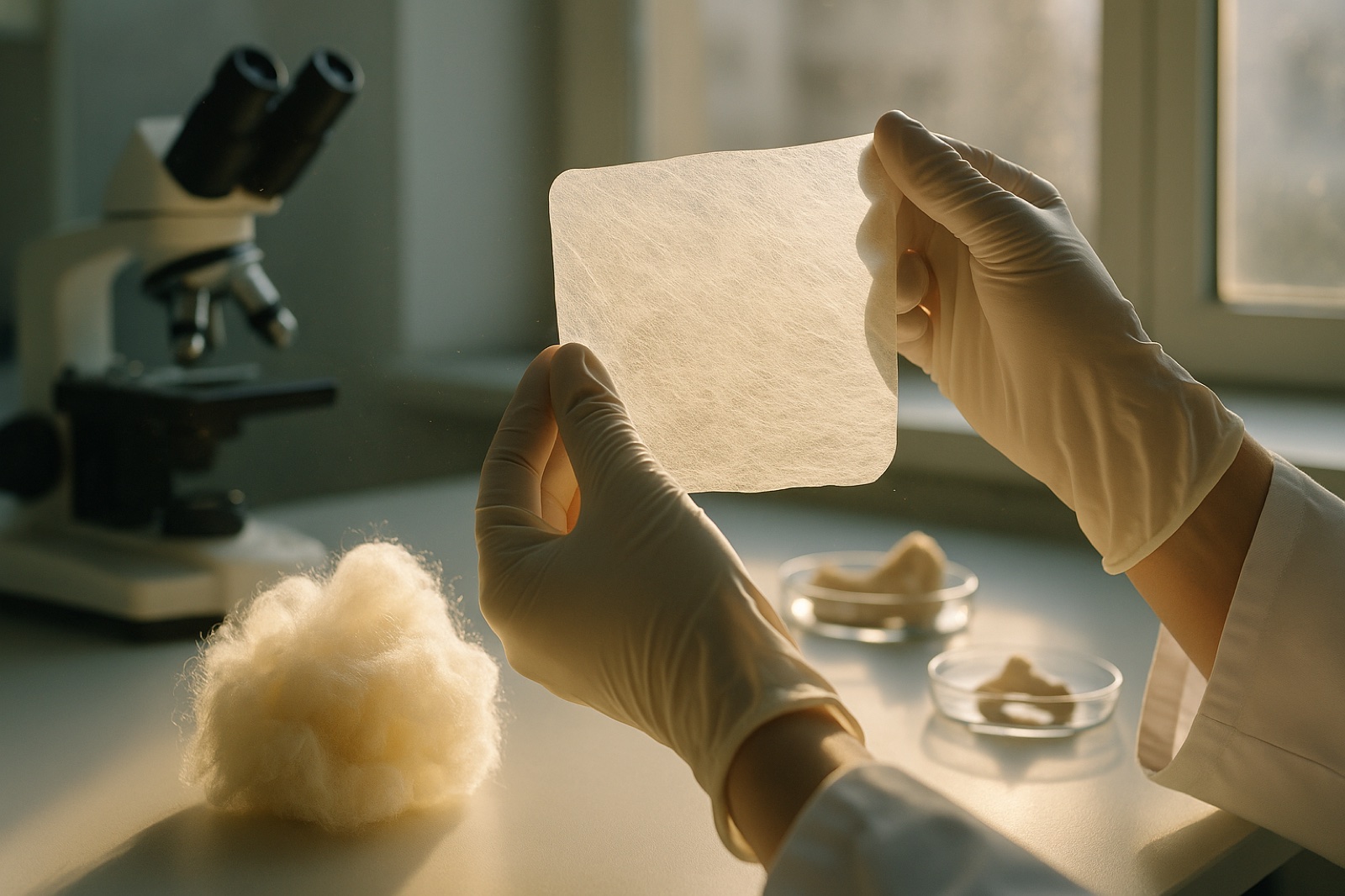
So Elsharkawy’s team extracted keratin from sheep’s wool and chemically treated it to build thin, stable membranes — scaffolds that could be placed directly over a bone injury. The idea was simple: give the body’s own repair process a sturdy, well-organized surface to build on, instead of asking it to fill the gap alone.
It’s part of a bigger pattern showing up across medicine lately — that the body is often better at healing itself than we’ve given it credit for, it just needs the right structure to work with. It’s the same idea behind the molecule scientists found that wakes your muscles’ own repair cells instead of replacing what they do.
What the Rat Trials Actually Found
The team tested the keratin membranes in rats with skull defects large enough that they wouldn’t have closed up naturally. After implanting the scaffolds, the new bone that grew back had unusually organized, well-aligned fibers — tissue that looked and behaved a lot more like healthy, natural bone than what collagen scaffolds typically produce.
Collagen still edged out keratin on one measure — it generated a slightly greater total volume of new bone. But structure matters just as much as volume when it comes to bone that actually needs to bear weight and hold up over time, and that’s exactly where the wool-based material pulled ahead.
“We’ve effectively demonstrated the technology in an animal model, which makes this much more than an early materials concept,” Elsharkawy said.
Why This Could Beat the Current Gold Standard
Beyond the science, there’s a practical case for keratin that’s hard to ignore. Wool is abundant, it’s a byproduct farms already produce whether or not anyone buys it, and turning it into a medical material is dramatically cheaper than extracting the same volume of usable collagen. A discarded resource turning into one of the more promising materials in bone repair isn’t just a nice detail — it’s part of why researchers are excited.
Sometimes the thing everyone already decided had no more use turns out to be the whole story. It happened with a set of megalodon bones that sat forgotten on a museum shelf for over three decades before anyone realized what they’d actually been holding onto the entire time. Wool might be having its own version of that moment right now.
What’s Next
To be clear about where this actually stands: the results so far come entirely from animal trials, not human patients. Nobody is getting a wool-derived bone graft at their next surgery. Researchers describe the findings as moving the technology “significantly closer” to real patients — which is genuine, meaningful progress — but there’s still a real distance between a successful rat trial and an approved human treatment.
Still, it’s a good problem to sit with for a minute: an entire industry treats this material as trash, and it may end up rebuilding human bone.
There’s a pattern that keeps showing up whenever someone actually bothers to look closely at what gets thrown away — the leftover has a way of turning out to matter more than whatever everyone was originally trying to make. It’s a quiet expectation woven through most faith traditions, that nothing offered up honestly is wasted, and that what gets set aside by the world can end up doing the most essential work of all. God has something of a track record, believers would say, of building what’s whole out of exactly what got discarded.
Maybe that’s worth remembering next time you’re staring at something you’ve already decided is used up — a relationship, a season, a version of yourself you thought had nothing left to give. The wool didn’t know it was going to end up holding a skull back together. It was just still there when someone finally looked twice.
Discussion Question
Do you think we’re too quick to decide something is “waste” before we’ve actually looked closely at it? What’s something in your own life you’d written off as used up — that ended up mattering more than you expected? Tell us in the comments below.
Share This
Copy and share this article’s link with any of these:
- Scientists just turned sheep’s wool into a material that heals broken bones better-organized than what doctors use now. Wool. The stuff nobody wants. Wild.
- Every year, farms throw away tons of wool because nobody wants it. Turns out it might be one of the best materials we’ve found for healing bone.
- I can’t stop thinking about this: researchers in London took sheep’s wool, literally a farming byproduct people pay to get rid of, and turned it into a scaffold that regrows bone in better-organized structure than the material currently used in surgery. Still early (animal trials only), but it’s one of those stories that makes you rethink what “useless” actually means.
Questions People Are Asking
What did scientists actually do with sheep’s wool?
Researchers at King’s College London extracted keratin, the structural protein inside wool, and chemically treated it to build membrane scaffolds that support new bone growth around injuries too large to heal on their own.
Does wool heal bones better than what doctors already use?
In animal trials, keratin scaffolds produced bone tissue with more organized, well-aligned fibers than collagen, the current standard material — though collagen still produced a slightly greater overall volume of new bone. Keratin also holds up longer during healing and is cheaper to extract than collagen.
Has this been tested on humans yet?
Not yet. The results so far come from tests on rats with skull defects. Researchers describe the findings as moving the technology “significantly closer” to real patients, but human trials haven’t started.
Why use wool instead of other materials?
Wool is an agricultural byproduct that farms already produce in huge quantities and often can’t sell or use. Turning it into a medical material gives value to something that’s usually discarded, and it avoids some of the cost and fragility problems that come with collagen.
Who led this research?
The study was led by Dr. Sherif Elsharkawy at King’s College London’s Faculty of Dentistry, Oral & Craniofacial Sciences, and was published in the journal Biomaterials Advances in August 2026. You can also read more on healing in Bible Verses About Healing: The Line Everyone Skips.