 0
0
 0
0
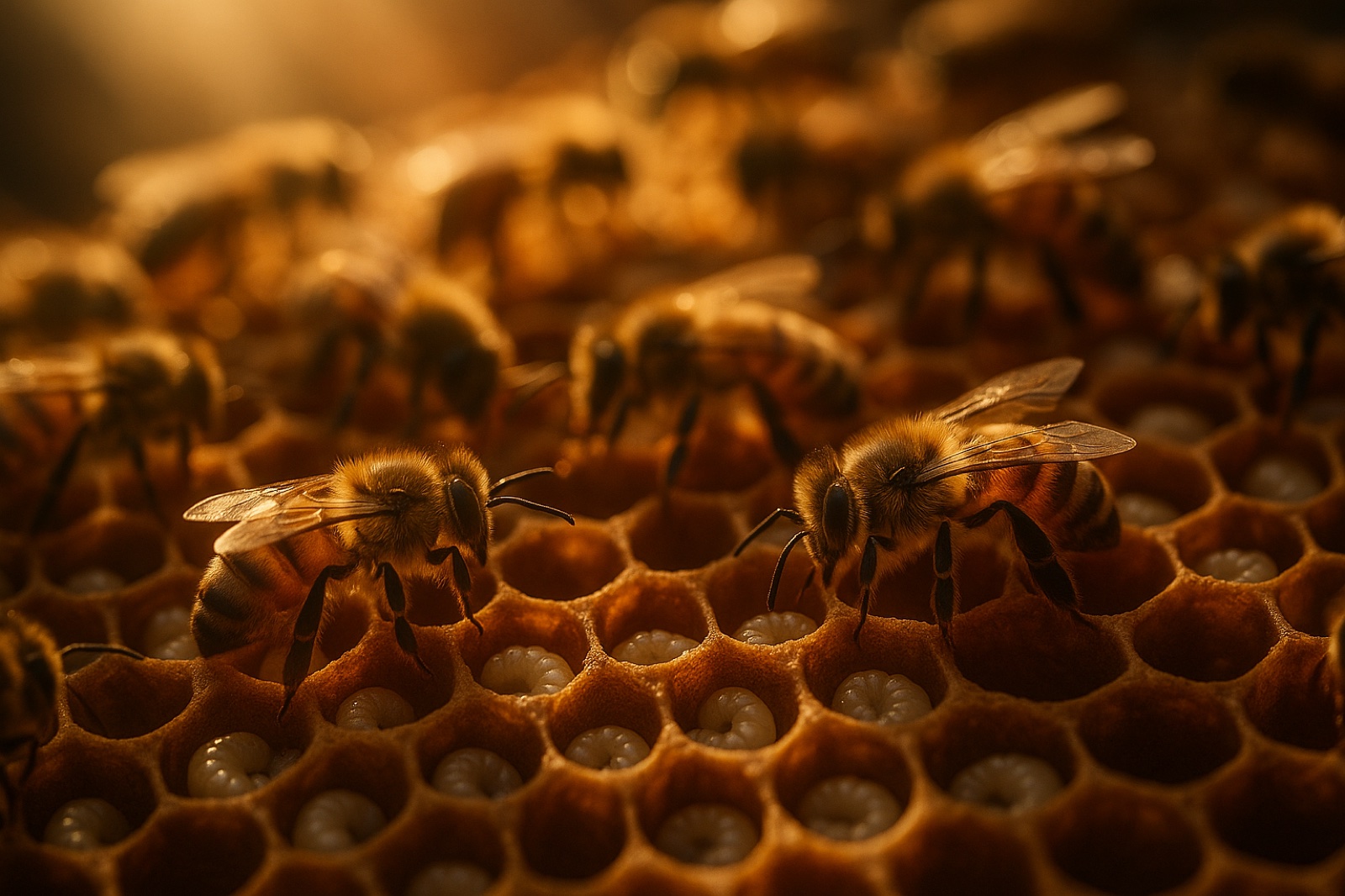
A honeybee never applies for a job. Nobody hands her a schedule. And yet, somehow, a colony of fifty thousand bees runs like a factory with perfect shift changes — nurses tending the youngest larvae, guards standing watch at the entrance, foragers flying miles for pollen — and almost nobody is doing the “wrong” job at the wrong time.
For decades, biologists chalked this up to something vague: pheromones, social cues, maybe just instinct. But a study published in 2026 in the Proceedings of the National Academy of Sciences, led by researchers at Heinrich Heine University Düsseldorf, found something far more specific. There’s a switch in a bee’s brain. It flips as she ages. And it decides, almost single-handedly, what her job in the colony will be.
The Brain Circuit Nobody Expected
The researchers focused on a set of neurons that express a gene called doublesex — a gene more commonly known for its role in determining sex characteristics in insects. In honeybees, it turns out, doublesex-expressing neurons do something else entirely: they help control age-related behavior.
Young worker bees spend their first days as nurses, tending to the queen and feeding larvae — a behavior scientists call “retinue behavior.” As they get older, their job changes. They become foragers, guards, or builders. That transition isn’t random, and it isn’t really chosen. When researchers silenced the doublesex-expressing neurons in older worker bees, something remarkable happened: those bees reverted. They went back to caring for the queen and the brood, like young nurses again — even though their bodies had aged normally.
In other words, the job wasn’t really coming from the bee’s choice, or even fully from her age. It was coming from a switch inside her brain — a switch scientists could turn off and on in a lab.
A Colony With No Manager, and No Chaos
Here’s what makes this discovery land harder than just “cool bee fact.” Beehives have no CEO. No supervisor walks the hive assigning shifts. And yet the division of labor holds — young bees nurse, older bees forage, and the whole system somehow just works, generation after generation.
Researchers describe this as a kind of decentralized intelligence: no single bee understands the whole plan, but the colony behaves as if someone does. This new study suggests the “someone” isn’t a leader at all — it’s a set of internal switches, present in every single bee, quietly assigning roles as each one is needed. It’s not the only place scientists have found evidence of hidden order shaping something we assumed was random — it shows up in why a song from years ago can bring you to sudden tears, and in why a shared meal sticks in your memory so vividly.
It’s a strange kind of comfort, if you sit with it. Every bee has a role. Not because she was the strongest, or the smartest, or applied for the position — but because something built into her, before she ever had a say, pointed her toward it.
An Old Answer to a New Discovery
Long before anyone had a microscope fine enough to see a neuron, people were already wrestling with this same question about themselves. Why do some people seem built for one kind of work, and others for something completely different? Why does a role that exhausts one person feel like home to another?
One of the oldest surviving answers to that question comes from an ancient letter written to a divided, arguing community almost two thousand years ago. Its argument was simple: different people are given different roles — not because they auditioned for them, not because they were the most qualified, but by design, for the good of the whole group they belong to. No role was called more important than another. The hand wasn’t better than the foot. The eye wasn’t better than the ear. Each part just did what it was made to do.
It’s not so different from a hive. Something bigger than any one bee — and maybe something bigger than any one person — seems to be doing the assigning. That same thread of design showing up where you’d least expect it is a pattern worth noticing everywhere it appears.
You probably weren’t looking for a life lesson when you clicked on an article about bee brains. That’s fair. Most people who are quietly anxious about “finding their purpose” don’t go looking for answers in an insect colony.
But maybe that’s exactly why it lands. There’s something steadying about watching fifty thousand creatures with no meeting, no manager, and no five-year plan somehow end up exactly where they’re needed — not because they forced their way there, but because something already knew.
You don’t have to have your whole life mapped out today. The bee doesn’t know she’ll be a forager someday when she’s still a nurse. She just does the next thing in front of her. Maybe that’s allowed to be enough for you too.
Join the Conversation
Discussion Question: If you found out part of your life’s “assignment” was already built into you before you ever chose it — would that feel more like relief, or more like losing control?
Share This
“Scientists just found the actual brain switch that decides a bee’s job as it ages. There’s no manager in a hive — just fifty thousand bees somehow ending up exactly where they’re needed. Kind of makes you wonder about the rest of us.”
“A bee doesn’t choose her job. A switch in her brain does, and it flips with age. No chaos. No power struggle. Just purpose, built in.”
“Fifty thousand bees. No manager. No meeting. And somehow every job gets done by exactly the right bee at exactly the right time. Scientists finally found out why.”
Common Questions
What brain circuit decides a bee’s job as it ages?
Researchers identified neurons that express the doublesex gene as the key switch controlling age-based job assignment in honeybees. When these neurons are active, older bees take on later-life roles like foraging and guarding; when researchers silenced them in a 2026 study, older bees reverted to nursing behavior typical of much younger bees.
How do bees decide who does what job in the hive?
Honeybee colonies divide labor by age, not by individual choice. Young worker bees start as nurses caring for the queen and larvae, then transition to guarding, building, or foraging as they age. Scientists have now traced this transition to a specific brain circuit rather than pheromones or social learning alone.
Who conducted the 2026 honeybee brain study?
The research was led by biologists at Heinrich Heine University Düsseldorf, published in the Proceedings of the National Academy of Sciences (PNAS) in 2026, examining doublesex-expressing neurons and their causal role in age-related division of labor.
Does the Bible say anything about people having different roles or gifts?
Yes. An early Christian letter (1 Corinthians 12) describes different people receiving different gifts and roles within a community — not by self-selection or competition, but as part of a larger design meant to serve the good of the whole group, comparing it to different parts of one body.
Why do some people feel like they haven’t found their purpose yet?
Feeling “purposeless” is often less about lacking a purpose and more about not yet seeing where you fit into something larger. Both the natural world (like a beehive’s division of labor) and ancient spiritual writing suggest that roles can be given rather than manufactured — which means the search itself may be less urgent than it feels.