 0
0
 0
0
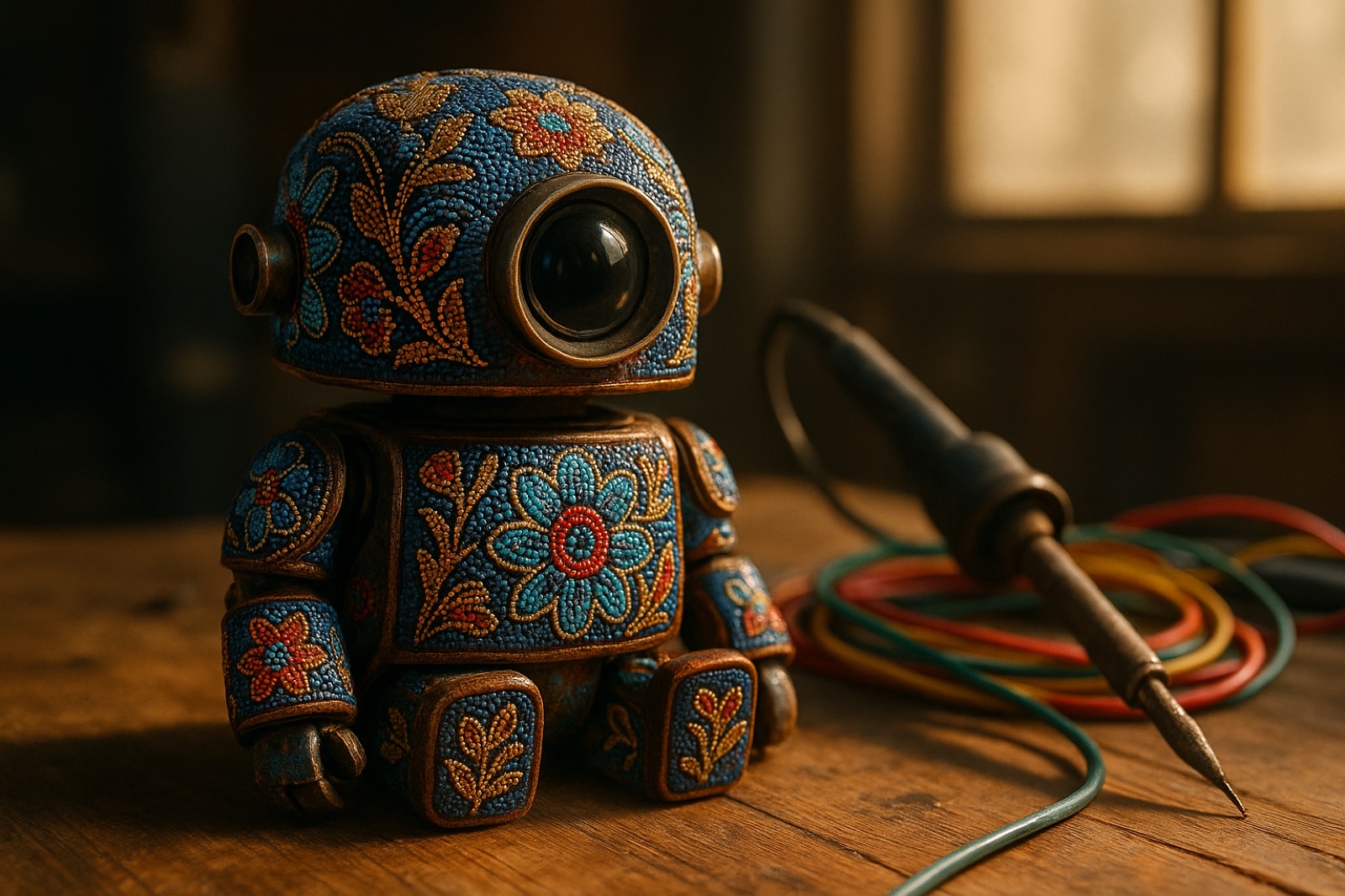
Holden Hoy is twelve years old, going into seventh grade, and this summer he built a robot. It isn’t the kind of robot that vacuums your floor or answers trivia questions. It has one eye, sits small enough to clip onto a shoulder, and looks a little like a woodland creature crossed with a mini R2-D2. Holden named it Sabe — the word for Bigfoot in the language his family is trying not to lose.
He programmed it to answer three questions before he had to present it in front of a room full of people. Ask it “What’s your name?” and it answers back in Holden’s own recorded voice, explaining who built it — not in English, but in Anishinaabemowin, the Ojibwe language spoken by the Sault Ste. Marie Tribe of Chippewa Indians in Michigan’s Upper Peninsula, where Holden lives.
There’s a reason a kid was the one holding the soldering iron instead of a linguist. Fewer than 10,000 people in the United States still speak Anishinaabemowin fluently — around 25,000 more in Canada, according to NPR’s reporting on the project. Every year, some of the oldest fluent speakers pass away, and with them goes a store of vocabulary, humor, and worldview that no dictionary fully captures. Linguists tracking languages worldwide estimate that of the roughly 7,000 spoken on Earth today, close to half could fall silent by the end of this century.
Holden’s mentor, 25-year-old Danielle Boyer, has spent years trying to slow that down — one kid, one robot, at a time.
The Woman Who Turned a Toy Store Trip Into a Movement
Boyer, also a member of the Sault Ste. Marie Tribe, started a nonprofit called STEAM Connection when she was eighteen. The idea for what became “SkoBots” — the robot kits kids like Holden build and program — reportedly came to her in a toy aisle, standing in front of a Tickle Me Elmo. If a stuffed toy could be built to giggle and talk in English, she wondered, why couldn’t something similar be built to speak the languages that were disappearing from her own community?
The robots aren’t powered by flashy generative AI, which makes them more honest than they might sound at first. “It’s simply listening to what you’re saying, identifying it, and playing that already exist,” Boyer told NPR — meaning every word Sabe speaks is a real recording of a real person’s voice, saying a real word in a real language, triggered at the right moment. Through her nonprofit, Boyer has now mentored hundreds of Native American kids across the country, teaching them coding and circuitry alongside their own heritage language, so the tool that keeps the words alive is one they built with their own hands.
What she says about why it matters is the part that stays with you. “It is devastating to feel like your language could be lost,” Boyer said. “You lose your culture, you lose a way to describe who you are.”
Why Losing a Language Is Never Just About Words
It’s easy to hear “endangered language” and think of it as a museum problem — something sad but abstract, like an old dialect fading into footnotes. It isn’t. A language carries the specific way a people learned to name a sunrise, grieve a death, joke with a cousin, or pray. When Anishinaabemowin goes quiet in a room, an entire way of noticing the world goes quiet with it — one that took thousands of years and thousands of speakers to build, and that no other language can fully replace, no matter how good the translation.
That’s what makes a twelve-year-old with a soldering iron more significant than the novelty of the story suggests. Holden isn’t just learning vocabulary words for a school project. He’s rebuilding a bridge his own community was, in living memory, actively discouraged from using — a history of boarding schools and forced assimilation that tried to erase Indigenous languages on purpose, not by accident. A kid choosing to speak it into a robot, on his own terms, in his own voice, is a quiet kind of reversal.
The Old Idea Hiding Inside a New Robot
Long before anyone had the word “robotics,” there’s an old story about language worth remembering here — one where a crowd made up of people from a dozen different nations, speaking a dozen different tongues, all heard the same message at once, each in their own language. Not one language flattening all the others into sameness. Every language, honored, all at the same time. It’s an old idea, easy to miss, that the differences between how people speak were never treated as a problem to be solved — they were treated as something worth preserving on purpose, tribe by tribe, tongue by tongue.
That’s a strange thing to find sitting inside an ancient text, because it runs against instinct. The instinct, historically, has almost always been to standardize — pick one language, one culture, and let the rest fade for convenience. But there’s a much older vision, one that predates smartphones and search engines by millennia, that imagines the exact opposite ending: every nation, every tribe, every language, still distinct, still present, none of them erased into a single voice. The tension between one language and many is old enough to show up at the very start of that story — and the ending it points toward was never uniformity. It was every voice, kept.
Holden probably wasn’t thinking about any of that while he was wiring Sabe’s eye sensor. But the instinct underneath what he’s doing — that a voice this specific was worth the effort to save, rather than letting it blend quietly into whatever’s easiest — is the same instinct behind a stadium full of nations planting their own flag in the same garden instead of flying one flag for all of them. Something in us recognizes that being reduced to sameness isn’t actually unity. It’s loss dressed up as convenience.
What This Says to Anyone, Not Just Anishinaabemowin Speakers
You probably don’t speak a dying language. But most people, at some point, have felt the version of what Boyer described — the fear of being flattened into something more convenient than who you actually are. Reduced to a job title. A demographic. A function you perform instead of a person you are. That fear of being erased or overlooked runs deeper than most people admit, and it doesn’t take losing a language to feel it — just a season of being unseen for exactly who you are.
Holden’s robot is a small, specific answer to a large, universal fear. It says: this voice was worth saving, exactly as it is, not translated into something easier. That’s worth sitting with, whatever language you speak.
Discussion Question
Do you think technology like Sabe can genuinely help save something as human as a language — or does it only slow down a loss that’s ultimately inevitable? What’s your take?
Share This
- A 12-year-old built a robot named Sabe to keep his language from disappearing. His mentor’s line stuck with me: “You lose your culture, you lose a way to describe who you are.”
- Fewer than 10,000 people still speak Anishinaabemowin. A middle schooler in Michigan just built a robot to help change that.
- The most moving tech story I’ve read in a while isn’t about AI — it’s about a kid, a soldering iron, and a language his community was once punished for speaking.
Questions People Are Asking
Who is Holden Hoy?
Holden Hoy is a 12-year-old member of the Sault Ste. Marie Tribe of Chippewa Indians who lives in Michigan’s Upper Peninsula. He built a robot named Sabe to help him learn and speak Anishinaabemowin, the endangered Ojibwe language of his tribe.
What is a SkoBot?
A SkoBot is a customizable robot kit created by the nonprofit STEAM Connection, designed to help Native American kids learn and preserve their Indigenous languages. The robots use prerecorded audio of real speakers rather than generative AI, and are triggered to respond in a specific language when they detect certain words or actions.
How many people speak Anishinaabemowin?
Fewer than 10,000 people in the United States still speak Anishinaabemowin fluently, with roughly 25,000 more speakers in Canada, according to NPR’s reporting.
Who is Danielle Boyer?
Danielle Boyer is a 25-year-old member of the Sault Ste. Marie Tribe who founded the nonprofit STEAM Connection at age 18. She created the SkoBot program to mentor Native American children in coding and electrical engineering while helping preserve their heritage languages.
Why are Indigenous languages endangered?
Many Indigenous languages, including Anishinaabemowin, declined sharply due to historical policies like forced boarding schools that punished children for speaking their native languages. Linguists estimate that close to half of the world’s roughly 7,000 languages could disappear by the end of this century without active preservation efforts.
Reporting on Holden Hoy, Danielle Boyer, and the SkoBot program is based on NPR’s coverage, “This robot speaks endangered Native American languages” (July 26, 2026).