 0
0
 0
0
In late 2025, a team of archaeologists working in the ruins of an ancient Egyptian city found something inside a 1,600-year-old mummy that nobody expected — and that no one has found in a mummy before.
It wasn’t gold. It wasn’t a charm or an amulet. It was poetry.
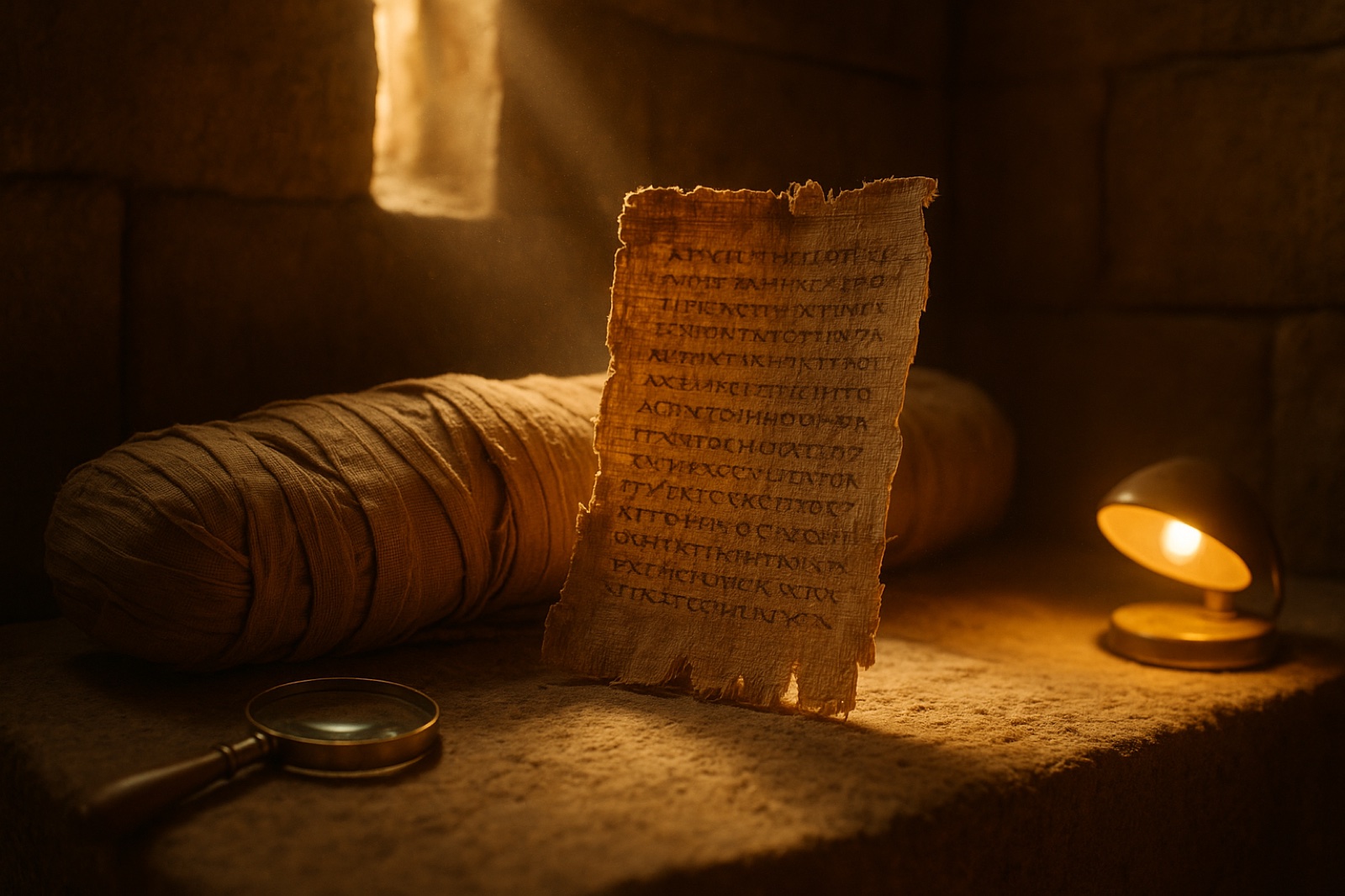
Tucked beneath the wrappings, resting against the mummy’s abdomen, was a fragment of papyrus. When researchers translated the faded Greek letters, they realized what they were holding: a passage from Homer’s Iliad — specifically, a piece of the “Catalogue of Ships,” the sweeping list of Greek forces sailing to Troy in Book II. One of the most famous passages in Western literature, folded into a burial more than a thousand years after Homer wrote it.
Where the 1,600-Year-Old Mummy Was Found
The tomb sits in Oxyrhynchus, an ancient city about a hundred miles south of Cairo, known today as Al-Bahnasa. It’s a site that has produced an extraordinary volume of ancient papyri over the last century — receipts, letters, tax records, literary fragments — because the region’s dry sand has preserved fragile paper-thin scraps that would have rotted almost anywhere else on Earth.
The mummy was found in Tomb 65, in a section of the necropolis researchers have labeled Sector 22. The excavation was carried out by the Oxyrhynchus Archaeological Mission, a team led through the University of Barcelona, and the tomb itself dates to the Roman period of Egyptian history — a time when Egypt had been under Roman rule for centuries, and Greek culture, language, and literature had thoroughly mixed with native Egyptian tradition.
Why This Fragment Is Different
Archaeologists have found papyrus scraps inside mummy wrappings before. It wasn’t unusual, in this era, for embalmers to reuse old paper as cheap packing material — stiffening cartonnage, padding out empty space, whatever scrap was on hand. But when those recycled papyri have been identified, they’ve almost always turned out to be magical texts, funerary spells, or religious formulas — documents connected, in some way, to death and the afterlife.
This one wasn’t. This one was simply a poem. A war story. Entertainment, or at least literature, rather than ritual.
Mission leaders Maite Mascort and Esther Pons, describing the find, put it plainly: what makes this discovery genuinely new is that the text is literary rather than magical — the first time a Greek literary work has been documented as deliberately part of the mummification process, rather than a religious or protective text.
And here’s the part that makes historians sit up: the researchers are being careful not to overclaim. They don’t actually know why this particular piece of Homer ended up against this particular body. Was it simply the nearest scrap of used paper an embalmer grabbed off a shelf, chosen for its thickness rather than its content? Or did it matter to someone — the family, the priest, the person being buried — that these specific words went into the ground with them? Mascort has noted that more papyri from the same excavation are still being restored, and researchers aren’t ruling out finding other literary fragments among them, which would start to suggest a pattern rather than a coincidence.
For now, it’s an open question. Which, honestly, might be the most interesting part of the whole story.
A City Where Homer Was Everywhere
What isn’t in question is how deeply Homer had saturated daily life in a place like Oxyrhynchus. The Iliad and the Odyssey weren’t reserved for scholars and aristocrats in Roman Egypt — fragments of Homer show up constantly in the papyri recovered from this region, on scraps used for schoolwork, quotations, and casual reference, the way certain phrases or stories are just part of the cultural water supply today. A Roman-Egyptian reading a line from the Iliad wasn’t necessarily doing something scholarly or sacred. It might have been as ordinary as someone today quoting a line from a movie everybody has seen.
Which is what makes its presence in a mummy wrapping so striking either way. Even if it landed there by administrative accident — grabbed off a stack of used paper because it was the right size and thickness — someone still handled it, folded it, and placed it against a human body being prepared for whatever came next. Intentional or not, it ended up doing something papyrus doesn’t usually do: it accompanied someone into the unknown.
The Question Underneath the Question
Strip away the archaeology for a second, and there’s something almost universal sitting underneath this discovery. Long before anyone had the tools to study DNA or carbon-date a fragment, people were already doing something remarkably consistent across cultures and centuries: tucking something — a story, a name, an object, a written word — alongside the people they loved when they buried them. As if some part of them believed that words, at least, might be able to go where the body couldn’t.
It shows up in Egyptian tombs painted with prayers for the journey ahead. It shows up in grave goods meant to equip the dead for another life. It shows up, maybe, in a scrap of Homer pressed against a stranger’s abdomen in the Egyptian desert, sixteen centuries ago.
There’s an old idea — older than Homer, actually — that doesn’t treat words as something you have to tuck in as an afterthought, hoping they’ll be enough to carry you through. It describes a Word that was there before anything else existed at all, and that doesn’t need borrowed paper to stay present, because it was never separate from life in the first place. Not something added at the very end, in other words, but something that was already there at the very beginning — and still there afterward.
Maybe that’s what people have always been reaching for when they slip something meaningful in beside their dead. Not decoration. Not superstition. Something more like an instinct — that whatever we hold onto tightest might, somehow, still be holding onto us.
What Happens Next
The Oxyrhynchus mission isn’t finished. More papyri from the same excavation season are still being cleaned, unrolled, and translated, and researchers have been careful to say this could be the first of several literary finds rather than a one-off anomaly. If more turn up, historians may end up rewriting a small but genuinely fascinating chapter of how Romans and Egyptians related to literature, memory, and death — not as separate categories, but as things that were always a little tangled together.
For now, one fragment of a three-thousand-year-old war story is sitting in a lab in Egypt, sixteen centuries after it was folded against someone’s body and asked, in whatever way paper can ask anything, to go with them.
Discussion Question
If you could tuck one piece of writing beside you — one poem, one letter, one story — to carry with you into whatever comes next, what would you choose? And what do you think that choice would actually say about what you believe lasts?
Share This
- Archaeologists just found a fragment of Homer’s Iliad tucked inside a 1,600-year-old Egyptian mummy — and they still don’t know why. Strangely, that’s the most interesting part. bgodinspired.com
- A 1,600-year-old mummy was just found with a piece of the Iliad folded into its wrappings. Somebody, sixteen centuries ago, decided a war poem should go with them into the unknown. What would you choose to bring? bgodinspired.com
- Turns out humans have been trying to send something eternal along with our dead for thousands of years — sometimes it’s gold, sometimes it’s Homer. Here’s the story of the mummy that just proved it again. bgodinspired.com
Questions People Are Asking
What did archaeologists find inside the 1,600-year-old Egyptian mummy?
They found a fragment of papyrus tucked beneath the mummy’s wrappings, resting against its abdomen, containing a passage from Homer’s Iliad — specifically part of the “Catalogue of Ships” from Book II, which lists the Greek forces that sailed to Troy.
Where was the mummy discovered?
The mummy was found in Tomb 65, Sector 22, at the ancient site of Oxyrhynchus (modern Al-Bahnasa, Egypt), roughly 100 miles south of Cairo. The excavation was carried out by the Oxyrhynchus Archaeological Mission, led through the University of Barcelona, during the 2025 dig season.
Why is this discovery considered unprecedented?
Papyrus scraps have been found in mummy wrappings before, but they have almost always been magical, ritual, or funerary texts connected to death and the afterlife. This is the first documented case of a Greek literary work — rather than a religious or protective text — being deliberately incorporated into the mummification process.
Do researchers know why the Iliad fragment was placed in the mummy?
No — the motivation is still unknown. Researchers have been careful not to overclaim, noting it could have been an intentional choice or simply a convenient scrap of used paper. Additional papyri from the same excavation are still being restored, and researchers haven’t ruled out finding more literary fragments, which could reveal a broader pattern.
How common was Homer’s writing in Roman-era Egypt?
Extremely common. Fragments of Homer’s Iliad and Odyssey are among the most frequently recovered texts from Oxyrhynchus’s papyri, turning up in schoolwork, quotations, and everyday writing — suggesting Homer’s stories were part of ordinary cultural life, not reserved for scholars alone.