 0
0
 0
0
You’ve been there. Maybe not with brothers who sold you into slavery, but you know the feeling. Someone who was supposed to protect you hurt you instead. And for years, you carried around this quiet, unspoken question: if I ever had the upper hand, what would I do with it?
Would you make them pay? Would you hold it over them? Would you finally get to say the thing you’ve been rehearsing in your head since it happened?
The story of Joseph and his brothers gets told in Sunday school as a tidy lesson about forgiveness — Joseph forgave the brothers who threw him in a pit and sold him for silver, the end, be like Joseph. But that’s not actually what happens in the text. When you slow down and read what Joseph actually says in Genesis 50, once he has total, unchecked power over the men who tried to destroy him, it isn’t a statement about choosing to forgive. It’s something stranger and more useful than that — and it might be exactly what you need if you’re still waiting for your own version of this moment.
What Actually Happened to Joseph and His Brothers
Joseph was the eleventh of twelve sons, and everyone — including his father, Jacob — knew he was the favorite. He got the coat. He got the dreams about his brothers bowing down to him. And he apparently didn’t have the emotional intelligence at seventeen to keep any of that to himself, which didn’t help.
His brothers hated him for it. Genesis says it plainly: they couldn’t speak a peaceable word to him. So one day, out in the fields near Dothan, far from their father’s eyes, they threw him into an empty cistern — a dry, stone-lined pit dug into the ground to collect rainwater — and sat down to eat while he screamed from inside it. Then they sold him to a caravan of traders headed to Egypt for twenty pieces of silver, dipped his coat in goat’s blood, and told their father a wild animal had killed him.
That’s the last Joseph’s family sees of him for over twenty years.
In Egypt, Joseph is sold again, into the household of an Egyptian official named Potiphar. He works his way up, gets falsely accused of assaulting Potiphar’s wife, and lands in prison for a crime he didn’t commit. He sits there for years — forgotten, even by a man he’d personally helped, who promised to mention him to Pharaoh and then just… didn’t. Two more years pass.
Finally, Pharaoh has a dream nobody can interpret, someone remembers the guy in prison who’s good with dreams, and Joseph is pulled out, cleaned up, and put in front of the most powerful man in the ancient world. He interprets the dream — seven years of abundance followed by seven years of famine — and within days, he’s elevated to second-in-command of Egypt. Not a promotion. A resurrection.
The Moment the Story Actually Turns
Years later, the famine Joseph predicted hits Canaan too, and his brothers — the same ones who sold him — travel to Egypt to buy grain, with no idea the man they’re bowing before is the boy they threw away. Joseph recognizes them instantly. They don’t recognize him at all.
He could have said nothing. He could have had them thrown in the same kind of prison he rotted in. He was, by any measure, entirely within his rights, and entirely capable of it.
Instead, in Genesis 45, after testing them and watching how they now treat their youngest brother Benjamin, Joseph breaks down and reveals himself: “I am Joseph your brother, whom ye sold into Egypt.” His brothers are terrified — the text says they couldn’t even answer him, they were so afraid. And Joseph says something that most people skip past on the way to the more famous line later in the story:
“Now therefore be not grieved, nor angry with yourselves, that ye sold me hither: for God did send me before you to preserve life.” (Genesis 45:5, KJV)
That’s already remarkable. But it’s not the moment the story is really building toward. That comes later — after their father Jacob dies, when the brothers panic. With the old man gone, they assume Joseph has just been waiting, biding his time, keeping up appearances out of respect for their father. Now that Jacob’s in the ground, they think, the real reckoning starts.
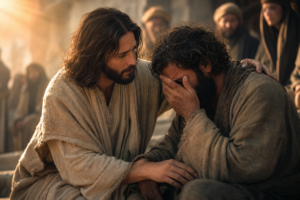
So they send Joseph a message, half-invented, claiming their father’s dying wish was for Joseph to forgive them. And when they finally come and fall down before him, terrified, Joseph weeps. Then he says this:
“And Joseph said unto them, Fear not: for am I in the place of God? But as for you, ye thought evil against me; but God meant it unto good, to bring to pass, as it is this day, to save much people alive.” (Genesis 50:19–20, KJV)
Why “Forgiveness” Isn’t Actually the Right Word for This
Read that answer again. Joseph doesn’t say “I forgive you.” He doesn’t say he’s decided, through sheer force of will, to let it go. What he says is a statement about meaning — about what actually happened, once you look at the whole shape of it. You meant evil. God meant it for good. Two intentions, running at the same time, through the same events, arriving at completely different destinations.
This is the part that gets missed when the story gets flattened into “forgive like Joseph forgave.” Forgiveness, as we usually talk about it, is something you decide to do — you grit your teeth, you release the debt, you choose peace even though the wound is still real and the story still hurts exactly as much as it did before. That’s a real and hard thing, and it matters. But it’s not what’s happening in Genesis 50:20.
Joseph isn’t willing forgiveness into existence in that moment. He’s naming something he can now finally see, because two decades have passed and the whole picture has developed. The pit. The false accusation. The forgotten years in prison. The famine. All of it, laid out end to end, turns out to have been the exact path that put him in position to save not just Egypt, but his own family, from starvation. He couldn’t have seen that from inside the pit. He couldn’t have seen it in prison, either. He can only see it now, standing at the end of the story, looking back.
That’s the real Turn here: meaning discovered in hindsight is not the same thing as meaning you have to manufacture through willpower in the moment you’re wronged. Joseph isn’t a superhuman example of forgiving instantly and completely. He’s a normal man who suffered for real, for years, without any of it making sense — and who was only able to say what he said in Genesis 50:20 because enough time had passed for God’s hand to become visible in it.
What This Means for Whatever You’re Carrying Right Now
If you’re in your own pit right now — a betrayal that’s still fresh, a wound from someone who was supposed to be safe, a season that makes no sense and offers no answers — you are not failing at faith because you can’t yet say “God meant it for good” and mean it. Joseph didn’t say that from inside the pit. He said it more than twenty years later, from the other side of an entire story he couldn’t see the shape of while he was living it.
The invitation here isn’t to force meaning onto your pain before you’re ready. It’s to trust that the meaning is being written even when you can’t read it yet — and to stay watchful for the moment, months or years from now, when you’ll be able to look back and finally see the thread. That’s not passive resignation. It’s active hope: the confidence that the story isn’t finished just because this chapter is dark.
Two Things You Can Actually Do Today
- Write down the “pit” moment. Take five minutes and name, in one or two sentences, the specific situation you’re still waiting to understand. Not the whole backstory — just what it is, plainly. Naming it is the first step toward eventually being able to trace its thread.
- Ask a different question than “why.” Instead of praying “why did this happen to me,” try praying “what am I positioned to do now, because of where this has put me?” It’s a small shift, but it points you toward Joseph’s posture — forward, not backward.
A Prayer for Whoever Is Still Inside the Pit
God, I don’t understand what this is doing yet. I can’t see the good in it the way Joseph could, looking back after twenty years — I’m still in the middle of it, and it just hurts. I’m not asking You to make it make sense today. I’m asking You to help me trust that You’re still writing something, even in the part I can’t read yet. Give me the patience to wait for the view from the other side. Amen.
A Question Worth Sitting With
Do you think it’s possible to genuinely trust that God is redeeming a painful situation before you can actually see how — or does real trust require at least a glimpse of the “how” first?
Share This
- “I used to think the Joseph story was about how good he was at forgiving. Now I think it’s about how long it can take before pain finally makes sense — and that’s okay.” (268 characters)
- “You meant evil. God meant it for good.’ Genesis 50:20 isn’t a forgiveness formula. It’s permission to still be in the pit and not have the answer yet.”
- “Joseph didn’t forgive his brothers in the pit, or in prison, or even right after Egypt. It took 20+ years for the meaning to surface. Yours might too.”
Questions People Actually Ask About This Passage
Is the story of Joseph and his brothers really about forgiveness?
Not primarily. Joseph’s famous line in Genesis 50:20 isn’t “I forgive you” — it’s a statement about how two opposite intentions (his brothers’ evil and God’s good) ran through the same events at the same time. Forgiveness is present in the story, but the emphasis in Joseph’s own words is on meaning and providence, not on the act of forgiving itself.
What does Genesis 50:20 actually mean?
Joseph tells his brothers, “ye thought evil against me; but God meant it unto good, to bring to pass, as it is this day, to save much people alive.” He’s saying that God used their harmful choice, without excusing it, to accomplish something good — specifically, positioning Joseph to save Egypt and his own family from famine.
Why didn’t Joseph take revenge when he had the power to?
The text doesn’t say he never wanted to — in fact, he tests his brothers first, watching how they treat Benjamin before revealing himself. But by the time he speaks in Genesis 50, over twenty years have passed, and Joseph has had time to see the whole arc of what happened. His response comes from that long-view perspective, not from an instant decision in the heat of betrayal.
How long did it take for Joseph to say God meant it for good?
More than two decades. He was around seventeen when his brothers sold him and around thirty when he rose to power in Egypt — and Genesis 50 takes place after his father Jacob’s death, years after that. The meaning didn’t arrive instantly; it arrived slowly, as the story unfolded.
What’s the difference between forgiving someone and seeing God’s purpose in what they did?
Forgiveness is a choice you make about how you’ll relate to the person going forward. Seeing God’s purpose is a separate recognition — that He can bring good out of something evil without that making the evil okay. Joseph does both in the story, but Genesis 50:20 specifically is him naming the second one.
If this story landed differently for you today, you might also want to read what the Greek word behind Romans 8:28 actually promises — it’s the New Testament version of the exact same principle Joseph discovered firsthand. And if you want the fuller arc of Joseph’s story, including the parts about faith under pressure, this look at what his trials can teach us about holding onto faith goes deeper into the years before the pit finally made sense. There’s also this piece on Joseph’s betrayal, which takes the more traditional forgiveness angle if you want to compare the two readings side by side.