 0
0
 0
0
Dance of Immortals and Mortals
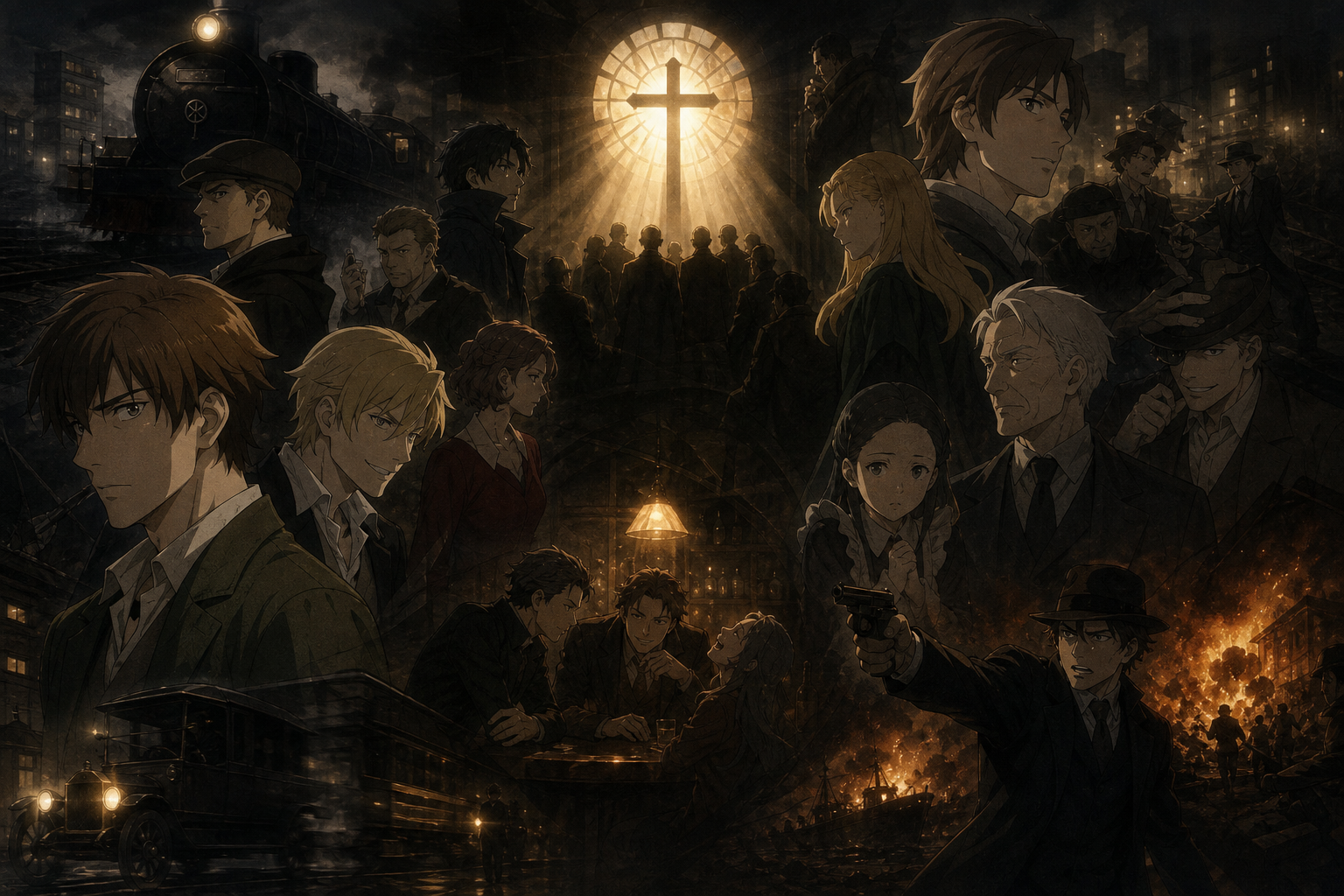
Remember that chaotic, visceral scene in Baccano! (2007) when Ladd Russo is gleefully hopping across the train cars during the Flying Pussyfoot arc? His unhinged enthusiasm for violence and destruction captures something uniquely captivating about this show: the dance between chaos and order, life and death. Ladd’s obsessive delight contrasts sharply with the eventual understanding among the immortals that existence requires balance and connection.
Baccano! spins its narrative web through entwined threads of mortals and immortals, revealing a tapestry where life, death, love, and chaos coexist. The immortals, like Maiza and Szilard, have their own timeless dance — constantly seeking meaning beyond mere survival. They’re not just after eternal life but the deeper, more elusive quest for purpose within it. Even Claire Stanfield, with his existential whims, illustrates the tension between power and the longing for personal meaning.
This resonant dance might remind us of Ecclesiastes: a book deeply rooted in the exploration of life’s transient beauty and the pursuit of something lasting. When Solomon writes, "He has set eternity in the human heart" (Ecclesiastes 3:11), it echoes the desires of Baccano!’s immortals. The immortals might be living forever, but the real narrative juice — like our own human experience — is squeezed from love, sacrifice, and the quest to understand our place in the world.
Interestingly, Baccano! reframes how we perceive the biblical notion of eternity. While Solomon speaks of eternity as divine longing within us, Maiza and company illustrate that eternity without love and connection is void. Their immortality isn’t the blessing it might seem without the tapestry of relationships and shared experiences. Doesn’t this mirror the essence of Jesus’ teaching that life is found not in isolation but in love and service to others?
In Baccano!, love becomes the anchor — the thing that truly outlasts time. Ennis’s evolution from Szilard’s tool to someone capable of love and sacrifice is a perfect testament to this. Her journey questions the nature of obedience and highlights the transformative power of love, underscoring the biblical truth from 1 Corinthians 13: “…the greatest of these is love.” Here, Ennis doesn’t just find love; she discovers liberation and purpose, transforming her eternity into something deeply human.
Imagine if Baccano!’s chaotic journey shows us that immortality, like life, requires us to embrace the messy, unpredictable dance of human connection. It’s this dance that reflects a God-given eternity — not in time span but in depth of meaning and love.
Do you think Baccano!’s immortals truly find fulfillment without relationships and love? Let me know in the comments.
Exploring Baccano!’s chaotic dance between order and chaos made me see eternity in a new way — not as living forever, but as living with purpose. Check this out: [BGodInspired.com Article URL]
If positive Biblical wisdom matters to you, I’d love your support of the mission
Q&A about Baccano! (2007)
Is it okay for Christians to watch an anime like Baccano! (2007)?
While Baccano! is an engaging story, it contains violence and themes that may conflict with Philippians 4:8, which encourages believers to think on things that are true, noble, and pure. It’s important for each person to discern whether watching aligns with their values and faith, seeking God’s wisdom in making such choices.
Does Baccano! emphasize themes contrary to Christian values?
Baccano! portrays themes of immortality and chaos, which can contrast with the Christian understanding of eternal life as described in John 3:16. Christians are encouraged to focus on a relationship with Christ for eternal life and purpose, emphasizing love and peace over chaos.
Can storytelling in Baccano! be appreciated from a Christian perspective?
Storytelling can reveal the complexity of human nature, something Romans 3:23 acknowledges when stating that all have sinned. By understanding diverse narratives, even those in Baccano!, Christians can better engage with different perspectives while still holding true to biblical principles.
How can Christians respond to violence depicted in Baccano!?
When encountering violence in media like Baccano!, Christians can reflect on Matthew 5:9, where Jesus blesses peacemakers. It’s a reminder to seek peace in actions and thoughts, encouraging us to consider how we can promote love and reconciliation in the world around us.