 0
 0
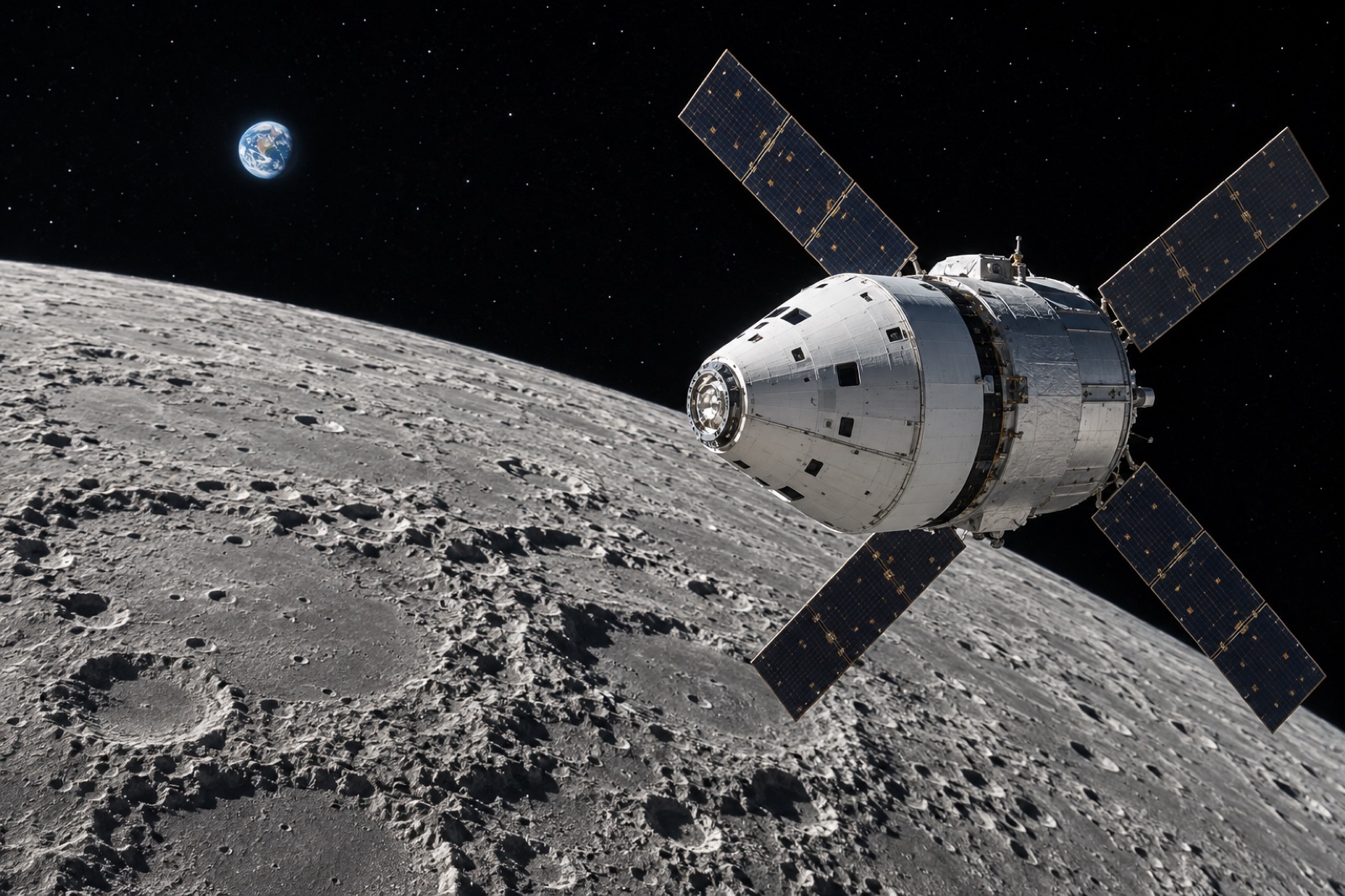
In late November 2022, an empty spacecraft flew around the Moon. Nobody was on board. But strapped into two of the seats were two mannequin torsos, and packed inside those torsos were more than 10,000 tiny crystals.
The crystals had no batteries and no wires. They sat in the dark for about three and a half weeks, quietly recording every particle that passed through them, the way photographic film records light.
Then they came home and waited. What they were holding is a fresh, independent reading of space radiation near the Moon.
In October 2026, a team at the Institute of Nuclear Physics of the Polish Academy of Sciences in Krakow published what a few dozen of those crystals turned out to be holding. They were an experimental kind nobody had flown this far before. The flight is old news. The reading is new.
And the number everyone braced for turned out to be smaller than expected.
Space Radiation Near the Moon Was Higher Than in Earth Orbit, But Not By Much
Several news aggregators ran this story as alarming. Dangerously high radiation near the Moon. That is close to the opposite of what the measurements say.
Artemis I carried a lot more than crystals, and the full instrument set was reported in a separate paper back in 2024. Out in interplanetary space, past the reach of Earth’s magnetic field, the dose equivalent rate from galactic cosmic rays came in at 0.96 to 1.24 millisieverts per day, depending on where in the capsule the sensor sat. The authors noted that was as much as 60% lower than previous observations.
For comparison, the same paper lists 0.68 millisieverts per day as the measured rate on the International Space Station. So the trip around the Moon was worse than living in low Earth orbit by something closer to half again, not by a factor of fifty. Across the whole mission, total dose equivalents landed between 26.7 and 35.4 millisieverts.
Pawel Bilski, who co-authored the crystal study, put the gap plainly: the difference is “not as large as one might intuitively expect.”
That is a genuinely good piece of news, and it is worth noticing how quietly it travelled compared with the scary version.
The Crystals Work Like Photographic Film
The new detectors are lithium fluoride. A salt, grown into clear crystals a millimetre or two across.
When a fast particle tears through one, it knocks electrons loose and leaves a permanent flaw in the crystal’s structure, called a colour centre. The flaw stays there. Shine a laser through the crystal later and the damaged path glows blue, tracing the exact line the particle took. Researchers stack microscope images about a micrometre apart and follow each track through the crystal in three dimensions.
Compare that with the standard method. Conventional plastic detectors record particles as microscopic tears, and reading them means soaking the plastic for hours in hot caustic soda. It works, but it destroys the detector, makes hazardous waste, and takes skilled hands. A crystal can be read without being harmed at all. You can put it back in a drawer and read it again.
Over the range where both types of detector can see, the crystals agreed with the plastic ones to within about 15%. At the heaviest, most biologically damaging end of the scale, the crystals read roughly 30% high. The team’s explanation for the overshoot is specific and a little unnerving: a stray neutron can strike a lithium nucleus inside the crystal and knock it out of place, leaving its own glowing track that looks like a cosmic ray but isn’t. They flew crystals enriched in lithium-7 to reduce that effect, and set aside the data from the ordinary-lithium ones. The team describes the whole set of estimates as preliminary.
Here is the detail that did not make the headlines. The crystals also picked up tracks from particles that deposited too little energy for the older detectors to register at all. The previous instruments were not wrong. They simply could not see the quietest part of what was arriving.
The Real Change Was the Kind of Radiation, Not the Amount
This is the part worth slowing down for, because it is more interesting than any single number.
Close to Earth, much of what hits an astronaut is low-energy protons trapped in the Van Allen belts, held in place by the planet’s magnetic field. Low-energy protons do not pass through a body. They push in to a certain depth, dump all their energy, and stop. So the dose is lopsided. It depends entirely on which part of you is facing the stream and what happens to be sitting in front of it.
The 2024 measurements show exactly that. During the belt crossings, peak dose rates differed by about fourfold between sensors in different positions inside the same capsule, from roughly 69 to 287 microgray per minute in the inner belt. The lowest reading came from the most shielded spot.
And then there is the five-minute detail. During the burn that sent Orion toward the Moon, the capsule rolled 90 degrees, turning its heavily shielded long axis into the plane of the trapped protons. The dose rate measured during that roll came in around half of what the model predicted. Geometry alone cut it in half.
Past the belts, none of that applies. Galactic cosmic rays come from outside the solar system at far higher energies. They go clean through a human body and leave only part of their energy along the way. There is no sheltered side to turn toward, because there is no direction they are coming from. The Artemis I crystals recorded a dose spread through the mannequins that was essentially uniform, unlike the earlier run of the same experiment on the International Space Station more than a decade ago, where the distribution was clearly uneven.
You also cannot build your way out of it. On Artemis I, increasing shielding mass by roughly 80% reduced the galactic cosmic ray dose equivalent by only about 30%.
Inside the belts, where you point matters. Outside them, pointing is meaningless and mass barely helps.
The Shield Nobody Built
Which leaves one uncomfortable conclusion sitting in the data.
The most effective protection on that entire flight was never part of the spacecraft. It was Earth’s magnetic field, and it was behind them.
That field is not engineered. It comes from molten metal moving thousands of kilometres beneath our feet, a process we did not design, cannot switch on, and are still arguing about the behaviour of. It is invisible. It makes no sound. Standing here, it feels like nothing at all.
And the only way anyone worked out how much of the work it had been doing was to leave it, and take a reading from outside.
Some of the oldest writing humans have about God reaches for almost exactly that image, over and over. Not a reward. Not a transaction. A shield. Something surrounding a person that they did not build, could not see, and would never have thought to be grateful for, until they found themselves somewhere it was not. It is a strange kind of protection, because it is almost always described afterwards, looking back, by someone slightly surprised.
Astronauts who have seen the whole planet through one window tend to come home describing it the same way: as something thinner and more generous than they had understood while standing on it.
What the Next Crew Will Carry
The experiment has an awkward name, Matroshka AstroRad Radiation Experiment, and the middle of it is a protective vest the mission was flying to test. One of the two torsos, Zohar, carried the new crystals alongside conventional plastic detectors so the two could be compared side by side on the same flight.
The practical payoff is not a single headline figure. It is that a detector you can read without destroying gives you a record you can keep, re-read, and recalibrate against later, which is exactly what you need before you send people somewhere for months rather than weeks. The crews now training for the trips that follow will be measured against these numbers.
The crystals, meanwhile, are still here. They kept their record in the dark for almost four years, felt nothing, claimed nothing, and waited for somebody to point a laser at them and ask.
Questions People Ask About Space Radiation Near the Moon
How much space radiation is there near the Moon?
During the uncrewed Artemis I mission in late 2022, detectors inside the Orion capsule measured a dose equivalent rate of 0.96 to 1.24 millisieverts per day from galactic cosmic rays in interplanetary space, depending on sensor position. Total mission dose equivalents across roughly three and a half weeks ranged from 26.7 to 35.4 millisieverts. The researchers reporting those figures in 2024 noted the galactic cosmic ray rate was as much as 60% lower than previous observations had suggested.
Is space radiation near the Moon dangerous for astronauts?
It is higher than in low Earth orbit, where the International Space Station measured 0.68 millisieverts per day, but the Artemis I figures came in below what had been expected. The team reporting them estimated that dose equivalents for a Mars mission would be about 30% lower than previously reported, potentially within NASA’s 600 millisievert career limit. These numbers describe the steady background only. They do not describe what a large solar storm would add during a mission, which is a separate risk.
What were the crystals flown on Artemis I and how do they work?
They were lithium fluoride crystals, a few dozen of them experimental, embedded among more than 10,000 detectors inside two mannequin torsos. A passing particle knocks electrons loose and leaves a permanent flaw in the crystal lattice known as a colour centre. Shining a laser through the crystal afterwards makes that damaged path glow blue, so the particle’s track can be traced under a fluorescence microscope. Unlike conventional plastic detectors, which must be etched in hot caustic soda and are destroyed in the process, the crystals survive being read.
Why is space radiation uneven in Earth orbit but even near the Moon?
In low Earth orbit, much of the dose comes from low-energy protons trapped in the Van Allen belts. Those protons penetrate only to a certain depth before stopping, so the dose varies with position and shielding and there is always a more sheltered side. Beyond the belts, galactic cosmic rays dominate. They carry far more energy, pass through the whole body, and arrive from all directions, so the dose recorded inside the Artemis I mannequins was essentially uniform.
Does more shielding protect astronauts from galactic cosmic rays?
Only partially. On Artemis I, increasing shielding mass by roughly 80% reduced the galactic cosmic ray dose equivalent by about 30%. Shielding and orientation work far better against trapped protons closer to Earth: during a five-minute 90-degree roll that turned the capsule’s shielded long axis into the proton stream, the measured dose rate was around half of what the model predicted.
A Question Worth Sitting With
If you were funding the first long human trip to Mars, where would you put the money: more shielding mass, which bought only about a 30% reduction on Artemis I, or a faster ship that cuts the number of days anyone is out there at all? Tell us which one you would fund, and why.
Share This
More than 10,000 crystals flew around the Moon in 2022, packed inside two mannequins. They have only just been read, and the radiation was lower than expected. https://bgodinspired.com/index.php/bgodinspired-news/bgodinspired-science-news/space-radiation-near-the-moon-artemis-i/
Fact I cannot stop thinking about: in Earth orbit the radiation lands unevenly, so there is always a more sheltered side of you. Past the Van Allen belts there isn’t one, because the particles go straight through. We only found out what Earth’s magnetic field was doing for us by leaving it and taking a reading from outside. https://bgodinspired.com/index.php/bgodinspired-news/bgodinspired-science-news/space-radiation-near-the-moon-artemis-i/
Adding 80% more shielding mass to Artemis I cut the galactic cosmic ray dose by about 30%. Turns out you cannot really build your way out of deep space. https://bgodinspired.com/index.php/bgodinspired-news/bgodinspired-science-news/space-radiation-near-the-moon-artemis-i/