 0
 0
In orbit, nothing weighs anything. Your pen floats. Your water floats. Your blood floats. It sounds like a holiday for the body.
For the heart, it is closer to being laid off. And the reason why the heart weakens in space is almost comically simple: nothing pushes back.
Down here, your heart spends every waking hour working against gravity. Stand up and it has to shove a tall column of blood uphill, out of your legs and into your head. Sit down and the job gets easier. Lie down and it gets easier still. Float, and it very nearly disappears.
The heart notices fast. Within the first two weeks in orbit, it starts to shrink.
That is the quiet part of a study published in the medical journal Circulation in September 2026, run as part of NASA’s long-running cardiovascular work aboard the International Space Station. Most of the coverage led with the cheerful headline — astronauts’ hearts may be able to handle a trip to Mars. Fair enough. But how they got there is the better story.
Why the Heart Weakens in Space
Muscle is expensive. The body will not pay for strength it is not using. Ask a muscle for less, and it quietly gives you less, and it does this without asking your permission first.
The heart is a muscle. That is the part people forget. It is not a pump bolted into your chest and sealed for life. It is living tissue that adapts, and the thing it adapts to is load.
Benjamin Levine, one of the cardiologists who co-led the study, said it plainly: the heart atrophies in both bed rest and in space — it becomes smaller and stiffer.
Read that sentence twice, because the whole article is inside it. Weightlessness is not doing something exotic and alien to an astronaut’s heart. It is doing the same thing a long stretch in bed does to yours. Space is simply the cleanest version of the experiment, because up there the resistance is not reduced. It is removed.
What the Study Actually Found
Here is the honest scale of it.
A small group of astronauts — about a dozen, each aboard the space station for roughly six months, which is close to the length of a one-way trip to Mars — had their hearts scanned with ultrasound before launch, several times in orbit, and again within a day of landing. They learned to scan one another, with the team on the ground watching the images live.
How small is “about a dozen”? It is worth being exact about the uncertainty here, because it is unusually visible. The two universities that co-led the work published their own write-ups about a month apart, and they do not agree with each other. One says fourteen astronauts. The other says thirteen. The paper itself is labelled an exploratory observational study — which is the authors’ own way of saying this is a first look, not a verdict.
What they found, in order. In the first two weeks, every astronaut’s heart changed: it filled with less blood between beats, and pushed out less with each squeeze. Then, as the months went on, those losses reversed. By the end of the six months the hearts had moved back close to where they started.
After landing, the team tilted each astronaut about 22 degrees up from flat — enough to pull blood back down toward the feet roughly the way the weaker gravity of Mars would. Their hearts handled that about as well as those same hearts had handled simply sitting upright on Earth, before they ever left.
That is a genuinely good result. It is also, by the researchers’ own labelling, a small and early one. Mars keeps turning up in stories like this for a reason — we wrote a while back about the rover that quietly ground out a marathon on its surface, five years, no rest days, nobody clapping.
The First Two Weeks Are the Interesting Part
Most of the coverage treated that early decline as background noise — the expected dip before the good news arrives. But it is worth asking why the dip happened at all.
Levine’s explanation was not mysterious. Most astronauts are motion sick in their first days up there. They are also buried in work, getting themselves and a spacecraft settled. So in those first two weeks, they exercised the least.
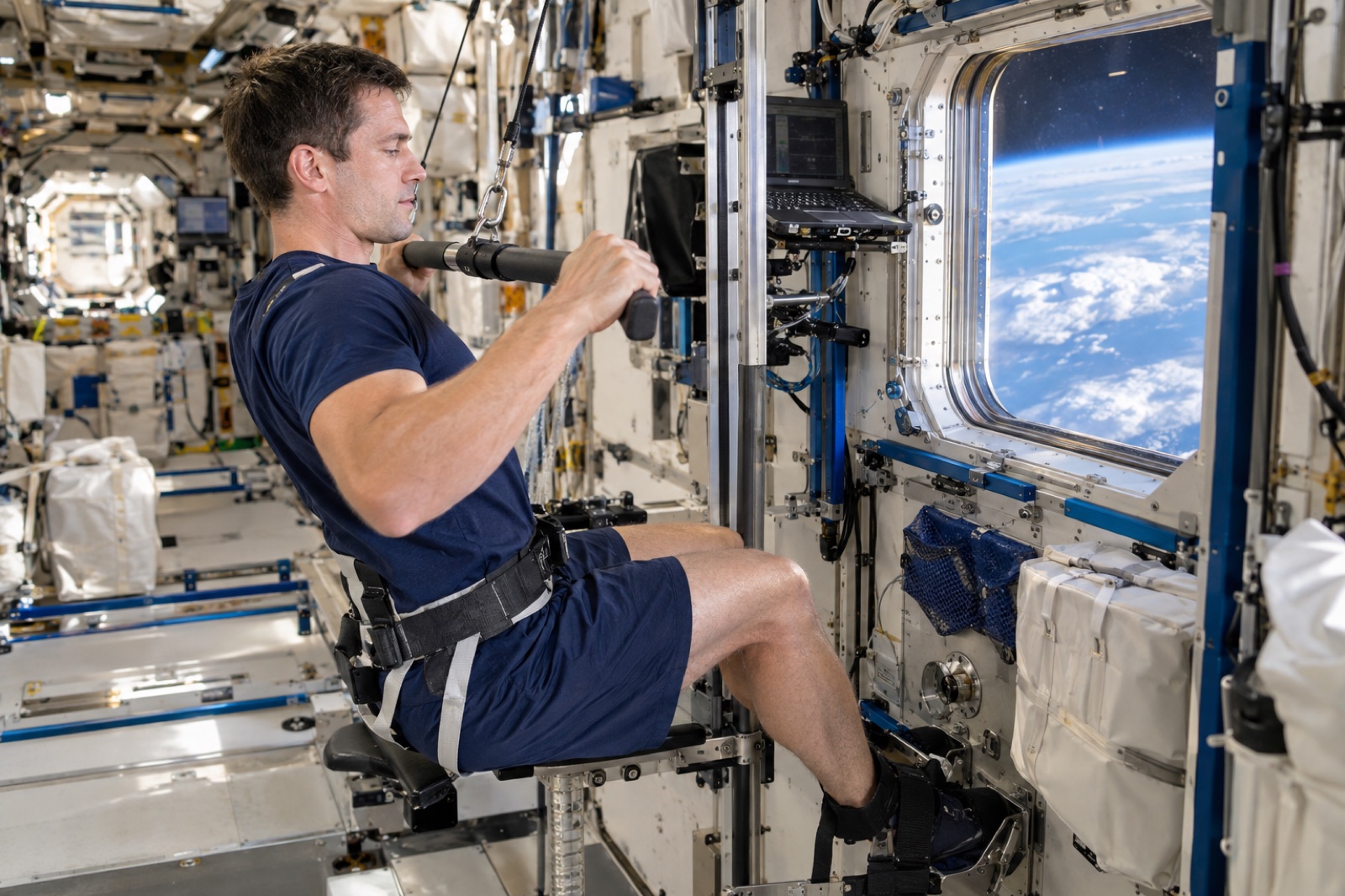
Then the exercise programme got going properly — up to around two hours a day, split between endurance work and resistance work, day after day, for months. And the losses turned around.
So the heart did not shrink because space is hard. It shrank in the exact window where nothing and nobody was asking anything of it. And it came back in the window where somebody was.
You Do Not Need a Rocket to Do This to Yourself
This is the part that matters for the rest of us, who are never going to leave the ground.
Levine’s own word was bed rest. Weeks in a hospital bed. A long illness. A broken leg. A job that holds you in one chair from morning to night. A season so tiring that the shortest version of every day becomes the only version you have in you. The heart reads all of it the same way: less is being asked, so less will be provided.
None of the fix costs money, and none of it needs a gym. Standing up more often than you strictly need to. Carrying the shopping home in one trip instead of two light ones. Taking the stairs, or the hill, instead of going around it. Walking until you are a little breathless and then staying there for another minute. The heart is not asking for equipment. It is asking for resistance.
Six months of this is a long time to live through, in either direction. We have written before about what 241 days away from everyone you love actually costs the person living it — a different kind of weight entirely, and still a weight the body has to answer.
What This Changes About an Easy Season
Here is something a lot of people feel and almost nobody says out loud, because it sounds ungrateful.
A hard stretch finally ends. The money comes through. The illness clears. The awful job is behind you. And then, a few months into the calm, you notice you are coping worse than you were when everything was on fire. Small things knock you sideways. You have less to give, not more. You cannot explain it, so you quietly assume something is wrong with you.
Nothing is wrong with you. You are a system that keeps what it is asked for. The hard season was asking constantly, every single day, whether you liked it or not. The easy one asks almost nothing — and you handed the capacity back without noticing, because nothing was pushing on it.
If you want a rough read on where yours sits at the moment, we built a short resilience check that takes a couple of minutes.
Which makes the comfortable stretch the one to pay attention to. Not the one to be afraid of.
There is a much older idea that lands in almost exactly the same place, and it is older than cardiology by a very long way. The people who wrote about God did not describe endurance as something a person simply has. They described it as something produced — the output of being under weight, rather than away from it. Strength, in that telling, was never a possession you kept in a drawer. It was a response. Something got asked, and in the answering, something grew.
That is not a claim that hard things are good for you, or that your worst season was handed to you on purpose as a training programme. A study of a dozen astronauts says nothing of the sort, and neither does the older idea. Both say something much narrower, and much more useful: strength is made out of resistance, so it goes quiet when the resistance goes away — and it can be asked back.
The astronauts did not come home strong because space was cruel to them. Space asked them for nothing at all. They came home strong because every single day, somebody asked anyway.
Whatever season you are standing in right now, that is the only question your body is actually answering: is anything being asked of me today?
Ask it something small. It is listening.
One Question Before You Go
Do you think people are shaped more by their hard seasons, or by what they choose to do in the easy ones? We would genuinely like to know which one you think did more to make you who you are — the comments are open below.
Worth Passing On
- “The heart shrank in the exact window where nothing was asking anything of it.” A study of a dozen astronauts, and somehow it is about my last six months. https://bgodinspired.com/index.php/health-and-wellness/why-the-heart-weakens-in-space/
- Astronauts’ hearts shrink in space — not because space is hard, but because nothing pushes back. Exercise brought them back. Apparently weeks in bed do the same thing to the rest of us. https://bgodinspired.com/index.php/health-and-wellness/why-the-heart-weakens-in-space/
- If you came out of a hard season and felt less capable in the calm, you are not broken. You are a system that keeps what it is asked for. https://bgodinspired.com/index.php/health-and-wellness/why-the-heart-weakens-in-space/
Common Questions
Why does the heart get weaker in space?
On Earth, the heart works constantly against gravity, pushing blood upward out of the legs and into the head. In orbit that load disappears, and like any muscle the heart adapts to what is asked of it. With nothing pushing back, it becomes smaller and stiffer. Cardiologist Benjamin Levine, who co-led a 2026 study of astronaut hearts published in the journal Circulation, described the same atrophy happening during long periods of bed rest on Earth.
Did the astronauts’ hearts recover while they were still in space?
Yes. In the 2026 Circulation study of astronauts on roughly six-month International Space Station missions, every astronaut’s heart changed during the first two weeks in orbit — filling with less blood between beats and pumping less with each contraction. Over the following months those losses gradually reversed, and by the end of the mission the hearts had returned close to their pre-flight measurements. Researchers credited the daily exercise programme astronauts follow aboard the station.
Can exercise protect an astronaut’s heart on a trip to Mars?
The 2026 Circulation study suggests it can, though the researchers labelled their work exploratory. Astronauts on the International Space Station exercise up to around two hours a day, combining endurance and resistance training. After landing, the research team tilted each astronaut about 22 degrees from flat to approximate the weaker gravity of Mars. Their hearts handled that simulated Mars gravity about as well as they had handled sitting upright on Earth before launch.
Does bed rest weaken the heart the same way space does?
According to cardiologist Benjamin Levine, the heart atrophies in both bed rest and in space, becoming smaller and stiffer in each case. The underlying mechanism is the same: the heart adapts to the load it is given, and both weightlessness and prolonged lying down remove most of the work of pushing blood against gravity. This is why long illnesses, injuries and highly sedentary stretches can leave people feeling less physically capable than they were before.
How many astronauts were in the space heart study?
Roughly a dozen, each on a mission of about six months. The exact figure is reported inconsistently: the two universities that co-led the research published releases about a month apart, one stating fourteen astronauts and the other thirteen. The paper itself is described as an exploratory longitudinal observational study, meaning the sample is small and the findings are an early signal rather than a settled conclusion.