 0
 0
A team of chemists has just designed a test for something that does not exist.
Not “does not exist yet” in the way a treatment can exist in a lab but not in a pharmacy. Does not exist at all. Nobody has made it. As far as the researchers closest to the question can tell, nobody is currently trying to make it. And several of the people best placed to make it have publicly asked that nobody does.
In October 2026, two chemists published a method for catching it anyway.
The thing they are watching for is called mirror life. The story of why the alarm got built before the fire is stranger — and quite a lot more hopeful — than it first sounds.
What is mirror life, in plain terms?
Hold up your hands.
Same shape. Same parts, in the same order. But they are not interchangeable, and you already know it, because you cannot slide a left hand into a right glove. Chemists call this handedness, and a great many molecules have it.
Here is the part that is easy to read straight past: every living thing anyone has ever found uses only one set of hands.
The proteins in every organism on Earth — in you, in a mango tree, in the bacteria in a puddle outside — are built from left-handed amino acids. The sugars in the backbone of DNA and RNA are right-handed. Not mostly. All of them, in every branch of life we know about. Chemistry done in a flask usually produces both versions in roughly equal amounts, which is exactly what makes life’s uniformity a real open question rather than a tidy fact. Nobody knows for certain why life picked a side.
Mirror life is the thought experiment that follows. An organism built from the other set. Right-handed proteins, left-handed genetic sugars. Chemically, it would work. Everything inside it would fit together as neatly as everything inside you does. It would simply fit together backwards.
Why a backwards bacterium worries people
Your immune system is, underneath everything, a shape-recognition machine. It learns what trouble looks like and goes looking for that shape. Cells are fussier than they look — even having too much ordinary RNA inside one can drain its energy — and almost everything a body does is a matter of one shape meeting another and recognising it.
A mirror bacterium would be made of shapes nothing on Earth has ever had to recognise.
That is the concern, and it is not the one people expect. The worry is not that such an organism would be especially aggressive. It is nearly the opposite: that it might be especially unnoticed. In December 2024, thirty-eight scientists published a piece in the journal Science called “Confronting risks of mirror life”, alongside a technical report running to hundreds of pages. They compared a mirror bacterium to an invasive species arriving somewhere with no natural predators, and noted that antibiotics could not realistically be deployed at the scale it would take to contain one in the wild. Their estimate of how far off such an organism might be ranged from roughly ten to thirty years, with the authors themselves saying the timeline is uncertain.
Their recommendation was blunt: this particular thing should not be built.
The part of this story almost nobody repeats
Here is the detail that changes the shape of the whole thing.
One of the authors of that warning was Kate Adamala, a synthetic biologist at the University of Minnesota. In 2019, she was among four researchers on a US National Science Foundation award of roughly four million dollars — to work toward building a mirror cell.
She was not a critic shouting from outside the building. She was inside it, with the funding, the lab and the skill to do the thing. Her view changed gradually, over months of conversations with specialists in immunology, ecology and biosafety, rather than in a single moment. She and her colleagues chose not to renew the grant. The lab’s mirror-cell work ended. She has since said she knows of no one currently trying to build one.
That is not how this usually goes. The usual shape of a story like this is that the people with the funding keep going and someone else writes the warning. It is rare for the warning to be written by the hands that were already on the project. Rare — but not unheard of. Google built an AI that can find hidden software flaws in hours, then restricted who is allowed to touch it. Occasionally the people who can do a thing decide, in public, that they would rather not.
Scientists do not actually agree about this
It would be easy to write all of this as settled alarm. It is not settled, and saying so matters more than a clean story does.
Ting Zhu, at Westlake University in China, has argued that “the hypothetical creation of mirror-image organisms lies far beyond the reach of present-day science”, and that a sweeping moratorium on early-stage work is premature — he draws a hard line between mirror-image molecular biology, which may yield useful medicines, and mirror-image life. Andy Ellington, at the University of Texas at Austin, has been blunter about where it sits on his own list of worries: “If there is going to be harm done to the human race, this is about position 382 on my list.” He still thinks it deserves study, precisely because so much is unknown.
Others point out that the body is not quite as naive as the scare version suggests — some sugars already occur in both handednesses, including in real pathogens, and the immune system copes. And the traffic runs both ways: the immunologist Timothy Hand began as a sceptic, with a reaction of “Who cares if it’s a mirror?”, and changed his mind after working through what happens upstream of the immune response, before recognition even gets its turn.
Nobody in this argument is lying. They are weighing a risk that cannot be measured without running the experiment, which is the one thing everybody agrees should not be run.
So what did the chemists actually build?
Lewis MacKenzie, at the University of Strathclyde, and Robert Pal, at Durham University, published their method in Royal Society Open Science in October 2026. They call it a contingency assay, which is a very dry name for a smoke detector installed in a house nobody has built.
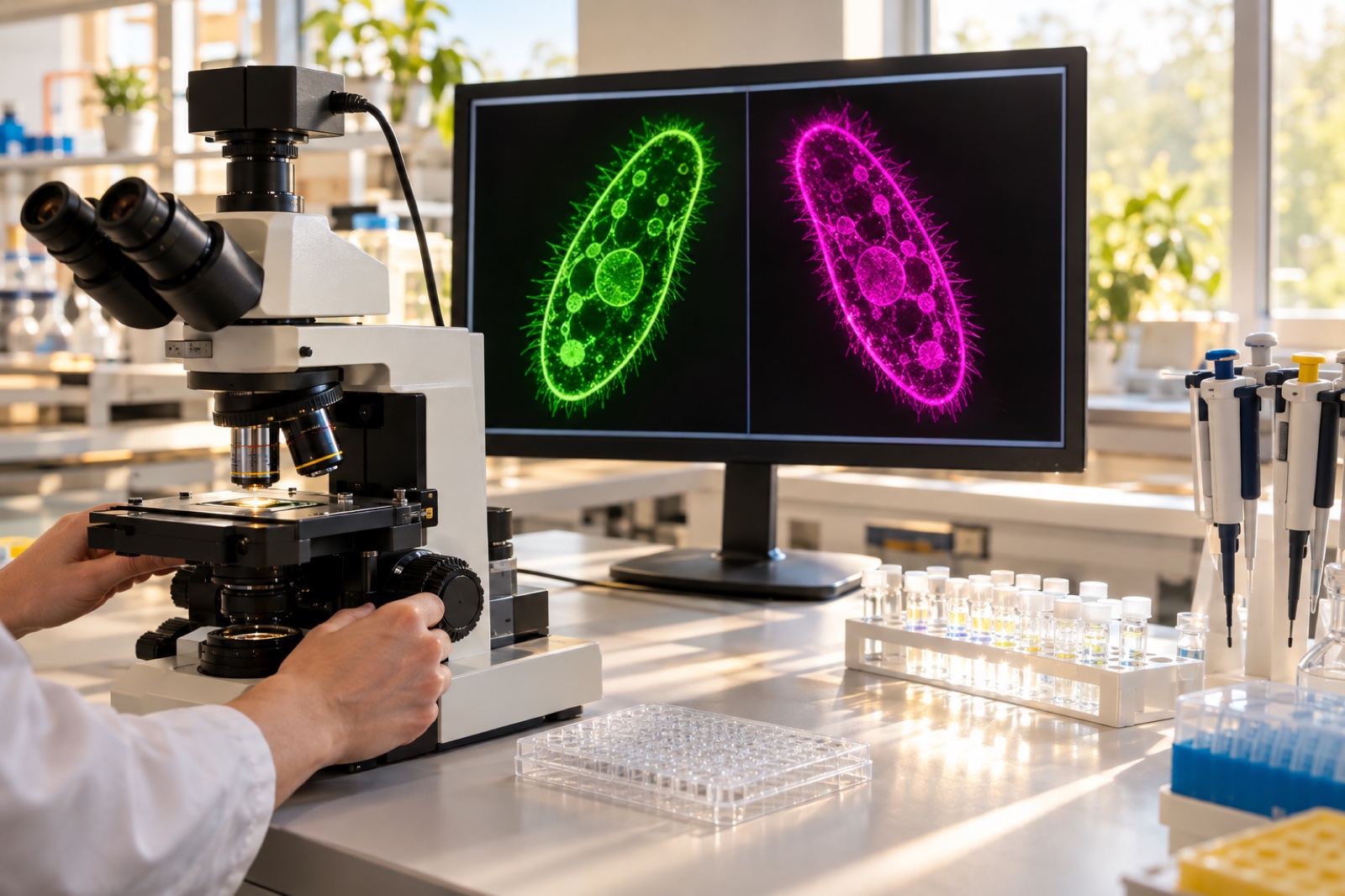
It uses circularly polarised luminescence. Light, it turns out, can itself be twisted one way or the other, and certain glowing molecules emit light with a twist that depends on their own handedness. So you take fluorescent probes designed to stick to particular structures inside a cell, you look at the twist in the light they give back, and you read off a kind of molecular fingerprint. A normal cell gives one pattern. A mirror cell would give the opposite one.
Two details matter more than the physics.
The first: they propose a panel of probes rather than a single one, because any one reading on its own could mislead. The test is designed on the assumption that it might be wrong, and built to argue with itself. That instinct is rarer than it should be — one study of AI decision-making found a model that had learned to look fair without being fair, catching the obvious prejudice while waving through the kind dressed up as good business sense. A single measurement that agrees with you is not the same thing as a measurement that is right.
The second detail is the quietly remarkable one. The method can be developed and refined using ordinary biological samples. Nobody has to make a mirror organism in order to build the test for mirror organisms. The alarm can be finished without ever starting the fire.
The limits deserve saying plainly, because the researchers say them plainly. Mirror life remains entirely hypothetical. The complete assay has not been experimentally demonstrated; what exists is laboratory-scale work on detecting handedness, plus a worked proposal for assembling it into a test. “We don’t expect mirror life to appear tomorrow,” MacKenzie said, “but if it did arise, the consequences could be severe.”
The oldest version of this question
There is a very old story about this, and it is almost always told backwards.
In it, a group of people discover that they can build anything they can imagine. The line everybody remembers is the one about nothing being out of their reach, and it gets quoted the way a compliment gets quoted — on posters, in speeches about human potential.
In the story itself, it is not a compliment. It is the diagnosis. It is the precise moment God steps in, because a people who can do anything and have not yet stopped to ask whether they should is not a strong people. It is a people with no brakes. The old texts were markedly less impressed by raw capability than we are. They kept circling a different question: not what can you build, but who are you becoming while you build it.
That question does not come from a laboratory. But a panel of fluorescent probes, designed for an organism nobody has made, is a surprisingly good answer to it. (If that old story is unfamiliar and you are curious how it actually runs, our free Bible Stories assistant will walk you through it — it opens in ChatGPT.)
Alarm first
Most of us will never stand anywhere near a decision this size. But the shape of it is familiar enough.
The message you could absolutely send. The thing you could say that would land exactly where you aimed it. The capability is real, and it is sitting right there, and the question is never really whether you are able. You usually are.
The question is whether you have built anything that can tell you to stop.
Two chemists did it in what looks like the wrong order on purpose. Alarm first. Fire never, if everyone is careful and a little bit lucky. It is an odd way to build a thing.
It might also be the most hopeful one anybody has tried in a while.
Questions People Ask About Mirror Life
Does mirror life exist?
No. Mirror life is entirely hypothetical. No mirror organism has ever been created, and researchers who have studied the question say they are not aware of any laboratory currently attempting to build one. It is a scenario scientists are preparing for, not an organism that exists.
What does “mirror life” actually mean?
Many molecules come in two mirror-image forms, the way a left hand mirrors a right hand. All known life on Earth uses one consistent set: left-handed amino acids in proteins, right-handed sugars in the backbone of DNA and RNA. A mirror organism would be built from the opposite set throughout — chemically functional, but structurally reversed compared with every living thing we know.
Why are scientists worried about mirror bacteria?
Immune systems work largely by recognising molecular shapes. Because a mirror bacterium would present shapes no immune system on Earth has encountered, a group of thirty-eight scientists writing in the journal Science in December 2024 argued it might go largely unrecognised by the defences of humans, animals and plants, spreading like an invasive species with no natural predators. They also noted that antibiotics could not be deployed at the scale needed to contain such an organism in the open environment.
How would a test for mirror life work?
A method published in Royal Society Open Science in October 2026 by Lewis MacKenzie of the University of Strathclyde and Robert Pal of Durham University proposes using circularly polarised luminescence. Fluorescent probes bind to structures inside cells and emit light with a measurable twist that depends on molecular handedness, producing a fingerprint that would distinguish ordinary cells from mirror ones. The researchers propose using a panel of several probes rather than one, since a single reading could mislead. The complete assay has not yet been experimentally demonstrated.
Do scientists have to create mirror life in order to test for it?
No, and this is a central point of the proposal. The detection method can be developed and refined using ordinary biological samples, meaning the test can be built without any mirror organism being manufactured first.
A Question Worth Arguing About
Should a field be allowed to build something dangerous as long as it builds the safeguard first — or are there things that simply should not be attempted, however good the brakes are? There is a reasonable case on both sides and plenty of serious scientists on each. Tell us where you land in the comments.
Worth Sharing
- Chemists just published a test for “mirror life” — an organism built backwards from everything alive. It doesn’t exist. Nobody’s building it. They designed the smoke alarm anyway. https://bgodinspired.com/index.php/bgodinspired-news/bgodinspired-science-news/what-is-mirror-life/
- The scientist who co-signed the warning about mirror life had a four-million-dollar grant to build it. She and her colleagues let the grant lapse instead. Not the usual ending to that story: https://bgodinspired.com/index.php/bgodinspired-news/bgodinspired-science-news/what-is-mirror-life/
- Every living thing on Earth is built left-handed. All of it. Nobody fully knows why. And some researchers are now quietly working out how we would spot it if something ever showed up built the other way round. https://bgodinspired.com/index.php/bgodinspired-news/bgodinspired-science-news/what-is-mirror-life/