 0
0
 0
0
Ten people who had gone blind from an inherited eye disease each got one injection in one eye. Then they put on a pair of goggles with a small camera on the front.
Some of them could find a doorway again. Some could follow a line on the floor. None of them could read a word or see a face.
That is the honest version of the trial results published on 7 October 2026 in the New England Journal of Medicine (reported here by Science News). It is smaller than most of the headlines. It is also stranger and more interesting, because of which cells in the eye were taught to see.
They were never meant to see anything at all.
What This Gene Therapy for Blindness Actually Did
The people in the trial have retinitis pigmentosa, often shortened to RP. It is a family of inherited conditions that slowly destroys the light-catching cells at the back of the eye, the rods and cones. By the late stage, most of those cells are gone. Some people can tell light from dark and nothing more.
The usual dream for a disease like this is to repair the rods and cones. This treatment does not try. It goes around them.
The trial, called PIONEER, was run by the company GenSight Biologics with the 15-20 National Hospital in Paris. The work was led by eye doctor José-Alain Sahel, now at the University of Pittsburgh, and neuroscientist Botond Roska of the Institute of Molecular and Clinical Ophthalmology Basel in Switzerland.
Here is the method in plain terms:
- A harmless virus carries a gene into the eye with one injection.
- That gene tells certain eye cells to make a protein called ChrimsonR. It comes from algae. It reacts to light.
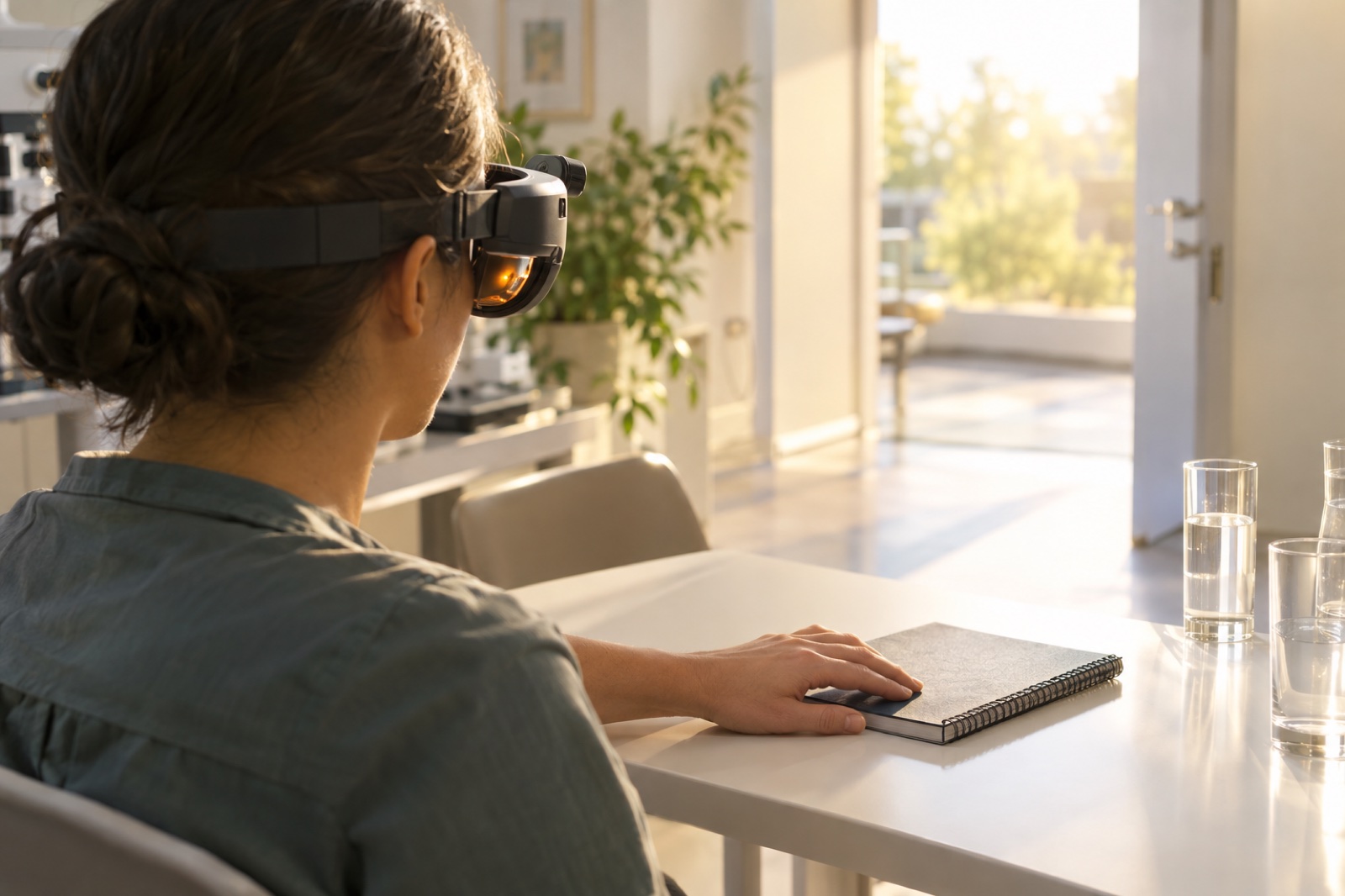
- The goggles have a camera that watches for changes in brightness in front of the person.
- The goggles turn those changes into pulses of amber light and shine them onto the treated part of the eye.
Why amber? Because the borrowed algae protein reacts to that colour of light, and the goggles make it bright enough for the treated cells to respond.
The Cells That Only Ever Passed Messages Along
This is the part most coverage rushes past.
The protein was not put into rods or cones. It was put into retinal ganglion cells.
In a healthy eye, ganglion cells are the last link in a chain. Rods and cones catch the light. Other cells tidy up that signal. Then the ganglion cells gather it all up and send it down the optic nerve to the brain.
Their whole job is to pass the message along. They report what the light-catching cells saw. They have never caught light themselves.
And in RP, they usually survive long after the rods and cones are gone. The messengers are still standing at their posts. There is just nobody left to hand them a message.
So the team gave the messengers the ability to receive the light directly. Cells built only to relay were turned into cells that can sense.
If that idea sounds familiar, it should. The same algae trick is what won the 2026 Nobel Prize in Medicine for optogenetics, announced two days before this paper came out. That prize was about switching brain cells on with light in the lab. This is one of the first places it has been tried in people’s eyes.
The Real Numbers, and What Nobody Could Do
This is where it pays to be careful, because the numbers are easy to blur.
Light sensitivity. Science reporting on the paper says light sensitivity improved in 7 of the 10 people. The company’s own statement uses a stricter bar, “clinically meaningful” improvement on a standard light test, and counts 6 of 10. Both can be true. They are measuring with different rulers.
Doing real tasks. Only 8 of the 10 finished the task testing. Of those 8, 4 got better at things while wearing the goggles. The tasks included finding, pointing to, or touching objects, telling which way a bar was tilted, and, as reported, finding a doorway or following a line.
So it was not “most patients can find a doorway again.” It was half of the people who completed the tests.
What nobody could do. No one in the trial could read words or recognise faces. The researchers say those are goals for later.
Safety. This was mainly a safety trial. It was not designed to prove the treatment works. Most eye side effects were mild or moderate. One was rated severe and cleared up within minutes after eye drops. No body-wide side effect was judged to be caused by the drug or the injection.
There was one more test that matters. In some patients, the team recorded brain activity with a cap of sensors on the head. The signals looked like the light from the goggles was reaching the visual part of the brain. In other words, this was not people guessing well. Their brains were getting something.
Roska put it carefully: “This is a proof of concept that optogenetics can bring back some visual activity [and] object sensitivity.”
Proof of concept. Some. Not a cure. The treatment is not approved anywhere.
The Man Who Found the Notebook
This trial did not start from nothing. In 2021 the same team described one man in the journal Nature Medicine. He was 58. He had been diagnosed with RP 40 years before.
With the goggles on, he was tested on a white table with everyday things on it. He reached for and touched a notebook in 36 out of 39 tries. A smaller box of staples was much harder; he found it only about a third of the time. When asked to count glass tumblers, he got it right a bit under two thirds of the time.
Without the goggles, he could do none of it.
And here is the detail that sticks. It did not happen fast. He began goggle training about five months after his injection. He only started reporting that he could see something around seven months after that. Months of practice, wearing goggles that seemed to do nothing, before anything showed up.
The new trial asked a simple question: was that one man a fluke? The answer so far is no. Some others responded too, though not everyone, and not as dramatically as the headlines suggest.
Who This Could Never Help
There is a hard limit built into the method.
It only works if the ganglion cells and the optic nerve are still working. The messengers have to be alive, and the road to the brain has to be open. If the nerve itself is damaged, as it is in glaucoma or after many injuries, there is nobody left to carry the message, and this approach cannot help.
That is the same lesson every lab breakthrough has to learn on its way to a clinic. A result can be completely real and still be a long way from a treatment. We saw the same gap when scientists turned an 80-year-old’s blood into young brain cells in a dish. Real result. Long road.
Light That Comes From Outside
Here is what stays with me about this one.
The ganglion cells did not earn this. They did not grow stronger, or try harder, or learn to make their own light. They are exactly the same cells they always were. The light is brought to them, from outside, by something that can see what they cannot. All they had to do was become able to receive it.
There is a very old idea that this is how rescue works for people too. Not that we finally produce our own light, but that light is given to the ones sitting in the dark, by Someone who was never in the dark. One of the oldest descriptions of what rescue looks like even puts sight for the blind right next to freedom for captives, as if they were the same kind of gift.
Maybe they are. Being shown what you could not see on your own is a kind of being set free.
A good place to start:
The Beginner’s Guide to Feeling God’s Presence Every Day
A short video guide and companion PDF for noticing God in ordinary days — the kitchen, the commute, the waiting room. Get the free guide. Free.
Where This Leaves Things
If you or someone you love has RP, this is not something you can ask for at a clinic. It is a first step, tested in ten people, aimed mainly at safety.
But it is a real step. Four people got better at finding things in front of them. A man diagnosed 40 years earlier reached out and touched a notebook, over and over, 36 times out of 39.
And it happened by giving new work to cells that had been waiting, quietly, at their posts the whole time. That might be the most hopeful part. The parts that were still there turned out to matter more than anyone expected.
Gene Therapy for Blindness: Q&A
Can gene therapy cure blindness from retinitis pigmentosa?
Not yet. In the PIONEER trial published in the New England Journal of Medicine on 7 October 2026, an optogenetic gene therapy called GS030 combined with light-projecting goggles improved light sensitivity in 6 or 7 of 10 people with late-stage retinitis pigmentosa, depending on the measure used. Four of the 8 people who completed task testing improved at finding or touching objects. No participant could read words or recognise faces, and the treatment is not approved anywhere.
How do the goggles in the optogenetic blindness trial work?
A camera on the goggles detects changes in brightness in the scene in front of the wearer. The goggles convert those changes into pulses of amber light and project them onto the retina. The light activates retinal ganglion cells that were given a light-sensitive algae protein called ChrimsonR through a single gene therapy injection. The goggles are needed because the protein needs light of the right colour and brightness to respond.
What are retinal ganglion cells?
Retinal ganglion cells are the output cells of the retina. In a healthy eye, rods and cones detect light, and ganglion cells collect that signal and send it to the brain through the optic nerve. They do not normally sense light for vision themselves. In retinitis pigmentosa, ganglion cells often survive after the rods and cones die, which is why optogenetic therapy targets them.
Who could not benefit from this kind of treatment?
Optogenetic therapy for vision depends on working retinal ganglion cells and a working optic nerve to carry signals to the brain. People whose blindness comes from optic nerve damage, such as advanced glaucoma, could not benefit from this approach, because the pathway the treatment relies on is no longer intact.
Was the 2021 blind patient who saw a notebook part of the same research?
Yes. In 2021 the same research group reported in Nature Medicine on a 58-year-old man with retinitis pigmentosa who received the same type of treatment. With the goggles, he touched a notebook on a table in 36 of 39 tries and counted glass tumblers correctly about 63 percent of the time. He began noticing visual changes roughly seven months after goggle training started. The 2026 trial tested whether those results could be repeated in more people.
One Question Worth Talking About
If a treatment let you sense light and find a doorway, but never read or see a face again, would you call that getting your sight back, or something else? Where would you draw the line? Tell us what you think in the comments.
If You Want to Share This
- Scientists didn’t fix the broken light cells in blind people’s eyes. They taught the cells that only ever passed messages along to sense light themselves. Half the people who finished testing could find things again. https://bgodinspired.com/index.php/bgodinspired-news/gene-therapy-for-blindness-goggles/
- The honest version of the blindness gene therapy news: no one can read or see faces, it’s not approved, and only 4 of 8 improved on tasks. It’s still one of the most hopeful things I’ve read this year. https://bgodinspired.com/index.php/bgodinspired-news/gene-therapy-for-blindness-goggles/
- A man diagnosed with a blinding eye disease 40 years earlier touched a notebook on a table 36 times out of 39. It took about seven months of practice before he noticed anything at all. https://bgodinspired.com/index.php/bgodinspired-news/gene-therapy-for-blindness-goggles/