 0
0
 0
0
Someone says your friend has “the Midas touch,” and it’s a compliment. Every business works. Every bet pays off. Everything they touch turns to gold.
But here is the strange part. In the old story, the man with the Midas touch did not feel lucky. He felt trapped. He got the exact thing he asked for, and within one meal he was begging to have it taken away.
So what is the real Midas touch meaning? It depends on whether you mean the phrase or the story. They point in opposite directions.
Midas Touch Meaning: The Phrase vs. the Story
The phrase: Today, “the Midas touch” means a knack for success, especially with money. If someone has it, whatever they start seems to make a profit.
The story: In the myth, the golden touch is not a skill. It is a wish granted by a god, and it nearly kills the man who wished for it. The point of the story is not “how wonderful to turn things into gold.” The point is “be careful what you ask for, because you might get it.”
We kept the gold and dropped the warning. That is worth a closer look.
The Original King Midas Story (Ovid’s Version)
The best-known telling comes from the Roman poet Ovid, in Book 11 of his long poem the Metamorphoses, written about two thousand years ago.
Midas was a king. One day some farmers found an old man wandering drunk in the countryside. He was Silenus, the old teacher of Bacchus, the god of wine. Midas knew him, welcomed him, and threw him a ten-day feast before bringing him safely home.
Bacchus was so happy to get his friend back that he offered Midas a reward. Anything he wanted.
Midas asked that whatever he touched would turn to gold.
Here is a detail most retellings skip. Ovid says Bacchus granted the wish, but with grief. In the Brookes More translation, the god agreed “with grief that Midas chose for harm and not for good.” The god could see what the king could not.
At first, Midas was thrilled. He touched a twig and it turned to gold. He picked up a stone. Gold. An apple. Gold.
Then he sat down to eat.
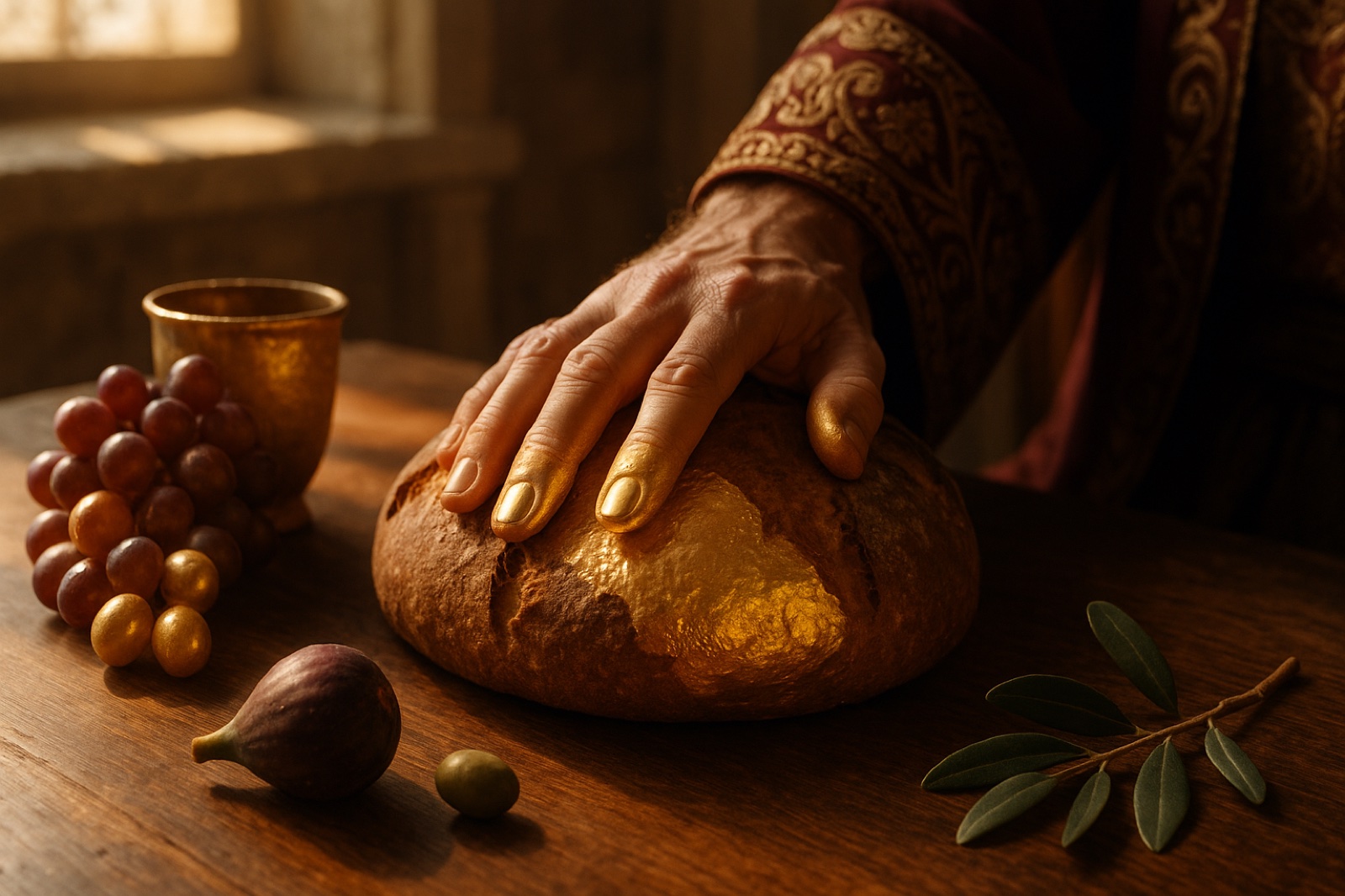
The bread turned hard and golden in his hand. Meat turned to flakes of gold between his teeth. Even his wine, mixed with water, became liquid gold in his mouth. He could have every treasure on earth, and he could not swallow a mouthful of dinner.
Ovid’s description of him in that moment is three words long: “rich and wretched.” He “hated all he had so lately longed for.”
Midas lifted his golden arms to the sky and begged Bacchus to take it back, calling it a “curse that looked so fair.”
How Midas Lost the Golden Touch
Bacchus was kind about it. He told Midas to go to the river that flows past the city of Sardis, follow it up to where it begins, and plunge his head and body into the water.
Midas did. The golden touch washed off him and into the river. Ovid says that is why the River Pactolus carried gold in its sand ever after. It was an ancient way of explaining a real river that really did have gold dust in it.
Notice what the cure was. Not a better wish. Not a smarter way to use the gift. The cure was letting it go.
The Part Everyone Forgets: Midas’s Daughter
If you learned this story as a child, you probably remember the saddest part. Midas hugs his little daughter, and she turns into a golden statue.
That scene is not in Ovid.
It comes from the American writer Nathaniel Hawthorne, who retold the myth for children in 1852 as “The Golden Touch,” part of A Wonder-Book for Girls and Boys. Hawthorne even admits he made her up. He says he never knew the girl’s name, or had forgotten it, and then writes: “So, because I love odd names for little girls, I choose to call her Marygold.”
It is worth sitting with that for a second. In the oldest version, Midas gives up the gold because he cannot eat. In the version most of us grew up with, he gives it up because he has lost the person he loves most. Hawthorne looked at the story and decided hunger was not enough. He needed to show what it really costs.
In Hawthorne’s telling, a stranger asks Midas which he would rather have: the golden touch, or a crust of bread? Midas answers that a piece of bread “is worth all the gold on earth.” About his daughter, he says he would not trade “that one small dimple in her chin” for the power to turn the whole earth into gold.
Both writers land in the same place. The things that keep you alive and the people you love cannot be turned into money without being lost.
Ovid’s Twist: The Lesson Didn’t Fully Stick
Here is the ending almost no one tells.
After the river, Midas hated riches. He left the palace and lived out in the woods and fields. That sounds like a happy ending. But Ovid adds that his mind “still obtuse remained.” He was still foolish.
Soon after, Midas sat in on a music contest between the god Apollo and the rustic god Pan. Everyone else gave the prize to Apollo. Midas loudly said Pan was better. Apollo gave him the ears of a donkey for his trouble.
It is a funny ending, but it is also honest. Swinging from “I want all the gold” to “I hate all gold” is not the same as becoming wise. Midas swapped one bad judgment for another.
That is a real trap with money, too. Some people chase it. Some people sneer at it. Both are still letting money run the show.
If you’ve ever wondered why a big win so often feels flat a few weeks later, our piece on the hedonic treadmill explains why every upgrade fades to normal.
Why the Midas Touch Still Feels Familiar
Most of us will never have a god offer us a wish. But a lot of us know a quieter version of the Midas problem.
- The job that pays more and costs every evening. The money comes in, and dinner with the family goes out.
- The side hustle that eats the weekend. Each hour starts to look like money you are “losing” if you rest.
- The habit of pricing everything. A walk, a nap, a friend’s visit all start to feel like time you could be “using.”
That last one is the real golden touch. It is not that things become gold. It is that you start to see everything as something to be turned into gold. And once you see bread that way, you cannot eat it.
Greek stories have a few kings who learned this the hard way. Another one hung a sword over a guest’s head at dinner to show what power really felt like from the inside.
Enough Is the Opposite of the Golden Touch
There is a warning in the Bible, much older than Hawthorne, that sounds almost like a summary of the Midas myth. It says the trouble isn’t money itself. It’s the wanting to be rich, and the way people who set their hearts on it end up hurting themselves with many sorrows. Not the gold. The wish.
And the same pages keep pointing at the cure Midas found in the river: you can let go, because what you actually need was never something you could turn into gold. The bread. The people. The God who gave them. Those are already enough.
Midas could buy anything and could not taste a thing. The person who knows they have enough can taste everything.
A Simple Way to Find Your “Enough”
You don’t need a river or a god to try this. You need about ten minutes.
- Write down what you actually need each month. Not what you want. Food, shelter, the basics. A free tool like our budget calculator can help you see the number plainly.
- Write down three things you would not trade for any amount of money. A person. A habit. A place. Midas’s list would have started with bread and a little girl.
- Look for the gap. If your time and energy mostly go to the first list and almost none to the second, that’s your golden touch showing.
This costs nothing, and it works whether you have plenty or very little.
A good place to start:
The Beginner’s Guide to Feeling God’s Presence Every Day
A short, simple guide to noticing God in ordinary moments, like the bread on your table and the people beside you.
Free.
The Real Midas Touch
So yes, you can still call someone’s knack for success “the Midas touch.” Just remember how the story ends.
The richest man in the story was the one who could not eat. The happiest moment in it was a king standing in cold river water, watching the gold float away, finally able to go home and have dinner.
Maybe the real gift is not turning things into gold. Maybe it’s being able to leave them as they are, and enjoy them.
Discussion Question
Which ending of the Midas story do you think makes the stronger point: Ovid’s, where he gives up the gold because he can’t eat, or Hawthorne’s, where he gives it up because his daughter turns to gold? Tell us in the comments below.
Share This
“In the original myth, King Midas didn’t lose the golden touch because he lost his daughter. That was added in 1852. He lost it because he couldn’t eat his dinner. Kind of says it all. https://bgodinspired.com/?p=117986”
“We use ‘the Midas touch’ as a compliment. Midas himself called it a curse and begged to have it washed off in a river. Worth reading: https://bgodinspired.com/?p=117986”
“The cure for the golden touch wasn’t a better wish. It was letting it go. Good read on what the King Midas story actually says. https://bgodinspired.com/?p=117986”
Midas Touch Meaning: Questions People Ask
What does “the Midas touch” mean?
“The Midas touch” means a talent for making money or making every project succeed. The phrase comes from the Greek myth of King Midas, who was granted the power to turn everything he touched into gold. In the original story, the power was a curse rather than a gift, because Midas could not eat or drink once his food turned to gold.
Is the Midas touch a good thing or a bad thing?
In everyday speech, the Midas touch is a compliment that means someone is very successful. In the original myth told by the Roman poet Ovid, the golden touch was a disaster: King Midas called it a curse, begged the god Bacchus to remove it, and was cured only by washing in the River Pactolus.
Did King Midas turn his daughter into gold?
Not in the oldest version. The scene where King Midas turns his daughter into gold comes from Nathaniel Hawthorne’s 1852 children’s story “The Golden Touch,” in A Wonder-Book for Girls and Boys. Hawthorne invented the daughter and named her Marygold. In Ovid’s Metamorphoses, Midas gives up the golden touch because he cannot eat.
How did King Midas get rid of the golden touch?
In Ovid’s Metamorphoses, the god Bacchus told King Midas to bathe in the source of the river near the city of Sardis. When Midas plunged into the water, the golden touch left his body and passed into the river, which the myth says is why the River Pactolus carried gold in its sand.
What is the moral of the King Midas story?
The moral of the King Midas story is that getting exactly what you wish for can hurt you, and that greed can cost you the simple things that keep you alive and the people you love. In the myth, the cure was not a better wish but letting the golden touch go.