 0
0
 0
0
You say a word out loud for the first time, and the room goes a little quiet. Maybe it was a name. Maybe it was a word you had only ever read. Maybe it was just your accent, in a place where nobody else sounds like you. Nobody says anything. But you feel it. For one second, everyone knows you are not from here.
There is an old word for that moment. If you came looking for the shibboleth meaning, here it is in one line: a shibboleth is a word, a way of speaking, or a habit that shows whether you belong to a group or not.
But the word has a story behind it, and the story is darker than the dictionary lets on. It also has a second half that most people never hear.
Shibboleth Meaning: The Short Answer
Today people use “shibboleth” in two main ways.
First, it means a test of belonging. A password. A bit of slang only insiders know. The way locals say the name of their own town. Say it right, and you are one of us. Say it wrong, and you are not.
Second, it can mean an old saying or belief that a group keeps repeating, even after it has stopped meaning much.
You may have met the word in odd places. Many universities use a login system called Shibboleth. An American TV drama, The West Wing, named an episode after it. In that episode a president questions a refugee to test whether the man’s Christian faith is real, and the man answers, “Faith is the true shibboleth.”
All of these go back to one day at a river, around three thousand years ago.
Where Shibboleth Comes From: Judges 12
The story is in the Bible, in the book of Judges, chapter 12. A man named Jephthah, from the region of Gilead, had just won a war. Then the men of a nearby tribe, Ephraim, showed up angry. They felt left out of the fight. And they did not ask nicely:
“Wherefore passedst thou over to fight against the children of Ammon, and didst not call us to go with thee? we will burn thine house upon thee with fire.” (Judges 12:1, KJV)
Jephthah said he had called them, and they never came. Then the men of Ephraim threw an insult. They called the people of Gilead “fugitives of Ephraim” (Judges 12:4, KJV). Runaways. Nobodies. People with no real home.
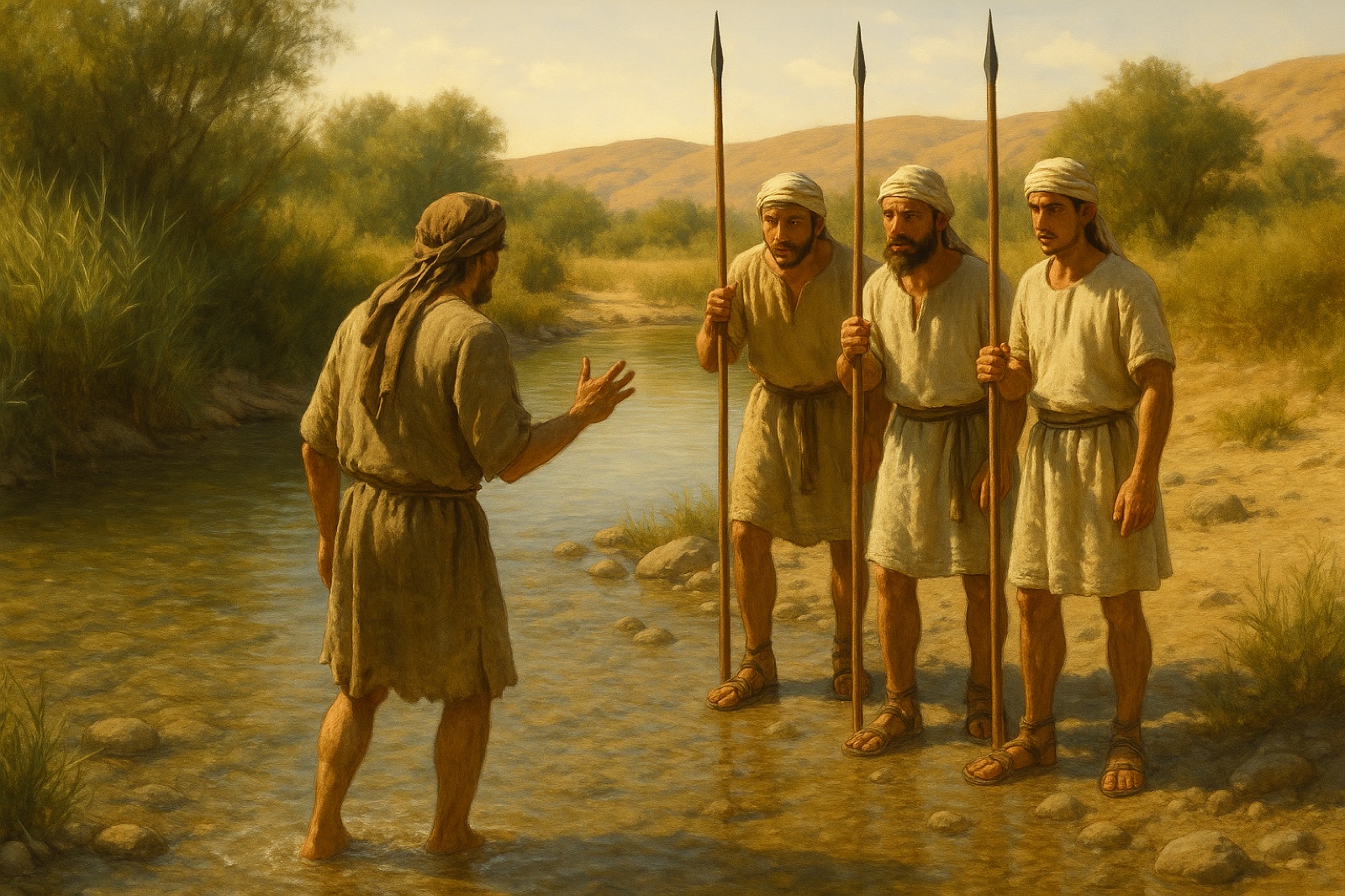
That was the spark. The two sides fought, and Gilead won. The men of Ephraim ran for home. But home was on the other side of the Jordan River, and the men of Gilead reached the shallow crossing places first.
What happened next is where the word comes from:
“And the Gileadites took the passages of Jordan before the Ephraimites: and it was so, that when those Ephraimites which were escaped said, Let me go over; that the men of Gilead said unto him, Art thou an Ephraimite? If he said, Nay; Then said they unto him, Say now Shibboleth: and he said Sibboleth: for he could not frame to pronounce it right. Then they took him, and slew him at the passages of Jordan: and there fell at that time of the Ephraimites forty and two thousand.” (Judges 12:5-6, KJV)
One sound. “Sh” or “s.” The people of Ephraim said that sound a little differently, the way people from one town can say a word differently from the next town over. A tired man could lie about where he was from. He could not hide how he talked.
The Bible gives the number as forty-two thousand. Some scholars think the Hebrew word for “thousand” can also mean a fighting unit, so the real count may have been smaller. Nobody knows for sure. Either way, a great many people died over a single sound.
What Shibboleth Means in Hebrew
Here is something strange. The word itself had nothing to do with the war.
In Hebrew, shibboleth is an everyday farm word. Most of the time it means an ear of grain, the top of the stalk where the seeds grow. It is the word for the ears of grain in Pharaoh’s dream in Genesis 41, and for what Ruth went out to gather in the field (Ruth 2:2). A few times it means rushing water, as in Psalm 69:2: “I am come into deep waters, where the floods overflow me.”
Standing at a river, “stream” would have been an easy word to reach for. But the Bible does not say why they picked it, and scholars still argue about exactly how the two tribes said it differently. What we can say is this: the meaning did not matter. Any word with that sound would have worked. A word about bread and water was turned into a blade.
Three Things in the Story Most People Read Past
They were family. Gilead and Ephraim were not strangers. Both lines went back to Joseph. Ephraim was Joseph’s son. The Gileadites traced their line to Gilead, a grandson of Ephraim’s brother Manasseh (Numbers 26:28-29). Same ancestor. Same language. Same God. The only thing between them at the river was one sound.
The insult came back around. Remember the taunt, “fugitives of Ephraim”? In the very next verse, the King James Bible calls the running men “those Ephraimites which were escaped.” In Hebrew it is the same word both times. The men who mocked others as runaways became the runaways. The English wording hides it. A Hebrew reader hears it at once.
The man in charge had been thrown out himself. One chapter earlier, we learn that Jephthah’s own brothers drove him from the family home because of who his mother was. “Thou shalt not inherit in our father’s house,” they told him (Judges 11:2, KJV). He knew just what it felt like to be told, “You are not one of us.” And still, when his side had the power, his men set up a checkpoint.
That last one is uncomfortable, because it is so human. Being shut out does not always make us kind. Sometimes it only teaches us how the gate works.
And it did not have to go this way. A few chapters earlier, the same tribe brought the same complaint to another leader, Gideon. He answered softly and gave them credit for their part. “Then their anger was abated toward him, when he had said that” (Judges 8:3, KJV). Same complaint. Two answers. One ended in peace. One ended at the river.
The Bible does not cheer for what happened at the Jordan. It simply tells it, in a book that ends with the words “every man did that which was right in his own eyes” (Judges 21:25, KJV).
The Test Never Went Away
People kept using the trick. Tradition says Frisian rebels in the 1500s tested strangers with a rhyme about butter, bread and green cheese. In the Second World War, the Dutch are said to have used the name of a seaside town, Scheveningen, because German speakers said it differently.
Most shibboleths today are quieter. Nobody dies. But the test still runs. It is the work jargon no one explains to the new person. The right school. The right part of town. The right way to pray out loud, with the right church words. It is the look that passes between two people when a third person says it “wrong.”
Every group does this. Mine does. Yours does too. And nearly all of us have stood on both banks of that river. We have been the one who could not say it right. And we have been the one listening for the slip.
The Night an Accent Gave Peter Away
Now go forward more than a thousand years, to the night Jesus was arrested. Peter is standing in a courtyard, trying hard not to be noticed. Then someone hears him talk.
“Surely thou also art one of them; for thy speech bewrayeth thee.” (Matthew 26:73, KJV)
“Bewrayeth” is an old word for “gives you away.” Mark’s Gospel fills it in: “thou art a Galilaean, and thy speech agreeth thereto” (Mark 14:70, KJV). Peter was from Galilee, up north, far from the capital. He talked like it. So did his friends. Jesus grew up in Galilee too, so it is fair to guess that He sounded the same.
It was a shibboleth moment. Peter’s own mouth marked him as one of the wrong people. He was so afraid that he swore he had never met Jesus. Then he went out and wept.
About seven weeks later came the feast of Pentecost. Jerusalem was full of people from many nations. The followers of Jesus were together in one house, and the Spirit of God came on them. A crowd gathered. And this is what the crowd said:
“Behold, are not all these which speak Galilaeans? And how hear we every man in our own tongue, wherein we were born?” (Acts 2:7-8, KJV)
Read that next to Judges 12, and something turns over.
At the Jordan, the stranger had to talk like the guard, or die. At Pentecost, God talked like the stranger. Each person heard about “the wonderful works of God” (Acts 2:11, KJV) in the language of their own childhood. Nobody was asked to say it right first. The work of being understood moved from the outsider to God.
And look at what did not change. The crowd could still tell these were Galileans. Acts does not say how they knew, but after Peter’s night in the courtyard, their speech is a fair guess. God did not fix their accents before using them. The same Peter whose voice gave him away is the one who “lifted up his voice” that morning to speak to the whole city (Acts 2:14, KJV).
One more thing, and I only noticed it while reading for this piece. Pentecost was a harvest feast. The law calls it “the feast of weeks, of the firstfruits of wheat harvest” (Exodus 34:22, KJV). And shibboleth, remember, is the word for an ear of grain. The Bible never ties these two stories together itself, so hold this loosely. But I find it hard to forget. At the river, a harvest word was used to cut people down. At the harvest feast, people of every language were gathered in. We look at that festival more closely in What Does Pentecost Mean? The Harvest Festival Behind the Fire.
The last book of the Bible shows where all of this is heading: a crowd no one can count, “of all nations, and kindreds, and people, and tongues” (Revelation 7:9, KJV). The tongues are still there at the end. Heaven is not a place where everyone finally learns to say it one way.
A good place to start: if you would like to know that kind of welcome as something near, and not only as an idea, we made a short free guide called The Beginner’s Guide to Feeling God’s Presence Every Day. It is a simple video and companion PDF for noticing God in ordinary moments, even on the days you feel like an outsider. Get the free guide. Free.
What This Means When You Are the One at the River
Maybe you have been made to feel that you said it wrong. That your accent, your schooling, your past, or your clumsy prayers marked you as not one of the real ones. If so, hear this. That test belongs to the men at the Jordan. It is not God’s test. God’s answer to “Can you sound like us?” was to come and sound like you.
If you often feel on the outside, you may also like Why Do I Feel Like I Don’t Belong Anywhere? What Hebrews 11 Says.
And if you are usually the one who knows the right words, the story asks something of you too. Not guilt. Just a small change of direction. Stop guarding the crossing. Start helping people over.
Actions to Take Today
- Get one name right. Think of someone whose name you are not sure how to say. Message them now, or ask the next time you see them: “Am I saying your name right?” Then practice it. It takes one minute, and it tells a person, “You don’t have to change to fit my mouth.”
- Explain one insider word. Write down one word or phrase your group uses that a newcomer would not know. It could be at work, at church, or in your family. The next time it comes up around someone new, explain it without being asked.
- Answer the meaning, not the mistake. The next time someone says a word wrong, or struggles in a language that is not their first, don’t correct them unless they ask. Just answer what they meant. Let the slip go by.
If another Bible word or story has you curious, you can ask our free Bible Answers assistant anything. It opens in ChatGPT.
A Prayer for the Ones Who Said It Wrong
God, you know the rooms where I have felt like I did not belong, and the words I was afraid to say out loud. Thank you that you did not wait for me to sound right before you came close. Forgive me for the times I have listened for someone else’s mistake so I could feel like an insider. Show me one person today who is standing at the edge, and help me make the crossing easier for them. Amen.
Let’s Talk
Do you think a group can have its own insider words and customs without shutting people out, or does every shibboleth end up as a wall? Share your thoughts in the comments. I’d love to hear what you think.
Share This
- “Shibboleth was a plain word for an ear of grain. At a river crossing, it became the test for who lived. One sound. (Judges 12:6)”
- “At the Jordan, the stranger had to talk like the guard. At Pentecost, God talked like the stranger.”
- “Peter’s accent gave him away the night he denied Jesus. Seven weeks later, God used that same voice to reach a city full of nations. God didn’t fix his accent first.”
Shibboleth Meaning: Common Questions Answered
What does shibboleth mean?
A shibboleth is a word, pronunciation, custom or belief that shows whether a person belongs to a particular group. The word comes from Judges 12:5-6 in the Bible, where soldiers from Gilead used the Hebrew word “shibboleth” as a spoken test to identify men from the tribe of Ephraim, who pronounced it “sibboleth.” Today shibboleth can also mean an old saying or belief that a group keeps repeating out of habit.
Where is shibboleth in the Bible?
Shibboleth appears in Judges 12:6 (KJV): “Then said they unto him, Say now Shibboleth: and he said Sibboleth: for he could not frame to pronounce it right.” After a battle between Jephthah’s men of Gilead and the tribe of Ephraim, the Gileadites held the crossing places of the Jordan River and used the word to catch Ephraimites trying to get home. The King James Version says forty-two thousand Ephraimites died.
What does shibboleth mean in Hebrew?
In Hebrew, shibboleth usually means an ear of grain, the seed-bearing top of a stalk. It is the word used for the ears of grain in Pharaoh’s dream in Genesis 41 and in Ruth 2:2. In a few verses, such as Psalm 69:2, the same word means a flood or rushing stream. In Judges 12 the meaning of the word did not matter. It worked as a test because of its opening “sh” sound.
Why couldn’t the Ephraimites say shibboleth?
Judges 12:6 says an Ephraimite “could not frame to pronounce it right,” saying “sibboleth” instead of “shibboleth.” The tribes of Ephraim and Gilead spoke the same language with different regional accents, and that one sound showed where a speaker came from. Scholars still debate exactly what the difference in sound was. The Bible records the difference without explaining it.
What is an example of a shibboleth today?
A modern shibboleth is anything that quietly marks insiders from outsiders: the local way of saying a place name, workplace jargon, slang, a dress code, or special religious words that newcomers do not know. A password is a shibboleth in the most literal sense. Most modern shibboleths are harmless, but they can still make a person feel shut out.
Quote to remember: “God did not wait for you to say it right.”