 0
0
 0
0
What is the oldest song in the world? The usual answer is a small clay tablet from Syria. It is about 3,400 years old. It holds the words of a hymn and, under them, the notes to play it.
You can find recordings of it online in seconds. Here is the catch. Those recordings do not sound alike. Scholars have read the same tablet in at least five different ways, and each way gives a different tune.
So we have the oldest song. We just do not know how it goes. And that is only the first surprise.
What Is the Oldest Song in the World? Three Fair Answers
It depends on what you mean by “song.” There are three honest answers.
- The oldest written tune. A hymn on a clay tablet from the old city of Ugarit, in Syria, from about 1400 BC. It is known as Hurrian Hymn No. 6, or the Hymn to Nikkal. Guinness World Records lists it as the oldest written song with notation.
- The oldest complete song. A short Greek song cut into a gravestone in what is now Turkey, from the first or second century AD. It is called the Seikilos epitaph. Every word and every note of the song is still there.
- The oldest song words. These are older still. Hymns from the city of Ur, in what is now Iraq, are credited to a priestess named Enheduanna, who lived around 2300 BC. She is often called the first author in history known by name. But no tune for her hymns survives. The copies we have were made at least six centuries after her time, and some scholars doubt she wrote them herself.
One more thing to keep in mind. Music is far older than any of these. Flutes made of bird bone and mammoth ivory, found in caves in Germany, are around 35,000 to 43,000 years old. People were playing tunes for tens of thousands of years before anyone found a way to write one down.
So “the oldest song” really means “the oldest song that got written on something hard enough to last.”
The Clay Tablet From Ugarit
In the 1950s, archaeologists were digging in the ruins of a royal palace at Ugarit, on the coast of Syria. They found broken clay tablets holding about three dozen hymns, pressed into the clay in cuneiform, the wedge-shaped writing of the ancient Near East.
Almost all of them are in pieces. One is nearly whole. That one is the famous one.
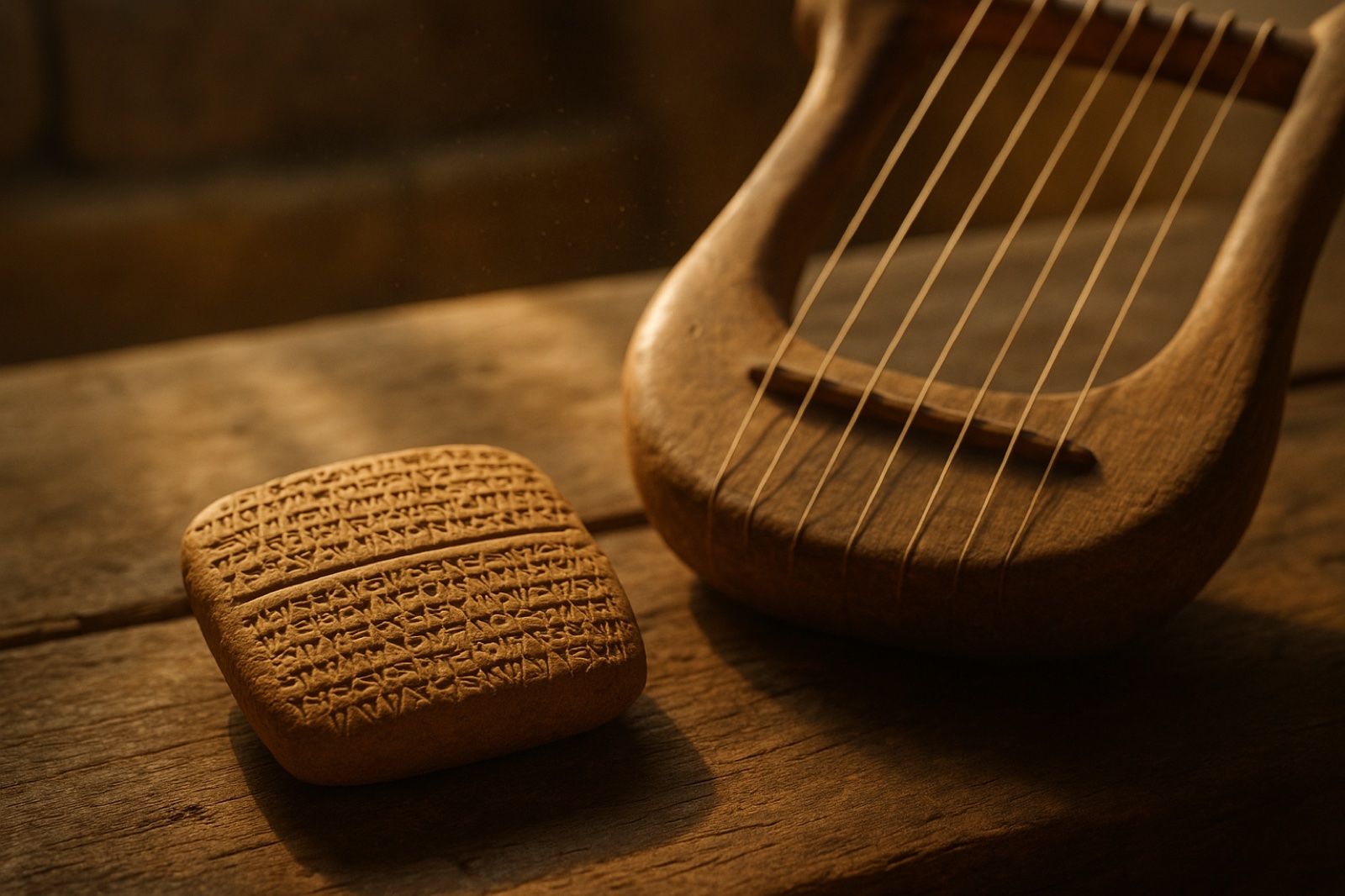
The tablet is laid out a little like a song sheet. The words are at the top, in a language called Hurrian. Then there is a double line. Under the line are the music directions, written in a different language, Akkadian. They are the names of musical steps, each followed by a number.
The song was for an instrument with nine strings, most likely a lyre, which is like a small harp you hold in your arms. A note at the end names the tuning. It also names the scribe who wrote it down: Ammurabi.
Here is a detail most people read past. Some of the broken tablets name their composers. This one does not. We know who held the pen. We do not know who wrote the song.
The hymn is to Nikkal. She is often called a moon goddess, but that is not quite right. Nikkal was a goddess of orchards, and the wife of the moon god. The tablet itself is in the collection of the National Museum of Damascus.
Why Nobody Agrees How the Oldest Song Sounds
The notes on the tablet are not like notes on a modern page. They are words and numbers. Nobody left a guide on how to read them.
What do the numbers mean? How many times to play each step? Something else? Does the scale run up or down? Scholars have argued about this for more than fifty years. There are at least five rival readings, and they give very different tunes.
Anne Kilmer, a professor at the University of California, Berkeley, worked on one of the best-known versions in the 1970s. In 1976 it came out on a record called Sounds from Silence. Others, among them Marcelle Duchesne-Guillemin, David Wulstan, Martin West and Richard Dumbrill, reached different answers from the same piece of clay.
Dumbrill has raised an idea that changes the question. As History.com reports, he thinks the tablet may be less like sheet music and more like a frame for a player to build on.
So when a video says “listen to the oldest song in the world,” what you are hearing is one careful guess. It may be close. It may not. The honest answer is that nobody knows.
The words are hard too. Hurrian is a dead language that is only partly understood, so every translation so far is a careful try. One early attempt, published by Hans-Jochen Thiel in 1977, reads part of it this way: “The sterile may they make fertile,” and then, “May she who has not yet borne children bear them.”
If that reading is close, the oldest tune we can read was not made to show off. It is someone bringing a gift of sesame oil and asking for a child.
The Oldest Complete Song Is on a Gravestone
The hymn from Ugarit has gaps. The oldest song that is whole, start to finish, is much younger and much shorter.
It is cut into a small marble column, a grave marker, from the first or second century AD. It was found around 1883 near Aydin, in Turkey, by Edward Purser, an Irish engineer who was building a railway. A man named Seikilos had it made. The Greek words have small signs above them that give the notes.
The whole song is only a few lines long. One common translation goes:
As long as you’re alive, shine, don’t be sad at all; life is short, time asks for its due.
The stone also says “Seikilos to Euterpe.” Euterpe may have been his wife. Or the name may point to Euterpe the Muse, the Greek spirit of music. No one can say for sure.
Then comes the part that makes historians wince. Purser wanted the column to hold his wife’s flowerpots. So he had the bottom sawed flat, to make it stand steady. That cut away a line of the writing, which is known today only from a rubbing made before the saw. A song that had lasted since Roman times lost a line to a plant stand.
The stone is now in the National Museum of Denmark, in Copenhagen.
Why So Few Old Songs Lasted
Think about how songs travel. A mother hums. A child copies her. Nobody writes anything. For most of history that was the only way a song moved, and a song like that dies when the last person who knows it does.
Writing was rare, and it cost a lot. Scribes worked for palaces and temples. So what got pressed into clay was mostly what palaces and temples wanted to keep. Farmers surely sang in the fields. Mothers surely sang babies to sleep. Hardly anyone was paid to write those songs down.
This is a plain case of survivorship bias: we judge the past by the small part of it that lasted. Almost all the oldest songs we can read are hymns. That may tell us what people sang most. Or it may only tell us who owned the clay.
Even the rooms are easier to bring back than the tunes. People who study ancient acoustics can rebuild the sound of spaces nobody has entered in thousands of years. But a room cannot tell you what was sung in it.
Still, look at the two songs that did make it. One is a plea for a child. One is a goodbye on a grave. Neither was written to fill a quiet evening. Both come from a person standing in front of something much bigger than they are.
The Old Song That Never Stopped Being Sung
There is a third old song, and it has the opposite problem.
The hymn from Ugarit kept its notes and lost its singers. For more than 3,000 years, no one sang it at all. This other song kept its singers and lost its notes.
It is called the Song of the Sea, and it sits in the book of Exodus, in the Bible. No music was ever written down for it. Only the words. Its Hebrew is older in style than the writing around it, and some scholars count it among the oldest poetry in the whole Bible. Others think it was written later, on purpose, in an old style. The dates on offer run from the 13th century BC to the 5th. That argument is not settled either.
But here is what is not in doubt. People never stopped saying it. It is still recited every morning in Jewish prayer. In handwritten Torah scrolls it gets its own layout, with the lines stacked like bricks in a wall, so it looks different from nearly everything around it.
The story it comes from is simple. A crowd of people who have just stopped being slaves are standing on the far side of the water. The army that chased them is gone. A woman named Miriam picks up a hand drum. The other women follow her, dancing. And they sing.
They are not asking for anything. That morning there is nothing left to ask for. The song is a thank-you to God for carrying them across.
Maybe that is why it never needed clay. A thank-you gets passed on, because people who were carried want their children to know it.
A good place to start: The Beginner’s Guide to Feeling God’s Presence Every Day. A short video guide and PDF with a simple 3-step rhythm for noticing God in the ordinary parts of your day. Get the free guide. Free.
A Plea, a Goodbye, and a Thank-You
So what is the oldest song in the world? A tune on a clay tablet that nobody can agree on. A few lines on a gravestone that someone turned into a plant stand. Or a thank-you with no tune at all that is still said every morning.
Put side by side, they cover most of a life. Please. Goodbye. Thank you.
You still do this. You hum when you are nervous. You go quiet when a funeral song starts. And when something finally goes right, the good test result, the safe trip home, the baby asleep at last, something in you wants to sing. People have sung through far worse, too. One well-known hymn, It Is Well With My Soul, has a shipwreck behind it.
You do not need a lyre or a good voice. The next time you get across something hard, try it. Hum the song you love on the walk home. It costs nothing, and it is one of the oldest things people do.
Seikilos had it cut into stone: as long as you are alive, shine.
What Do You Think?
Which one counts as the real oldest song in the world to you: the oldest tune nobody can agree on, the oldest complete song, or the oldest one people still say out loud? Tell us in the comments. We read every one.
Share This
Copy one of these if it says what you were thinking:
The oldest song in the world is on a 3,400-year-old clay tablet, and scholars have read it at least five different ways. Nobody knows how it really goes. https://bgodinspired.com/?p=117740
The oldest complete song ever found is on a gravestone. A railway engineer sawed the bottom off so it could hold his wife’s flowerpots. I can’t stop thinking about this: https://bgodinspired.com/?p=117740
“As long as you’re alive, shine.” That line is about 1,900 years old and it was written as music. The story of the oldest songs we have: https://bgodinspired.com/?p=117740
Oldest Song in the World FAQ
What is the oldest song in the world?
The oldest song in the world with written music is Hurrian Hymn No. 6, also called the Hymn to Nikkal. It was pressed into a clay tablet around 1400 BC in the city of Ugarit, in modern Syria, and holds both the words and directions for playing the tune on a nine-stringed instrument. Older song words exist, such as Sumerian hymns credited to the priestess Enheduanna around 2300 BC, but no music survives for them.
How old is the Hurrian Hymn to Nikkal?
The Hurrian Hymn to Nikkal is about 3,400 years old. It dates to roughly 1400 BC and was found in the 1950s in the ruins of the royal palace at Ugarit, now Ras Shamra in Syria. The words are in the Hurrian language and the music directions are in Akkadian. The tablet names its scribe, Ammurabi, but not its composer.
What is the oldest complete song in the world?
The oldest complete song in the world is the Seikilos epitaph, a short Greek song carved with its musical notes into a marble grave marker in the first or second century AD. It was found around 1883 near Aydin in Turkey and is now in the National Museum of Denmark in Copenhagen. Its words tell the listener to shine while alive, because life is short.
What does the oldest song in the world sound like?
Nobody knows for certain what the oldest song in the world sounds like. The Hurrian Hymn to Nikkal gives its music as names of musical steps followed by numbers, and scholars disagree about how to read them. At least five rival readings have been published, and they produce very different tunes, so every modern recording of the hymn is one scholar’s reconstruction rather than a sure copy of the original.
What is the oldest song in the Bible?
The Song of the Sea in the book of Exodus is often named as one of the oldest songs in the Bible, along with the Song of Deborah in the book of Judges. The Song of the Sea is written in an older style of Hebrew than the text around it. Scholars have proposed dates from the 13th century BC to the 5th century BC, and some think the old style was used on purpose by a later writer. No music for it survives, only the words.