 0
0
 0
0
Your brain is shrinking. So is mine. It started years ago, and neither of us felt it.
That is not a scare line. It is just what a brain does after middle age. A little tissue goes each year. The hollow spaces inside widen a bit. A scan can measure it, even when you feel fine.
So when a study says the MIND diet was linked to slower brain aging, people lean in. The headline number was 2.5 years. That is real, and it came from a careful 12-year study. But the details underneath it are more interesting than the headline, and one of them surprised the researchers themselves.
What the MIND diet actually is
The MIND diet is a mix of two older eating plans: the Mediterranean diet and the DASH diet, which was built to lower blood pressure. It was designed with the brain in mind, which is where the name comes from.
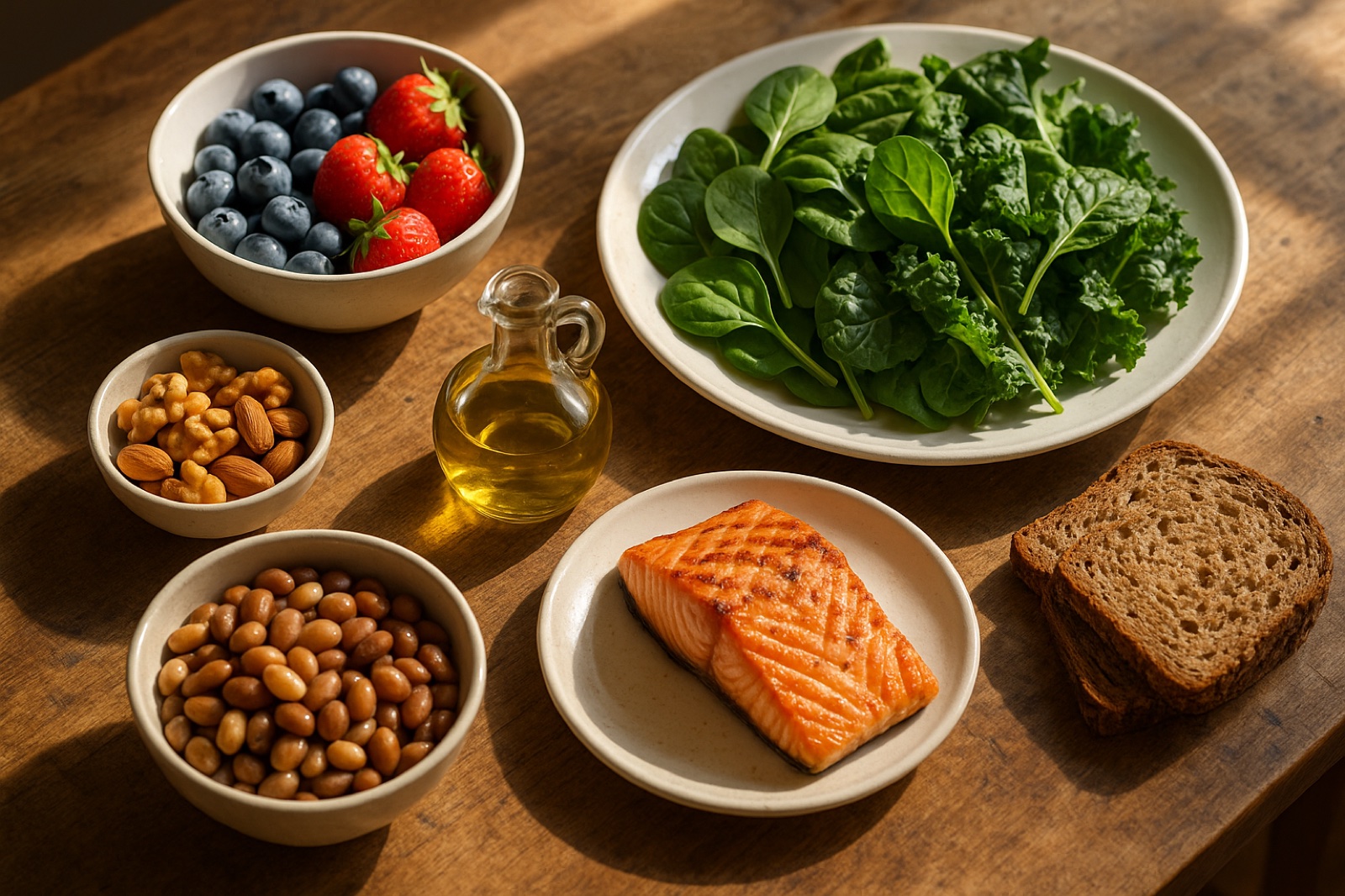
It is scored on a simple 0 to 15 point scale. You earn points for eating more of nine food groups: leafy greens, other vegetables, berries, nuts, whole grains, fish, beans, olive oil and poultry. There is one point for moderate wine. And you earn points for eating less of five things: butter or margarine, cheese, red meat, pastries and sweets, and fried fast food.
A perfect 15 is rare. In this study, the average person scored just under 7. Keep that number in your head, because the whole result hangs on it.
What the 12-year study found
The study followed 1,647 adults from the Framingham Heart Study in the United States. Their average age at the start was 60. None had a stroke or dementia when they joined. Over about 12 years they filled out food questionnaires, had regular check-ups, and had at least two MRI brain scans each, taken every two to six years between 1999 and 2019. The results were published in the Journal of Neurology, Neurosurgery & Psychiatry in March 2026. The publisher’s summary of the study has the full numbers.
Here is the main finding. For every 3 extra points on the MIND scale, grey matter shrank about 20% more slowly. Grey matter is the tissue that does most of the thinking, remembering and deciding. The researchers worked out that 20% slower loss is roughly the same as 2.5 years of brain aging that did not happen.
The hollow spaces inside the brain, called ventricles, grow as tissue around them shrinks. Those grew about 8% more slowly for every 3 points, which the team put at about one year of delayed aging.
Now go back to that average score of just under 7. The study is not comparing perfect eaters to terrible ones. Three points is the gap between an average person and someone who added two or three habits. That is a smaller change than most diet headlines imply, which makes the result more useful, not less.
The catch inside the findings
This is the part the headlines skipped.
When the researchers looked at the 15 foods one at a time, the picture got messy. Berries and poultry carried most of the benefit. People who ate more of them had slower grey matter loss and slower ventricle growth. Sweets and fried fast food went the other way, and were linked to faster shrinking in the hippocampus, the brain’s memory centre.
Then came the two surprises. Whole grains, which earn you a point on the MIND scale, were linked to faster grey matter loss, not slower. And cheese, which costs you a point, was linked to slower loss. Two of the rules pointed the wrong way.
The researchers did not hide this. Their answer was that the overall pattern matters more than any single food, and that you should not pull one item out and treat it as the magic ingredient. That is a fair reading. It is also an honest admission that nobody fully understands which parts of this diet do the work.
One more detail. The hippocampus, the region people worry about most when they think of memory, was not clearly protected by the diet as a whole. The benefit showed up in total grey matter and in the ventricles. And the link was stronger in older people, in people who were more physically active, and in people who were not overweight.
What this study cannot tell you
The researchers were plain about the limits, and they are worth repeating.
- It is observational. Nobody was assigned a diet. People who eat this way may differ in other ways, like income, sleep or exercise. The study cannot prove the food caused the slower shrinking.
- The diet was self-reported. People filled out questionnaires about what they ate. Memory is not perfect, and most of us report eating better than we do.
- The group was mostly White Americans. The results may not carry over the same way to everyone else.
- Some early memory problems may have been missed. The team could not fully rule out mild cognitive trouble at the start.
None of that makes the study bad. It makes it one piece of evidence, in line with earlier work on lifestyle changes for brain health, rather than a verdict.
What you can actually do with it
If three points is the useful gap, then three habits is the useful goal. You do not need a plan, a budget or a special shop.
- Add beans. They are among the cheapest foods on earth, dried or tinned, and they earn a point.
- Add leafy greens. Spinach, cabbage, kale, local greens, whatever grows near you and costs least.
- Add berries when you can. Frozen berries count. This was one of the two foods that did the most in the study.
- Drop one fried or sweet thing. Not all of them. One. Fried fast food and sweets were the foods most clearly linked to faster memory-centre shrinking.
That is it. Do not chase a 15. The people in this study who benefited were not perfect. They were slightly better than average, for a long time.
The part of you that was never in the scan
Here is something I keep coming back to. Every result in this study is about slowing a loss. The best diet in the world, on the best day, buys you a couple of years of delay. The tissue still goes. The scan still shows it. Nothing on that food questionnaire can stop the outside of a person from wearing down.
And yet anyone who has spent real time with the very old knows the strange thing that happens next. The body gets smaller. The brain, we now know, gets smaller too. But some people seem to get bigger inside the whole time. Kinder. Calmer. More sure of what matters. There is an ancient idea, older than any of the diets, that says this is not an accident. It says the outer person wears away day by day, but there is an inner person that God renews day by day, at the very same time. One part of you shrinks on schedule. The other part was never on the schedule at all.
The study measured the first part. It had no instrument for the second. That does not make the second one less real. It just means a scan was never the right tool for it.
A good place to start:
The Beginner’s Guide to Feeling God’s Presence Every Day
A simple guide to noticing God in the ordinary moments of a day, even when life feels chaotic.
Free.
So eat the beans. Eat the berries. Take the two and a half years if they are on offer. The research on brain shrinkage with age keeps finding small things that soften it, and this is one of them. Just do not confuse the thing you can slow with the thing that was never shrinking. You are more than the part that fits on a scan.
Discussion question
The study found two of the MIND diet’s own rules, whole grains and cheese, pointed the wrong way. Does a surprise like that make you trust the overall result more, or less? Tell us in the comments.
Share this
A 12-year study linked the MIND diet to 20% slower grey matter loss. The surprise: whole grains pointed the wrong way, and cheese helped. Worth a read. https://bgodinspired.com/index.php/health-and-wellness/mind-diet-brain-aging/
Turns out the useful gap in the MIND diet study was 3 points out of 15. That is beans, greens and berries, not a whole new life. https://bgodinspired.com/index.php/health-and-wellness/mind-diet-brain-aging/
“You are more than the part that fits on a scan.” Did not expect a diet article to end there. https://bgodinspired.com/index.php/health-and-wellness/mind-diet-brain-aging/
Questions and answers
What is the MIND diet?
The MIND diet is an eating pattern that combines the Mediterranean diet with the DASH diet, a plan built to lower blood pressure. It is scored from 0 to 15. Points are earned for eating more leafy greens, other vegetables, berries, nuts, whole grains, fish, beans, olive oil and poultry, plus moderate wine, and for eating less butter or margarine, cheese, red meat, pastries and sweets, and fried fast food.
Does the MIND diet slow brain aging?
A 2026 study of 1,647 adults in the Framingham Heart Study, followed for about 12 years with repeated MRI scans, found that every 3 extra points on the MIND diet scale was linked to about 20% slower loss of grey matter, roughly equal to 2.5 years of delayed brain aging. The study was observational, so it shows an association and cannot prove that the diet caused the slower shrinking.
Which MIND diet foods helped the brain most?
In the 2026 Framingham study, berries and poultry showed the strongest links to slower brain shrinking. Sweets and fried fast food were linked to faster shrinking of the hippocampus, the brain’s memory centre. Unexpectedly, whole grains were linked to faster grey matter loss and cheese to slower loss, so the researchers said the overall eating pattern matters more than any single food.
How many points do you need on the MIND diet to see a benefit?
In the 2026 Framingham study, the average participant scored just under 7 out of 15 on the MIND diet scale, and each 3-point increase was linked to about 20% slower grey matter loss. That means the benefit was measured across small, realistic differences, roughly two or three extra healthy habits, not across the gap between a perfect score and a very poor one.
What are the limits of the MIND diet brain study?
The 2026 MIND diet brain study was observational, so it cannot prove cause and effect. Diet was self-reported on questionnaires, which depend on memory. The participants were mostly White adults in the United States, so the results may not apply equally to everyone. The researchers also could not fully rule out mild memory problems at the start of the study.