 0
0
 0
0
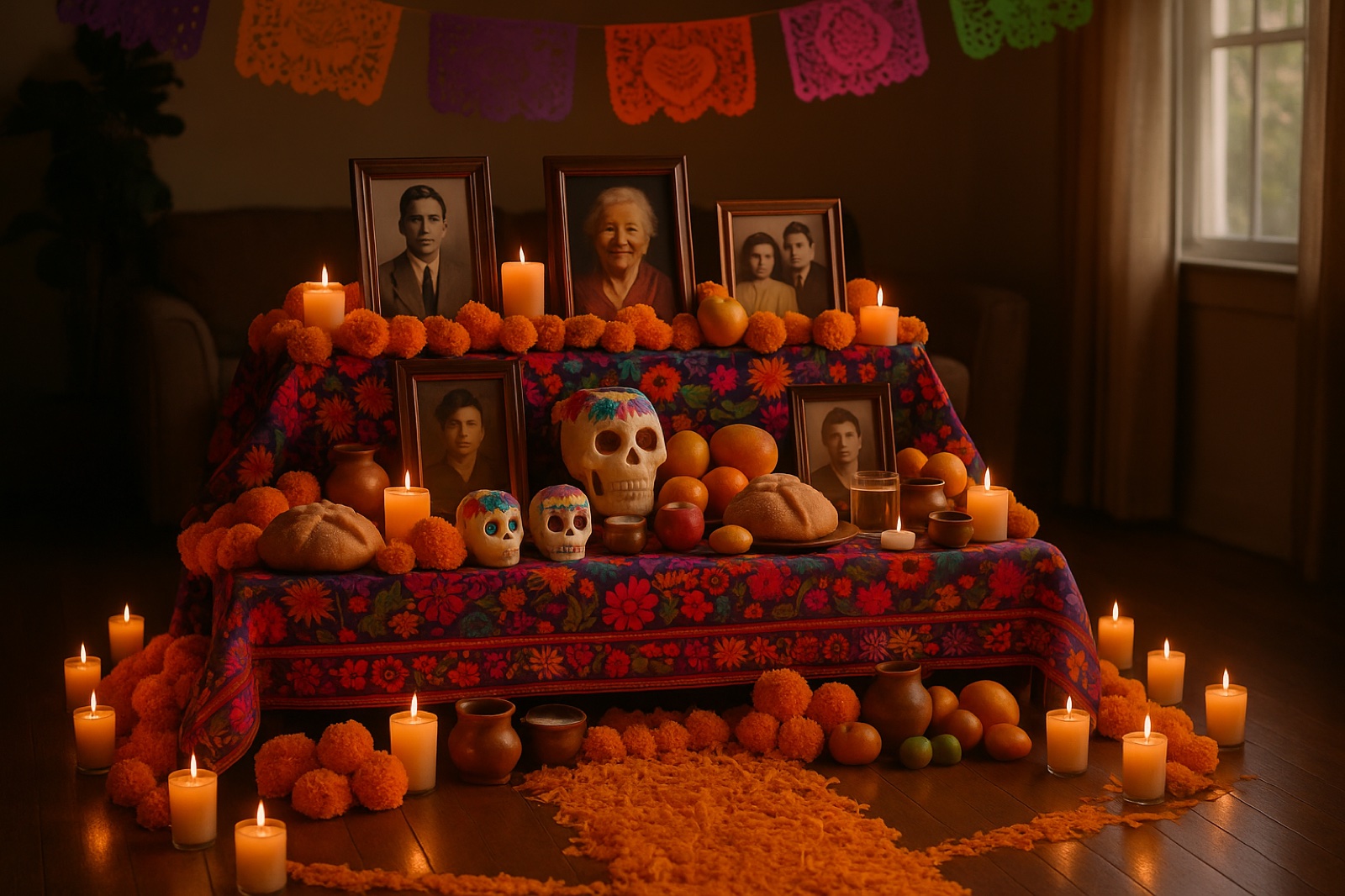
Early November. A table in a living room, stacked in steps like a small staircase. On it: a photo of a grandmother, a glass of water, a loaf of sweet bread, a pile of orange flowers so bright they almost hum. Candles everywhere. And a sugar skull with a name written across its forehead.
That table is the heart of Day of the Dead. The name is the bluntest in the world. The feeling in the room is the opposite of blunt. It is tender, loud, funny, and sad, all at the same time.
Maybe you are reading this because you saw the flowers in a shop. Maybe it is because a film made you cry. Or maybe it is because this year, for the first time, there is a photo you could put on a table like that. Whatever brought you here, this is a plain guide to what Day of the Dead is, what goes on the altar, where it really comes from, and the one quiet idea sitting under all of it.
What Is Day of the Dead?
Day of the Dead, or Día de Muertos in Spanish, is a holiday from Mexico. Families welcome back the people they have lost. It is not a day of fear. It is a family reunion where some of the guests have died.
It falls on 1 and 2 November. In 2026 that is a Sunday and a Monday. By tradition, 1 November is for children who died, and 2 November is for adults. Many families begin the night before, on 31 October.
The belief at the center is simple. For these two days, the dead are allowed to come home and visit. So the living get the house ready. They build an altar called an ofrenda. They cook the food the person loved. They clean and decorate graves, and some families stay in the cemetery through the night with music, blankets, and stories.
In 2008 UNESCO added the tradition to its list of the world’s Intangible Cultural Heritage. It is now kept in parts of Central America and by Mexican families all over the world, including in the United States, where it has grown fast in the last twenty years.
What Goes on a Day of the Dead Altar
An ofrenda is not a shrine to be stared at. It is a welcome table. Each thing on it does a job for a tired traveler who has come a long way.
- Photos. The faces of the people being welcomed. This is the one thing an ofrenda cannot do without.
- Marigolds. Called cempasúchil, a name from the Nahuatl language. Their strong color and strong smell are said to guide the dead home. Families often lay a path of petals from the door to the altar.
- Candles. Light for the road. Many families light one candle for each person they are waiting for.
- Water. Tradition says the dead arrive thirsty after the journey.
- Salt. A small dish, often set in the shape of a cross or a plain pile. Tradition links it to cleansing and protection on the way.
- Pan de muerto. A soft, sweet, round bread. The strips of dough on top are often said to be bones, and the little knob in the middle a skull or a tear.
- Sugar skulls. Bright, decorated, and smiling. The name of a dead person, or a living one, is written across the forehead. Yes, you can get one with your own name on it. That is part of the joke.
- Papel picado. Paper banners cut with tiny patterns. They move in the slightest breeze, which is said to stand for the air, and for how thin the line between life and death is.
- Their favorite things. A bottle of the drink they liked. The dish they always ordered. A toy, if the altar is for a child. A pack of the cards they used to cheat at.
Here is the detail people miss. The food is not for show. Families believe the dead take the essence of it, the smell and the goodness. Then, when the visit is over, the living eat what is left. The meal is shared across the line.
Where Day of the Dead Really Comes From
Most short answers say “ancient Aztec festival.” The honest answer is more interesting.
The dates come straight from the Christian calendar. The Church set 1 November as All Saints’ Day, to honor the holy dead. Around the year 1000, a French abbey began setting aside 2 November to pray for all the dead, and that spread as All Souls’ Day. The night before All Saints’ is All Hallows’ Eve, which is where Halloween gets its name. The three days together were called Allhallowtide. Day of the Dead sits exactly on top of two of them. If you want the older half of that story, we wrote about what All Saints’ Day actually means and who the saints were.
The peoples of Mexico before the Spanish arrived did hold festivals for the dead. The Aztecs had several each year. When Spanish priests came in the 1500s, those customs and the Church’s two feast days met and mixed. That is the usual telling, and much of it is true.
But not every historian agrees on how much is indigenous. The Mexican historian Elsa Malvido argued that the holiday as we know it can be traced fully to medieval Europe, with the Aztec link added later. Others see a real blend. What most agree on is this: Day of the Dead became a symbol of the whole nation only in the 1930s and 1940s, when the Mexican government leaned into indigenous roots as part of its identity. The “ancient” holiday, in its modern shape, is partly a modern creation.
And the most famous part may be the newest. The big skeleton parade through Mexico City did not exist until 2016. The year before, the James Bond film Spectre opened with a huge, invented Day of the Dead parade. Tourists started asking where to see it. So the city built one. Reports put the first crowd around a quarter of a million people. Then in 2017 the Pixar film Coco carried the holiday into living rooms around the world.
Even the elegant skeleton lady in the fancy hat, La Catrina, has a story. The printmaker José Guadalupe Posada made her around 1910 as a joke. She was a skull in a rich French hat, poking fun at people who pretended to be European and were ashamed of their roots. Her point was sharp and simple: dressed up or not, we all end up the same. The painter Diego Rivera later gave her a full dress and a name in a 1947 mural, and she became the face of the holiday.
So the tradition is old and new, European and Mexican, serious and silly. That mix is not a flaw. It is the point.
Is Day of the Dead Sad or Happy?
Both, and it does not apologize for either.
People who grew up with it will tell you the same thing. You laugh at the sugar skull with your uncle’s name on it. Then you set down his coffee cup and your throat closes. Then someone tells the story about the time he drove the wrong way for an hour, and you laugh again.
That is what makes it different from most of the ways the world handles death. It does not pretend the person is still alive. It does not pretend they are fully gone. It sets a place at the table and sees what happens.
Which brings us to the quiet idea underneath all of it.
Every ofrenda rests on one assumption that nobody says out loud. The people in the photos still are. Not were. You do not pour water for someone who no longer exists. You do not cook for a memory.
That instinct is older than the holiday. In the story that sits underneath this calendar, Jesus was once asked a trick question about the dead. His answer turned on a single verb. Long after Abraham had died, God spoke to Moses and said, “I am the God of Abraham.” Am. Not was. Jesus said that settled it: God is the God of the living, not the dead. Whatever you believe, the marigolds are making the same argument. The door is still open. The guests are still expected.
If You Want to Build One This Year
You do not need to be Mexican, and you do not need much. People who keep this tradition are usually glad when it is done with care. Done with care means you are honoring your own dead, not wearing someone else’s culture as a costume.
- Start with one photo. One is enough.
- Add one candle and one glass of water.
- Add one thing they loved. Food, a song playing, the terrible jumper they always wore.
- Say their name out loud. Tell one story about them to someone, even if it is just the dog.
- If flowers are hard to find, any bright orange or yellow bloom will do. The color is the message.
If this is the first November without someone, go gently. Grief does not follow a tidy order, and it helps to know roughly where you are in it before the holidays start arriving one after another. We also keep a short prayer for the first holiday without a loved one, if that is a door you want to open.
Either way, the table is a good idea. Light the candle. Pour the water. Leave the door open. They were never only a memory.
A good place to start:
The Beginner’s Guide to Feeling God’s Presence Every Day
A simple guide to noticing God in ordinary moments, even in a hard season, with a three-step rhythm you can keep on your worst day.
Free.
Discussion Question
Is it healthier to set aside one day a year to talk about the people we have lost, or to let it happen whenever it happens? Tell us what you think in the comments.
Share This
Copy one of these if you want to pass it on:
- Did not know the famous Mexico City Day of the Dead parade only started in 2016, because of a James Bond film. This whole piece surprised me. https://bgodinspired.com/?p=117594
- “You do not cook for a memory.” Reading about Day of the Dead this year and this line stopped me. Building a small altar for my dad. https://bgodinspired.com/?p=117594
- A clear, kind explainer on what Day of the Dead actually is, what goes on the altar, and where it really comes from. Worth five minutes if you have lost someone: https://bgodinspired.com/?p=117594
Questions People Ask About Day of the Dead
What is Day of the Dead?
Day of the Dead, or Día de Muertos, is a Mexican holiday held on 1 and 2 November. Families welcome back the spirits of relatives who have died by building home altars called ofrendas, decorating graves, and sharing the food and drink the dead person loved. It is a warm family remembrance, not a frightening event. UNESCO recognized it as Intangible Cultural Heritage in 2008.
When is Day of the Dead in 2026?
Day of the Dead falls on Sunday 1 November and Monday 2 November 2026. By tradition, 1 November is for children who have died and 2 November is for adults. Many families begin preparing altars and visiting cemeteries on the evening of 31 October.
Is Day of the Dead the same as Halloween?
No. Day of the Dead and Halloween share the same calendar, because both grew up around the Christian feasts of All Saints’ Day on 1 November and All Souls’ Day on 2 November. But their purpose is different. Halloween in most places is about costumes, scares, and sweets. Day of the Dead is about welcoming specific loved ones home, with their photos, their favorite foods, and their names spoken aloud.
What do you put on a Day of the Dead altar?
A traditional Day of the Dead altar, or ofrenda, holds photos of the dead, orange marigolds called cempasúchil, candles, a glass of water, a dish of salt, sweet pan de muerto bread, decorated sugar skulls, cut-paper banners called papel picado, and the favorite foods, drinks, or small belongings of the people being remembered. Each item is meant to guide, refresh, or welcome a visiting spirit.
Is it disrespectful to celebrate Day of the Dead if you are not Mexican?
Most people who keep the tradition welcome others who take part with care. Taking part with care means building an altar for your own dead, learning what the items mean, and treating the holiday as remembrance rather than a costume theme or a party trend. Painting a sugar-skull face for a night out with no connection to the meaning is the part many Mexican families find hollow.