 0
0
 0
0
You sit down. The cuff squeezes. A number flashes up, and it is higher than you hoped.
Before you worry, look at your arm. Where was it while the machine was working? Hanging down by your side? Resting in your lap? Held up by the nurse for a moment?
That small detail can change the number more than most people would guess. Learning how to take blood pressure correctly starts with something almost nobody thinks about: what is holding your arm up.
What the Arm Study Found
In a study published in October 2024 in JAMA Internal Medicine, researchers at Johns Hopkins tested the same 133 adults, aged 18 to 80, in three seated positions. Each person had their arm:
- resting on a desk, at about heart level (the way guidelines say to do it)
- resting in their lap
- hanging down by their side, with nothing under it
Compared with the desk, the results were clear:
- Arm in the lap: the top number (systolic) read about 3.9 points higher, and the bottom number (diastolic) about 4.0 points higher.
- Arm hanging at the side: the top number read about 6.5 points higher, and the bottom number about 4.4 points higher.
Nothing about these people’s hearts changed between readings. Only their arms moved.
One of the researchers, Dr. Sherry Liu, put it this way: an extra 6.5 points could be “a potential difference between a systolic BP of 123 and 130, or 133 and 140.” Under US guidelines, 130 is where stage 1 high blood pressure begins. Many other countries draw their main line at 140. Either way, a few points can move you across a line that changes what a doctor says to you.
If a number like that has you lying awake doing the maths, you are not the only one. A health worry tends to get louder at night, which is exactly why this free guide exists:
Why a Hanging Arm Reads Higher
The study measured the effect. It did not set out to explain it. But two simple ideas help it make sense.
Gravity. When your arm hangs below your heart, the blood in it sits lower down. The cuff is then measuring blood that has a bit of extra weight pressing on it. That is why guidelines say the cuff should sit at about heart level.
Effort. An arm with nothing under it is never fully at rest. Your muscles quietly work to hold it in place, even when you don’t notice. Working muscles can nudge pressure up.
So the arm that holds itself up looks more strained on paper than it really is. Keep that thought. We will come back to it.
The Part of the Study Most People Skip
Here is the detail that surprised me. The researchers did not invent this problem in a lab. They wrote that blood pressure is often checked while people sit on an exam table with little or no support for their arm. Sometimes the arm rests in the patient’s lap. Sometimes a clinician just holds it for a moment.
In other words, the “wrong” positions in this study are the ones many of us meet in real life.
The researchers were also careful about what they could not prove. The results may only apply to automated machines, the kind most clinics and homes now use. And this was a single visit for each person. That is good science: they told you where their answer stops.
The study’s senior author, Dr. Tammy Brady, said patients need to speak up for themselves, both in the clinic and at home. That doesn’t mean being rude. It can be as simple as: “Could I rest my arm on the desk, please?”
How to Take Blood Pressure Correctly at Home
You don’t need special gear for any of this. A chair, a table, and a few quiet minutes are enough.
- Get ready first. Empty your bladder. Skip coffee, exercise and smoking for about 30 minutes before.
- Sit in a chair with a back. Let the chair hold your back. Put both feet flat on the floor. Don’t cross your legs.
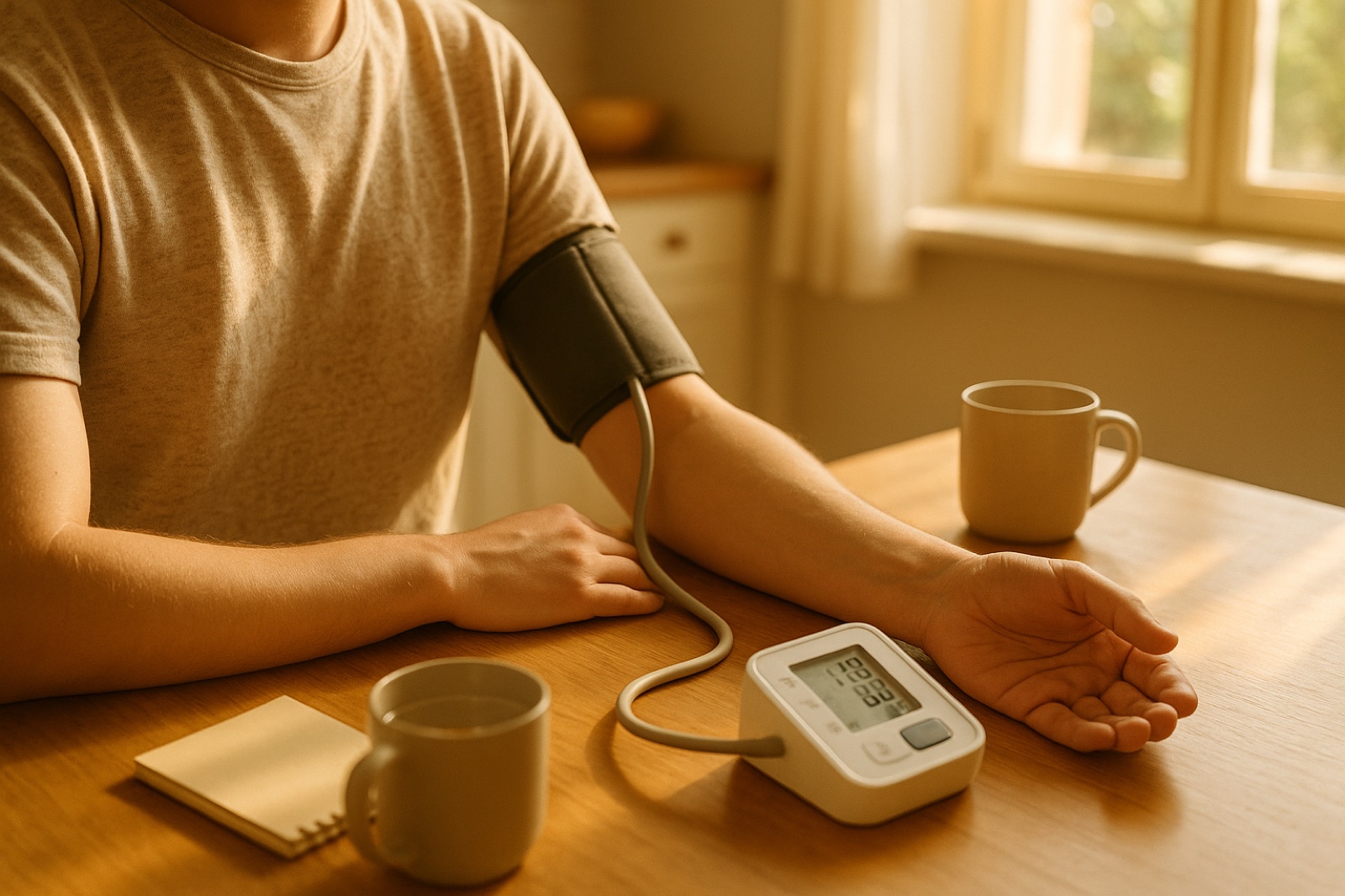
- Rest your arm on a table. The cuff should sit at about the level of your heart. If the table is low, put a folded towel or a cushion under your arm.
- Use bare skin and the right cuff. Put the cuff on your bare upper arm, not over a sleeve. A cuff that is too small or too big can throw the number off. Most cuffs show a size range on the inside.
- Rest for five minutes. Sit quietly before you press start. In the study, people even walked for two minutes and then rested for five, to copy what happens when you walk into a clinic.
- Don’t talk, don’t scroll. Stay still and quiet while the cuff works.
- Take two or three readings. Wait about a minute between them and write them all down. One number is a snapshot. A pattern over days tells the real story.
If your readings are often high even when you do all of this, take your notes to a doctor or nurse. Proper setup isn’t a way to wish a real problem away. It is a way to make sure the problem you are treating is real.
If Your Numbers Spike at the Clinic
Lots of people read higher at a clinic than at home. Nerves are part of it. Rushing in from the car park is part of it. Now we know the arm can be part of it too.
Stress and the heart are linked in more ways than one reading can show. We looked at what a large study found about how long-term stress can quietly reshape the heart. If you are not sure how much worry you are carrying, the free How Anxious Am I? check-in takes a few minutes and can help you put words to it.
The Arm That Wasn’t Meant to Hold Itself Up
There is something quietly true in all this.
An arm left to hold itself up reads as more strained than it really is. Give it something to rest on, and the true number shows up.
People are a lot like that. We spend whole seasons holding ourselves up. No one under us. No one beside us. And we start to read our own tiredness as proof that something is wrong with us.
One of the oldest stories in the Bible is about a tired leader on a hill whose arms grew heavy. His friends found him a stone to sit on, and then stood one on each side and held his arms up until the sun went down. The arms that couldn’t hold themselves up were never the failure. They were the reason help came close. (If you want the whole story, we told it here: the battle Moses couldn’t win alone.)
Maybe you were never meant to hold yourself up alone either. Maybe God built us that way on purpose.
One Small Change, Starting Today
Next time the cuff goes on, look down at your arm. Find it a table. Find it a cushion. Ask, kindly, for a desk to rest it on.
It is a small thing. But it might mean the number you take home is the true one. And true numbers are the only kind worth making decisions about.
Discussion Question
Has anyone ever checked your blood pressure with your arm hanging down or in your lap? Do you think clinics should change how they do it, or is this a small thing? Tell us what you think in the comments.
Share This
- Didn’t know this: letting your arm hang by your side during a blood pressure check added about 6.5 points to the top number in a Johns Hopkins study. Rest it on a table.
- My blood pressure “jumped” at the clinic and now I’m wondering where my arm was. Turns out an arm in your lap or hanging down can read several points higher than one resting on a desk.
- Saving this for my parents: feet flat, back supported, arm on a table at heart level, two or three readings, write them down. Simple, free, and it actually matters.
Questions People Ask About Taking Blood Pressure
What is the correct arm position for taking blood pressure?
The correct arm position for a blood pressure reading is resting on a table or desk, supported, with the cuff at about the level of the heart. A 2024 Johns Hopkins study in JAMA Internal Medicine found that an arm hanging unsupported at the side read about 6.5 points higher on the top (systolic) number than an arm supported on a desk, and an arm resting in the lap read about 3.9 points higher.
Can arm position really make blood pressure look high?
Yes. In a crossover study of 133 adults, the same people had higher readings when their arm hung at their side or rested in their lap than when it rested on a desk. The top number rose by about 6.5 points with a hanging arm, which researchers said could move a reading from 133 to 140 or from 123 to 130. The study used automated machines, and the authors noted the results may only apply to that kind of device.
How should I sit when checking my blood pressure at home?
To check blood pressure at home, sit in a chair with your back supported and both feet flat on the floor, legs uncrossed. Rest your arm on a table so the cuff is at heart level, use a cuff that fits your bare upper arm, sit quietly for five minutes first, and avoid talking during the reading. Take two or three readings about a minute apart and write them down.
Why is my blood pressure higher at the doctor’s office than at home?
Blood pressure is often higher at a clinic than at home for several reasons, including nerves, rushing to the appointment, and how the measurement is taken. Researchers at Johns Hopkins noted that clinic readings are often taken with the arm unsupported, in the lap, or held by a clinician, and their study found those positions can overestimate blood pressure. Asking to rest your arm on a desk is a simple way to get a fairer reading.
How many blood pressure readings should I take at once?
Most guidance suggests taking two or three blood pressure readings about one minute apart, then recording all of them. A single reading can be thrown off by movement, talking, or position. Tracking readings over several days gives a more reliable picture to share with a doctor or nurse.