 0
0
 0
0
A grandmother says it about a grandchild. A father says it about a daughter. Maybe someone once said it about you, or maybe you have waited a long time to hear it: “You are the apple of my eye.”
We all know the apple of my eye meaning. It is the person you treasure most. But stop and look at the words. Why an apple? Why an eye? Nobody keeps fruit in their eye.
The answer is older than English. It goes back to a song Moses sang near the end of his life. And it holds a small picture that most of us have seen with our own eyes and never noticed.
Apple of My Eye Meaning, in Plain Words
Today, “the apple of my eye” means the one person you love and guard above everyone else.
But at first the phrase was not a picture at all. It was a body part. In old English, the “apple” of the eye was the pupil, the dark round spot in the middle. People thought the pupil was a small solid ball. And for hundreds of years, “apple” was the everyday word for almost any round fruit. So the round thing in the eye got the fruit’s name.
Shakespeare still used it that way. In A Midsummer Night’s Dream, magic flower juice is dropped on a sleeping man with the words, “Sink in apple of his eye.” He means the pupil. Nothing more.
So when you say someone is the apple of your eye, you are really saying: you are the pupil of my eye. You are the part of me I would protect before anything else.
That is a lovely thought. But the older words behind it say even more.
Where “Apple of My Eye” Comes From in the Bible
The phrase appears five times in the King James Bible. The oldest one is in Deuteronomy. Moses is old. He is about to die. He sings a song about how God found a lost people and carried them:
“He found him in a desert land, and in the waste howling wilderness; he led him about, he instructed him, he kept him as the apple of his eye.” (Deuteronomy 32:10, KJV)
Later, David is being hunted. He turns the same words into a prayer:
“Keep me as the apple of the eye, hide me under the shadow of thy wings,” (Psalm 17:8, KJV)
English Bible readers met the phrase in these verses for centuries. That is how a line about an eye became something we say about a child. Like many sayings we use without thinking, this one has Bible roots. (We found the same thing when we looked at the meaning of “God forbid”.)
The Hebrew Word: “The Little Man of the Eye”
Here is the part most people never hear.
Moses did not write “apple.” He wrote in Hebrew, and the word he used is ishon. The Hebrew word for man is ish. Add the ending and you get something like “little man.” Strong’s Hebrew dictionary explains ishon in just those words: “the little man of the eye.”
What little man?
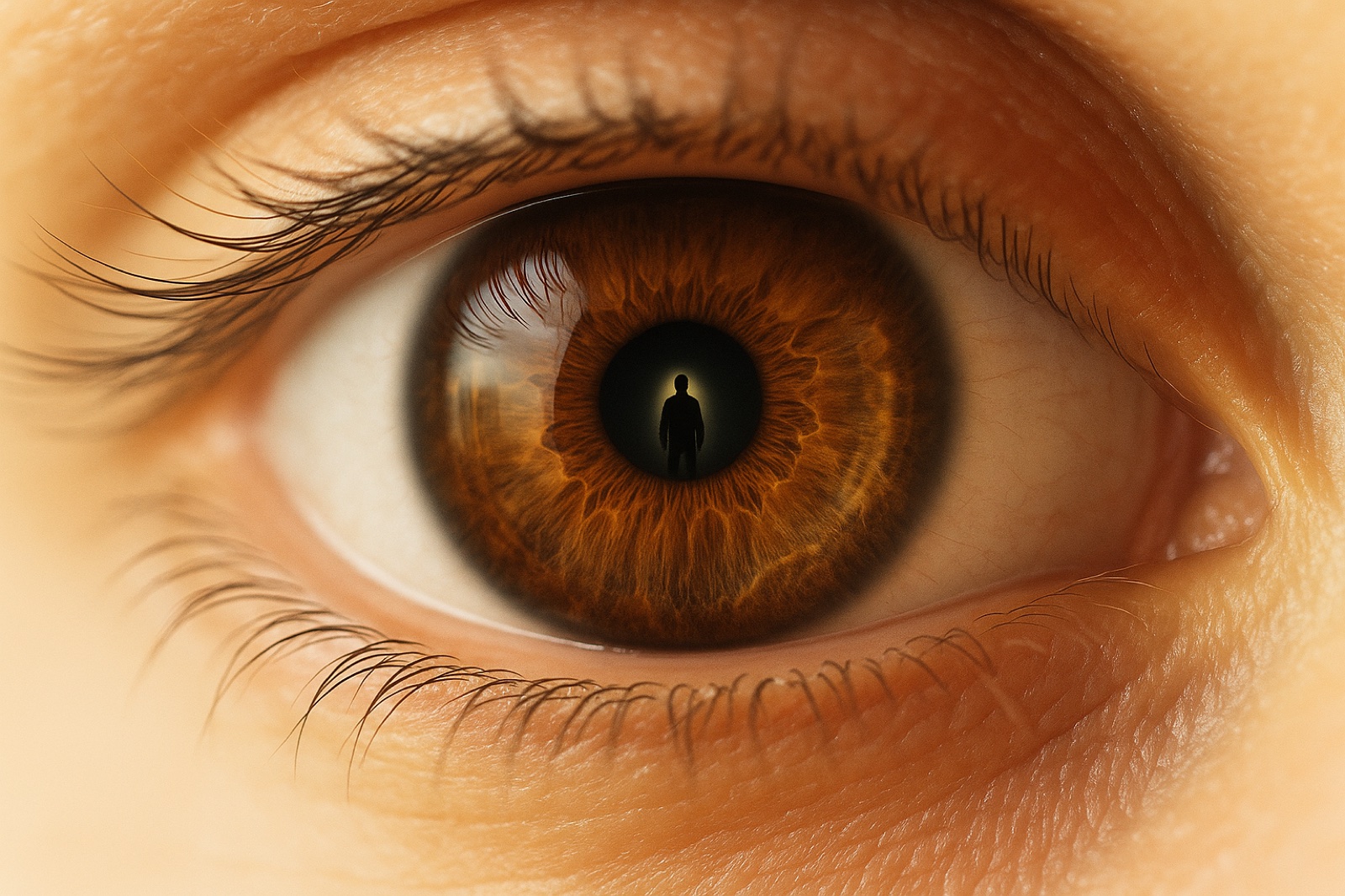
Stand very close to someone you love. Look into the dark center of their eye. You will see a tiny person looking back. It is you. Your own face, very small, shining in their pupil.
That is the little man of the eye.
Hebrew is not the only language that noticed. Our word “pupil” comes from the Latin pupilla, which means “little doll.” The Greeks used kore, their word for “girl.” Even English once called that tiny reflection a “baby.” To “look babies” was an old way of saying two people were gazing into each other’s eyes.
Four languages. Four groups of people, far apart. They all looked closely into a loved one’s eye and named the same small thing.
A fair word of caution. The “little man” meaning is the long-standing one in the standard older Hebrew dictionaries, but no one can prove where a word this old began. The same word, ishon, also shows up in Proverbs 7:9 for the deepest part of the night, where the KJV reads “the black and dark night.” So some readers think the first idea was “the dark center.” Both fit a pupil. It is dark, it is in the middle, and it holds a tiny person.
Two more details are worth knowing. In Psalm 17:8, David stacks two pictures at once. The Hebrew says ishon bat-ayin: “the little man, the daughter of the eye.” And in Zechariah 2:8, “he that toucheth you toucheth the apple of his eye,” the Hebrew uses a different word, babah. It appears only once in the whole Bible, and scholars are honestly not sure where it comes from. The Bible is full of this kind of wordplay, like the almond branch pun God showed Jeremiah.
What the Verse Is About First: Being Guarded
Let’s be honest about what the verses say on their face. Their main point is protection.
Think about how your body treats your pupil. It sits behind bone. A lid snaps shut over it before you can even think. Lashes catch the dust. If something flies at your face, your hand goes up to your eye on its own.
You do not decide to protect your eye. You just do.
So when Moses says God “kept him as the apple of his eye,” the plain meaning is this: God guards these people the way you guard your own sight. Fast. Without being asked.
And look who was being guarded. Not people at their best. People found “in a desert land, and in the waste howling wilderness.” Lost people. Found first, then kept.
You Can Only See It From Inches Away
Now put the two things together. The guarding, and the little man.
You cannot see your reflection in someone’s eye from across a room. You cannot see it from across a table. You have to be close enough to feel their breath. The little figure only shows up at the distance of a hug.
And the little figure is always the one being looked at.
The verse does not spell this out. The word carries it. When the Bible says God keeps a person as the ishon of God’s eye, the picture is not of someone approved of from far away. It is of a face turned toward you, so near that you show up in the eye.
This matters most if you have been left out. If you were the child who was not picked. If a parent never said words like these to you. If you have spent years feeling looked past.
The oldest use of this phrase was not for a favorite who earned it. It was for someone found in a howling wilderness. And David did not wait to be told. He asked for it: “Keep me as the apple of the eye.”
You are allowed to ask, too.
If you are not sure where you stand with God right now, our free How Close Am I to God? check takes about two minutes and gives you one kind next step.
Three Small Things to Do Today
- Find the little person. Stand close to a mirror, or ask someone you trust to let you look. Find the tiny you in the dark center of the eye. It takes thirty seconds. Now you know what Moses was talking about.
- Carry David’s words. Write “Keep me as the apple of the eye” on a scrap of paper or on your phone. The next time you feel passed over today, say it once, quietly, as a prayer.
- Say it to someone, up close. Pick one person you treasure. Put everything down, look at them, and tell them they are the apple of your eye. Tell them what the words really mean. Someone near you may be waiting to hear it.
A Prayer to Pray Right Now
God, I have felt far away and easy to overlook. I did not know these old words were about being held this close. Keep me as the apple of the eye, the way David asked. Guard me today the way I would guard my own sight. And help me look at someone else closely enough that they know they are treasured too. Amen.
Your Turn
Which part of this old phrase means more: being protected, or being seen up close? Tell us what you think in the comments.
Share This
- I just learned that “apple of my eye” comes from a Hebrew word that means “the little man of the eye.” It is the tiny reflection of yourself you see in someone’s pupil when you stand close enough.
- You can only see yourself in someone’s eye from inches away. That is the picture behind “Keep me as the apple of the eye.” Psalm 17:8.
- Hebrew called it the little man. Latin called it the little doll. Greek called it the girl. Everyone who looked closely into a loved one’s eye saw the same thing.
Questions and Answers About “Apple of My Eye”
What does “apple of my eye” mean?
“Apple of my eye” means the person you love and treasure most. The phrase first meant the pupil, the dark center of the eye, which old English speakers called the “apple” because they thought it was a small round ball. Calling someone the apple of your eye says that person is as precious to you as your own sight.
Is “apple of my eye” from the Bible?
Yes. The phrase “apple of the eye” appears five times in the King James Bible: Deuteronomy 32:10, Psalm 17:8, Proverbs 7:2, Lamentations 2:18 and Zechariah 2:8. The English word “apple” for the pupil is even older than the King James Bible, but these verses are how the saying became a common way to describe someone deeply loved.
What is the Hebrew word for “apple of the eye”?
In Deuteronomy 32:10, Psalm 17:8 and Proverbs 7:2, the Hebrew word is ishon. Strong’s Hebrew dictionary explains ishon as “the little man of the eye,” from ish, the Hebrew word for man. It points to the tiny reflection of yourself that you see in another person’s pupil. Zechariah 2:8 uses a different Hebrew word, babah, whose origin is uncertain.
Why is the pupil of the eye called a pupil?
The word “pupil” comes from the Latin pupilla, which means “little doll.” It was named for the tiny image of yourself that you can see reflected in another person’s eye. Greek used the word kore, meaning “girl,” in the same way, and Hebrew used ishon, “little man.”
What does it mean that God keeps us as the apple of God’s eye?
In Deuteronomy 32:10 and Psalm 17:8, being kept as the apple of the eye means being guarded the way a person guards their own pupil: quickly, carefully and without being asked. The Hebrew word behind the phrase also pictures closeness, because the reflection in a pupil can only be seen from a few inches away.