 0
0
 0
0
You know the groan. Someone makes a terrible pun at dinner, half the table rolls their eyes, and somehow everyone remembers it for a week. That is the strange power of wordplay. It sticks.
So here is a question that surprises a lot of people: are there puns in the Bible? There are. Quite a lot of them. Most readers never see them, because they live in the sound of Hebrew and Greek words, and translation quietly sands them away. And one of the most important puns in the whole Bible was spoken to a young man who was scared out of his mind.
Are There Puns in the Bible? Yes, and They Mostly Hide in Translation
A pun works when two words sound alike but mean different things. Change the language and the sound changes, so the joke disappears. English readers get the meaning of the verse, but they lose the “click” that an ancient listener would have heard straight away.
That is why a verse can feel a little odd in English. You read it and think, “Why did God say it like that?” Very often the answer is: because in the original language, it rhymed, or it echoed, or it played on a name. The Bible was mostly heard out loud before it was read. Wordplay helped people remember.
Let’s start with the best one.
Jeremiah’s Almond Branch: The First Vision Was a Pun
Jeremiah was young when God called him. He was the son of a priest from a small town called Anathoth, and his first reaction to being called was pure panic. He said so:
“Then said I, Ah, Lord GOD! behold, I cannot speak: for I am a child.” (Jeremiah 1:6, KJV)
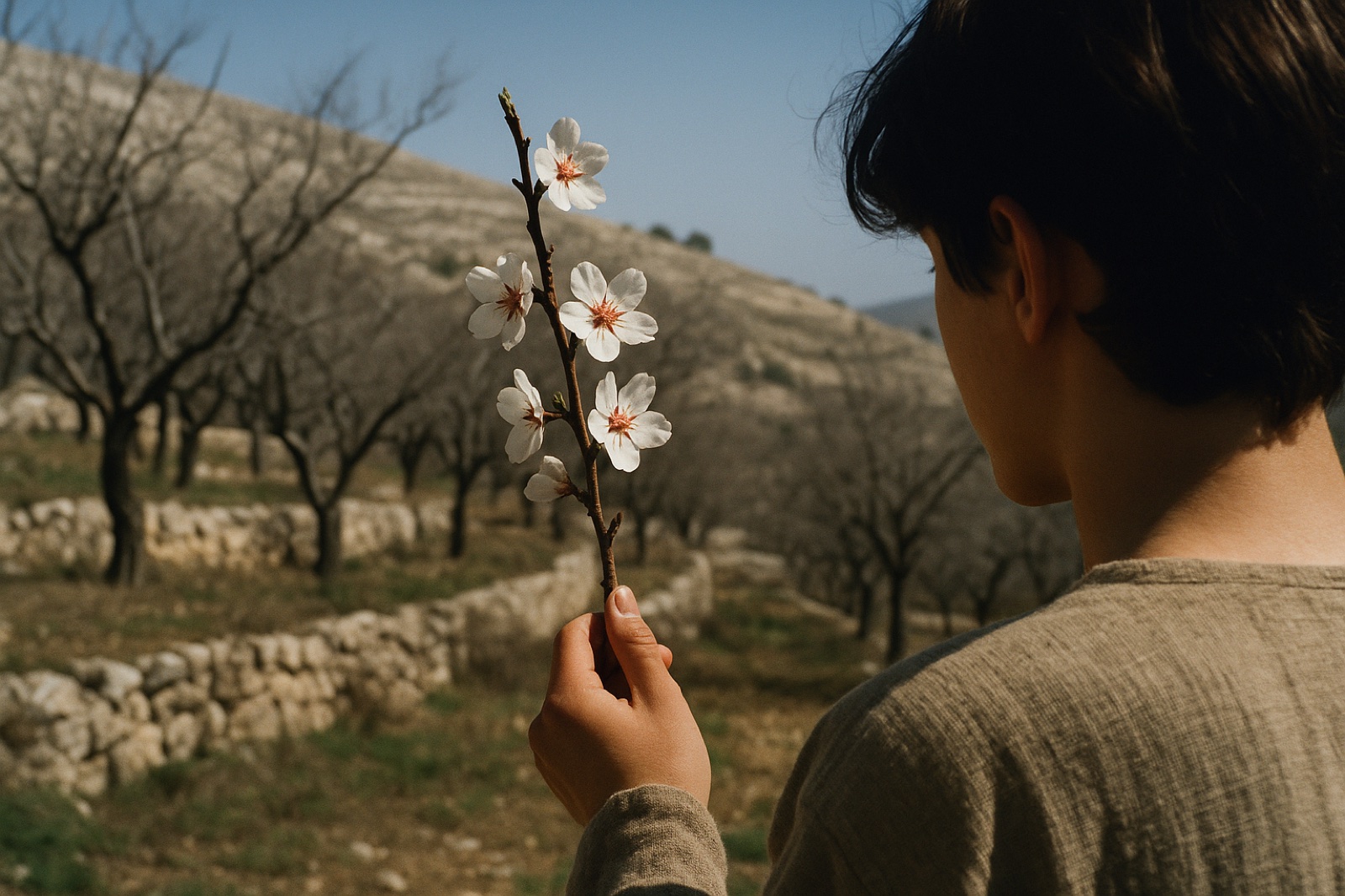
God told him not to be afraid. And then, right away, God showed him something. Not a fiery throne. Not an angel. A stick.
“Moreover the word of the LORD came unto me, saying, Jeremiah, what seest thou? And I said, I see a rod of an almond tree. Then said the LORD unto me, Thou hast well seen: for I will hasten my word to perform it.” (Jeremiah 1:11-12, KJV)
In English, that sounds like a random pairing. Almond branch. Hasten. What’s the link?
The link is the sound. In Hebrew, the word for almond is shaqed. The word God answers with is shoqed, which means “watching” or “keeping watch.” Many modern translations put it this way: “I am watching over my word to perform it.” The King James says “hasten,” which gets the idea of God being wide awake and ready, but it hides the sound completely.
So what Jeremiah actually heard was something like this. “What do you see?” “A shaqed.” “Good. Because I am shoqed.”
It is a pun. God’s very first lesson to a frightened young prophet was a play on words.
Why an Almond Tree, of All Things?
The almond is one of the first trees to blossom in that part of the world. It flowers in late winter, while the rest of the orchard still looks bare and dead. Its name in Hebrew is connected to the idea of being awake. It is the tree that wakes up first.
Think about what that does. Jeremiah is going to spend decades giving hard messages to people who do not want to hear them. He will be mocked, beaten, thrown into a muddy well. And every single spring, before anything else in the land had leaves, an almond tree somewhere near him would burst into white and pink flowers. Every one of them would be saying the same thing: shaqed. Shoqed. I am watching. I am awake. I have not forgotten my word.
God didn’t give Jeremiah a promise he would need to remember. God gave him a promise that would remind him, every year, whether he felt like remembering or not.
And there’s one more layer. The only other famous almond branch in the Bible belonged to Aaron, the first priest. When Israel argued about who God had really chosen, Aaron’s dry walking stick was left overnight in the tabernacle, and in the morning it “brought forth buds, and bloomed blossoms, and yielded almonds” (Numbers 17:8, KJV). A dead stick that woke up was God’s sign that a calling was real. The text doesn’t say Jeremiah thought of Aaron’s rod. But a priest’s son, being called by God while insisting he wasn’t up to it, was shown an almond branch. It is hard to miss.
The Part Almost Nobody Notices: The Pun Comes Back
Here is the detail that turns this from a clever moment into something much bigger.
That word watching doesn’t stay in chapter one. It returns thirty chapters later, after years of the hardest news Jeremiah ever had to give. And this time it comes back as hope:
“And it shall come to pass, that like as I have watched over them, to pluck up, and to break down, and to throw down, and to destroy, and to afflict; so will I watch over them, to build, and to plant, saith the LORD.” (Jeremiah 31:28, KJV)
Same watching word. Same God who stayed awake. But now the promise is to build and to plant. The almond branch at the start of the book was not only a warning that God’s word would come true. It was a promise that God’s attention would never switch off, even through the worst years, until planting season came again.
That is what a good pun does. It plants a sound in your head so that when it comes back, you feel it.
Other Puns in the Bible Worth Knowing
Once you know to listen for them, you start finding them all over the place. A few of the clearest:
- Adam and the ground (Genesis 2:7). “The LORD God formed man of the dust of the ground.” In Hebrew, man is adam and ground is adamah. The first human is basically named “Earthling,” made from earth.
- Amos and the summer fruit (Amos 8:1-2). Amos is shown “a basket of summer fruit,” and then told, “The end is come upon my people of Israel.” Summer fruit is qayits. End is qets. Another “what do you see?” vision, another pun, and this one is heavy.
- Isaiah’s vineyard (Isaiah 5:7). God “looked for judgment, but behold oppression; for righteousness, but behold a cry.” In Hebrew, justice is mishpat and bloodshed or oppression is mispach. Righteousness is tsedaqah and a cry is tse’aqah. What was hoped for and what showed up sound almost the same, and that is exactly the point. The fake looked a lot like the real thing.
- Micah’s town names (Micah 1:10). “In the house of Aphrah roll thyself in the dust.” Aphrah sounds like aphar, the Hebrew word for dust. Micah runs a whole list of towns this way, each name twisted into its own warning.
- Peter and the rock (Matthew 16:18). “Thou art Peter, and upon this rock I will build my church.” In Greek, Peter is Petros and rock is petra. Jesus gave Simon a nickname that was also a promise about what He would build.
- Onesimus (Philemon 1:10-11). Paul writes about a runaway slave named Onesimus, a name that means “useful,” and says he “in time past was to thee unprofitable, but now profitable.” Paul was punning on a man’s name to get him welcomed home. There’s a whole story there, and you can read it in Who Was Onesimus? The Runaway Whose Name Meant Useful.
Not every pun is funny. Some are playful, some are painful, and some are both. But all of them do the same job. They make a truth stick. (If you like finding the odd corners of scripture, you might also enjoy the weirdest verses in the Bible.)
What This Means for You: God Speaks in Ways You’ll Remember
Here is what the almond branch quietly tells us.
God didn’t answer Jeremiah’s fear with a lecture. God answered it with an ordinary thing he could see, tied to a word he couldn’t forget. The promise was hidden inside the plain world around him, in a tree that would bloom again every year.
Most of us have a fear like Jeremiah’s. “I can’t do this.” “I’m too young.” “I’m too old.” “I’m not enough.” And most of us expect that if God answers, it will be dramatic. But the first thing God did with Jeremiah was teach him to look. “What do you see?” “Thou hast well seen.”
Maybe God is still doing that. Not shouting. Watching. And leaving reminders around in ordinary places for those who have been taught to notice them. A tree that blooms before everything else. A word that keeps coming back. A small thing you see every day that could become your own “almond branch,” something that says, every time you pass it, I am still watching over my word.
That is not a distraction from faith. It is how memory works. And God seems to know it very well.
Actions to Take
- Pick your almond branch. Choose one ordinary thing you see every day, like a tree outside your window, a cup, or a crack in a wall. Decide right now that each time you see it, you’ll remember: God is watching over the promise.
- Read Jeremiah 1:4-12 out loud. It takes about two minutes. Say “almond” and “watching” slowly and notice how they sit next to each other. Hearing scripture, not just reading it, is how these words were first meant to land.
- Write down the fear you’d say to God. Jeremiah’s was “I am a child.” Write yours in one short line. Then write under it: “Thou hast well seen.” Keep it where you’ll find it again.
Journaling Prompts
- What is the “I cannot” sentence you say most often about yourself, and where did you first learn to say it?
- When have you felt as though God had fallen asleep on something you were waiting for? What would it change to believe God was awake the whole time?
- What is one thing in your everyday world that could carry a promise for you, the way the almond branch did for Jeremiah?
A Prayer for Today
God, I’ll be honest, a lot of days I feel like Jeremiah. I look at what’s in front of me and I think, I can’t do this, I’m not enough. Thank you for not answering my fear with a lecture, but with something I can see. Teach me to notice the almond branches you leave around me. And when I forget, remind me again that you are awake, and you are watching over your word. Amen.
Discussion Question
Why do you think God chose a pun, of all things, for the very first vision given to a scared young prophet? Tell us in the comments. We’d love to hear what you think.
And if you want more of the lighter side of faith, you can swap clean, groan-worthy Bible humor with our free Bible Jokes AI assistant (it opens in ChatGPT).
Share This
- Just learned God’s first vision to Jeremiah was a pun. Almond = shaqed. Watching = shoqed. “What do you see?” “An almond branch.” “Good. I’m watching.” I’ll never look at an almond tree the same way.
- The almond tree blooms first, while everything else still looks dead. That’s the tree God used to tell a scared young man, “I am awake. I am watching over my word.” I needed that today.
- There are puns all over the Bible. Adam/adamah. Petros/petra. Summer fruit/the end. They vanish in translation, but they were put there so we’d remember.
Questions and Answers
Are there puns in the Bible?
Yes. The Bible contains many puns and wordplays, mostly in the original Hebrew and Greek, where words that sound alike are placed side by side. Well-known examples include Jeremiah 1:11-12 (almond, shaqed, and watching, shoqed), Genesis 2:7 (adam, man, and adamah, ground), Amos 8:1-2 (qayits, summer fruit, and qets, end), and Matthew 16:18 (Petros, Peter, and petra, rock). Most of these are lost in English translation because the sounds change.
What is the almond branch pun in Jeremiah 1?
In Jeremiah 1:11-12, God shows Jeremiah the branch of an almond tree, called shaqed in Hebrew, and then says God is shoqed, meaning “watching,” over the divine word to perform it. The two Hebrew words sound nearly the same. The King James Version translates the second word as “hasten,” which keeps the sense of God being alert but hides the wordplay.
Why is the almond tree significant in the Bible?
The almond tree is one of the first trees to blossom in late winter in the land of Israel, which is linked to its Hebrew name suggesting wakefulness. It appears in Jeremiah 1:11-12 as a sign that God is watching over the divine word, and in Numbers 17:8, where Aaron’s dry rod buds, blossoms and yields almonds overnight as a sign that God had chosen him.
Does the watching promise in Jeremiah come back later in the book?
Yes. The same Hebrew idea of watching returns in Jeremiah 31:28, where God promises that just as God watched over Israel “to pluck up, and to break down,” God will also watch over them “to build, and to plant.” The almond branch pun in Jeremiah’s first chapter becomes a promise of restoration thirty chapters later.
Did Jesus use puns?
Yes. The clearest example is Matthew 16:18, where Jesus tells Simon, “Thou art Peter, and upon this rock I will build my church.” In Greek, Peter is Petros and rock is petra, so the new name Jesus gave Simon is itself a play on words.