 0
0
 0
0
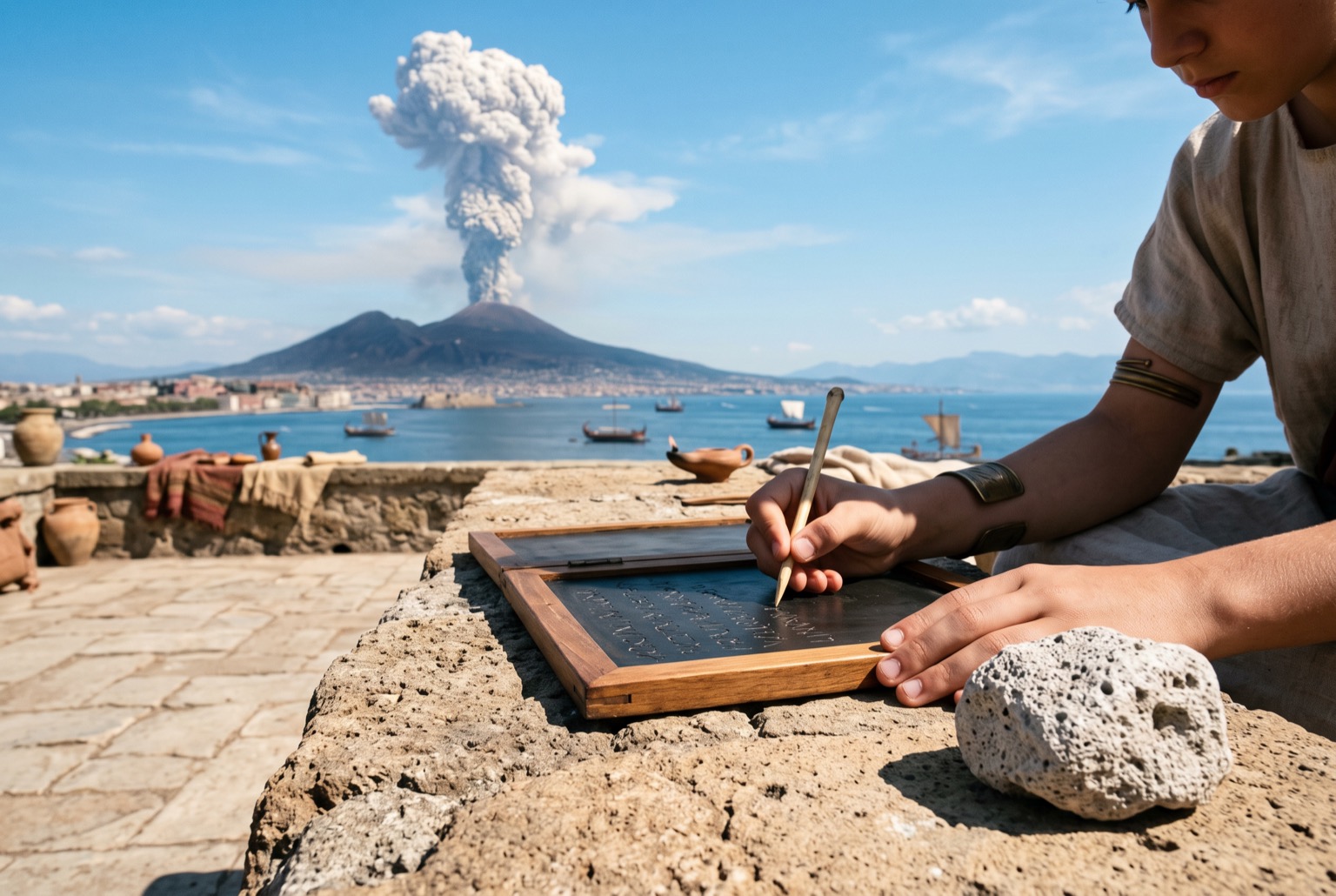
In the year 79, a 17-year-old stood across the bay from Mount Vesuvius and watched a cloud climb out of the mountain. He said it looked like a pine tree: a tall trunk, then branches spreading out at the top.
His name was Pliny the Younger. His uncle sailed toward the eruption to help and never came home. About 25 years later, Pliny wrote down what he saw in two letters to a historian friend.
This week, those letters did something nobody expected. They helped scientists sharpen one of the most important clocks in geology, the one used to date volcanoes, ancient rocks and even the asteroid that ended the dinosaurs. The Pompeii eruption is now the best-tested checkpoint that clock has for recent history. And the fixed point the scientists trusted was not a machine. It was a witness.
What the Pompeii Eruption Study Actually Found
The study was published on 25 September 2026 in the journal Science Advances. The team came from the Berkeley Geochronology Center, the University of California, Berkeley, and the University of Padua in Italy. Their paper has a title you do not often see in a geology journal: “Pliny the Younger advances geochronology.”
Here is what they did, in plain words.
- They used eight samples of a volcanic crystal called sanidine, taken from pumice that fell on Oplontis, a Roman town buried in the same eruption as Pompeii.
- Those samples were collected back in 1998 and sat on a shelf for about 27 years before being measured in 2025.
- They dated the crystals with a method called argon-argon dating.
The rock said the eruption happened 1,938 years (give or take 13 years) before 2025. The history books say 1,946 years. That is a match, well inside the margin.
For a method built to measure millions and billions of years, that is remarkable. The team reports 0.7% precision and 0.4% accuracy for an eruption this young, which they describe as a first for the method.
How Does a Rock Tell Time?
Some volcanic crystals hold a little potassium. A small part of that potassium is a kind called potassium-40, and it slowly turns into argon gas that gets trapped inside the crystal. It happens at a steady rate, like sand falling through an hourglass.
When a volcano erupts, the hourglass is flipped. Measure how much argon has built up since, and you know how long ago the eruption was.
But every hourglass has to be checked against something. How fast does the sand really fall? For a clock that usually measures things millions of years old, it is very hard to find a test where you already know the right answer.
That is what Pompeii gave them: an eruption with a written date, recorded by someone who was there.
Using it, the team measured the rate that potassium-40 decays more precisely than before. They put its half-life at 12.044 billion years, give or take 0.088 billion, about twice as precise as the earlier figure.
Lead author Paul Renne put the point simply: “If you want to put together the eruptive history of a volcano in relatively recent time, precision and accuracy really count.” Speaking about the wider payoff, he said the method “lets us more precisely infer causality between events in the geologic record, for example a meteor impact structure and a mass extinction.”
That matters for people alive today. Berkeley’s announcement of the study names cities living beside volcanoes, including Naples, Mexico City and Yogyakarta in Indonesia. Knowing exactly when their volcanoes erupted before helps people understand what those volcanoes might do next.
The Part Nobody Is Talking About: The Witness Was Questioned First
Here is the detail that makes this story better than the headline.
The scientists did not simply take Pliny’s word for it. They checked him.
Pliny’s letter gives the date as what we now call 24 August. For years, some historians have argued the eruption actually happened in the autumn. One piece of evidence was a coin found at Pompeii, in a home known as the House of the Golden Bracelet. Some read it as minted after September, which would have meant the eruption came later. A charcoal scrawl found on a Pompeii wall in 2018, which many read as dated to mid-October, has added to the debate.
So a graduate student on the team, Caroline Hasler, did what a good investigator does. She went back to the record. She compared the Pompeii coin with two other Roman coins of known date, one minted before 24 June of the year 79 and one minted after 8 September. Her conclusion: the Pompeii coin matched the earlier one. It was likely made before September. The coin did not overturn the witness after all.
Even so, the team gave the date an honest margin of two months either side. And here is the part worth sitting with: over nearly 2,000 years, a two-month question turned out to matter less than expected. The day is still argued about. The year held.
That is how testimony usually works. A witness can be questioned on the small details and still be completely right about the thing that matters.
Why This Story Stays With You
We tend to think of science as the opposite of trusting people. Machines measure. People remember, and people get things wrong.
But look at what happened here. A very advanced machine, one that reads time in billions of years, got more accurate by leaning on the written memory of a teenager. Not blindly. The scientists tested his account, looked at the evidence against it, and found it stood up.
We have seen this before. When Vesuvius buried the scrolls at Herculaneum, scientists later found a way to read charred words nobody had read in 2,000 years. It keeps turning out that old written records carry more than we assume.
It also raises an honest question about memory. Pliny wrote about 25 years after the event. We know eyewitness memory can drift; we have written about how a memory survives a generation. Yet the core of what Pliny wrote down held up against a physics lab.
There is something very old in all this. For thousands of years, courts and communities have settled hard questions the same way: they call a witness. Much of what people believe about God reached us in exactly that shape, too. It came through letters written by ordinary people who said, in effect, “I was there. This is what I saw.” Some details in those accounts are still debated. But this week’s study is a good reminder that an argued-over detail is not the same as a false witness, and that the right response to testimony is not to dismiss it, but to test it and see if it holds. Sometimes it does.
The next time you hear that the dinosaurs died out about 66 million years ago, or that a volcano near a big city last erupted a certain number of centuries back, remember where some of that confidence came from: a young man on a terrace across the bay, trying to describe a cloud shaped like a pine tree, so that someone later would know what happened.
Discussion Question
Scientists tested Pliny’s account before trusting it, and it held up. When you hear an old eyewitness account, whether from history, your own family, or anywhere else, what makes you decide whether to trust it? Share your answer in the comments below.
Share This
Post 1: A physics clock that measures billions of years just got more accurate by trusting a 17-year-old’s letter about the Pompeii eruption. I did not expect to find that moving. https://bgodinspired.com/index.php/bgodinspired-news/bgodinspired-science-news/pompeii-eruption-pliny-geology-clock/
Post 2: The best part of the new Pompeii study: the scientists questioned the eyewitness first. They checked the coin that seemed to prove him wrong, and it didn’t. The day is still debated. The year held. https://bgodinspired.com/index.php/bgodinspired-news/bgodinspired-science-news/pompeii-eruption-pliny-geology-clock/
Post 3: We think of science as the opposite of trusting people. Then a team at Berkeley named their paper “Pliny the Younger advances geochronology.” Worth a read: https://bgodinspired.com/index.php/bgodinspired-news/bgodinspired-science-news/pompeii-eruption-pliny-geology-clock/
Questions People Ask About the Pompeii Eruption Study
How did the Pompeii eruption help scientists date rocks?
The Pompeii eruption of the year 79 has a known date from written history, mainly the eyewitness letters of Pliny the Younger. In a study published in Science Advances in September 2026, scientists from the Berkeley Geochronology Center, UC Berkeley and the University of Padua used volcanic crystals from that eruption as a test case with a known answer. Their argon-argon dating gave 1,938 years (plus or minus 13) before 2025, matching the historical 1,946 years, and let them refine the decay rate of potassium-40.
Who was Pliny the Younger?
Pliny the Younger was a Roman writer who, at about 17 years old, watched the eruption of Mount Vesuvius in the year 79 from across the Bay of Naples. His uncle, Pliny the Elder, died after sailing toward the eruption. Roughly 25 years later, Pliny the Younger described the event in two letters to the historian Tacitus. They are the only surviving eyewitness account of the eruption.
Did Vesuvius erupt in August or October of the year 79?
This is still debated. Pliny the Younger’s letter is traditionally read as giving 24 August. Some historians favor an autumn date, pointing to a coin found at Pompeii and a charcoal inscription found in 2018 that many read as dated mid-October. In the 2026 Science Advances study, graduate student Caroline Hasler compared the Pompeii coin with Roman coins of known date and concluded it was likely minted before September. The team still allowed a two-month uncertainty, which made little difference to their results.
What is argon-argon dating?
Argon-argon dating is a method for finding the age of volcanic rocks. Some crystals contain potassium-40, which slowly decays into argon-40 at a steady rate. When a volcano erupts, the clock starts. By measuring how much argon has built up, scientists can calculate how long ago the eruption happened. It is widely used for events millions of years old, such as the asteroid impact linked to the extinction of the dinosaurs about 66 million years ago.
What is the new half-life of potassium-40?
Using the Pompeii eruption as a known-age benchmark, a 2026 study in Science Advances measured the half-life of potassium-40 decaying to argon-40 as 12.044 billion years, plus or minus 0.088 billion years. The researchers describe this as about twice as precise as the previous measurement, which improves the accuracy of dates for volcanic rocks worldwide.