 0
0
 0
0
Somebody paid high school students to copy out lines from Star Wars, from the Bible, and from a 1960s science fiction show. They wrote with reed pens on real papyrus from Egypt. Then a scientist rolled the pages up tight, sealed them in a steel box with almost no air inside, and put them in a furnace until they came out as black as charcoal.
He did it on purpose. It was the only way to find out how to read the Herculaneum scrolls: about 1,800 ancient scrolls and fragments that a volcano burned black almost 2,000 years ago, and that nobody can open without destroying.
What Are the Herculaneum Scrolls?
In the year 79, Mount Vesuvius erupted in southern Italy. It buried the town of Pompeii, and it buried the smaller, richer town of Herculaneum right next to it. In one grand house there, now called the Villa of the Papyri, somebody kept a library.
The heat didn’t turn that library to ash. It turned it to carbon. Each scroll became a hard, black lump, a bit like a burned log from a campfire. They were found in the 1700s, starting in 1752.
People tried to open them for years afterwards. Most of those attempts left only crumbs and ash, and in the end the authorities stopped them. The scrolls that were opened held mostly philosophy, much of it by a Greek thinker named Philodemus. The rest stayed rolled up and unreadable.
Douglas Seiler, the researcher who burned his own scrolls, explains why that matters so much. “Almost everything from antiquity has been destroyed,” he said. Most ancient books we have today survived because scribes copied them again and again. But some of these scrolls, he said, “aren’t copies. These are books directly from the ancient world frozen in time.”
Why Can’t Scientists Just Read Them?
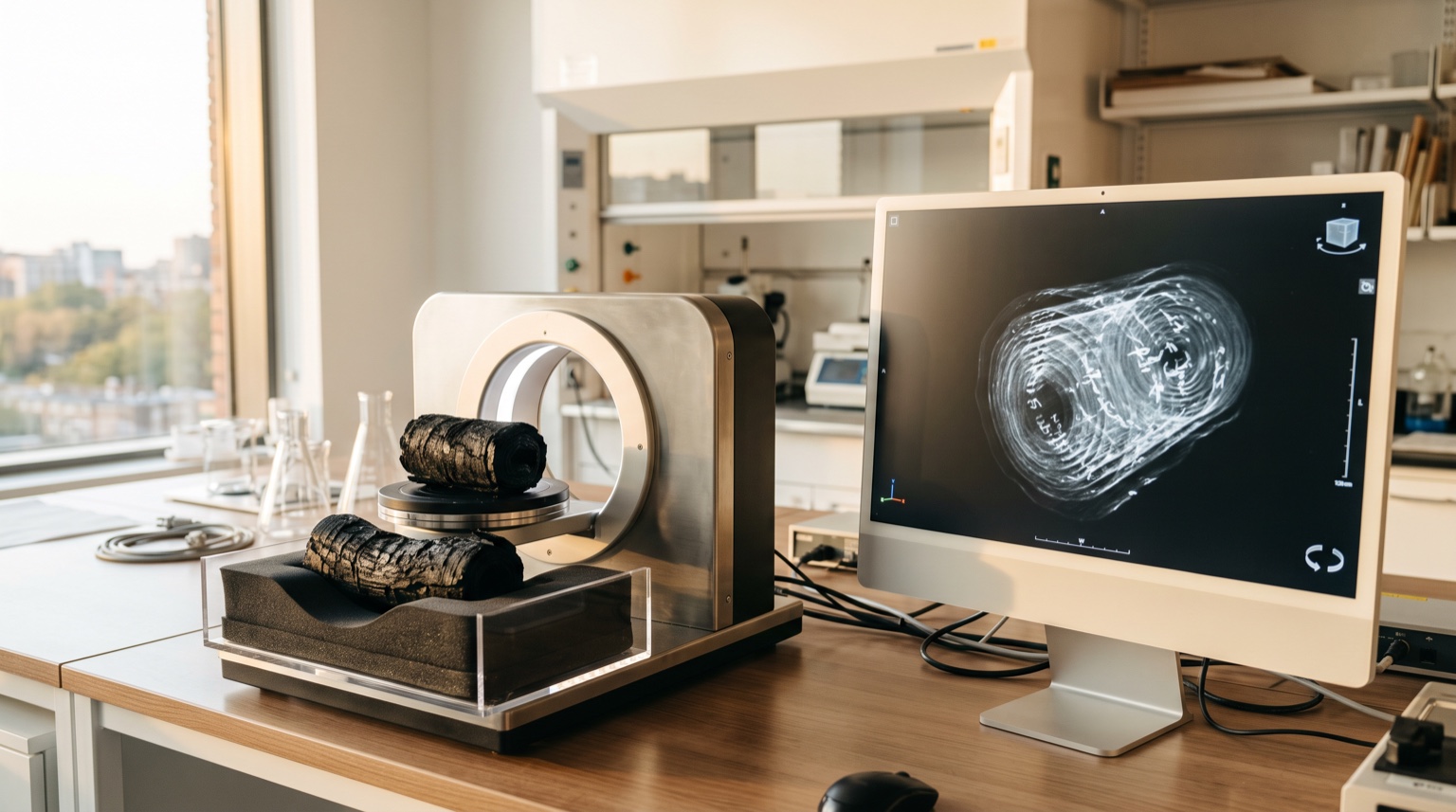
X-ray scanners can already look inside a rolled scroll without touching it. A CT scanner, the same kind of machine a hospital uses, takes thousands of thin slices and builds a 3D picture. Computers can then “unroll” the layers on screen.
The problem is the ink. Most ancient ink was made from soot, which is carbon. The burned papyrus is carbon too. So on an X-ray you are looking for black writing on a black page. The letters barely stand out.
Since 2023, a contest called the Vesuvius Challenge has been attacking this with artificial intelligence. It worked, slowly. The first word anybody read from a closed scroll was the Greek word for “purple.” By 2024, teams had read 15 full columns of a text about pleasure and the senses. But only a few scrolls have been read this way so far, and the signal the computers are hunting for is extremely faint.
What the Burned Test Scrolls Showed
Seiler is a research affiliate at the University of California, Berkeley. He wondered about one thing: what if some ancient ink had a little lead mixed into it? Lead is a heavy metal. X-rays have a much harder time passing through it than through carbon.
So he made ink the old way, from lampblack soot, and added lead in carefully measured amounts. The students wrote with it. The replica scroll, only about 11 centimetres long, went into the furnace. Then a team at the US National Institute of Standards and Technology scanned it.
The result was published on September 16, 2026, in the journal PLOS ONE. Here is what they found:
- The leaded ink absorbed up to 25 times more X-rays than the charred papyrus around it.
- The letters showed up at every amount of lead they tried, even as little as 25 micrograms per square centimetre. That is a tiny trace.
- A cheap handheld X-ray device could also detect the lead from outside, without any big scan.
Seiler said that with lead in the ink, “the letters light up like a Christmas tree.” That last point may matter most of all. If a small handheld scanner can sweep scroll after scroll and flag the ones with lead, researchers could know which scrolls to scan first.
Why not just test on the real thing? Leah Packard-Grams, a papyrus expert at Berkeley who worked on the study, put it simply: “If you hurt a model, it’s fine. If you hurt a 2,300-year-old ancient artifact, you’ll have a bunch of archeologists ready to jump you.”
The Catch Nobody Is Leading With
This does not mean the scrolls are about to be read. The test proves that lead would make the writing show. It does not prove the real scrolls have lead in them.
Nobody has yet searched the whole collection for it. At least one fragment, left over from the old attempts to unroll the scrolls, has been found with lead in its ink. “Some of them do, some of them don’t,” Packard-Grams said.
And there is a detail in the research that is easy to read past. Berkeley also holds a collection of papyri from an Egyptian town called Tebtunis. Leaded ink turns up in some of those, but mostly in scrolls written after the first century. The Herculaneum library was buried in the year 79, before that window had even opened. So it is a real open question how many of its scrolls were written early enough to have missed the lead entirely. Nobody knows yet. That is what the handheld scanner could find out.
If you like this kind of detective work on old books, scientists have also started reading the DNA of medieval manuscripts to learn what animals their pages were made from, without harming a single page.
What Decides Whether Words Survive a Fire
Here is the strange lesson of this experiment. The fire does not decide which words survive. The volcano burned every scroll the same way. What decides it is what was mixed into the ink long before the fire came. A little lead, added by a scribe who never imagined a volcano, is the difference between a word that can be read 2,000 years later and a word that is gone.
There is a much older story about a burned scroll, and it goes the other way.
About 2,600 years ago, in Jerusalem, a prophet named Jeremiah had his warnings written down on a scroll by a scribe. The scroll was read aloud to the king. It was winter, and the king was sitting by a fire. Each time a few columns had been read, the king cut them off with a small knife and threw them into the fire, until the whole scroll was gone.
There was nothing left. No charred lump. No trace of lead to scan. By every rule of this experiment, those words should have been lost for good.
They weren’t. Jeremiah took a new scroll, and the scribe wrote the whole thing out again as Jeremiah spoke it. Then the old story adds one quiet detail: this time, many more words like them were added. The king burned a scroll, and he got a longer one back.
The Herculaneum words depend on the page surviving. Those words depended on something else. The scroll was only a copy. The source was still speaking. The ancient writers were convinced that the source was God, and that words from God don’t live or die with the paper they are written on. It is worth thinking about which kind of words you are leaning your own life on.
What Happens Next
For now, the lab’s burned scroll is a map, not a treasure. Jake LaManna, a physicist on the team, said he would like to study the ink in more detail, “not just lead,” and use scrolls like this one to train better computer programs for reading the real ones.
Somewhere in Italy, France and England, around 1,800 black lumps are still waiting. Some of them may be glowing with lead we just haven’t looked for. Some may hold books nobody alive has ever read. And the first step to finding out may be a small device you can hold in one hand.
You might also enjoy another piece on how old texts get studied today: the Dead Sea Scrolls calendar that slowly stopped working.
Discussion Question
If researchers could read just one of the unopened Herculaneum scrolls, what kind of book would you most want it to be: lost philosophy, a lost history, a lost poem, or something nobody expects? Tell us in the comments.
Share This
Post 1: Scientists burned their own scrolls on purpose, just to learn how to read the ones a volcano burned 2,000 years ago. A trace of lead in the ink makes the letters glow on X-ray. https://bgodinspired.com/index.php/bible-resources/bible-history/herculaneum-scrolls-lead-ink/
Post 2: The fire didn’t decide which ancient words survived Vesuvius. What was mixed into the ink long before did. Great read on the Herculaneum scrolls: https://bgodinspired.com/index.php/bible-resources/bible-history/herculaneum-scrolls-lead-ink/
Post 3: High school students wrote lines from Star Wars and the Bible on papyrus, then scientists baked it to charcoal. It may be the key to reading about 1,800 lost scrolls. https://bgodinspired.com/index.php/bible-resources/bible-history/herculaneum-scrolls-lead-ink/
Questions People Ask About the Herculaneum Scrolls
What are the Herculaneum scrolls?
The Herculaneum scrolls are about 1,800 ancient papyrus scrolls and fragments from a library in the Villa of the Papyri at Herculaneum, Italy. The eruption of Mount Vesuvius in the year 79 carbonized them, turning each scroll into a black lump that crumbles if anyone tries to unroll it by hand.
Why are the Herculaneum scrolls so hard to read?
The Herculaneum scrolls are hard to read because most ancient ink was made from soot, which is carbon, and the burned papyrus is carbon too. On an X-ray scan the writing and the page look almost the same, so the letters give off only a very faint signal.
How could lead in ink help read the Herculaneum scrolls?
A 2026 study in PLOS ONE led by Berkeley researcher Douglas Seiler burned replica scrolls written with ink containing small amounts of lead. The leaded ink absorbed up to 25 times more X-rays than the charred papyrus and showed up clearly on CT scans, even at 25 micrograms of lead per square centimetre.
Do the real Herculaneum scrolls contain lead ink?
Nobody knows yet how many of the real Herculaneum scrolls contain lead ink. Lead has been detected in the ink of at least one leftover fragment, but the collection has never been searched systematically. Researchers suggest a handheld X-ray fluorescence scanner could quickly check which scrolls have lead.
Has anyone read a closed Herculaneum scroll?
Yes, a few. Since 2023 the Vesuvius Challenge has used AI and X-ray scans to read text inside closed scrolls. The first word read was the Greek word for “purple,” and in 2024 teams recovered 15 columns of a philosophical text about pleasure and the senses.
Sources: UC Berkeley News (September 16, 2026); ScienceDaily; Gizmodo; the study “A Model Carbonized Papyrus Scroll Opens a Novel Path to Identifying Readable Scrolls of the Herculaneum Library,” PLOS ONE, 2026.