 0
0
 0
0
In 1665, the Dutch scientist Christiaan Huygens noticed something strange.
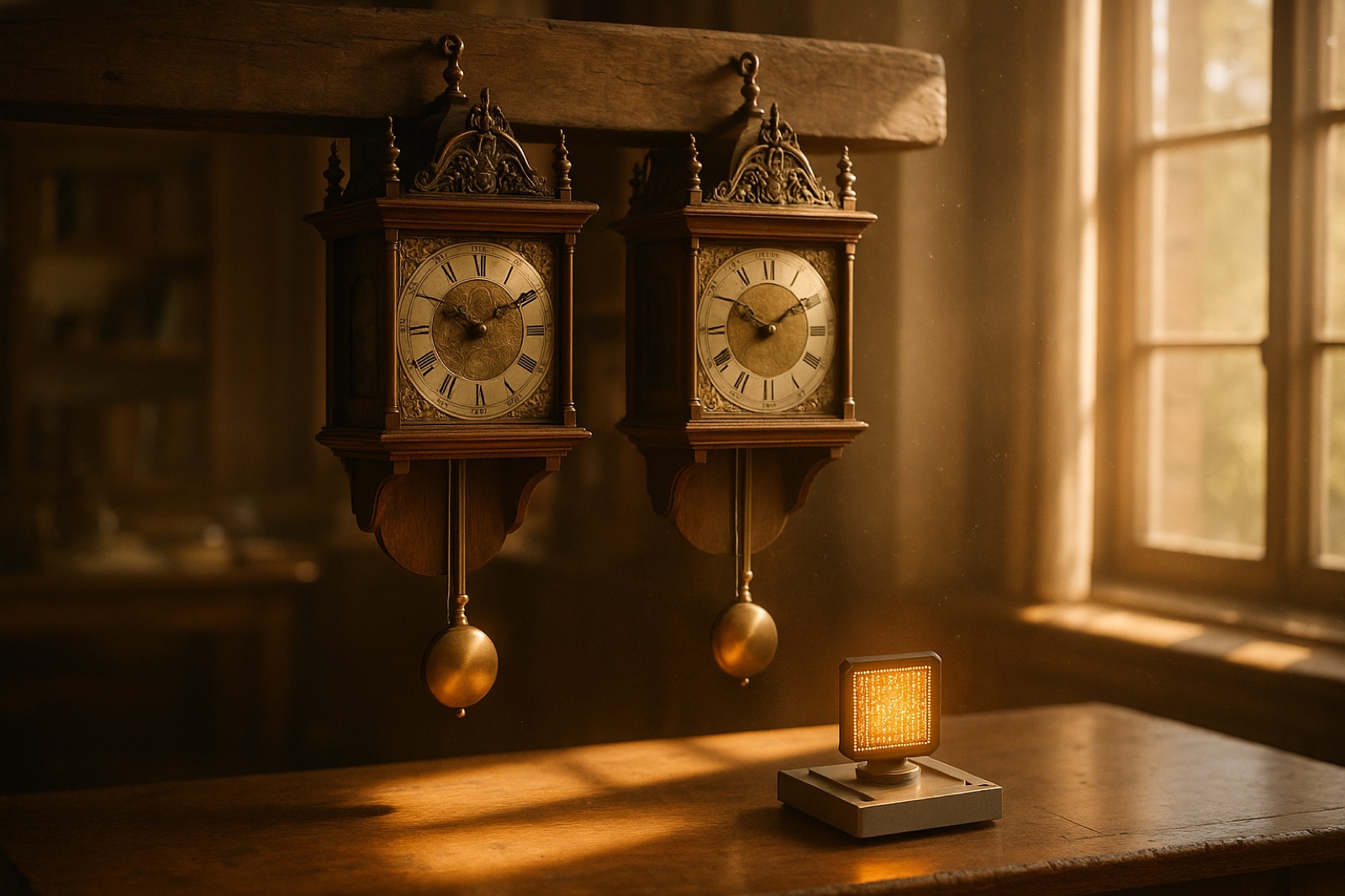
He had two pendulum clocks hanging side by side from the same wooden support. And the two pendulums kept ending up in rhythm with each other. Tick for tick. Nobody had set them that way. They just drifted into it.
Huygens could not fully explain it. The phrase recorded for it at London’s Royal Society was “an odd kind of sympathy.”
More than 360 years later, physicists in Germany have watched the same thing happen somewhere Huygens could never have imagined: between time crystals on a tiny chip, frozen to about -270°C. Separate time crystals, each ticking at its own pace, fell into one shared rhythm.
It sounds like science fiction. It is actually one of the oldest stories in physics, and it says something surprisingly simple about how things that are apart end up together.
What Is a Time Crystal?
Start with a normal crystal, like a grain of salt. Its atoms sit in a pattern that repeats over and over in space. Row, row, row.
A time crystal is a pattern that repeats in time. It ticks, all by itself, in a steady rhythm.
Here is the strange part. The kind used in this study is called a continuous time crystal. You shine a steady light on it, a light that is not flashing or pulsing at all, and the material starts to oscillate on its own anyway. Nothing is telling it when to tick. It finds its own beat.
In this case, the “ticking” happens inside a semiconductor called gallium arsenide, with small amounts of indium and silicon added. A laser lines up the tiny magnetic spins of electrons in the material. Those electrons pass their alignment on to the centres of nearby atoms, the nuclei. According to the university’s account of the work, each electron interacts with roughly a million nuclear spins. The electrons and nuclei push and pull on each other in a loop, and that loop keeps a steady oscillation going.
So each little region of the chip becomes its own tiny clock.
How the Time Crystals Fell Into Step
The team, led by Professor Alex Greilich at TU Dortmund University, published their results in Nature Communications in 2026.
What they found is the heart of the story. When two of these tiny oscillators sat near each other on the chip, they did not start out matching. In the researchers’ own words, they had “individually different frequencies.” Different speeds. Different beats.
But once both were switched on, those different frequencies locked to one common value. The two clocks agreed.
And they did it at a distance. The oscillators synchronized across gaps of up to 40 micrometres. That is tiny to us, a bit less than the width of a fine human hair. But for these oscillators it is huge: more than a thousand times the size of a single one. Imagine two people falling into step while standing more than a kilometre apart.
What carried the signal between them? Not wires. Not vibration. Electrons, carrying their spin with them as they wandered through the material from one region to the other. The crystal itself was the shared ground they both stood on.
The Detail Nobody Mentions: Together Made Them Steady
Most of the coverage stops at “they synchronized.” But the scientists’ own summary of the paper goes one step further, and it is the most interesting line in the whole thing.
When they lit up a wide area of the chip, every oscillator inside that spot joined one single synchronized state, “despite their inhomogeneity.” In plain words: even though no two of them were quite the same.
Then comes the kicker. The researchers say this synchronization “accounts for the exceptional stability” of the oscillations.
Read that again. These time crystals were not steady first and then joined up. They were steady because they were joined up. On its own, each little clock was a bit different, a bit wobbly. Together, they held a rhythm none of them could have held alone.
Where the Rhythm Breaks
There is a limit, and it matters.
Past about 40 micrometres, the synchronization breaks. The time crystals simply go back to ticking on their own, each at its own pace.
Why that distance? The researchers found that it matches how far a spin-carrying electron can travel through the material before it loses its spin. In other words, the clocks can only fall into step if the signal between them can actually reach. Too far apart, and the connection fades before it arrives.
Nobody forced these clocks together. Nobody forced them apart either. It came down to one thing: were they close enough, on shared enough ground, for the small signals to get through?
Back to Huygens: The Clocks Did Not Copy Each Other
Here is the other surprise, and it is hiding in the 1665 story.
When we hear “the clocks fell into rhythm,” we picture two pendulums swinging the same way, like twins. But that is not what Huygens saw. His two clocks, hanging from the same support, often became synchronized swinging in opposite directions. One went left while the other went right, perfectly timed, like two people in a dance.
They were in rhythm without being identical. They matched by complementing each other, not by copying.
And what joined them? Modern researchers have confirmed what Huygens suspected: tiny back-and-forth vibrations in the wooden beam they both hung from. Movements far too small to see. Weak, quiet, constant.
That is the pattern across 360 years of physics. Two clocks on a beam. Two time crystals on a chip. Scientists even use the same idea to describe fireflies flashing together and heart cells beating as one. Things with different natural rhythms, sharing the same ground, joined by small signals, drift into step.
Why This Feels So Familiar
If you have ever been lonely, you might recognise the other side of this.
Loneliness often feels like being out of rhythm with everyone. Everyone else seems to know the beat. You are ticking along on your own, a little off, a little wobbly, and it is exhausting to hold it together by yourself.
The physics offers an unexpectedly gentle thought. The clocks did not sync up because one of them tried harder. They did not have to become the same as each other. They just had to hang from the same beam, close enough for the small signals to reach.
That is worth noticing, because it is the opposite of what loneliness tells us. Loneliness says: fix yourself first, then you will fit. The clocks say: get close first, and the rhythm comes. If you tend to carry everything alone, you may recognise yourself in what hyper-independence really is. And if you are not sure how lonely you actually are, this free, private check-in can help you put words to it: How Lonely Am I?
It is also why the same thing shows up in something as ordinary as laughing. Research finds that we laugh far more with other people than alone. Rhythm, it turns out, is something we mostly find together.
There is a very old description of the first community of faith that reads almost like Huygens’ notebook. Before anything remarkable happened to them, it says, they were simply all in one place, and of one accord. Being in the same room came first. The shared rhythm came after. Maybe that was never just a detail. Maybe it is how we were made, by a God who seems to have built the same quiet pull toward each other into pendulums, crystals and people alike.
Small Ways to Share a Beam This Week
- Be in the same place, on purpose. Sit in the shared room instead of your own. Work at the cafe, the library, the common table. Closeness comes before connection.
- Let the signal be small. The clocks were joined by vibrations too tiny to see. A short message, a wave to a neighbour, a two-minute call all count.
- Repeat it. Coupling works because it is constant. The same walk at the same time, the same weekly call, the same seat at the same gathering.
- Don’t wait to match. Huygens’ clocks swung in opposite directions and still kept perfect time. You don’t have to be like the people around you to be in step with them.
Discussion Question
Do you think people fall into step with each other more easily when they share a physical place, like a home, a workplace or a street, than when they only connect online? Share your thoughts in the comments below.
Share This
- In 1665 two pendulum clocks on the same wooden beam fell into rhythm on their own. In 2026 physicists watched time crystals on a chip do the same thing. https://bgodinspired.com/index.php/bible-resources/bible-and-science/time-crystals-synchronize-huygens-clocks/
- Weird physics fact: tiny time crystals on a chip were more stable together than apart. Their shared rhythm is WHY they held steady. Kind of like people. https://bgodinspired.com/index.php/bible-resources/bible-and-science/time-crystals-synchronize-huygens-clocks/
- Huygens’ famous clocks didn’t swing the same way. They swung in opposite directions, perfectly in time. You don’t have to be the same to be in step. https://bgodinspired.com/index.php/bible-resources/bible-and-science/time-crystals-synchronize-huygens-clocks/
Questions About Time Crystals and Synchronization
What is a time crystal?
A time crystal is a system whose pattern repeats in time rather than in space. A normal crystal, like salt, has atoms arranged in a repeating spatial pattern. A time crystal instead oscillates in a steady, repeating rhythm. A continuous time crystal starts oscillating on its own even when it is driven by a steady, non-pulsing source such as constant laser light.
How did scientists get time crystals to synchronize?
Researchers at TU Dortmund University, led by Professor Alex Greilich, created continuous time crystals in a gallium arsenide semiconductor containing small amounts of indium and silicon, cooled to about -270°C. When two of these oscillators with different natural frequencies were optically pumped, their frequencies locked to one common value. The coupling between them was carried by spin-polarized electrons moving through the material. The results were published in Nature Communications in 2026.
How far apart can time crystals be and still synchronize?
In the TU Dortmund experiment, time crystals synchronized across separations of up to 40 micrometres, which is more than a thousand times the size of a single oscillator. Beyond that distance the synchronization broke and each time crystal oscillated independently. The researchers found the limit matches the electron spin diffusion length, the distance spin-carrying electrons can travel through the material.
What did Christiaan Huygens discover about pendulum clocks?
In 1665, Dutch scientist Christiaan Huygens noticed that two pendulum clocks mounted on the same support often became synchronized, with their pendulums swinging in opposite directions. The Royal Society recorded it as “an odd kind of sympathy.” Modern researchers have confirmed that the clocks were coupled through tiny vibrations in the shared wooden beam. The effect is now known as entrainment or synchronization.
What could synchronized time crystals be used for?
The TU Dortmund researchers say synchronized time crystals could provide a foundation for networks of controllable spin oscillators in future spin-based technologies, known as spintronics. Their work also found that synchronization is what gives these oscillations their exceptional stability, since many slightly different oscillators lock into one shared rhythm.