 0
0
 0
0
Picture two of the most feared faults on Earth. One runs under the sea off the coast of Oregon, Washington and British Columbia. The other slices through California. People who live near either one already know the phrase “the Big One.”
Now picture them going off together. Not years apart. Maybe minutes apart.
That is the question at the centre of a study on the Cascadia and San Andreas faults led by marine geologist Chris Goldfinger of Oregon State University. His team did not find the answer in the ground. They found it in mud, pulled up from the bottom of the Pacific, where it had been quietly keeping a record for more than 3,000 years.
Here is what they found, what it does and does not mean, and why the most useful part of the story is not the scary part.
What Did the Study on the Cascadia and San Andreas Faults Find?
First, a quick map. The Cascadia Subduction Zone is a giant fault more than 1,000 km long, where one piece of the Earth’s crust slides under North America off the Pacific Northwest coast. The San Andreas Fault runs roughly 1,200 km (about 750 miles) through California. The two meet near a spot off northern California called Cape Mendocino.
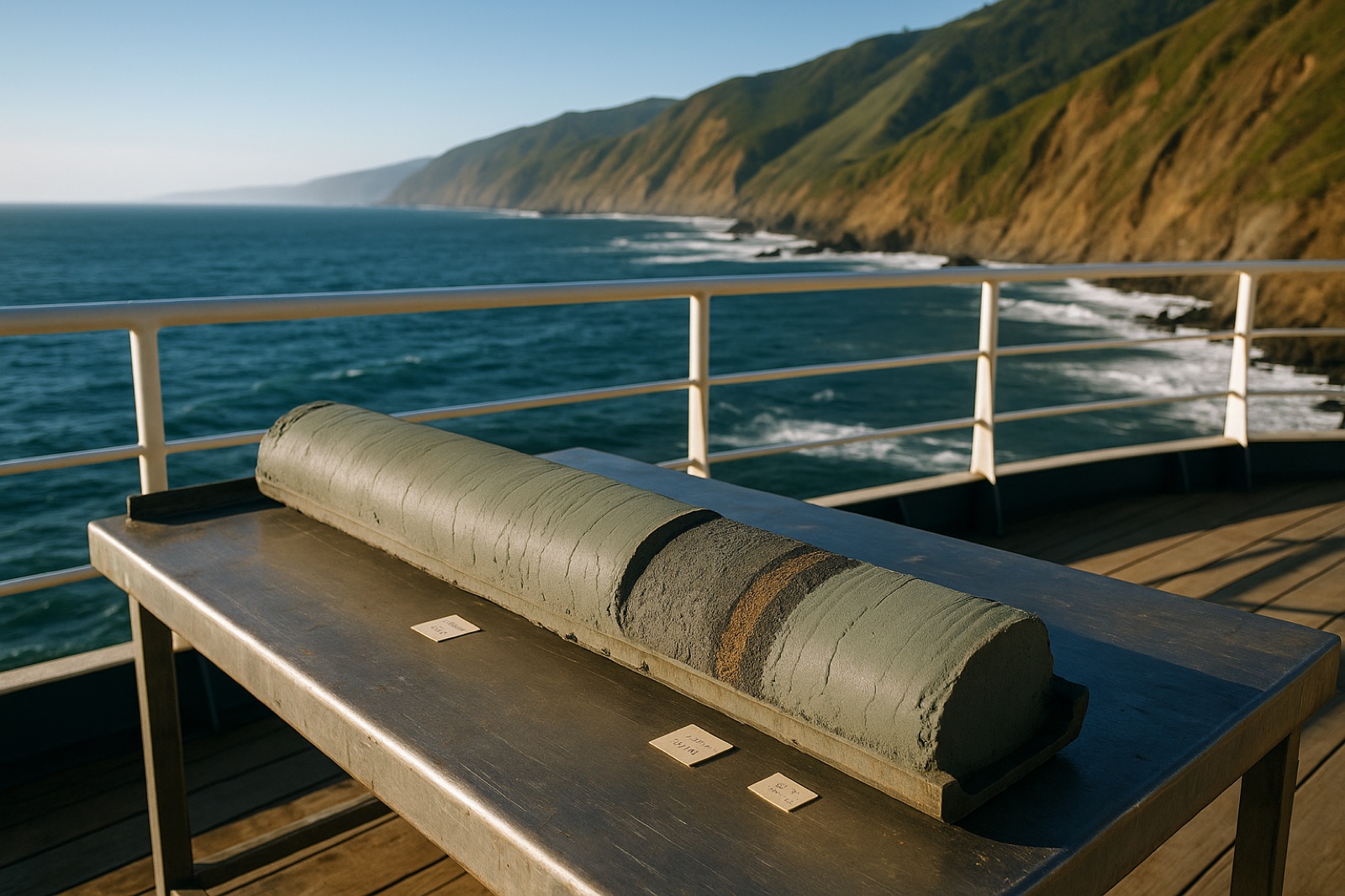
When a big earthquake shakes the seafloor, it knocks loose underwater landslides. Clouds of sand and mud rush down undersea canyons and settle on the deep ocean floor as a layer. Geologists call these layers turbidites. Each one is like a page in a diary: the ground shook hard here.
Normally a turbidite settles the way a shaken jar of muddy water does. Heavy sand falls first and ends up on the bottom. Fine silt drifts down last and ends up on top.
But in cores taken north and south of Cape Mendocino, the team kept finding layers that were upside down or stacked. Sand sat on top of silt, as if a second rush of sediment arrived before the first had finished settling. Researchers call these “doublets.” The simplest explanation is two earthquakes, on two different faults, close enough together that the mud from the first had not landed yet.
According to Oregon State University, the team identified three times in the past 1,500 years when the two faults appear to have ruptured in rapid succession, possibly just minutes to hours apart. The most recent was around 1700. The work was published in the journal Geosphere, in a paper titled “Unravelling the dance of earthquakes.”
The 1700 Earthquake: A Clue Written on Two Sides of the Ocean
The year 1700 matters here because it is one of the best-documented great earthquakes that nobody in North America wrote down.
On the night of January 26, 1700, the Cascadia fault broke along much of its length, in a quake that scientists estimate was around magnitude 9. There were no written records on that coast at the time. The evidence came later, from drowned forests, from the oral histories of Indigenous peoples of the Pacific Northwest, and from a tsunami that crossed the entire Pacific and struck Japan, where local officials recorded the damage. For a long time it was called the “orphan tsunami,” because Japan had felt no earthquake to explain it.
Goldfinger’s cores suggest that this famous Cascadia quake may not have been alone. The mud hints that the northern San Andreas may have broken right alongside it.
Is This New? Not Exactly, and That Is the Interesting Part
You may have seen this story in your feed this month as if it were breaking news. It is not. The paper came out in late 2025, and science sites have been re-running versions of it ever since.
The real story is older still. Goldfinger’s team began drilling cores near the spot where the two faults meet back in 1999. According to Oregon State, the first hint came almost by accident, from cores taken off the northern California coast. It took roughly a quarter of a century of patient work to go from “that layer looks odd” to a published case.
That slowness is worth pausing on. The most important evidence in this story did not come from a dramatic moment. It came from people willing to look at mud for 25 years.
What the Headlines Leave Out
“Two faults may strike back to back” is true as far as it goes. But the researchers themselves put limits around it, and those limits matter:
- “Minutes to hours” applies to a few events, not all of them. The tightly paired ruptures are the three found in the past 1,500 years. Across the longer record, Scientific American reports that at least eight large San Andreas quakes in the past 3,000 years came within decades of a significant Cascadia quake. Decades is a very different thing from minutes.
- It does not mean one fault will always set off the other. Oregon State’s own summary says closely timed ruptures have happened in the past, not that every big quake on one fault will trigger the other.
- San Francisco’s famous 1906 earthquake appears to have been a solo event on the northern San Andreas, not paired with Cascadia, according to Scientific American’s reporting on the study.
- Nobody fully understands the trigger yet. Seismologist Meng Wei told Scientific American that even when the faults are linked, the time between quakes can still be decades, and that more research is needed.
- It is rare on a world scale. The only other clear case of faults synchronizing like this that the researchers point to is in Sumatra, where two great quakes struck in 2004 and 2005, about three months apart.
So the honest summary is this: the two faults may be linked, the link has sometimes been tight, and nobody can say when either one will move next.
Why This Matters Even If You Live Far Away
Goldfinger explained the stakes plainly: “We could expect that an earthquake on one of the faults alone would draw down the resources of the whole country to respond to it.”
That is the real concern. Not that the ground would shake harder, but that help would be split. A double disaster could hit cities from San Francisco to Portland, Seattle and Vancouver within a short window. Rescue teams, hospitals, supplies and attention would all be pulled in two directions at once.
If you have ever lived through a flood, a storm or an earthquake anywhere in the world, you know the feeling. The worst moments are not only when things break. They are when you realise the people who would normally come to help are busy somewhere else.
If this kind of news tends to send your mind straight to the worst case, you are not alone. Our piece on what catastrophizing is and the question worry never asks is a good next read. And if you are curious how a different kind of disaster would unfold, here is what scientists say about the warning signs that would come weeks before a Yellowstone eruption.
What You Can Actually Do
You cannot stop a fault. But a few simple, free habits help anywhere the ground can shake:
- Know your spot. In each room you spend time in, notice one sturdy table or desk you could get under. Official guidance in quake zones is “Drop, Cover, and Hold On.”
- Keep water. A few refilled bottles of drinking water tucked away cost almost nothing.
- Know your neighbours. After a big disaster, the first help usually comes from the people on your street, not from far away. Knowing who lives near you, and who might need help, matters more than most gear.
- Agree on one meeting point with the people you live with, in case phones stop working.
The Old Song That Pictured This Scene
There is something striking about how the evidence was found. The whole case rests on underwater landslides: mountains of sediment, shaken loose and carried down into the deep sea.
About three thousand years ago, someone wrote a song that pictured almost exactly that. It imagined the worst thing a person could imagine: the ground itself giving way, “the mountains be carried into the midst of the sea,” the waters roaring, the hills shaking. And the song did not pretend any of that was impossible. It named it. Then it said, “Therefore will not we fear.” Not because the ground would hold still. Because the writer had placed their safety somewhere the ground could not reach. The song opens by calling God “a very present help in trouble,” which is a different kind of safety than solid rock.
That is an old idea, and a steady one. Scientists will keep reading the mud. We will keep learning when and how the Earth moves. But the question of where you stand when it does has always been a bigger one than geology.
The Bottom Line
The Cascadia and San Andreas faults may be more connected than anyone thought, and the proof was hiding in thin layers of seafloor mud for thousands of years. The finding is real, it is careful, and it comes with honest limits. It is a reason to prepare, not a reason to panic.
The most hopeful part might be the least dramatic one. A handful of people spent a quarter century looking closely at something everyone else would have walked past. Because of that, millions of people now know a little more about the ground they live on, and a little more about how to look after each other when it moves.
Questions People Ask About the Cascadia and San Andreas Faults
Can the Cascadia and San Andreas faults rupture at the same time?
A study led by Chris Goldfinger of Oregon State University, published in the journal Geosphere, found evidence in deep-sea sediment cores that the Cascadia Subduction Zone and the northern San Andreas Fault have ruptured in rapid succession at least three times in the past 1,500 years, possibly minutes to hours apart. The most recent likely paired event was around the year 1700. The researchers say this does not mean every large quake on one fault will trigger the other.
What is a turbidite and how does it record earthquakes?
A turbidite is a layer of sand and mud left on the deep seafloor by an underwater landslide. Strong earthquakes often shake loose these landslides, so each turbidite can mark a past quake. Normally the heavy sand settles first and the fine silt settles on top. When scientists find stacked or upside-down layers, called doublets, it can mean a second earthquake struck before the sediment from the first one had settled.
When was the last big Cascadia earthquake?
The last great Cascadia earthquake struck on January 26, 1700, and scientists estimate it was around magnitude 9. There were no written records in the Pacific Northwest at the time, but the tsunami it caused crossed the Pacific Ocean and was recorded in Japan. Evidence also comes from drowned coastal forests and Indigenous oral histories.
Was the 1906 San Francisco earthquake linked to Cascadia?
According to reporting on the Oregon State University study, the 1906 San Francisco earthquake appears to have been a solo event on the northern San Andreas Fault, not paired with a Cascadia earthquake. The linked ruptures the researchers identified happened earlier, with the most recent around 1700.
Has any other place had two faults rupture in sequence like this?
The researchers point to Sumatra in Indonesia as the one other clear example of fault synchronization, where two great earthquakes struck in 2004 and 2005, about three months apart. That makes the possible link between the Cascadia and San Andreas faults rare on a world scale.
Discussion Question
If scientists could tell you the exact year the next big earthquake would hit where you live, would you want to know, or would you rather not? Tell us which you would choose, and why, in the comments.
Share This
“The clue that two of the world’s most dangerous faults may break together wasn’t found on land. It was hiding in 3,000 years of seafloor mud. Fascinating read: https://bgodinspired.com/index.php/nature-and-creation/cascadia-and-san-andreas-faults-rupture-together/”
“Scientists spent 25 years studying mud to learn this about the Cascadia and San Andreas faults. The headlines say ‘minutes apart.’ The full story is more careful, and honestly more hopeful. Worth five minutes: https://bgodinspired.com/index.php/nature-and-creation/cascadia-and-san-andreas-faults-rupture-together/”
“Not a reason to panic, a reason to prepare. What the new Cascadia and San Andreas study really says, and what the headlines leave out.”
Sources: Goldfinger et al., “Unravelling the dance of earthquakes: Evidence of partial synchronization of the northern San Andreas fault and Cascadia megathrust,” Geosphere 21(6), 2025; Oregon State University; Scientific American.